- P-ISSN 2799-3949
- E-ISSN 2799-4252



In the role of the Buddhist Messiah, the Maitreya symbol goes beyond the boundaries of Buddhism. It has become a central symbol in many religious movements of East Asia that have emerged over the past century. One of these movements, called Long Hoa Di Lặc (龍華彌勒), was born in Vietnam in the late 19th century. Although Long Hoa Di Lặc still exists today, it could not become a religion like Cao Đài or Hòa Hảo in Vietnam. Similarly, a religious movement related to the Maitreya symbol called Daesoon Jinrihoe in Korea, has developed into a new religion that has contributed significantly to the spiritual life of people in Korea and beyond. Throughout the observation of the movements above, this paper will delve deeper into Daesoon Thought and its academic contribution in Korea, compare it with Long Hoa Di Lặc in Vietnam, and shed light on the role of the intellectual class in the new religious movements (NRMs) of East Asia.
Dinh Hong Hai earned two bachelor's degrees, one from Hanoi University of Industrial Fine Arts in 1996 and the other from Vietnam National University, Hanoi in 1998. After being educated in the M.Phil program at the University of Delhi (India) in 2006, Hai attended Harvard University from 2008 to 2010 and then defended his Ph.D. dissertation at the Graduate School of Social Sciences, VASS, in 2011. He now serves as a faculty member at Vietnam National University-Hanoi City, and deputy general secretary of the Asian Semiotics International Association (ASIA)
JDTREA 2025,4(2): 13–33
The religious landscape of East Asia is characterized by a rich tapestry of traditions, beliefs, and practices that have evolved over centuries of cultural exchange and interaction. It always plays a vital role in shaping individual and collective identities, values, and communities across the region. When integrated with Western civilization, many religious movements in East Asia encompass a wide range of folk and regional religions and Christianity forming many new religious movements related to the Messiah. These religious movements have shaped East Asia's spiritual, cultural, and social landscapes, influencing everything from art and architecture to governance and social norms. Unlike China, the birthplace of Confucianism and Taoism, Korea and Vietnam are countries that inherited many of Chinese civilization's achievements as part of the Sinosphere but both countries also showed dynamism in the process of acculturation, creation, and building their own identites. The Maitreya symbol is one of the clearest examples of this process with the creation of unique identities in each country.
Maitreya (彌勒菩薩, Mireuk Bosal) is one of the most important symbols in East Asian religions involving Messianic notions other than the Messiah in Christianity which was imported from Western culture. It appears not only in Buddhism as the Future Buddha or Bodhisattva in Tusita Heaven but also in new religious movements with different practice methods and different ways of connecting to other religions. Long Hoa Di Lặc (龍華彌勒) in Vietnam (hereafter as LHDL) and Daesoon Jinrihoe (大巡眞理會) in Korea are two main movements that are relevant to the Buddhist Messiah. But the development of these sects goes in different ways and achievements: Daesoon Jinrihoe in Korea was “was one of the most successful movements in terms of its size and social impact” ( Kim 2020 , 2) meanwhile LHDL is still working towards survival in Vietnam at present.
In fact, new religious movements in East Asia encompass a diverse range of beliefs and practices. They often incorporate elements of Buddhism, Taoism, and Confucianism, as well as indigenous folk traditions. Throughout history, almost all temples, shrines, and communal rituals were integral to Chinese, Japanese, Korean, or Vietnamese folk religions, which played a significant role in the lives of many people in the Sinosphere. Under new circumstances, East Asia has seen the emergence of various new religious movements in modern times, often blending elements of traditional beliefs with modern ideologies, charismatic leadership, or foreign influences and especially, systems of Western thought. This is the reason why Olav Hammer and Mikael Rothstein claimed that “… most young religions are thus received with a mixture of distance and mistrust by outsiders, and conversely, adherents of most young religions view majority society as misguided or corrupt” ( Hammer and Rothstein 2012 , 4). However, what is not seen as “misguided or corrupt” in the eschatological thought of NRMs or millennialism is the Buddhist Messiah Maitreya's appearance in Buddhism.
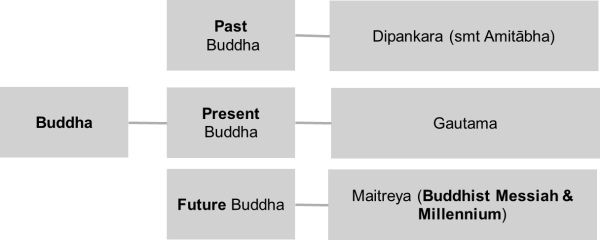
Buddhism has been a dominant religious force in Asia for over two millennia. It encompasses various schools and traditions, including Mahayana, Theravada, and Vajrayana. Each school has its own doctrines, practices, and rituals. Buddhism has had a profound influence on the cultures, arts, and philosophies of East Asian countries such as China, Japan, Korea, Vietnam, and Taiwan. Together with Avalokitesvara, the Maitreya symbol appears in Early Buddhism as one of the attendants of Buddha (Figure 1). “Maitreya is the bodhisattva anticipated by all Buddhist traditions to become the next Buddha of this world, Jambudvpa. Currently dwelling in the Tusita heaven, Maitreya awaits rebirth at that time in the distant future when Shakyamuni Buddha's dispensation will have been completely forgotten” ( Buswell 2004 , 7). It is his positions both as a bodhisattva and as the Future Buddha that makes the role of Maitreya so important. One of the most important roles he fulfills is that of being the Buddhist Messiah. In this role, the Buddhist Messiah has been influenced beyond the framework of Buddhism to create new forms of religious movements, of which Long Hoa Di Lặc in Vietnam and Daesoon Jinrihoe in Korea are the most vivid examples.
A question that needs to be asked is why do non-Buddhists in Vietnam and Korea easily accept a Buddhist symbol like Maitreya? Alan Sponberg had an impressive idea that Maitreya “become a hope for the future, a time when all human beings could once again enjoy the spiritual and physical environment most favorable to enlightenment and the release from worldly suffering” ( Sponberg and Hardacre 1988 , 2). This is a key point for many practical Buddhist sects in the past as well as new religious movements at present. In East Asia, various new religious movements have emerged in the Sinosphere, often blending Eastern and Western spiritual elements. These movements, at first, focus on self-improvement, healing, meditation, or only charismatic leadership, then development to become new religions or religious sects. For example, Falun Gong, a spiritual practice incorporating qigong exercises and moral teachings, went on to become a global movement in a hundred countries.
In Vietnam, after a long time practicing folk beliefs and several Asian religions such as Buddhism and Daoism, the Vietnamese adopted Western Christianity as one of the “new” religions in the sixteenth century. With the significant changes in political economy, society and culture in modernity, many new religious trends were born, helping to form two new religions in Vietnam, Cao Đài and Hòa Hảo. At the same time, many new and prominent trends, such as Tứ Ân Hiếu Nghĩa (meaning Four Debts of Gratitude), Bửu Sơn Kỳ Hương (meaning Strange Fragrance from the Precious Mountain), and LHDL contributed to the development of NRMs. However, only Cao Đài and Hòa Hảo have survived and developed into new religions. In contrast, Bửu Sơn Kỳ Hương, after 147 years, has only about 15,000 followers living in the provinces of An Giang and Đồng Tháp, Bà Rịa - Vũng Tàu, Long An, Sóc Trăng, Vĩnh Long, Tiền Giang, and Bến Tre (Duong 2010). Even at present, LHDL struggles to avoid being wiped out.
In Korea, many NRMs appeared over centuries: “Notwithstanding their different Christian and non-Christian backgrounds, most Korean new religions share some common features, including messianism, millenarianism, and proposals for social reform [...]. In 1987 Yoon Yee Heum estimated the number to be between 150 and 200 while Kim Hong Cheol referred to over 500 new religions in 1998” ( Introvigne 2021 , 13). Daesoon Jinrihoe was founded in 1969 and is today the largest new religion in South Korea. “When ideas and practices contributed by Maitreyan millenarianism, geomantic prophecies, and Catholicism intermingled with various more traditional religious beliefs and practices, new threads in Korea's popular religious culture began to form” ( Ro 2002 , 38).
Unlike Gautama Buddha, who was a historical figure, Maitreya's birth is associated with the formation of Mahayana and the Five Dharmas of Maitreyanatha, “these significant treatises attributed to Asanga (無著) were written under the pseudonym Maitreyanatha” ( Dinh 2024 ). According to Jonathan Gold, “Asanga is the monk who meditated in solitude for twelve years until he was able to meet with and receive teachings directly from the future Buddha, Maitreya. Asaṅga thereby became the preeminent expounder of the Yogācāra synthesis of `Great Vehicle' (Mahāyāna) Buddhism, writing some texts himself, and transmitting the so-called `Five Treatises' revealed by Maitreya” ( Gold 2022 ).
According to this doctrine, Maitreya is a compassionate person who will be a Bodhisattva. He is the last Buddha who will appear on earth and is currently abiding in Tusita. This is common information in one of the three key sutras about Maitreya Buddha in the Mahayana scriptures. The content of the sutra mainly describes the circumstances when Maitreya Buddha was born, the world was peaceful and prosperous, and preaching in the Dragon Flower Association to save sentient beings. Among the sutras about Maitreya's next life, this sutra has been considered the most valuable.
In the future when the Holy King Zhenjiu turns the wheel, Maitreya was born in Tushita World. After attaining enlightenment, he taught and transformed 84,000 people including his parents and relatives, and together with Sakyamuni Buddha in this life, he taught the three-vehicle teaching to all sentient beings. In addition, during the time of the past Buddhas, Kassapa was good at practicing the Brahma lineage and the Twelve-headed Buddha lineage, so he was able to help Maitreya to persuade everyone. This sutra's address to the public is Ananda, which is a major feature of this sutra; in other sutras, the address to the public is mostly Shariputra (Fo Guang Ta-tz'u-tien 1988).
In China, the notion of Maitreya appeared during the Jin Dynasty (266–420). At the beginning of the Tang Dynasty, under the development of high-ranking monks and the support of Empress Wu Zetian, the folk concept that “Maitreya Buddha appeared” circulated widely and developed. Maitreya is often depicted as a Buddha-to-be who resides in the Tusita Heaven, awaiting the right time to descend to Earth and become the next Buddha. In Mahayana texts, his qualities and teachings are extensively discussed, emphasizing compassion, wisdom, and the eventual attainment of Buddhahood. In East Asian cultures, including China, Japan, Korea, and Vietnam, folk beliefs and syncretic religious movements often incorporate elements of Maitreya worship. This can range from temples dedicated specifically to Maitreya to folk rituals and festivals celebrating his anticipated arrival. As Ho Wai Kam mentioned in his research, Maitreya was a sacred figure who captured the imagination of the Chinese. He is the Buddhist Messiah or Future Buddha, destined to succeed the Shakyamuni Buddha ( Ho 1960 , 185).
In the context of Buddhism, there is a considerable difference between Maitreya Buddha and other symbols. While the roles of Buddhas, Bodhisattvas, and Arhats are clearly divided at different levels, Maitreya is both a Buddha and a Bodhisattva. As the Future Buddha, Maitreya holds a significant position in both Buddhist and non-Buddhist movements. The symbol of Maitreya appears in various religious movements across East Asia because Maitreya is believed to be a bodhisattva who will appear on Earth in the future, achieving enlightenment and bringing about a new era of spiritual awakening, the new Millenium.
Based on the idea of Millennium, “devotees sought to secure rebirth in Tusita, first to benefit from Maitreya's teaching there, and later to join him during his tenure as the next Buddha. Although eventually eclipsed in East Asia by the more popular Amitabha cult, anticipation of Maitreya's golden age continued to erupt periodically in millenarian movements that were intensely devotional and occasionally political as well” ( Buswell 2004 , 508). Beyond the scope of Buddhism, Maitreya in the role of Buddhist Messiah helped form many new religions as well as NRMs in East Asia. With that in mind, did NRMs adopt the Maitreya symbol from Buddhism or was Maitreya in the role of Buddhist Messiah an inspiration for NRMs? To answer the above question, this study focuses on the role of the Millenium of NRMs in East Asia.
The word “millennium” comes from the Latin word “mille,” which means “thousand,” and “annus,” which means “year”. “In popular and academic use, the term `millenarianism' is often synonymous with the related terms `millennialism', `chiliasm' and `millenarism'. These words refer to an end-times Golden Age of peace, on earth, for a long period, sometimes referred to as the `millennium'” ( CenSAMM 2021 ). In the Christian world, it refers to the thousand-year period mentioned in Revelation 20:4 that begins after the Second Coming of Jesus. It is also alluded to in other portions of Scripture:
I saw thrones on which were seated those who had been given authority to judge. And I saw the souls of those who had been beheaded because of their testimony about Jesus and because of the word of God. They had not worshiped the beast or its image and had not received its mark on their foreheads or their hands. They came to life and reigned with Christ a thousand years (Revelation 20:4).
Many Christians eagerly anticipate this time, as it will be the first time since the resurrection that humans will be able to spend directly in the physical presence of Jesus. The Millennium influenced not only Christianity in medieval times but also many other religions because of
apocalypticism, eschatological (end-time) views and movements that focus on cryptic revelations about a sudden, dramatic, and cataclysmic intervention of God in history; the judgment of all men; the salvation of the faithful elect; and the eventual rule of the elect with God in a renewed heaven and earth. Arising in Zoroastrianism, an Iranian religion founded by the 6th-century-BC prophet Zoroaster, apocalypticism was developed more fully in Judaic, Christian, and Islāmic eschatological speculation and movements… The key determinant of millennialism's impact on society is timing. As long as the day of redemption is yet to come, millennial hopes console the suffering and inspire patience and political quiescence ( Landes 2024 ).
In Asia, this concept is most clearly concretized with the cases of Chakravartin in India and Zhuǎnlún Shèngwáng (転輪王/転輪聖王, the Wheel-Turning Holy King) in China. Chakravartin (or Cakravartin) is an ideal (or idealized) universal ruler, in the history, religion, and mythologies of India. The concept is present in Indian subcontinent cultural traditions, narrative myths, and lore ( Gopal 1990 , 81). One of the most well-known vestiges of Chakravartin is Vishnu in the form of Chakra which was held as “the ideal of worship for Kings desirous of obtaining Universal Sovereignty” ( Begley 1973 , 48). But the most famous embodiment of Chakravartin in Indian medieval times was King Ashoka. In Buddhist chronicles, the Buddha supposedly told the boy that he would indeed become a Chakravartin emperor in the next life due to his act of generosity in offering sand, and the boy in the next life was born as Ashoka ( Ikeda 1977 , 41). Thus, a Chakravartin is the secular counterpart of a Buddha that applies to temporal and spiritual kingship and leadership that turns the wheel of dharma.
The most prominent Wheel-Turning Kings in China were Wu Zetian (also known as Empress Wu) and Zhu Yuanzhang. Wu Zetian (624–705) ruled the Tang Dynasty from 665 to 690 and called herself the reincarnation of Buddha Maitreya. In 690, she abolished the Tang Dynasty and founded the Later Zhou Dynasty (周) as the Holy Spirit Emperor (聖神皇帝). Wu Zetian was the lone ruling-Empress in Chinese history. After ascending the throne, she called Luoyang the “Holy City” and ruled China from 690 to 705. Quite a long time after Wu Zetian, Zhu Yuanzhang (1328–1398) launched an uprising to overthrow the Yuan dynasty with the slogan “Buddha Maitreya was born and a new king appeared in the world.” In the end, Zhu Yuanzhang brought the uprising to success, founding the Ming dynasty (1368–1644). The special thing is that both Wu Zetian and Zhu Yuanzhang claim to be Maitreya in the world to get the throne.
At the end of the medieval period, the Asian millennial tradition was faced with a new wave of Western religion: Christianity. When Asian and European civilizations mixed together during this time, it created major conflicts and changes. Conflicts over ideology, politics, technology, and so on mostly end in victory for Western civilization because of its scientific superiority. Meanwhile, harmonization, whether voluntary or mandatory, has contributed to the Westernization process of countries in East Asia such as China, Japan, Korea, and Vietnam. One of the most important cultural harmony processes that needs to be recognized is religious harmony, and NRMs are one of the clearest manifestations.
When Western missionaries arrived in East Asia during the later medieval period, they encountered strong resistance from endogenous Asian religions such as Taoism, Buddhism, and Confucian ideology that worshiped the King-Master-Father (君師父) with a respectfulness derived from the Chinese Confucian concepts of sān gāng wǔ cháng (三綱五常). However, with individual efforts and the persuasive power of superior reason in Western religious thought, they have established an increasingly greater influence in these countries with the great contribution of Matteo Ricci, Francisco de Pina, Alexandre de Rhodes and so on.
Matteo Ricci (1552–1610) was an Italian Jesuit missionary as well as a Roman Catholic bishop. He was the first European to absorb Chinese culture and was also a pioneer in the exchange of knowledge between China and Europe, creating a cultural bridge between these two major cultural centers. Ricci was instrumental in bringing Christianity to China and then Korea and establishing the Christian faith among the indigenous people. Also, during this period, missionaries Francisco de Pina (1585–1625) and Alexandre de Rhodes (1591–1660) came to Vietnam and were instrumental in “Romanizing” the Vietnamese language with a largely borrowed alphabet. The integration of Christianity with local culture has helped them successfully explain what God is and who Jesus is to non-Christian followers. “This is a rare phenomenon in Asian countries influenced by Chinese politics and culture and imbued with Confucianism” (Pham 2024).
This was a turning point in religious life in Asia when people learned about Christianity and the role of Jesus in Western religious life and culture. To help non-Christians understand God, Ricci went from the concept of a ruler in a “celestial empire” called tiānzhǔ (天主) and took a Chinese name for a religion connected to Christianity (what Chinese never knew before) tiānzhǔjiào (天主教) associated with the image of Jesus Christ. In the same way, the early missionaries adopted the Korean term Hanaism “which designated the supreme heavenly ruler in Korea's traditional shamanistic pantheon, as a name for the Christian God. They insisted that Hanaism whom Koreans revered as the Supreme God of Heaven for thousands of years was the same God in the Bible” ( Han 1995 , 186). Similarly, the Cao Đài religion in Vietnam has affirmed that God is the most sacred and supreme being:
Back in the chaotic time of the world's creation, the Creator [một Đấng Tạo Hóa] was born from the breath of the Nothingness [nhứt Khí Hư Vô]. The Easterner calls Him the Jade Emperor [玉皇上帝], the Westerner calls Him DIEU [GOD], the Celestial Lord [Đức Chúa Trời], the Annamese [người An Nam] calls Him the Celestial Grandfather [Ông Trời]; He is the Being [Đấng] who created Heaven and Earth and countless living creatures (Jammes and Trương 2023, 272–73).
How do people connect the thousands of years of indigenous beliefs and Buddhism in East Asia with the Supreme Being in modern life as Western ideas? The answer comes from NRM followers adopting the Millenium and the Maitreya symbol from Buddhism as a starting point to resolve East-West cultural differences. Thus, the idea of Maitreya Buddha has become a universal idea throughout the world with the Millennium. Many social and educational organizations outside of Buddhism have also used the title Maitreya in their organizations, most recently L. Ron Hubbard (1911–1986), founder of the Church of Scientology (USA). It looks similar to Korean Tajong-gyo, a modern Korean millenarian sect that originated in the late 19th century that connects the Lord, the Light, or the Progenitor of Heaven. “The union and harmony of the Heavenly Trinity with the Trinity of humanity, adherents believe, will renew humanity and reform society. The trichotomy of man, his universe, and its pursuit of ultimate harmony in terms of yin-yang theory was derived mainly from Neo-Confucianism” ( Britannica 2024 ).
It can be said that the Millennium was the aspiration of people worldwide in Christianity and other religions connected Chakravartin, then Zhuǎnlún Shèngwáng, as a Wheel-Turning King with Jesus Christ to make a great change of religions in East Asia. The notion of Jesus Christ as a supreme god standing for the Jade Emperor (玉皇, Yuhuang) or Shangdi (上帝, such as 姜聖上帝 in Daesoon Jinrihoe) 1in East Asia is an extremely harmonious way to connect religions from the West to Asian religious life. Maitreya, in the role of Messiah, inspired NRMs with teachings characteristic of monotheistic religions: the Millenium of all followers. The Messiah symbol in monotheistic religions based on local polytheistic beliefs not only helps believers easily imagine a “Supreme God” at the human level but also makes monotheistic doctrines easier to follow, more understandable, and more consistent. The Maitreya symbol in the teachings of Long Hoa Di Lặc and Daesoon Jinrihoe are the most vivid examples that we want to introduce below.
Long Hoa Di Lặc in Vietnam
LHDL in Vietnam has been influenced by Chinese culture together with the Earth God and the God of Wealth. “During the Ming and Qing dynasties, popular religious movements emerged in China in great numbers; in particular groups proclaiming `the unity of the Three Teachings' (三教合一), `the final kalpa of the Three Ages' (三期末劫), and `the three Dragon Flower Assemblies' (龍華三會) often found themselves in a precarious situation, being subject to persecution by the authorities” ( Clart et.al. 2020 , 227). These religious practices not only exist in NRMs related to Buddhism such as LHDL or Hoa Hảo but also strongly influence some religions with complex doctrines such as Cao Đài. “Cao Đài propagated the doctrine of the Unity of the Three Teachings, millenarian expectations of Maitreya's arrival, and the theological content of the Book of the Dragon Flower (龍華經, Lónghuá jīng ch.; 經龍華, Kinh Long Hoa vn).” (Jammes and Trương 2023, 260).
LHDL is based on the notion of Long Hoa (Nagapushpa in Sanskrit or Dragon Flower in English) which appeared in the doctrines that mentioned Maitreya in Tusita heaven. After enlightenment, he organized Dragon Flower Assemblies (Pháp hội Long Hoa) to teach Buddhist Dharma to people. LHDL is one of the NRMs which appeared in the south of Vietnam over a century ago, including Cao Đài, Phật giáo Hòa Hảo, Bửu Sơn Kỳ Hương, Tứ Ân Hiếu Nghĩa, Tịnh Độ Cư Sĩ Phật Hội Việt Nam, Minh Lý Đạo, Phật Giáo Hiếu Nghĩa Tà Lơn. What is special is that the above NRMs all take the views of eschatology and Millennialism combined with the Buddhist Messiah Maitreya symbol as the foundation. Because it “signals and awakens people that the Dharma-ending period is about to end to enter the Millenium that is when Maitreya was born and established the Long Hoa association” ( Son 1997 , 31–33).
Thus, LHDL formation occurred in a similar way as the formation of Millennium, Chakravartin, Zhuǎnlún Shèngwáng, and the Messiah in East Asia. The main difference between LHDL and the above religions is its lack of doctrine as Nguyễn Thế Anh mentioned. “Most of the time this doctrine remained no more than the undeveloped core of a religion which sought individual and familial happiness, for Maitreya symbolized the aspirations of Vietnamese Buddhists for salvation and rebirth in his Pure Land. But it could also coexist with an ideological commitment to the appearance of a descendant of a discarded dynasty, who supposedly manifested himself suddenly in order to overthrow the corrupt established order” (Nguyễn 2002, 229). Thus, from the concept of “salvation” through the symbols of the Savior and Supreme God, religions such as Cao Đài or Hòa Hảo have perfected doctrines and new teachings while LHDL is still just a “superficial” NRM until today.
It is easy to see that religious trends related to Maitreya all try to explain the appearance of the Messiah in the Millennium Era through indoctrination 2, what Lukas Pokorny called The Millenarian Myth Ethnocentrized. This “enables us to refine the overall analytical framework used in the study of millenarianism, comprehending the full range of possible configurations through which the myth of the millennium may find expression” ( Jorgensen 2018 , 342). Meanwhile, LHDL developed and withered through many stages, showing the “uncertainty” in practicing without doctrine. Therefore, in the current period, Long Hoa Maitreya is being “misunderstood” as a “new religious phenomenon” of the 21st century, for example, some high-ranking Vietnamese management agencies mentioned 3. This is closely related to religious teachings as well as the academic contributions of religious specialists. This is the reason why LHDL did not receive the support of the Vietnamese state. This is completely different from what is happening in Korea with Daesoon Jinrihoe being the most successful trend.
Daesoon Jinrihoe in Korea
Daesoon Jinrihoe is a religious movement in South Korea that emerged in the late 20th century. It is one of the largest NRMs in the country, with a significant following and a complex set of beliefs rooted in Korean shamanism, Confucianism, Daoism, and Buddhism, among other influences. Daesoon Jinrihoe was founded by Park Wudang (1917–1996), also known as Park Han-gyeong. He is considered a spiritual leader and visionary who built upon the teachings of Kang Jeungsan (Kang Il-Sun), a significant figure in Korean NRMs. The movement was officially established in 1969. Park Wudang's leadership and the subsequent organization of the movement have helped it grow substantially over the years.
The teachings of Daesoon Jinrihoe focus on the idea of the “Great Transformation” (Daesoon), a period of cosmic change leading to a new era of peace and harmony. Followers believe in the divine status of Kang Jeungsan, who is seen as a god who descended to Earth to set the world on a path towards this Great Transformation. Emphasis is on ethical and moral living, with a focus on virtues such as sincerity, respect, and propriety:
In Daesoon Thought, The Supreme God, Sangje, saw major disorganization leading to extreme violence and doom and decided to incarnate on earth under the human form of Kang Jeungsan (1871–1909). Then the living God taught the solution to human suffering through the revelations he sent in 1917 to Jo Cheol-Je, or Jo Jeongsan (1895–1958) and the revelations were passed on to Dojeon Park Wudang who in 1969 founded Daesoon Thought... These figures are unique in that their followers actually claim their Messiah is a man, or a woman, with a Korean passport ( Rigal-Cellard 2022 , 61).
According to Bae Kyuhan, currently Daesoon Jinrihoe has about one million followers, primarily in Korea, with significant religious infrastructure. Efforts to promote Daesoon Thought include founding Daejin University and the Daesoon Academy of Sciences, publishing research, and hosting international forums. Key concepts include the belief in the Supreme God taking human form and visiting the realms of Heaven, Earth, and Humanity to create the era of civilization and super civilization with these standards and distinctions, that have constructed the logical basis, or theoretical basis, for defining the situation of the times leading to the `future of humans and the world'.
The characteristics of the era of `super civilization', which consistently inferred and viewed humans and the world through Haewon Coexistence Ideas:
First, this is the `era of humanity' where respect for people is maximized.
Second, it is the `Fantasy Age' in which the civilizations of heaven, earth and the three worlds are integrated and become ultra-advanced through human reform and the creation of the world.
Third, it is a permanent `peace era' in which all relationships between humans and the world (nature) are resolved and coexisted ( Bae 2018 , 55).
Thanks to these academic studies, we know that Daesoon is the main idea not only to connect Heaven, Earth, and Humanity but also to connect Confucianism, Daoism, and Buddhism. This is similar to the way Matteo Ricci connected Christianity with East Asian religion and beliefs. Daesoon Jinrihoe practices include prayer, ritual offerings, and participation in community events designed to cultivate spiritual growth and communal harmony. The movement has established numerous temples and training centers across South Korea, where followers can participate in rituals, receive teachings, and engage in communal activities. The organization places a strong emphasis on community service and social welfare, aligning with its ethical teachings. By now, Daesoon Jinrihoe has grown to become one of the largest new religious movements in South Korea. The movement has also established educational institutions to promote its teachings and provide education based on its principles.
As with many new religious movements, Daesoon Jinrihoe has faced criticism and controversy, but in reality, Daesoon Jinrihoe is a significant and influential religious movement within South Korea's diverse spiritual landscape. Its unique blend of traditional Korean beliefs with new religious ideas has attracted a substantial following and continues to impact Korean society both spiritually and culturally. Daesoon Thought, rooted in the teachings of Daesoon Jinrihoe, presents a unique philosophical and religious framework that has garnered significant interest in academic circles in Korea.
Central to Daesoon Thought is the concept of the Great Transformation, which envisions a forthcoming era of universal harmony and peace. This transformation is believed to be guided by divine intervention and moral rectitude. Daesoon Jinrihoe followers venerate Kang Jeungsan as a divine figure who initiated this transformative process. His teachings emphasize the rectification of human hearts and societal ills. The movement stresses the importance of ethical living, incorporating values such as sincerity, respect, and propriety. This aligns with traditional Korean virtues and Confucian ethics. There is a strong emphasis on the interconnectedness of all beings and the universe, reflecting influences from Daoism and Buddhism, especially, the figure of Maitreya.
The Appearance of Maitreya in Daesoon Thought
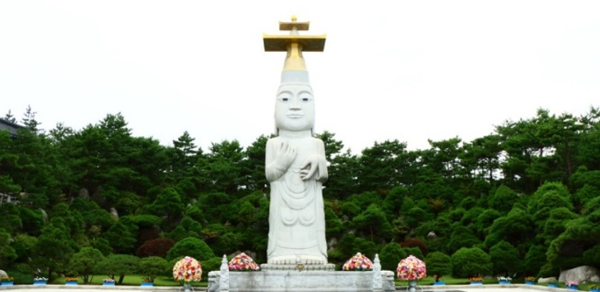
Figure 2. A statue of Maitreya Buddha was symbolically erected at Geumgangsan Toseong Training Temple Complex (Source: http://eng.daesoon.org/app/en/temples/building2)
Inspired by Sangje's declaration, “I am precisely Maitreya,” a statue of Maitreya Buddha was symbolically erected at Geumgangsan Toseong Training Temple Complex. In Buddhism, Maitreya is considered to be a buddha who will descend to this world in the future to deliver sentient beings from suffering. This icon was constructed as a granite statue depicting a standing Maitreya Buddha. The statue is 18 meters high and depicts Maitreya wearing a heavenly crown upon his head (Figure 2). “The meaning of this charismatic philosophy in doctrine/beliefs is demonstrated in the view that the god of Daesoon himself (like the Son of God in Christianity) was present in the world and directly involved in the restoration process of the corrupted universe (三界, Samgye, 삼계 kr.) as the superintendent of the universe” ( Kim 2020 , 5). Disciples continue the continuation of the Maitreya belief through successive generations as Lee Byung-Wook mentioned below.
In the Silla era, the people accepted Maitreya about Hwarang (花郞). In the Unified Silla era, Beopsang jong (法相宗) accepted Maitreya devotion positively and the typical person was Jinpyo (眞表). In the Goryeo era, Beopsang jong was devoted to Maitreya, on the other hand, Maitreya devotion changed popular devotion. In the Joseon era, Maitreya's devotion changed the popular devotion more and more. In this background, Kang Jeungsan accepted the idea of Maitreya Buddha. Kang Jeungsan insisted that he existed to give Heaven's decree to Choe Jeu (崔濟愚) of Donghak and to combine Jesus with Christianity. Daesoon thought to have a common point in the idea of Maitreya Buddha and the interpenetration (unity) of the three teachings” ( Lee 2015 , 157).
Besides helping maintain the faith of believers, the leading disciples directly or indirectly help family members of spiritual leaders continue their positions. According to Massimo Introvigne, “The other leading disciple of Kang Jeungsan, Kim Hyeong-Ryeol, first promoted Kang's widow, Jeong, as the master's successor, then went on to establish a branch known as Maitreya Buddhism, which in turn went through several schisms. All these branches are called “Jeungsan Branches” by Korean scholars, due to their association with the belief that, after his death, Jeungsan spiritually resided in the Maitreya Buddha statue in the Geumsansa Temple at Moak Mountain” ( Introvigne 2021 , 4). That follows the confirmation of Robert Flaherty, “millennialism in the Korean context has not been primarily a reflection of Christian eschatology” (Flaherty 2011, 327). It can be seen that Maitreya's appearance in Daesoon Thought serves as a symbol throughout Korean culture. This symbol represents the highest role of a Supreme God covering many different religions such as Confucianism and Daoism that exist in the religious life of people.
That shows that the Korean notion of Sangje in Confucianism has been combined with the teachings in Daoism to complete a symbol that is characteristic of Buddhism, which is Maitreya. This was mentioned by Bernadette Rigal-Cellard: “the Buddhist elements crop up as well in Daesoon Jinrihoe as was just exemplified by the presence of Buddha in the sanctuary of Yeoju temple. The major evidence, though, is that Sangje/ Kang announced that he was Mireuk, the Korean term for Maitreya the Buddha of the future, hence emphasizing his messianic role more forcefully” and she pointed out that “Sangje[is] a Confucian God between Daoism and Maitreyaism” ( Rigal-Cellard 2022 , 72). Thus, the formation and development of the Maitreya symbol in Daesoon Thought is a process of “doctrinalization” of religions outside Korea into a separate doctrine, suitable for Korean culture. That also confirms the role of Korean academia in the process of Koreanization to become a new religion.
Daesoon Thought and the Involvement of Academia in NRMs
In recent times, Korean scholars have shown a growing interest in Daesoon Thought. They have examined its philosophical, theological, and sociological dimensions. Many studies on this topic have been published in academic journals, theses, and dissertations, contributing to our understanding of its teachings and societal impact. Research on Daesoon Jinrihoe often takes an interdisciplinary approach, drawing from fields such as religious studies, sociology, anthropology, and Korean studies. Additionally, centers have been established to support scholarly research and facilitate academic discussions. Regular academic conferences and symposia are conducted to explore various aspects of Daesoon Thought, bringing together scholars, practitioners, and students from both Korea and around the world. These events create a collaborative environment for the exchange of ideas.
Some universities and research institutions in Korea have established centers dedicated to the study of new religious movements, such as Daejin University and Daesoon Academy of Sciences (DAOS). These centers facilitate scholarly research and provide a platform for international academic discourse. Numerous books and academic articles have been published on Daesoon Jinrihoe, covering its history, teachings, rituals, and social implications. Journals like the Journal of Daesoon Thought and the Religions of East Asia (JDTREA), Journal of East Asian Religions and Cultures (JEARC), and Journal of the Daesoon Academy of Sciences (JDAOS) serve as valuable resources for both scholars and the general public. Some academic journals in Korea focus on the study of religion and new religious movements, featuring articles on Daesoon Thought, which helps disseminate research findings to a wider audience.
Moreover, courses on new religious movements and Korean religious traditions often include sections on Daesoon Jinrihoe, enabling students to gain a comprehensive understanding of Korea's diverse religious landscape. By integrating Daesoon Thought into religious studies curricula, academic institutions contribute to the preservation and dissemination of this religious philosophy. It can be said that the role of academia in Korea is pivotal in the study and understanding of Daesoon Thought. Through research, publications, conferences, and education, scholars and institutions help to illuminate the complexities of this movement and its place within the broader context of Korean and global religious traditions. This academic engagement not only enriches the field of religious studies but also fosters a greater appreciation of Korea's spiritual heritage.
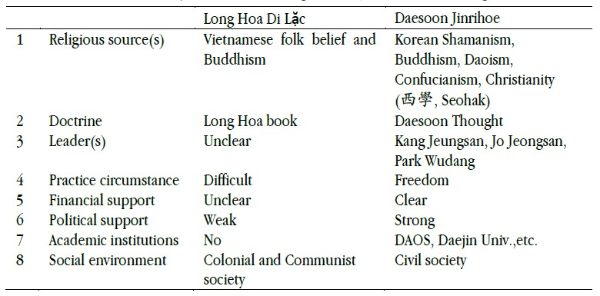
Along with academic contributions, Daesoon Jinrihoe also carries out many social, educational, medical, and relief activities with Three Major Societal Works: Charity Aid, Social Welfare, and Education more actively and systematically from 1972. Daesoon Jinrihoe pledges to devote 70% of its financial resources to social work. Even critics believe that it does keep this pledge ( Jorgensen 2018 , 377), which explains the good reputation the religion has acquired among South Koreans in general, including those who are far away from its theology and worldview. By 2014, yearly expenses for Daesoon Jinrihoe's social work had reached the impressive figure of $680 million (AADDJ 2017, 73). This social activity includes what Daesoon Jinrihoe calls the “Three Major Works,” education, social welfare, and charity aid ( Soryte 2022 , 91). In comparison with Long Hoa Di Lac, Daesoon Jinrihoe works as a denomination, with a positive relationship with society partly due to many welfare projects based on its good strategy and organization. We can see the differences between Daesoon Jinrihoe and Long Hoa Di Lặc as below.
Table 1. A comparison between Long Hoa Di Lặc and Daesoon Thought
Maitreya is one of the key symbols connecting traditional thought with modern thought to create the NRMs of East Asia, of which Long Hoa Di Lac and Daesoon Jinrihoe are typical examples. From a Buddhist symbol, Maitreya has become the Messiah in many NRMs in East Asia, especially Korea and Vietnam. The more connected the world becomes, the more traditional religions change, which has led to enormous changes in East Asian religious life over the past century. Maitreya is not only the savior of Buddhism but also plays the role of connecting many other religions as well as NRMs in the role of Messiah.
Comparative research of LHDL in Vietnam and Daesoon Jinrihoe in Korea shows us the enormous difference in the process of perceiving religious ideology. One side has too little contribution from academia and the other side has much attention from academia. Therefore, the awareness of followers of these two movements is extremely different even though both are based on Messiah notions. Daesoon Jinrihoe is the ideology of harmonizing the Three Realms that unify faith from major religions, and Daesoon Thought takes Maitreya as a symbol of harmony between ideologically different religions through the revelation of Kang Jeungsan to harmonize Korean people together. This is a very reasonable combination of Daesoon Thought with faith in Daesoon Jinrihoe. Therefore, this movement is not only the largest NRM in Korea but also crosses national borders to reach many followers around the world.
The more chaotic society is, the greater the belief in the Messiah, but to understand the status of the Messiah, an understanding of Millenarianism and the role of academia is extremely important. This is clearly shown through Daesoon Jinrihoe in Korea. It can be said that the contribution of academia is extremely important in maintaining the faith of believers, especially those who are educated or belong to the upper class in society. Through academic activities, scientists not only evaluate the role of NRMs but also deeply explain related religious phenomena. Comparative research of LHDL in Vietnam and Daesoon Jinrihoe in Korea shows us the enormous difference in the process of perceiving religious ideology between the two movements.
Daesoon Jinrihoe is the ideology of harmonizing the Three Realms (Heaven, Earth, and Humanity) that unify faith from major religions. Daesoon thought takes Maitreya as a symbol of harmony between ideologically different religions by the revelation of Kang Jeungsan to harmonize Korean people together. This is a very reasonable combination of Daesoon Thought with faith in Daesoon Jinrihoe to reach many followers around the world. As Han Bong-Hee concluded: “Throughout Korean history, the Maitreya faith has shown a great ability to adapt to changing social needs and aspirations, by developing appropriate ideas and images of Maitreya within its developments. Through the process of adopting appropriate Maitreya's image to changing needs in changing times, the vitality of the Korean Maitreya faith, and that of Korean Buddhism, has been maintained among the Korean people as a whole” ( Han 1995 , 214).
1.Daesoon Thought gives the full name as Gucheon Eungwon Nwehseong Bohwa Cheonjon Kangseong Sangje (九天應元雷聲普化天尊姜聖上帝,구천응원뇌성보화 천존강성상제 kr.), the Supreme God of the Ninth Heaven, Celestial Worthy of Universal Creation through His Thunderbolt, the Originator with Whom All Beings Resonate.
3.According to this page, LHDL was “made by Dao Thi Minh, a farmer, with low education level (2/10), in Soc Son district, Hanoi city self-established”. “In 1986, the simultaneous appearance of LHDL, Uncle Ho religion (Ba Cam religion), Reasonable religion, Uncle Ho religion (Vietnamese Spiritual Club) in the Northern Delta provinces, Vang Chu religion in the Mong and Dao communities in the Northern mountainous provinces, opening the birth and development of a new religious phenomenon in Vietnam”. See: https://daibieunhandan.vn/van-hoa/nguon-goc-da-dang-bieu-hien-phuc-tap-i304276/.
Dương, Văn Khá 2010 “Introduction on Bửu Sơn Kỳ Hương”. Government Committee for Religious Affairs [Vietnamese Language Text] “Giới thiệu khái quát về đạo Bửu sơn kỳ hương”. https://btgcp.gov.vn/gioi-thieu-cac-to-chuc-ton-giao-da-duoc-cong-nhan/Gioi_thieu_khai_quat_ve_dao_Buu_son_ky_huong-postOrxqeK0R8y.html. Accessed on 15 May 2024.








This website recommended the use the Chrome browser for journal website.