- P-ISSN 2799-3949
- E-ISSN 2799-4252



One unique thing about the Manipuri ethnic group in the Indian subcontinent is their wide range of religious beliefs and ways of praying. Manipuri's syncretized religion made them unique from other ethnic tribes in Bangladesh. They have their own language, history, ancestry, culture, and practices. They mostly follow the ancient religion of Sanatana, and many of them also follow their primitive faith, called Sanamahism. Hinduism spread in the 18th century, making Manipuri a syncretized religion. However, some Manipuri people believe in Islamism. Different religious beliefs urge them to observe different formalities. Manipuri traditional handicrafts are as old as their history runs. Their handicrafts are an integral part of their culture. Manipuri traditional handicrafts production not only provide an extra means of financial support but also play a crucial role in their religious celebrations. This study shows the mutual contribution of the Manipuri religion and there in Bangladesh. It shows how the different religious beliefs of the Manipuri community shaped their handicraft production. In the same way, it further shows how the observation of religious formalities is dependent on their traditional handicrafts.
Jakir Hossan is a PhD fellow in the School of Ethnology and History, Yunnan Minzu University. Jakir is also an enlisted advocate in the Supreme Court of Bangladesh. He has been teaching at North East University, Bangladesh since 2013. Before that, he served as a staff lawyer for the famous NGO BRAC.
Md Jashim Uddin Bhuiyan is a PhD fellow in the Faculty of Management Science & Engineering, Kunming University of Science & Technology.
Bai Xingfa is a professor of ethnology in the School of Ethnology and History, Yunnan Minzu University. He is also an expert in the Chinese Yi ethnic minority. He has guided numerous research and PhD students throughout his career and has published several notable research articles in China.
JDTREA 2025,4(2): 55–78
The Bangladeshi Manipuri ethnic minority migrated from Manipur state, India. Manipuri refers to the indigenous population residing in the Manipur region of Assam, India. The information available about the Manipuri settlement does not fully support the claim that the Manipuris began to migrate to Bangladesh during the Manipur-Burma War in 1765. It is possible that they started settling there in the early eighteenth century. In 1765, Myanmar's leader fought with Vagya Chandra Joy Singh, the king of Manipur. After being vanquished, King Vagya Chandra fled to Kachar, Assam, and Tripura, and many of his followers migrated to Bangladesh. A. K. Sheram says that Manipuri people came to Bangladesh from Assam, Kachar, Tripura, and Manipur later. He divided the movement of Manipuris to Bangladesh into three times: a) the Ancient Period, which was before the Manipur-Burma War; b) the Interim Period, which was during the War; and c) the Following Period, which was afterwards ( Sheram 1996 ).
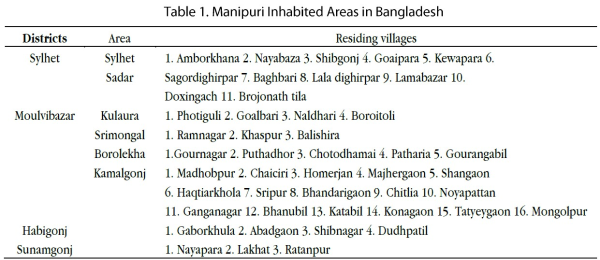
Historians suggest that Manipuris migrated to Bangladesh in the eighteenth century, likely during the 1755 Burmese war, as per the Tripura census. The Manipuris first reached Bangladesh and Srihatta (now Sylhet) around 1714 ( Sheram 1996 ). Other historical evidence suggests the Meiteis settled in Sylhet during Manipur ruler Pamheiba (Garivnawaz)'s reign from 1709 to 1748 ( Sanajaoba 2005 ). However, some literature contradicts the claim that Manipuris migrated to Bangladesh during the 1765 Manipur-Burma conflict or in the early eighteenth century. The number of Manipuris is uncertain due to data availability and reliability. In Bangladesh, 30,618 persons are Manipuris ( Ahmmed and Singh 2007 ). Manipuris live in Sylhet city and its adjacent areas. Some settled in Netrokona's Durgapur, and Commilla's Kashba ( Satter 1971 ). A part of Dhaka city is still named Manipuri Para. They are rarely found there, though relics evidence their previous settlement. Moulvibazar district has the most Manipuri residents in Sylhet division.
Md Faisal Ahmmed and Laksmikanta Singh studied the concentration of the Manipuri population in Bangladesh ( Ahmmed and Singh 2007 ).
Mohammed Shamim Khan (2008) provided a narrative about the Manipuri religion, its origins, and its current beliefs, while Haobam Bidyarani Devi (2018) provided a similar account of the Manipuri Pangal community. E. Nilkanta Singha (2020) discussed socio-cultural changes in Manipur, India, during the eighteenth and nineteenth centuries. Ningthoukhongjam Khelpriya Devi (2020) incorporated this seventeenth century history. Yumnam Rosy (2020) draws upon the history of Manipur, India, and found no evidence linking the ethnicity, religious beliefs, and handicrafts of the Manipuri people. Several initiatives were undertaken for Manipuri handicrafts study both in India and Bangladesh. Besides, participant observation among Manipuri people in Bangladesh is rarely undertaken.
This study will contribute to specifying the interrelation between Manipuri religious beliefs and their crafts. Thus, craft buyers will be able to differentiate between Manipuri's original and introduced products. This study also sheds light on the parallel origins and remarkable journeys of religious beliefs and crafts. It will help them rethink craft development as they are not willing to consider their crafts as a career pathway.
The methodology and rationale of this study are mainly analytical and empirical. Both primary and secondary sources were consulted to prepare this article. The secondary data consists of published and unpublished books and journals. Primary data was collected by the method of participant observation of Manipuri people in Bangladesh. Multi-sited visits were made for data collection. Participants include weaving women, community leaders, entrepreneurs, and businessmen distributing and retailing Manipuri handicrafts. Multi-sited visits were held at different Manipuri inhabited areas in Moulvibazar district, Sylhet city, and Dhaka, Bangladesh. As multi-sited ethnographers' research topics are not limited to specific locations or people, and often involve interviews, text analysis, internet, photography, and video rather than participant observation, ritual initiation, and apprenticeship this is a flexible research strategy ( Robben and Sluka 2007 , 334).
Late twentieth century global anthropological history emphasizes travel, communication, and commerce, making it perfect for multi-sited fieldwork ( Wolf 1982 ). However, anthropologists like Franz Boas, Bronislaw Malinowski, and Margaret Mead were unaware of the connections between people and their environment through trade, travel, and power. They were more interested in local than trans-local cultures and connections ( Robben and Sluka 2007 ).
Gupta and Ferguson (1992) questioned the belief that place, location, culture, society, and collective identity are all part of a complex, raising questions about cultural differentiation. Post the collapse of the Berlin Wall, globalization accelerated, making these issues relevant. Gupta and Ferguson argue borders symbolize globalization more than stable governments and communities ( Gupta and Ferguson 1997 ). David B. Edwards (1994) disagreed with the question of how to maintain trans-local qualities and mutually reinforcing effects of different field sites, and how to honour his in-person experiences and the intuitive links between them ( Robben and Sluka 2007 , 333). The challenge of ethnographic fieldwork is how to properly account for all the links that spread out around the world from research sites that were once easier to define. Frequently, sited ethnography is presented as the best way to do this ( Robben and Sluka 2007 , 332).
Ulf Hannerz points out that this research perspective would better be labelled trans-local than multi-sited because it is not the different localities themselves but their interconnections that matter the most ( Robben and Sluka 2007 , 333; Hannerz 2003 , 201-216). Frequently sited research, though new, has great potential for ethnography and can help us learn more about new areas of anthropology. Here ethnographers do not have to stay at a research site for a whole year. Instead, they can mix week-long or month-long visits to specific places with things like telephone calls, observations in public places, a thorough search of websites and news groups, trips with research participants, and so on ( Robben and Sluka 2007 , 335).
The result of this study is discussed in three segments. First, the historical evolution of the Manipuri religion. Second, the impact of religion on Manipuri traditional handicrafts (MTH) production. Lastly, the dependence of Manipuri religion on their traditional handicrafts.
The growth and development of the Manipuri religion in the sub-continent can be discussed considering some basic issues. These major issues are: 1) the adoption of the Manipuri ancient religion; 2) the chronological development of the Manipuri religion; 3) the king's contribution to the furtherance of Manipuri religion; and 4) Sanskritization and the modern form of Manipuri religion. The growth and development of Hinduism in Manipur was a long continuous process. Before the adoption of Hinduism, the Meiteis were the dominant community of Manipur state, and followed their traditional religion. Accordingly, they maintained unique traditional customs, institutions, scripts, culture and religious beliefs and practices ( Devi 2020 ).
Major changes happened in the Manipuri socio-cultural structure because of external forces ( Singha 2020 ). Among those external forces, Hinduisation is responsible for drastic changes in Manipuri socio-cultural structure. This Hinduisation is a strong social influence on Manipuri society. Casteless Manipuris were assimilated and merged into the Hindu society and thus they assigned a social order and eventually were entitled to equal status in the region ( Sudhir 2012 , 68).
Historically the Manipuri king's conversion to a new religion affected the Manipuri religion and its socio-cultural structures. Chronologically, Manipuri people first came into contact with Hinduism in the form of Vishnu worship in the middle of the 15th century CE, i.e. during the reign of King Kyamba, and secondly, the development of the Nimandi and Ramanandi cult in the eighteenth century CE. The third stage is the introduction of the Goudiya cult during the reign of King Bheigyachandra, and the fourth and final stage was the development of the religious authoritative power of Brahma Sabha in the 19th century CE ( Singh 2012 , 55–56).
During the reign of King Kyamba in the fifteenth century many Brahmins migrated to Manipur for the very purpose of preaching the Hindu religion. It was especially through the cultural project of the Brahmins that the whole myth of the Meiteis was re-narrated with elements from Hindu mythology. It began with the renaming of the state from `Kangleipak' to `Manipur', relating Manipur to the Mahabharata, ruled by Babrubahana, son of Arjuna, the great Pandava hero ( Sudhir 2012 , 81). All the Meitei kings were also given Hindu names and declared to be Kshatriyas ( Kabui 1991 , 257; Singh 1965).
King Kyamba introduced Vishnu worship after receiving a small image of Vishnu as a gift from King Chaopha Khekhomba of Pong, and after that, built a Vishnu temple at Vishnupur, India in which the image of Vishnu was installed. Thus, the reign of King Kyamba (1467–1508 CE), witnessed not only the immigration of Brahmins to Manipur but also the beginning of Vishnu worship among the people of Manipur (Singh 1965, 83–84). The worship of Vishnu received special patronage from the King, but it was confined only to the royal family members ( Kabui 1991 , 236).
It was due to the influence of Brahmins that the construction of icons of Hindu gods and goddesses started gradually which caused the growth and development of temples in the valley of Manipur ( Sanajaoba 2005 , 453). With time, they began to settle in the Manipur valley under royal patronage and then carried on their proselytizing activities. Thereafter, they played a very significant role in the socio-religious life of the people of the valley which paved the way for the rise and growth of Hinduism in Manipur ( Singh 2012 , 62–63). The popularity of the Hindu religion among the Manipuri people was widely spread when it was adopted as a state religion of Manipur in eighteenth century CE ( Shakespear 1913 , 409–455).
There are many important sources, like epigraphic evidence, history of numismatics, and so on, that have already established the facts of the adoption of the Hindu religion by Manipuri people towards the beginning of the eighteenth century C.E. ( Sanajaoba 2005 , 159). In the early eighteenth century, the social and cultural life of the Manipuri people changed dramatically for the very reason of Hinduisation. During the monarchical government, they showed their superiority in all aspects of the socio-cultural domain of the hill tracks of Manipur, India ( Sanajaoba 2005 , 145).
However, this spiritual transformation affected their whole social and cultural lifestyle. Whatever the customs, the rites and ceremonies as well as the festivals observed by the Meitei community in Manipur are actually in conformity with the Hindu ideals and practices during the reign of Garibniwaz ( Singh 1980 , 126). As noted earlier, the process of socio-religious and cultural integration of Manipur, India, began during the reign of Garibniwaz, but was consolidated by his grandson, Bheigyachandra. He especially took various steps to the popularization of Hinduism in Manipur by constructing temples and carving images of the gods and goddesses ( Kabui 1991 , 275). He installed the image of Shri Govindaji ( Singh 1993 , 58). However, one important fact during the reign of Bheigyachandra was that there occurred the emergence of a new syncretic religion, and a new dance form, “Ras dance”, was introduced ( Singh 2012 , 56).
The reign of Manipuri king Charairongba marked a drastic socio-cultural and political transformation in the history of Manipur. King Charairongba's reign was very significant as his conversion to Hinduism as well as his great patronage of the new religion had produced a great positive impact for the consolidation of Hindu colonialism in Manipur ( Paratt 2013 , 135). The development of Hinduism reached greater heights during the reign of King Pamheiba known by his Hindu name Garibniwaz ( Moirangthem 1996 , 119). When Garibniwaz ascended to the throne of Manipur in 1709 CE, the history of Hinduism in Manipur took a new form ( Singh 2012 , 37). He not only accepted Hinduism as the state religion but also imposed it on all his subjects and it marked the opening of a new era in the socio-religious spheres of Manipur ( Moirangthem 1996 , 120). Therefore, the reign of Garibniwaz was crucial, a transitional period in the religious history of Manipur. We must note that at first his religious policy formed a death blow to the traditional religious practices, and secondly, it laid the basic foundation for complete transformation of the social-cultural life of the Manipuri people under the influence of Hindu way of life ( Singh 2012 , 61). When Hinduism became the state religion, the traditional socio-cultural and religious system of Manipur was integrated with the Hindu traditions ( Bareh 2001 , 99).
Manipuri people have worshipped gods and goddesses through dance and music since the earliest times. Therefore, dance is a part and parcel of the cultural life of the people of Manipur ( Singh 2012 , 99). Manipur has made a significant contribution to the evolution of Hindu culture in India through her dance and music. Hence, as a result, cultural forms and figures in Meitei society were reconstructed and retransformed many times through various measures taken by the king and religious authority to survive and sustain the power and authority of the king in different historical periods. The major impact of the Hinduisation process in Manipur was on the socio-cultural identity of the Meitei community. With the emergence of Hinduism in Manipur, the process of Sanskritisation was begun and it resulted in the renunciation of the traditional religion of Meities ( Devi 2020 , 146). Besides the growth and development of Hinduisation, Sanskritization took place under the guidance of Manipur rulers, India ( Singh 1980 , 149).
Traditionally, the Meiteis were divided into seven clans known as the salais. Under these clan oligarchies there existed a feudal social system, having two social classes, namely the royal aristocracy and the commoners, including the slaves. Surprisingly after Hinduisation, all the Meitei people were classed as Kshatriyas and accordingly so-called seven salais were also assigned with the Hindu gotras ( Sudhir 2012 , 81). The Brahmin priests used these gotra names during the life cycle rituals connected with birth, death, and marriage ceremonies. They played an important role in the socio-cultural and religious life of the Meitei society. Hinduism changed the traditional Meitei custom considerably. As a result of mass conversion into Hinduism, their indigenous ancestral deities were also identified with Hindu deities. For instance, the Meitei god Nongpok Ningthou was identical with Lord Shiva, Soraren, king of heaven with Indra, Wangbaren, the water god with Varuna, the goddess Panthoibi with Parvati or Durga and the god Pakhangba was identical with Lord Vishnu.
In addition to this, most of the traditional Meitei festivals were given Hindu names or modified with Hindu forms. For example, in the traditional festivals of Meiteis: Waira Tenkap became Kirtan of Lord Rama; Kongba Leithong Phatpa became Vishnu Sankranti; Ahong Khongching became Ratha-Yatra; and Heikru Hidongba became Jal-Yatra ( Sudhir 2012 , 81). Kwak Tanba was then substituted by Dusserah as well as Chanou Hui Chintu was replaced by Govardhan Puja ( Singh 2012 , 77). In this way, the pre-Hindu festivals were thoroughly Sanskritised and modified to bring them within the Hindu fold. Apart from these, the Hinduised Meitei started to celebrate many Hindu religious festivals, like Holi, Janmasthami, Durga Puja, Ratha Yatra, Shivaratri, Saraswati Puja, Diwali, and so on.
Other changes brought by Hinduism were on the rites and ritual ceremonies associated with various stages of life were modified and expanded by addition of Hindu elements. According to the chronicles and other ancient Manipuri texts, prior to the Hinduisation in Manipur, there were four methods of disposal of the dead, namely Nungshitki Potloi (left in air), Ishingi Potloi (immersed in water), Leibakki Potloi (interred in earth), and Meigi Potloi (cremation) ( Sudhir 2012 , 37–38). All these methods were based on the nature of death. But the system of cremation was allowed after Hinduisation. Due to the acceptance of the Hinduisation process, the role and function of the traditional Maiba and Maibi (priests and priestesses) were also replaced by the Brahmins ( Singh 2012 , 50–51). Hinduism also has a considerable effect upon the rites of the passage of the Meitei. Due to the cultural contact with mainland India, various other changes also appeared in the Meitei culture, as the Meiteis began to regular pilgrimages in the Hindu holy places. The practice of merging the forehead bones/ funeral ash of the cremated person in the river Ganga was also followed ( Kabui 1991 , 258). So, pilgrimages to the holy places of Hinduism are still practiced in Meitei society, in syncretism with Meitei indigenous religion with its gods, goddesses, legends, tradition, myths, rituals, beliefs, practices, rites, and ceremonies.
The Brahmanical faith and Vaishnava Hinduism constitute the essence of present-day Hinduism in Manipur ( Singh 2012 , 71). As a prospective measure of the Hinduisation process, idol worship became very popular in Manipur. Many temples sprang up and the most famous is the palace temple dedicated to Shri Govindaji. The temple of Shri Govindaji is the institution par excellence connected with the cultural life of people of Manipur valley ( Sharma 2009 , 24). The development of Hinduism in Manipur resulted in great literary progress which had witnessed during the eighteenth and nineteenth centuries CE. The Bengali script was adopted in place of the archaic Meitei script. The local writers were also attracted towards producing those kinds of literature which mainly focused on Hindu religion and culture. The primary objective behind such activities was to create awareness among the Manipuri people about Hindu culture and consciousness for preserving and promoting Hinduism ( Singh 2012 , 81–83). Manipuri literature proved to be a convincing force for the propagation and popularization of the Hindu religion and culture among the masses. It may be mentioned here that through the process of Sanskritisation, the devotional songs were sung in archaic Bengali and Sanskrit. The social outlook of the Meiteis also underwent tremendous changes due to the influences of Bengali language and literature ( Lal 1990 , 101). As a result, the people started not only to adopt Hindu names (especially Sanskrit and Bengali) but also used it in the names of localities, hills, rivers, and so on ( Kabui 1991 , 277).
Moreover, they liked to use Bengali cloths, such as dhotis and kurtas, and even the royalty had almost adopted the Bengali style with minimum ritualistic dresses and costumes ( Singha 2020 , 76). It thus, indicates that the Meiteis were not only the followers of Hindu culture but also the preservers of Sanskrit and Bengali culture. So, the major changes in socio-cultural and religious spheres which were specially made by the king and religious authorities during the period of Hinduisation were parts of such a project. Undeniably, the whole of Meitei society was gradually transformed into a Hindu culture. Thus, the growth and development of Hinduism in Manipur valley marked the synthesis of the old and new elements and caused a syncretized form of Hinduism to develop, which is still practised in the valley of Manipur. Later, Bangladeshi Manipuri people experienced the same trend.
The Manipuri handicrafts production process has a deep relationship with sacredness. Manipuri women, after waking in the morning, do cleaning-related duties and only then take a bath for their physical purity. They then do household duties like cooking and other daily work. They usually do not enter the kitchen before taking a bath. They do not touch their weaving tools before taking a bath. This work routine continues all through the year.
Many Manipuri products (except some made for marketing) are made of joined pieces. The excepted products are Sharees and Scarves. Manipuri traditional dresses like Fanek, and Fidup bedding clothes, are made of several joint parts. Though the joining of several parts together looks improper, this is the unique process they follow. There are some reasons behind it. For example, they weave pieces of intended clothes at different times. When they get free time, they weave a small portion of the weaving. Thus, the time of weaving depends on how much free time they gain after completing their household duties. One Manipuri weaver was asked if any cloth had different parts, and then its look became odd. She thereafter added that “we emphasise tradition rather than outer looking beauty of the product.”
Muslim Manipuri (Pangal) weavers cannot weave “Wangkei Fidup” (a blouse worn by women) properly. Muslim weavers have their distinct design, which has a religious impact on their products. They also produce designs from the imagination like weavers of other religions. Here, weavers from Hinduism and any other religions also have a religious impact on their design of products. But Muslim weavers use designs based on their religious beliefs which are absent in the case of other religions.
Manipuri handicrafts contain Moirang (a triangle-shaped temple design) which is a must for some dresses like Fanek, Phidup, and Sharee. If anyone does not find Moirang in Manipuri products, they can easily regard that product as a copied product made by another community or from another locality. Moirang means “temple” of the Meithei religion whether large or small. There are other additional designs that they follow in the middle border of their product. That is “Leikup” and “Leijao”. Leikup indicates a small flower and leaf of a tree and Leijao indicates a flower or leaf that is larger in size. The specific mood of the weavers determines the design of clothes. The design indicates here the design of the inside (body of the cloth) design of the clothes. Mainly border designs are focused on “Moirang”. Moirang never changes, though the designs of Moirang can vary from cloth to cloth.
Manipuri textile weaving has been linked to social and ritual events since ancient times. Manipuri textile weaving has had a significant impact on the social and economic aspects of the Manipuri people's lives over the years. The inhabitants of this region view the practice of the profession not as an obligation but as a revered obligation. In the Meitei community, the act of weaving textiles is seen as a representation of the cosmic process. In the dance of creation, the male and female messengers of God (Maiba and Maibi) evoke the sound of spinning and weaving. To state this simply, creation is a splendid process of intricately merging to form a cosmic entity. In the traditional belief system of the Meitei, the God of Handicrafts (Leismbi) is highly important as they are said to have given the Meitei people the techniques of textile weaving and the secrets of dance creation. Nonetheless, this is an alternate stance within the Meitei religious system. According to this, humanity acquired the art of textile weaving not by divine intervention, but through initiative in learning from nature. Humans witnessed arachnids intricately constructing their silk traps on the shrubs and bushes and actively engaged with this task. Notable kings known for their support for craft manufacturing during their reign were “Jabista Nongda Laivel Pakhangba” (thought to have governed from 34 CE to 153 CE) and King Loyamba.
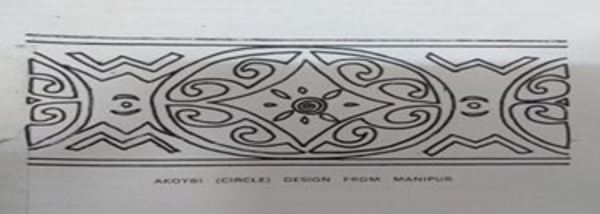
An intricate design is named Akoybi (circular) since the pattern is round, with each circle linking the next, and each circle is divided into patterns with significant motifs and names. A romantic narrative links it to the fabled serpent Pakhamba, who was killed by the goddess's husband and later tried to atone for it by replicating its scaly patterns through textile design. Inspiration from the motif can be less romantic and more inventive. However, this simple description scarcely conveys the Akoybi's complexity. Bangladeshi Manipuri handlooms rarely have Akoybi designs. Instead, Indian Manipuri weavers follow the Akoybi pattern.
Likewise, religious belief has an impact on motif design. Temples of the Meitei, Bishnupriya, and Pangals have an important focus on Manipuri handicrafts. Weavers designed Moirang fabrics as images of their religious temple. Bishnupriya and Meitei Manipuri have temples as the main place for worship. The Manipuri Muslim Pangals often draw Moirang, thinking it is the symbol for the mosque. Temples and mosques have similar shapes when drawn in handicrafts. Some Muslim Pangals use variations that are more obviously Islamic in design.
Manipuri people, as a religious obligation, have a pit loom in every family home. They produce Sharees, mosquito nets, handkerchiefs, and woollen scarves. Weavers collect raw materials for the pit loom by themselves. Now, modern spinning mills provide yarn for pit loom production. Now, every district of Bangladesh has a power loom combined with a pit loom. Whereas Indian Manipur has developed rapidly, Bangladeshi Manipuri still use traditional pit looms. Manipuri women believe that traditional looms are more suited to them than modern looms. Every weaver has a loom of varying sizes. The researcher found a few families who no longer produce handicrafts requiring large looms, but they have kept their old looms in their homes. Some families have restructured the walls of their houses but have kept monuments of their old waist loom. This fact shows their deep interaction with handicrafts and with related traditions.
Manipuri people live together communally. A Manipuri community is made up of a few families, and many communities live together to make up Manipuri culture. Their way of living in a community is not always based on the old model; instead, the democratic process drives them. They do not have autocratic or hereditary leaders like some other Bangladeshi groups do. Rather, every Manipuri village has a Mandapa, which is a hall or pavilion used for public ceremonies, usually in the style of Hindu temples. For Manipuri, this is a public area. This temple is an idol designed for making handicrafts.
Bangladeshi Manipuri people brought with them ancestral “Lockei-Sagei-Shinglup” from India, based on an ancient social system, way of life, housing patterns, food habits, clothing, social customs and religion. Manipuri Meithei or Manipuri Vishnupriya did not lose their spiritual relationship with their ancient religion. They survive in Bangladesh depending on their belief and feeling of “mother—mother tongue—motherland.” They never speak the Bengali language among themselves; if anyone cannot speak Meitei or Manipuri that person is not regarded as Bangladeshi nor Manipuri, but rather in the middle of the two. This Manipuri sense of identity derives from ideology and ideology comes from parents, family, society, and surroundings. One educated Manipuri boy said, “We are Manipuri, and we have limitations such as we have three classes or groups, having different religions and each group has different traditions. But we can't go beyond our Manipuri ethnic identity”. A Manipuri girl's manufacturing skill starts from her mother or another woman relative of the family. Womenfolk teach their girls as a mandate of serving tradition as religion.
One can easily differentiate between Manipuri products (mainly Sharee) and other products, because Manipuri products have special skills and features. Every Manipuri Sharee has Moirang at its border. The inner body may have different types of designs. Sharees woven on power looms do not contain Moirang, and the inner part of Sharee and other long dresses do not contain natural designs like trees, leaves, and other natural elements. Therefore, in terms of MTH, there must be visible religious temple design “Moirang.” Thus, religious belief is the core of MTH weaving.
There are differences between authentic Manipuri cotton and copied cotton imported from other parts of Bangladesh. Firstly, samples are made with the design of the English letter “H” or “M,” and these types of products give no impression of the religion while weaving. Copied clothed sheets are made to a fixed design and shape, and are commercially on a large scale. On the other hand, traditional Manipuri cotton is made as a part of recreation and as a mandate of tradition and religion. According to the view of a Manipuri undergraduate college student, “We weave, knit, and process the preparatory task of our product as a recreation. Bangladeshi girls use the internet, mobile games, and watch movies, and in that free time, we produce handicrafts.”
Many Manipuris now follow the Chaitanya faith of Sanatana Dharma, a form of Vaishnava Hinduism. But before they converted to Sanatana Dharma in the 1800s, the Manipuri people followed the Apokpa religion. They did not completely abandon their religious views, though. Their rites and rituals are a mix of old and new ideas. Manipuris celebrate religious events like Rathayatra, Rasa Purnima, and Jhulanjatra with great pomp and ceremony. They also celebrate events from their culture, like Laiharaoba and Sajibu Chairaoba, and worship home gods like Sanamahi, Pakangba, and Leimaren (Mohammed Shamim Khan 2008).
The Manipuri religion, also known as Apokpa or Sanamahi, is an ancient religion that infuses life of the Manipuri people as narrated in Indian and British literature. The religion's core is the importance of natural phenomena and the worship of various forces as deities. Manipuri dances, songs, music, and martial arts evolved from appeasing the gods. The religion has religious literature and sacred texts, called “Puya,” containing philosophical discussions about the universe, life, the soul, nature, and death. The supreme man, Atyyakuru Shidaba, is considered the origin of the universe. Manipuris also worship Paramanari, the supreme woman, mother of the universe. The dharma of Manipuri society combines religion, life, science, art, and morality.
Responses from key informants were used to develop a comprehensive understanding of the cultural and social significance of MTH; these aspects are connected to the Manipuri religious observations as well. Certain items are customary attire, while others serve ceremonial functions, and are only utilized on specific occasions. Handicrafts help people to make a living. But few of the Manipuri families adopt weaving handicrafts only for revenue. They mainly focus on MTH to continue their established culture. Handicrafts are an important element of observing religious obligations. According to the primary sources, there are approximately seven different types of handicrafts process that are produced in the area under investigation. Weaving, knitting, stitching, and dyeing are some of the arts in this category. Beading is traditionally done by Manipuri women, but now most is done by business owners. These days, the community of Manipuri only has a few members who are skilled at carving and pottery. MTH are largely influenced by culture, which is what determines responsibilities within a household and a society.
Three groups of Manipuri have positive interactions among them, and they believe in unity. They become a common unit while observing common festivals like “Raash” and the “Puja” festivals though some of them (Pangals) do not conform to these festivals principally. Having some differences in belief they become united during these festivals. No one can differentiate them in respect of Meitei, Bishnupriya and Muslim Pangals while interacting with Bangladeshi people. It was noted by key informants that culture also plays a role in the development of skills. These skills are typically formed through children's hobbies and household activities, which are typically passed down through the female line. Handicraft items are mostly utilized in cultural events such as traditional weddings, religious rites (Raas Leela dance), and other birth and death ceremonies, which are still spiritually vital in the Manipuri community according to key informants.
Manipuri women are involved in the production of a variety of items, including Furit, Fanek, and Fidup. Manipuri women adorn themselves with Furit as a shirt for the upper body, while they wear Fanek to cover the lower half of their body. Additionally, they wear Fidup on the upper side of the Furit. Manipuri women skillfully craft a variety of items using traditional Manipuri clothes and coordinating colors with Sharee. These include Innafi, which is worn to wrap the upper part of the body (wrapping the upper part of the Muslim women is a mandate under Islamic Shariah law).
When asked about the motivations behind people's participation in handicrafts, industry experts typically cited cultural and historical factors as the most compelling justifications. The habits and traditions of the Manipuri people are the inspiration for many of the handicrafts that Manipuri women manufacture. They maintain their traditional practices and cultural identity. In the past, people would wear hand-made clothes. They use this as a source of inspiration for clothing designs for both men and women.
The primary data revealed that women manufacture MTH for their personal use. They dress in traditional attire during the festival. They do not part with their traditional ceremonies even for the most solemn of ceremonies, from birth to death. Typically, they divide these into two separate parts, such as a Fanek and a Fidup. Festival season is the busiest period of the year for the sale of handicrafts. Informants suggested that the handicrafts play in uplifting and conserving the culture of the Manipuri people is a significant one. Women manufacture handicrafts for the sole purpose of keeping their traditions and culture alive. Clothes woven in the Manipuri houses are the thread that binds one Manipuri individual from birth to death. In addition to that, the clothes they wear daily are hand-made by them. The worth of MTH can be classified into two categories: the first is cultural or social value, and the second is economic value.
According to them, the quality of Manipuri products is contingent upon the quality of the raw ingredients. However, the issue lies in the fact that brokers typically provide low standard raw materials at a reduced cost, which helps the weavers. Occasionally, suppliers disperse assortments of blended raw materials for spinning. Consequently, the overall quality of the woven product diminishes. Raw materials and handicrafts are brought from the Indian Manipuri region for specific purposes, such as marriage ceremonies of aristocratic Manipuri individuals and other festival events that involve dances.
Some of their traditional products are specially made for daily and occasional purposes. Manipuri people use a clothing sheet on the floor on which they sit and eat rice. This is called Chak Cha Fida which indicates some joint words. Chak means rice, Cha means to eat, and Fida means seat. Besides, they knit and weave blankets for the winter and summer seasons. Bedding of their tradition is called Tolayfi which is used as their bed sheet. A special kind of bedding is used to keep the dead body of a Manipuri Muslim in the grave. Thus, a Manipuri is connected with MTH from birth to death.
The Manipuri people live through dance and singing. Dance (Jagoi) is the most important part of Manipuri culture. In this dance, the body moves to make either a circle or an ellipse. Rasa dance is the core of Manipuri dance culture. Manipuri dances are of two main types: folk and Shastriya (classical) dance. The folk dances of Manipur are Laiharaoba, Khamba-Thoibi, Meibi Jagoi, and Leisham Jagoi. The formal dances are Rasa, Gostha Leela, Udukhol, and Mridanga. Manipuri dance is known for its lashya (gentleness), devotion, and compassion. The feelings of life have no limits. Thyang-Ta, Mridonga Nritya, and some forms of Shri Krishna Nartan remind this. For every occasion of dance, they wear traditional dresses. Even every distinct dance has a dress. Thus, dance and MTH go in a single line.
The marriage system of Manipuri is founded upon distinctive norms and practices and categorized into three segments. Before the wedding (Hinaba), the boy's parents visit the girl's parents. After calculating the horoscopes, a mutually agreed-upon day for the meeting is scheduled. During the upcoming meeting, known as Yathang Thanaga, the girl's parents provide their consent. Following that, the subsequent phase is known as `Waroipot puba', during which the groom's relatives present food, and the agreement is ultimately formalized. The engagement is announced among friends and relatives, a tradition known as “Heijapot.” Subsequently, friends and relatives from the boy's family visit the girl's parents, bearing food, fruits, and gifts. The Brahmin arranges the marriage. The men attire themselves in dhoti and kurta, complemented by a shawl draped around their shoulders. The women, on the other hand, wear pink Fanek and white Chader. The seating arrangement is organized in a circular formation around a Tulsi plant. The bridal gown is distinctive. The bride is required to wear the Rash Lila skirt. The attire of the groom consists of a white dhoti, kurta, and turban. The Kirtans and Shahnai music play as the bride and groom circumambulate the Tulsi plant seven times. The bride gracefully executes the choreographed movements in synch with the melodic Shahnai music. She portrays the character of a gopi. MTH wearing is mandatory in all stages of a marriage. Meitei marriages have numerous commendable aspects. The guests are presented with Dakshina (gift). The dowry is not obligatory but rather discretionary. The girl's parents supply her with important things, including kitchenware, sewing machines, equipment, and clothing. Traditionally, the bride's parents gift weaving tools with other gifts. Manipuri are engaged with handicrafts for wearing, gift making, and decoration, during the marriage.
At different times, different cultures have influenced the women of Manipur, who seem to have more freedom and visibility than women in other parts of the country. If Manipuri women visit their relatives, they usually prepare woven gifts for their relatives. In response, they are also offered woven gifts by relatives. These rules are their tradition is maintained except for some accidental reason. If this tradition is broken by any party, it is regarded as an insult to those to whom it accrues. In the premarital setting, the guardian of the bridegroom traditionally asked about the bride's weaving skill, which was a mandatory quality for Manipuri brides.
Manipuri traditional dances are organized by the Meithei Manipuri and Bishnupriya communities. Both communities have distinct features in their dancing. Sword dances and weapon dances developed by the Meithei Manipuri, who were familiar with martial arts due to their propensity for war. Thus, Meithei Manipuri dances have variations not seen in Bishnupriya dances. Both communities wear Manipuri traditional dancing clothes.
Manipuri traditional dances became popular because of poet Rabindranath Tagore's initiatives to promote Manipuri traditional dances. A myth in the matter of the relationship between the origin of MTH weaving and traditional Manipuri dances is popular in the Manipuri community. Manipuri weavers weave their handicrafts, falling into line with dancing steps. Key respondents informed the researcher that Manipuri traditional dance is part of Manipuri rituals. The origin of Manipuri traditional dance is based on a myth. Ancient Manipur (India) King Bhagya Chandra dreamed that he was organising a dance program. For this very reason, the Manipuri traditional “Raash” dance starts with the name of this king. After all, whatever the inspiration for Manipuri dance, it is quite dependent on MTH. Wearing crafts is a precondition for dancing.
The principle for observing festivals in Bangladesh is: “everyone belongs to his or her religion, nevertheless festivals belong to all.” For this national principle of religion and festival observation, all communities including Hindu-Muslim-Buddhist-Christian observe Manipuri's common festivals harmoniously. Manipuri festival customs also offer the freedom of people of all ethnic groups and regions, and customs have the social function of uniting people and strengthening unity among three Manipuri communities. Every time a festival activity is held in the village, most of the villagers actively return to the village to participate. Some Manipuri who have migrated elsewhere are unable to return to the village, and they can only participate in the festival activities by sharing money. At present, activities are held in the villages and Moulvibazar and Sylhet cities.
MTH have a deep relation with their festivals. Festivals observed by the Muslim community and other common festivals of the Hindu religion have a precondition of wearing MTH. A major part of their festivals includes traditional dancing, and dancers collect dancing dresses from India at high prices. Common festivals are a great opportunity for Manipuri weavers to display and sell MTH to the Manipuri community as well as to the Bangladeshi Muslim community coming to enjoy the festivals. Raash festival is a popular festival for all Bangladeshi communities. The lower part of Manipuri traditional dress is called Fanek in the Meitei language. Mainly Meithei Manipuri people call it Fanek. Bishnupriya Manipuri people call it Anggaluri. But the upper part of their dress is commonly called Innafi. Innafi has two types, one is for daily usage and the other is for marriage purposes. Manipuri women wear Innafi instead of blouse which other Bangladeshi women wear. Innafi is worn on festival occasions and marriage ceremonies.
The Bangladeshi Manipuri community's major festivals are the Raash festival, and other Puja festivals with the Hindu community, Yaoshang (Durga Puja), Kang Festival, Sangai Festival, Ningol Chakouba, Eid Ul Fitre, Eid Ul Azha. Lai Haraoba. Besides the above-mentioned festivals, Indian Manipuri people along with other Naga Kuki observe Christmas, Cheiraoba Festival, Heirku Hindongba, Kut Festival, Manipur Chumpha Festival, Lui Ngai Ni, and Gang Ngai festivals.
Raas Leela is the main religious festival of the Manipuri community. This Raas Leela is in the full moon of November or December. The Manipuri Raas Utsav has been celebrated for 178 years in Shibbazar (Joramandap) of Madhabpur in Kamalganj of Moulvibazar district in Bangladesh and for 35 years in Tetaigaon of Adampur. Raash festival has two episodes, “Rakhal Raas” during the day and “Maharaas” at night. At the beginning of Rakhal Raash, the tearful lamentations of the mothers are embodied in song coins to allow the boys Krishna, Balarama, and Sakha to go for grazing. Then Krishna's various deeds of herding cattle in Vrindavan as a shepherd in his childhood are presented. Maha Raash Leela shows a relationship between living things that is both worldly and transcendental. Maha Raash begins at night. It is a philosophy of spiritualism and materialism that is served with dance and songs as Radha Krishna's love story is told. Visitors from all districts irrespective of religion come to Moulvibazar, Madhapur, and Sylhet city during the Raash festival and watch Manipuri traditional dances. Visitors buy MTH and stay where rash festivals are arranged. Raash festival is also a significant event for the Manipuri weavers to sell handicrafts. During the traditional dance dancers wear MTH. Thus, Raash festival is the largest festival for Manipuri and the largest platform for Manipuri weavers to display connection with handicrafts.
The Yaoshang Festival of Manipur, also known as Holi, is significant in northeastern India and Bangladesh, lasting five days on the full moon day of Phalguna month. People participate in singing, dancing, and spraying dyes on each other. Children receive money from families to plan events in their neighbourhoods. Thabal Chongba is a popular dance. Yaoshang is similar to the Durga Puja in Bengal, Diwali in north India, and Bihu in Assam. During this festival, traditional dress is an important part.
Every year, the Kang Festival, also known as the Rath Yatra, takes place in villages where men are mostly in Manipuri and different spots in Moulvibazar. Manipuri people who live in the city of Sylhet also celebrate this holiday. This 10-day-long festival is one of the most important festivals in the Manipuri community. The singing of Kirtan Khubakisei (religious songs) by the people in the procession is one of the best parts of the festival. Rath Yatra is a happy festival that starts on the second day of the fourth lunar month on the Manipuri calendar. This month falls in late May or early June and lasts for ten days. Manipuri traditional dress is an unavoidable part of the festival.
Lai Haraoba is a popular festival in Manipur, India, where people worship local gods and goddesses, including their ancestors. The festival, known as “festivity of gods,” includes folk dances, plays, and Thoibi and Khamba. Since 2022, the festival has been organized by Bangladeshi Meitei Manipuri. The festival brings shamans and shamanesses from Manipur to the village. Without Manipuri traditional dress it is impossible to observe Lai Haraoba.
The Manipur Sangai Festival, held annually in November, showcases the state's unique art and culture through dance, music, sports, and local food and crafts. The festival features performances of dances like Kabui Naga Dance, Raas Leela Dance, Bamboo Dance, and Khamba Thoibi Dance. The Ningol Chakouba festival, held in Hiyangei, India, features special foods like Pan Thongba, Chagempomba, Champhut, and Iromba. Manipuri women wear and exchange gifts made from traditional dresses during this festival ( Paratt 2013 ).
Manipuri Muslims celebrate Eid al-Fitr (Festival of Breaking the Fast) during the month of Ramadan and Eid al-Adha (Feast of Sacrifice) on the 10th day of Dhul Hijjah. Muslims exchange traditional Manipuri dresses as gifts and visit family and friends. The Cheiraoba Festival, also known as the Spring Festival, is a popular event in Manipur, held on the first day of Sajibu month (March-April). It involves traditional attire, family visits, gift exchange, local cuisine, and prayers to the goddess Sanamahi.
Manipuri people wear Manipuri traditional dresses in all the above-mentioned festivals. Festivals include dancing, dressing, decoration, procession, and visiting relatives. Thus, MTH is a must for observation of these festivals. MTH is a pre-condition during Manipuri festivals. Except for the above-mentioned festivals, there are a few Puja festivals that Hindu religious people and Manipuri Hindu people concurrently observe. Manipuri people also wear their handicrafts during these festivals. Most respondents (86.66%) stated that they engage in handicrafts due to their affinity for the activity and as a means of preserving their cultural heritage. Meanwhile, 73.33% of respondents stated that they engage in handicrafts for personal use as well. 40% of respondents stated that they engage in handicraft production as a means of generating revenue.
MTH weaving and other skill work is a holy duty to Manipuri womenfolk. Women abstain from weaving during their menstruation period and the fixed period of 40 days after giving birth to a child. A woman interviewee added to the researcher that “we do not even touch the machinery and other related materials of weaving after waking up from bed unless we wash our hands”. Manipuri people use and utilize their woven clothes in festivals starting from birth to the death of a Manipuri member. They have some formalities after a Manipuri dies. They use their traditional clothes to observe formalities. There are two major formalities in the case of death of a Manipuri: one starts after four days; and the other starts after 13 days past the death. They use Manipuri cotton on these traditional occasions. One woman added that “when Manipuri child is born that child is for the first-time child wrapped with Manipuri traditional dresses in arms.” They wear special Manipuri traditional clothes to decorate the wedding chamber for the wedding night.
Manipuri Muslim Pangals usually produce their prayer mats. Pangals have a deep relationship with their handicrafts. They weave some special bedding-type clothes with the intention that they will use these clothes when Manipuri Muslims die. They keep dead bodies on their traditional bedding purposively made for this purpose. They use their traditional bedding while they keep dead bodies in graves. They weave other bedding clothes which they used in the time of Manipuri Muslim marriage. Muslim bridegrooms along with their friends and relatives usually eat food sitting on their traditional bedding clothes. Meithei and Bishnupriya Manipuri families do not follow this culture.
Newly married couples wear traditional dress. All Manipuri communities use their traditional special and colorful clothes to decorate the wedding night stage. These decorative traditional clothes are highly designed and colorful. All Manipuri families cannot own these clothes. They usually borrow from others. This culture of wearing traditional clothes is a part and parcel of the Manipuri marriage and they regard it as a religious duty to observe. The Manipuri community traditionally had a variety of dates and rituals. All three classes of the Manipuri community harmoniously observe their common festivals. Though Pangals are Muslim they also take part in common festivals. The Muslim community never worship Hindu gods as it is opposed to Islam, but they take an active part in preparation and observation. In terms of clothes, no outsider can differentiate between the three Manipuri groups during festivals. Here traditional clothing makes them unique and united.
Manipuri culture is carried and continued by women. Women significantly contribute to culture. Women execute their holy duty in Manipuri traditional dance, festivals, weaving, and daily traditional usages. Manipuri women carry their handicraft tradition, and this happens here as a religious mandate. They think weaving skills are an inherent feature of Manipuri women. The community considers any Manipuri woman who lacks the handicrafts skills as worthless. The elder generation is uncertain about the sustainability of this handicraft tradition beyond a certain period. In response to this question, Manipuri young girls, both uneducated and educated, replied that they would teach the weaving technique to the next generation. They believe that the next generation will automatically acquire this skill through observation, like theirs. It is said that Manipuri girls have the ability to master any skill they see. They believe that “as a Manipuri girl, it is a matter of shame and insulting if we cannot make our handicrafts.” As a result, girls learn their weaving and knitting skills through observation, without any training. They hold the belief that the weaving industry has limited potential and have no desire to pursue a career in Manipuri weaving. They consider it to be their religious duty.
In terms of indigeneity, there is controversy among Manipuri subgroups. Meitei and Bishnupriya make claims and counterclaims about design, skill and originality of their handicrafts. Meithei and Bishnupriya have unique religions, but their languages have differences. Pangal Muslim Manipuri and Meitei people in Bangladesh share a common language, with religious disparity yet intimacy in social communication. Their different religions motivate all subgroups to produce handicrafts, which are the prerequisite for attending all three communities' religious and traditional ceremonies.
Cultural Data (Informant): Experts in Manipuri Handicrafts
List the handicraft activities through which Manipuri people are engaged in.
What are the main economic and social factors influencing the choices of the different Handicrafts activities?
How can the choices be improved if there are any limitations?
What are these products used for?
How has the craft contributed to women's realization of self-worth?
In your experience, what do you consider to be the main challenges facing handicraft business?
Is there any kind of support that is being provided to producers in order to cope with the challenges?
Where do these women obtain their raw material?
Do they experience any challenges in accessing the resources?
What are the challenges that they have encounter?
What do you consider to be the main drive that sustains the market of craft products and why?
Please describe how you and other stakeholders promote handicraft
Manipuri people involved in handicraft activities
Bibliographic Information
Household Code
Age at last birthday : Below 20 , 20-29 , 30-39, 40-49, 50-59, Above 60
Marital status: Single, Married, Cohabit, Divorced , Widowed, Separated
Educational details: No formal schooling, Some primary education, Primary education, completed Some Secondary school, Secondary school, completedHigh school, High school completed, Tertiary education
Are you employed? : Yes, No If yes, please state the type of your contract : Working full-time, Working part-time, Unemployed
Is this household?: Male headed, Female headed de jura(mandead/left), Female headed de facto (man works away from home for most of the year without making regular decisions, Yourself
How many people live in this household? 1-6, 7-12, Above 13
How many income contributors in this household?
Who are the income contributors?
What are the sources of income in this household?: Craft products, Remittances, Farming (crop and livestock sales), Selling fruits and vegetables, Old age pension, Selling scones, Other, Selling traditional beer, Wage employment
Handicraft Production
Do you like handicraft? Yes, No
Why did you decide to participate in handicraft production?
At what time do you do handicraft?: Morning, Afternoon, Night, At convenience Fulltime
Who taught you the handicraft skill?: Mother, Grandmother, Friend, College/school, Observation, Other
How long have you practiced handicraft? Less than 5, 6–10, 11–20, Over 20
What handicraft activities do you do?: Weaving, Pottery, Carving, Beading, Sewing, Dying, Other
Why did you decide to concentrate on this handicraft activity?
What are the general challenges in your activity?
What resources do you use in your activity? Raw, material
Where do you obtain your raw material?
How do you harvest your natural raw material?
Who harvests your raw material?: Myself, My husband, My children, Other
At what time of the year do you harvest your raw material?
How do you process your raw material?
Where do you store your raw material?
Contribution Of Handicrafts to Household Income
What products do you sell and how much do they cost?: Product, Cost
What is the best for business?: Pension day, Festive season, Month ends, Other(specify)
Where do you sell your handicraft?: Home, Local market, Along the road, Town
How much do you make from selling crafts?: Taka0-100, Taka101-R200, Taka 200-500, Taka 500-1000, Taka1000-3000
What is the money used for per month?: Burial, Give to dependents, Clothing, Health, Communication/cellphones, Paying loans, Education, Savings, Food, Transport, Other
Who decide on the use of the money you make from your handicraft trade?: Myself, Husband, Myself and husband, Myself, husband and children,
What are the livelihood activities you participate in?: Brewing beer, Farming, Full time employed, Hawker, Domestic worker, Baking and selling scones, Nothing, Other
Which strategy do you consider your primary source of income?: Brewing beer, Farming, Full time employed, Hawker, Domestic worker, Baking and selling scones, Nothing, Other
Are there any reasons for not participating in the other livelihood strategies?
Where do you get help when there are pressing needs in your family?: Church, Relatives, NGOs, Other—specify









This website recommended the use the Chrome browser for journal website.