- P-ISSN 2799-3949
- E-ISSN 2799-4252



The Jade Emperor is a prevalent belief in the southwestern region (Vietnam), primarily within the Vietnamese and Chinese communities. Through years of our research in the southwestern region, we've noticed a distinct pattern: the worship of the Jade Emperor is less prominent in the delta areas compared to the mountainous regions. As one moves towards the mountains, particularly exemplified by the Seven Mountains in An Giang Province, the worship of the Jade Emperor becomes more prevalent. With larger temple complexes, the local populace holds a deeper faith in the Jade Emperor than in coexisting Buddhist temples of the Mahayana tradition. In this article, we delve into the worship of the Jade Emperor in the Seven Mountains region, An Giang Province, highlighting prominent temple complexes revered by both locals and tourists. These include the Jade Emperor temples on Cam Mountain (An Hảo commune, Tịnh Biên district, An Giang Province) and on Tô Mountain (Núi Tô commune, Tri Tôn district, An Giang Province).
NGUYEN Trung Hieu holds a Master's and Doctoral degree in Cultural Studies. He is a researcher and lecturer at An Giang University, National University of Ho Chi Minh City, and has also taught at the University of Kien Giang, Vietnam. He is a member of the Vietnam Historical Science Association, the Vietnam Folklore Association, and the Vietnam Journalists Association. His research focuses on beliefs and religions, tourism, and the culture of ethnic groups in Southern Vietnam. He has published 27 scientific articles, delivered 40 papers at conferences, and authored or co-authored 6 books. His research has been widely disseminated and received attention from scholars in Vietnam.
JDTREA 2025.4.2:35–53
The Seven Mountains area of An Giang Province encompasses two districts, Tịnh Biên and Tri Tôn. According to statistics, the entire Seven Mountains region comprises around 37 major and minor peaks, among which seven mountains play a significant role in the spiritual life of the people of An Giang Province and the southwestern region of Vietnam. Therefore, locals collectively refer to this region as “Bảy Núi” , derived from the names of these seven mountains: Cấm Mountain (Thiên Cấm sơn/ 天禁山), Dài Năm Giếng Mountain (Ngũ Hồ sơn/ 五湖山), Tô Mountain (Cô Tô/ 孤苏山), Dai Mountain (Ngọa Long sơn/ 臥龍山), Tượng Mountain (象山), Két Mountain (Anh Vũ sơn/ 鸚鵡山), and Nước Mountain (Thủy Đài sơn/水檯山).
Through surveys in the Seven Mountains Region, Cấm Mountain stands out as the location with the highest number of Jade Emperor temples. According to locals, these temples have existed for two generations (grandparents and parents) and have been passed down to the third generation. Some of the temples have a history of nearly 30 years. Initially, these temples existed only in the minds of the people, with simple worship places consisting of incense burners and Han script names such as “Ngọc Hoàng” (玉皇) or “Ngọc Hoàng Thượng Đế” (玉皇上帝), without any statues. However, with the development of spiritual life and the widespread availability of worship statues, locals began placing Jade Emperor statues on altars and expanding temple complexes. This has attracted many visitors and worshippers.
The largest Jade Emperor temple on Cấm Mountain is located at Bồ Hong Temple, which is the highest point on the mountain (716 meters above sea level). This area features rugged terrain, with a plain below and several small mountains. At Bồ Hong Temple, mist and clouds often envelop the area, creating a mystical and eerie atmosphere, especially during sunrise or sunset. Today, BồBồ Hong Temple is inhabited by a significant population, and additional new temples have been established, making the area less desolate and mysterious but still a sacred destination in people's hearts.
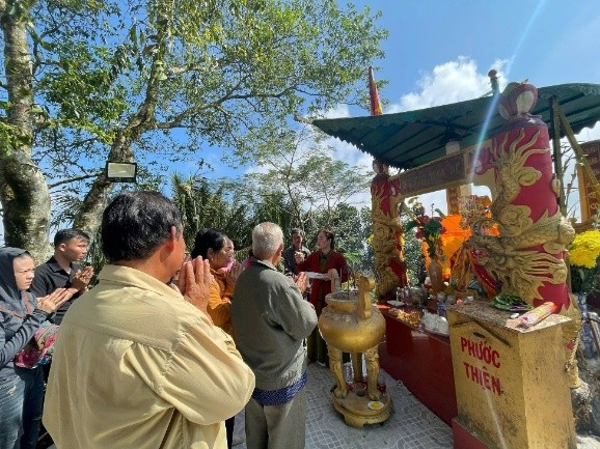
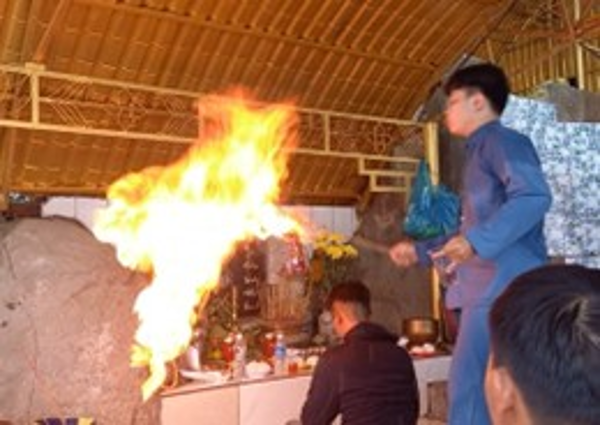
Figure 1. The Jade Emperor Shrine at Bồ Hong peak, Cấm Mountain, where locals perform the ritual of xin lộc (seeking blessings) from the Supreme Jade Emperor. (Photograph by Author)
At Bồ Hong Temple, on the highest rock platform, locals have erected a shrine with a Jade Emperor statue standing approximately one meter tall, adorned with a golden dragon head crown and colorful silk robes; these robes and crowns are regularly replaced. In front of the statue is a spacious courtyard used for worship and offerings to the Jade Emperor. The worship style at Bồ Hong Temple differs from other temples in the same Cấm Mountain area, such as Cây Quế Temple, Huỳnh Long Temple, and Tứ Vị Thiên Vương Temple. These places not only worship the Jade Emperor but also incorporate worship of other deities such as Earth Mother, Southern Deity, and Northern Deity. In contrast, Bồ Hong Temple exclusively focuses on the Jade Emperor.
Bồ Hong Temple is a renowned pilgrimage site on Cấm Mountain; therefore, the Jade Emperor temple attracts many visitors for worship and offerings. Alongside regular offerings such as incense, flowers, fruits, and water placed on the altar and prayers according to individual spiritual needs, many groups, individuals, and families offer vegetarian meals to the Jade Emperor. Locals prepare vegetarian dishes such as sour soup, watermelon, fried tofu, pickled vegetables, and filtered water for the offering. After two or three rounds of prayers and prostrations, the locals present the offering meal, gather around, and enjoy the “blessings” of the Jade Emperor; worshippers must finish all the food and drinks provided. People pray to the Jade Emperor for the well-being, happiness, health recovery, and smoothness in work for themselves and their families. Particularly, we heard locals referring to the Jade Emperor as “Father” and addressing themselves as “children” in a reverent and earnest manner during their prayers.
The number of visitors to the Jade Emperor temple at Bồ Hong Temple is significant. Among them, the majority are followers of indigenous religions such as Bửu Sơn Kỳ Hương (寶山奇香), Tứ Ân Hiếu Nghĩa (四恩孝義), Hoa Hao Buddhism (和好佛教; Phật giáo Hòa Hảo), and Buddhist devotees. Many of these visitors are residents from the provinces in Central Vietnam who come to visit and pray.
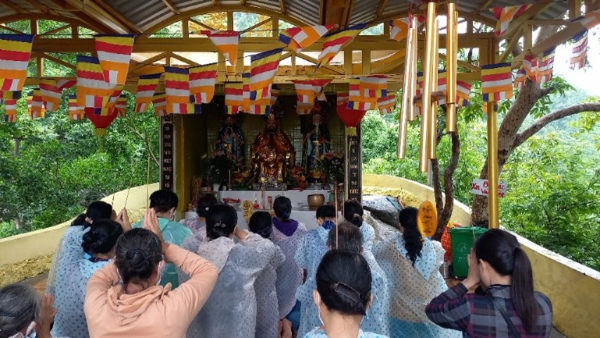
Figure 2. Worshippers in prayer at the Shrine of the Supreme Jade Emperor, Cây Quế Temple, Cấm Mountain (Photograph by Author).
About 4 kilometers away from Bồ Hong Temple is Cây Quế Temple. The mountainous road to Cây Quế Temple is treacherous, with steep, winding, narrow, and rugged sections along the mountain slopes. Many legends are associated with Cây Quế Temple, depicting it as a place of hermitage for ascetics and giant snakes. Cây Quế Temple boasts picturesque scenery, with rice fields and surrounding forests below. In the mornings and evenings, the temple is often shrouded in mist and clouds, resembling a scene from paradise.
The ruggedness, mystique, tranquility, and space of Cây Quế Temple have turned it into a gathering point for various shades of beliefs, and explaining the religious system and worship practices found here can only be explored through the psychological and cognitive aspects of the people of the Seven Mountains region. This is because the unique worship at Cây Quế Temple has disrupted the traditional Triple/ Three Religion (or Tam Giáo in Vietnamese text) structure in Vietnam: Buddhism—Confucianism—Taoism.
The Cây Quế Temple, with its spacious surroundings, is where locals have established four shrines: one for worshiping the Jade Emperor, one for the Three Lifetimes of the Buddhas of the Ten Directions , one for worshipping the Divine Consort Kim Mẫu, and one for venerating guardian spirits and ancestors. These shrines cover a wide area, with the main shrine being approximately 40 square meters and accommodating up to 50 worshippers. At the highest point of the Cây Quế Temple lies the shrine dedicated to the Jade Emperor. To reach this shrine, worshippers must navigate through a narrow path resembling a heavenly gate.
Worship practices at the Cây Quế Temple differ from those at the Bồ Hong Temple. Here, the focus is on the central shrine dedicated to the Jade Emperor, featuring a large statue with familiar motifs such as a dragon-shaped crown, a golden velvet robe, and the emperor's seated posture holding a precious seal. Flanking the Jade Emperor are two tall statues: one representing the Northern Emperor and the other representing the Heavenly Grandfather. The attire of these deities and the Jade Emperor may vary, as worshippers often donate different colored robes and crowns to them.
On the altar, worshippers and visitors place bells, candlesticks, flower vases, fruits, and cakes, with a large incense burner placed in front of it. The spacious courtyard in front of the Jade Emperor shrine serves as a gathering place for worshippers to perform rituals and offer items to the Jade Emperor. Similarly to worship at the Bồ Hong Temple, worshippers pray for family prosperity, good health, and the end of illnesses during their offerings. During our visit to the Cây Quế Temple on July 13, 2022, we observed two groups of pilgrims, totaling around 50 people from various provinces such as An Giang, Cà Mau, and Tiền Giang (Vietnam), praying and referring to the Jade Emperor as “Father” and themselves as “children”: “We pray that Father blesses us (our names, hometowns, dates of birth, ages...) with good health, family safety, business prosperity, and the end of illnesses...”. Special prayer sessions, including meditation and Buddhist chants lasting 60 minutes, are also conducted. These prayers and Buddhist chants are derived from the Hoa Hao Buddhist tradition.
In Vồ Đầu (Vồ Đầu is a proper noun, meaning a protruding rock formation, regarded by locals as the first head), there is also a shrine dedicated to the Jade Emperor. The natural environment in Vồ Đầu is desolate and eerie, shrouded in mist and clouds in the morning and evening, making it even more tranquil, mysterious, and ideal for spiritual practice by adepts. On the rocky platform in Vồ Đầu, locals have established shrines for the Jade Emperor and the Earth Mother. The shrine is elevated, with a spacious canopy. Beneath the shrine, locals have set up multiple altars for various deities and spirits such as Quan Yin, the Nine Mysterious Guardians (Cửu huyền thất tổ in Vietnamese text/ 九玄七租 in Chinese text), and Master Hổ (a local deity). At the center of the shrine is the statue of the Jade Emperor, and next to it is the shrine for the Earth Mother, with a depiction of “Mother” with a round face, black hair, wearing a magnificent golden crown, seated cross-legged with her right hand resting on a pillow and her left hand holding the GuanYin seal. Locals here also refer to them as “Father Sky—Mother Earth” or “Heavenly Emperor—Earthly Empress.” Surrounding the shrine and on each altar are offerings, bells, and various religious symbols.
Figure 3. Devotees gathered before the Shrine of the Heavenly Emperor and Earthly Empress (Thiên Hoàng và Địa Mẫu, “Father and Mother”) at Vồ Đầu, Cấm Mountain (Photograph by Author).
The shrines dedicated to the Jade Emperor and the Earth Mother (Heavenly Emperor—Earthly Empress) at Vồ Đầu are important spiritual tourism destinations similar to other Jade Emperor shrines in the Forbidden Mountain. Locals and tourists flock here, especially during festivals and holidays. The most significant number of visitors are still followers of indigenous religions and those who have ancestral altars (believing they have ancestral spirits). Apart from practicing rituals, they also come here to connect with their ancestral roots. The offerings presented to the Jade Emperor typically include vegetarian items such as fruits, vegetarian rice, pastries, and water. After offering, locals gather to consume all the offerings, believing that it helps rid their bodies of lingering illnesses.
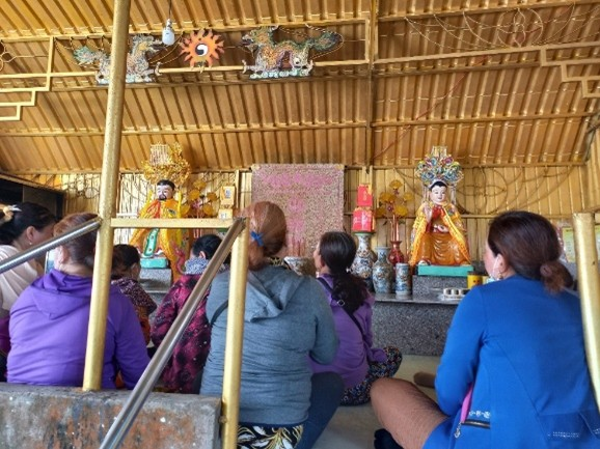
Another significant location on Cấm Mountain where people worship the Jade Emperor is the Four Heavenly Kings Temple. This temple, situated at a lower elevation, nestled against the mountainside, lies along the community's main thoroughfare. The Four Heavenly Kings Temple is a natural cave, about 2.5 meters deep, 3 meters tall, and approximately 4 meters wide. About 40years ago, this cave served as a dwelling for local residents. During that time, the locals established an altar dedicated to the Four Heavenly Kings, including the Southern King, Western King, Northern King, and Eastern King. Although referred to as the Four Heavenly Kings Temple, the central figure worshipped here is the Jade Emperor, depicted sitting on a golden throne, wearing a dragon-patterned crown made of gold, and adorned in yellow velvet attire. A notable feature is the unique fusion of beliefs, as the worship of the Jade Emperor here is accompanied by the presence of the Bodhisattva Quan Yin and the Three Buddhas positioned behind the Jade Emperor. The altar is modestly adorned with incense and floral offerings. Visitors come here to practice rituals, make offerings, respectfully address the Jade Emperor as “Father,” and regard themselves as “children,” much like in other temples.
To the right of the Jade Emperor's altar lies a smaller altar dedicated to the Four Heavenly Kings, featuring four small bronze statues, four incense burners, and twelve cups of water. Through the distinctive worship practices at this temple, one can observe the profound cultural integration of the local mountainous community. At times, folk beliefs in the Jade Emperor seem to overshadow the traditional religious practices of families.
In addition to these grand temples dedicated to the Jade Emperor, there are also smaller worship sites scattered throughout Cấm Mountain, such as the Huy Long Temple, Vo Ba Temple (a rocky hillside where the local Mother Goddess is worshipped), Vo Ong Buom Temple, Ong Voi Temple, among others.
In Tri Ton district, An Giang province, there are many places dedicated to worshipping the Jade Emperor, among which the most prominent is the Jade Emperor Temple on Tô Mountain (also known as Cô Tô Mountain), located in Núi Tô commune, Tri Tôn district. The Jade Emperor Temple on Tô Mountain is constructed on a large scale, grand and majestic, resembling a “palace of the immortals” nestled amidst the slopes of Cô Tô Mountain. It is a popular destination for many tourists both from within and outside An Giang province. Besides the Jade Emperor Temple, there are also Tô Sơn Pagoda and the shrine of the Queen Mother of the West (Tây Vương Mẫu in Vietnamese text/ 西王母 in Chinese text).
The cult and temple of the Jade Emperor on Tô Mountain have emerged over the past 35 years. Perhaps influenced by the natural landscape of the mountains, as well as the impact of legends and religious beliefs, the worship of the Jade Emperor has become prevalent here.
Compared to many other places in the Seven Mountains region, the Jade Emperor Temple in Núi Tô commune, Tri Tôn district, has the largest scale. Although it is named the Jade Emperor Temple, it has become a complex of worship for various deities, from the first steps leading up to the central shrine of the Jade Emperor. The Jade Emperor Temple stands about 300 meters high, nestled on the slopes of Cô Tô Mountain, with numerous terraces and altars dedicated to various deities. The highest deity worshiped here is the Jade Emperor. Other deities worshiped include the Celestial Hand, Mountain God, Mother Goddess, Earth God, Fallen Heroes, Kṣitigarbha Bodhisattva, the Nine Mysterious Myriads of Beings (Cửu huyền trăm họ in Vietnamese text/ 九玄百姓 in Chinese text) 1 , Lost Souls in the Mountain, and the spirits of deceased children, each placed at different rock nooks and altars as individual “realms”. At the highest point, on the mountain ridge, is the place designated for the Jade Emperor's residence, overseeing and ruling over all the deities of heaven and earth. The central worship area of the Jade Emperor Temple spans about 150m 2 and houses various deities according to the concept of “attendants” to the Jade Emperor.
In the central worship area stands a statue of the Jade Emperor facing west towards the plains, depicted as “a man sitting cross-legged on a dragon seat, with a dignified appearance, with a calm and sacred face, wearing a hat adorned with precious golden jewels, and draped in a yellow silk robe” ( Đinh 2015 , 238). The worship characteristics here are significantly different from those in the Cấm Mountains. While in the Cấm Mountains, the worship of the Jade Emperor is often associated with Guanyin Bodhisattva, Mother Goddess, the Purple Star Astrology (紫微斗數, Zi Wei Dou Shu in Chinese text), and The Supreme Venerable Sovereign (Thái Thượng Lão Quân in Vietnamese text/ 太上老君- Taishang Laojun in Chinese text), or solely with the Jade Emperor, here the Jade Emperor is worshiped alongside two familiar and traditional figures: Southern Deity (Nam Tào in Vietnamese text/ 南曹 in Chinese text) and Northern Deity (Bắc Đẩu in Vietnamese text/ 北斗 in Chinese text). To the right of the Jade Emperor is Southern Deity, depicted in red, holding a brush in his right hand and a scroll in his left, symbolizing the god of creation. To the left is Northern Deity, depicted in green, holding a seal box. The Jade Emperor, Southern Deity, and Northern Deity are worshiped in a high temple, the central sanctuary of the temple.
Ngọc Hoàng (Jade Emperor) is a manifestation of the deity in Vietnamese folk belief —the heavenly god. The designation of the heavenly god as Ngọc Hoàng originates from the myths and beliefs of the Chinese people, specifically influenced by Daoism.
According to the folk belief of the Chinese people, the Jade Emperor (玉皇上帝), the Great Jade Emperor (玉皇大帝), or the Jade Emperor (玉帝) is the supreme ruler of the sky, the master of the Celestial Palace. The Jade Emperor is also known by various other titles such as God, Heavenly God, Great Primordial Father, Creator, Lord of Heaven..., This Creator founded the vast universe and all beings, is the source of religions, is the supreme and omnipotent being, ruling over gods and saints..., The Jade Emperor is the king of the Celestial Palace, governing the entire sky, earth, sea, and the underworld. The Jade Emperor leads all immortals with supreme authority, possessing natural powers such as clouds, rain, thunder, firewater..., The Jade Emperor has the power to command the gods to fulfill his intentions, usually for benevolent purposes. The Jade Emperor also judges and rewards or punishes the celestial beings ( Đinh 2015 , 233–234).
According to author Đức Nguyên Nguyễn Văn Hồng, the Jade Emperor is the supreme being of the universe in the worldview of religions and folk beliefs. The Jade Emperor is also known as the Great Heavenly Deity or the Holy Supreme Emperor. This deity creates and nurtures all beings. From the Supreme Polarity, Two Modes (lưỡng nghi in Vietnamese text/ 兩儀 in Chinese text) are formed, generating the Four Images (四象, sixiang ch.; tứ tượng vn.), and transforming into the Eight Trigrams, thus forming the vast universe and all beings. Above, he governs 36 heavens and 3000 worlds. Below, he governs 72 Spheres and the Four Great Continents. This is the Great Primordial Father. He is the king of the sun, moon, stars, and time. He is the ruler of gods, saints, immortals, and Buddhas. He is the Supreme Emperor of the Jade Frame. He is the Great Heavenly Sovereign ( Đức Nguyên 2003 , 865–868).
In Daoist thought in China, the figure of the Jade Emperor is also very complex. Each scripture tells a different story about this deity. And in Daoism, this deity is not the highest god. For example, in the Taoist scriptures, the story of the Great Jade Emperor is recounted: It is said that in the country of Guangning Diaoluo, the king did not have a successor. One day, the queen dreamed that The Supreme Venerable Sovereign bestowed upon her a child. Afterwards, she became pregnant and gave birth to a prince. The prince succeeded the throne and ruled the country with a compassionate heart. Seeing the suffering of the people, he abdicated and went into the mountains to cultivate. After 3,200 lifetimes of cultivation, he attained Buddhahood and was called the Pure King of Tranquility (Thanh Tĩnh Giác Vương Như Lai in Vietnamese text). The Buddhas enlightened him to the Great Path, and after thousands of lifetimes of cultivation, he officially became the Great Jade Emperor. This deity is extremely wise and omnipotent. He traveled far and wide to preach the pure Dao for liberation. The Jade Emperor is the highest deity governing heaven and earth. According to Taoist history, the Great Jade Emperor, or the Jade Emperor Supreme Being, also known as the Incomparable Chief Celestial Officer, the Miraculous Lord of Natural Phenomena (Vietnamese text: Hạo Thiên Kim Khuyết Vô Lượng Chí Tôn Tự Nhiên Diệu Hữu Di La Chí Chân Ngọc Hoàng Đại Đế, còn gọi là Hạo Thiên Kim Ngọc Hoàng Đại Đế), is also known as the Jade Emperor. His birthday is on the 9th day of the 1st lunar month. The Jade Emperor wears a hat with 12 jade pieces hanging down in front, holding a jade tablet, and sitting on a dragon chair, having a Golden Boy (Kim đồng in Vietnamese text; 金童 in Chinese text) and a Jade Maiden (Ngọc nữ in Vietnamese text; 玉女 in Chinese text) attending to him in both sides. In the Daoist pantheon, although the Great Jade Emperor does not hold as high a position as the Three Pure Ones (who are the Jade Pure One, the Supreme Pure One, and the Daoist Pure One), in this belief, he holds the highest position. According to legend, on the 25 th day of the 12th lunar month is the day the Jade Emperor goes on inspection tours. The Jade Emperor will personally inspect the lower realms, judge good and evil, and reward and punish accordingly. On the night of the 24th, Daoist temples conduct ceremonies to welcome the Jade Emperor with utmost solemnity and reverence. On the 25th, people establish Daoist altars to receive blessings ( Trương 2012 , 126).
The worship of the Jade Emperor is a deeply ingrained aspect of folk beliefs in Vietnamese culture. Different regions have their own distinct forms of worship, shaped by religious influences, which consequently define the role and significance of the Jade Emperor. While worship of the Jade Emperor, also known as the Heavenly Emperor, is widespread in southern Vietnam and across the country, the specific imagery associated with this deity in Daoist practices is relatively limited. However, in mountainous regions, the worship of the Jade Emperor tends to be more elaborate and grandiose. The rituals and customs related to Jade Emperor worship vary significantly from place to place, evident in the ceremonial practices, the pantheon of deities revered, and the overall ambiance surrounding the temple.
The characteristic of worshipping the Jade Emperor in the Seven Mountains region is the harmonious blending of various cultural streams, sometimes “without principles”. This means that worship practices may inherit from prototypes or integrate multiple deities within the same temple without following any specific pattern, primarily guided by faith, which can fill the spiritual void of individuals. For instance, despite all being devoted to the Jade Emperor, there are distinct differences in various locations: at Bồ Hong temple, only the Jade Emperor is worshipped individually, while at Vồ Đầu temple, worship is combined with Earth Mother and Buddha; at Cây Quế temple, there's also the presence of the Great Emperor of the Earth and Supreme Old Lord; at Tứ vị Thiên Vương temple, it encompasses Guan Yin, the Three Buddhas, and more. In Tô Mountain, worship of the Jade Emperor follows traditional Chinese and Vietnamese customs like Southern Deity, and Northern Deity, but also incorporates Earth Mother, Maitreya Buddha, and Mountain Deities. From these worship characteristics, it can be affirmed that the syncretic spiritual consciousness of the people in the southwestern region of Vietnam, particularly in An Giang Province, is deeply rooted in whichever deity can protect them, and the more deities worshipped, the more protective power they receive, without a clear separation between deities or a fixed model in the worship of the Jade Emperor.
The beliefs and worship characteristics of the Jade Emperor in the Seven Mountains region (An Giang Province) with its polytheistic nature are partly influenced by:
folk tales, historical novels, Chinese history, which carry the semblance of Daoist fairy tales spread quite popularly in the South of Vietnam from the late 19th century to the present. Therefore, the people or adherents of indigenous religions in the South have sought the ideal world view, living environment in a `Celestial realm', and that `shadow' is projected from the Daoist world view in fairy tales, fairy tales of China, for people to `hide' their souls in it. That `illusory' world is like a redemption for personal and community life; and faith sometimes causes `hallucinations', leading to perseverance on the path of cultivation to take care of the future ( Nguyễn 2019 , 109).
The supreme deity, the Jade Emperor, profoundly influences the spiritual life of the people in the southwestern region of Vietnam, particularly in the Seven Mountains, An Giang Province, also due to the influence of religious thought. The people in An Giang Province, Vietnam, are mainly followers of indigenous religions such as Bửu Sơn Kỳ Hương, Tứ Ân Hiếu Nghĩa, Hoà Hảo Buddhism, and Tứ Ân Đạo Phật. These religions have an open-minded approach to receiving and integrating deities, among which the figure of the Jade Emperor is crucial in the consciousness of the believers. From this consciousness, along with the influence of natural landscapes into the perception of the world view and spiritual beliefs of humans, it leads to a high level of devotion to the Jade Emperor. The Seven Mountains region is a land of rugged mountains, covered by a system of overlapping forests, where many legends about mysticism, deities, ghosts, and Daoists ascending to immortality, the `Elysium' with a peaceful life source, Long Hoa Association, are hidden. In summary, the majestic and mysterious mountain scenery, the “gold and jade temples” have deeply hidden in people's minds the appearance of a `supreme deity', the Jade Emperor, reigning. The image of this divine being, the sacred `imaginary' space, appears frequently in the oral traditions of indigenous religions such as Bửu Sơn Kỳ Hương, Tứ Ân Hiếu Nghĩa, Hoà Hảo Buddhism. From many such influences, the image of the Jade Emperor has been brought closer to the image in religion, so the people in this area establish more temples dedicated to worshipping the Jade Emperor. (Dật and Nguyễn 1955, 232; Nguyễn 2019 , 60)
The Jade Emperor: The Supreme Deity in the Daoism of Chinese Culture Becoming the “Father” of the Local People
The Jade Emperor is worshipped in the Seven Mountains region of An Giang Province, with a history spanning hundreds of years. This practice is closely linked to the process of land reclamation and village founding by the Vietnamese people in the Southwest of Vietnam since the 13th century. This belief system flourished most strongly from the mid-eighteenth century to the mid-20 th century, in association with the emergence of various indigenous religions in Southern Vietnam, such as Bửu Sơn Kỳ Hương, Tứ Ân Hiếu Nghĩa, Cao Đài, Phật giáo Hiếu Nghĩa Tà Lơn, Phật giáo Hòa Hảo, and Tứ Ân Đạo Phật. These religions frequently mention the figure of the Jade Emperor and believe that the Seven Mountains region, specifically the summit of Cấm Mountain, is the dwelling place of the Jade Emperor. It is said to be the site where the Jade Emperor will establish the Upper Epoch 3 (new world), ushering in a new world where humanity will live in happiness and peace amidst a setting of “golden palaces and jade halls.” This renewal is believed to occur as the cycle of the Lower Epoch (current world) approaches its end. This worldview led to the widespread veneration of the Jade Emperor in the Seven Mountains. Over time, the Jade Emperor, originally a deity from Daoist Chinese culture, was “localized” by the Vietnamese people in the Mekong Delta, becoming a local deity of the community, a powerful god capable of determining the fate of individuals in both their present and future lives. In the indigenous religions of the Mekong Delta, the Jade Emperor frequently appears as a central figure, and worshippers strive to attain the “golden palace” of the Jade Emperor in their spiritual practice.
In addition to the worldview of the indigenous religions, another significant factor contributing to the strong development of the Jade Emperor worship is the concept of “yin” and “yang,” which is deeply embedded in the rice-based agricultural culture of the Vietnamese people, with a history of thousands of years. Rice agriculture has greatly influenced the cultural mindset of the Vietnamese people.
The primary concern of agricultural people is the reproduction of crops and humans, always hoping for abundant harvests and large families [...]. The reproduction of humans depends on two factors: father and mother, male and female. As for the reproduction of crops, it depends on the earth and the sky—two elements: the earth gives birth, and the sky nurtures. This means that these two forms of reproduction share the same essence: the earth is equated with the mother, while the sky is equated with the father. The union of the two pairs – `mother-father' and `earth-sky' – is the initial generalization leading to the philosophy of `yin' and `yang.' While `yin' and `yang' may seem abstract and vague today, in ancient times, they had very specific meanings. Their original meaning was none other than `mother-father-earth-sky' ( Trần 1996 , 111-112).
Based on the traditional cultural understanding of “yin” and “yang” in relation to the creation of all things and human existence, the people of the Mekong Delta “localized” the Jade Emperor into the figure of the “father-sky.” Due to this transformation, many temples dedicated to the Jade Emperor in the Seven Mountains also enshrine Địa Mẫu, symbolizing the “mother-earth.” This demonstrates the deep-seated concept of “father” and “mother,” which continues the cultural tradition rooted in the ancient rice farming civilization. The localization process from the Jade Emperor to the “father-sky” was quite brief due to the strong similarities between Vietnamese cultural traditions and Daoist beliefs. As a result of this close relationship between the two figures, the prayers of the local people before the Jade Emperor are no longer directed toward the supreme deity of Daoism but are “localized” into personal supplications to the “father” who is closely linked to individual and community life: “I pray that 'father' blesses me and my family with peace and prosperity in our work” (Nguyễn 2024, fieldwork materials). Similarly, people refer to Địa Mẫu (Tây Vương mẫu/ 西王母/ Queen Mother of the West) as “mother” with earnest, intimate prayers: “I pray, mother, to bless me.” Most people who visit the temples dedicated to the Jade Emperor and Địa Mẫu in the Seven Mountains region of An Giang Province share a common sentiment and use the terms “father-child” and “mother-child” in their expressions of devotion.
Based on this, it can be demonstrated that the Vietnamese understanding of the creation of all things and natural phenomena, rooted in the rice-based agricultural culture, has given rise to the imagery of the “father” (sky) and the “mother” (earth). This concept has been consistently present throughout Vietnamese cultural traditions. Later, when encountering similar figures of the Jade Emperor and Địa Mẫu (the Earth Mother) in the Daoist pantheon that was transmitted from China to Vietnam, the people of the Mekong Delta (Southern Vietnam) “localized” these figures into the representations of “father” (sky) and “mother” (earth).
In addition to the traditional cultural understanding, the worldview of indigenous religions in the Mekong Delta also features the Jade Emperor as a deity with the power to bring happiness or punish humans through the event of “the end of the world.” The site where the “end of the world” and the “annihilation” of humanity will occur, thereby creating the new world of the “palace of gold and jade,” is believed to be in the Seven Mountains, with the center being Cấm Mountain:
When Mount Cấm turns into a hall, Peace shall reign for one and all.
Chừng nào núi Cấm hóa lầu
Thì là bá tánh đâu đâu thái bình
(prophecy from the Bửu Sơn Kỳ Hương religion).
Based on the two factors—the “rice-based agricultural culture” and the understanding of “father” (sky) and “mother” (earth) as creators of all things, humans, and the world, as well as the worldview present in the indigenous religions—the widespread belief in the worship of the Jade Emperor in the Seven Mountains region of An Giang Province has been formed. Along with the Jade Emperor, the belief in Địa Mẫu also appeared frequently, either worshipped alongside the Jade Emperor or in separate temples. These two figures of worship have become a cultural hallmark of the Seven Mountains region of An Giang Province.
The Transformation of the Jade Emperor’s Function
The Jade Emperor is the supreme deity in the Daoist worldview, the creator of the universe and humanity; the one who governs and determines the existence and development of all things and beings; and the ruler of the celestial and earthly pantheons, among other domains. For the people of the Mekong Delta (Southern Vietnam), especially the followers of indigenous religions such as Bửu Sơn Kỳ Hương, Tứ Ân Hiếu Nghĩa, and Phật giáo Hòa Hảo, the Jade Emperor is regarded as the “father,” the deity who determines human destiny. The function of the “father” (sky)—the Jade Emperor—is not seen as an abstract power, but one that actively helps people in all aspects of life, with the power to heal and bless individuals. On the other hand, some people believe that the “father” figure of the Jade Emperor has “entered” their bodies, and they “pass on” the powers of the “father” to others. Although this belief may seem somewhat delusional and superstitious, it reflects a deep spiritual conviction. One can refer to several notable examples of the transformation of the Jade Emperor's function in the spiritual life of the people in the Mekong Delta when they visit the Jade Emperor in the Seven Mountains.
The Jade Emperor’s Healing Function:
Illness is an inevitable part of human life. When people fall ill, they typically resort to two forms of treatment: one through medicine (material treatment), and the other through spiritual means (faith-based healing). For the Vietnamese, the latter method is widespread, showing that belief and religion serve as the final recourse for people in times of illness, as Lenin once wrote: “Fear created the gods” (cited in Nguyễn 2008, 14 ). Author Nguyễn Đức Lữ suggests that “beliefs and religions also alleviate the fear of illness and death. The common desire of humans is to prolong life, whether in this life or the next. People do not want to end their existence with physical death; how many are brave enough to face death and turn to dust?” ( Nguyễn 2008 , 15). Depending on the severity of the illness, the form of spiritual treatment may vary. Many people in the Mekong Delta, when visiting the Jade Emperor's temple in the Seven Mountains, bring with them various ailments. They pray to the Jade Emperor, asking the “father” to help heal their illnesses. Prayers for healing are very common, and even those who are not ill will pray for good health and the removal of sickness. The practice of spiritual healing is deeply reflected in the prayers, such as: “I (name, age, address, etc.) pray to father for my illness to be cured. I vow to visit the mountain every year to pay respects to father and mother (Địa Mẫu).” After making the prayer, the devotee performs the act of bowing. Many people also touch the Jade Emperor's statue and then rub their hands over their bodies, believing this act will transfer the healing power.
In addition to the prayers, the belief in healing through the “father” is also expressed through offerings. When visiting the Jade Emperor's temple, people often offer vegetarian food; after the ritual, they consume the offerings. They believe that eating the offerings will bring strength and health, curing any illness. If the offerings include water, they will drink it, again with the belief that it will restore their health and eliminate diseases.
Another method of healing based on spiritual belief and the image of the Jade Emperor is the phenomenon of “spirit possession.” Although this phenomenon is not aligned with the cultural traditions of the people in the Mekong Delta and is criticized by the community as superstition, it still has a significant impact on the community's psychology and the cultural space in the Seven Mountains region of An Giang Province. These individuals exhibit “abnormal” behaviors and psychological states, attracting the attention and respect of a small number of people. When they visit the temples in the Seven Mountains, they claim to possess powers and strengths granted by the deities of the mountains and the “father” (the Jade Emperor). The manifestations of these powers include unusual actions that draw attention, such as speaking in “divine language,” dancing, crying, and so on. They claim to have the ability to heal others, discuss events from their “previous lives,” or predict future occurrences. However, their behaviors, healing methods, and prophecies are only believed and accepted by a small group of people; the majority remain skeptical and disagree, viewing these activities as superstitions that negatively affect human life.
The Jade Emperor as a God of Blessings
In the view of the majority of people in the Mekong Delta, the Jade Emperor (father) is believed to function as a god of blessings, bringing peace, happiness, success in work, and prosperity to individuals and the community. This belief is reflected in the prayers and actions of people in front of the Jade Emperor's statue. According to fieldwork conducted by the author of this article in November 2024, many people pray by offering money, highlighting the Jade Emperor's role as a deity who bestows wealth. Many people place money, in denominations of 200,000 or 500,000 VND 4, on a tray. A woman who is believed to have the ability to “communicate” with the gods leads the ritual. The woman raises the tray with money above her head and recites the prayer: “Today, on this day... month... year..., we come to offer our respects to Father. We present gold and silver, hoping that Father will witness and bless us so that we can have smooth business dealings and wealth.” After the prayer is completed, those attending the ritual kneel or bow respectfully and then retrieve the money they had placed on the tray, believing that the Jade Emperor will bring wealth, peace, and good fortune into their lives.
From these beliefs and practices, it is evident that the supreme deity of Daoism in Chinese culture has been “localized” by the people of the Mekong Delta into the figure of the "father." This process of localization is based on two cultural foundations: first, it stems from the Vietnamese agricultural worldview linked to rice farming; and second, it has been influenced by the cosmology of indigenous religions that arose in the Mekong Delta (Southern Vietnam). These two factors have created the widespread belief in the worship of the Jade Emperor in the Seven Mountains region of An Giang Province. The Jade Emperor, originally the supreme deity in the Daoist worldview of Chinese culture with the power to govern the universe and all things, has had his role and function transformed into that of a “father” figure—close, personal, and spiritually comforting in times of change in human life.
The worship of the Jade Emperor in the Seven Mountains region (An Giang Province) has developed significantly in recent decades. Previously, many families in the region only established small shrines, sometimes without placing any image, only worshipping through Chinese characters. However, nowadays, worship is primarily conducted with images, and the scale of worship has been increasing. The number of people practicing this belief is also growing, and during this process, there are some practices that verge on superstition, such as fortune-telling, divination, and other rituals.
In addition to the Jade Emperor temples that we have surveyed, there are many other temples and shrines in the Seven Mountains region that we will continue to study in the future. The question arises: Why are there so many Jade Emperor temples in the Seven Mountains region? Initially, it can be assumed that the “Father - Heaven, Mother - Earth” consciousness in the Vietnamese cultural foundation, along with various other influences like religion, natural landscapes, etc., are the origins that make the worship of the Jade Emperor play a significant role in the lives of the people in the Seven Mountains region, especially in An Giang Province.
The Jade Emperor temples have become important spiritual tourism destinations, contributing to the development of tourism in the Seven Mountains region, An Giang Province. In many years of fieldwork at the Jade Emperor temples and various other temples and shrines in the region, we have observed that the Jade Emperor temples attract more pilgrims than other temples in the same area.
The localization of beliefs is the process of transforming the roles and functions of deities from other ethnic and national cultures into deities of the local community, aligning them with the spiritual life of the people in that region. The Jade Emperor has been "localized" by the people of the Mekong Delta, with his functions being adapted to meet the spiritual needs of the community, reflecting the cultural similarities between Vietnam and China. In the future, the Jade Emperor may acquire additional functions based on the psychological changes of the people, who rely on deities as their spiritual support.
In addition to the development of worship of the Jade Emperor and pure religious practices, in some temples, there are occurrences of superstition such as pilgrims claiming to be “possessed” or engaging in practices like exorcism to cure illnesses, which can affect the spiritual atmosphere and people's health. Therefore, there is a need for management measures at the Jade Emperor temples specifically and at many other folk belief worship sites in the Seven Mountains, An Giang Province, in general.
1.“ C ử u huy ề n tr ă m h ọ ” is a familiar term used by the people of the Mekong Delta region to refer to the ancestors of their family and community. Although it means “ a hundred families ” ( 百姓 ), it is not entirely distant, but rather reflects a “ bloodline ” connection across many generations. The ancestors of one person might have been the ancestors of another family in a past life, and vice versa. Therefore, despite being “ a hundred families, ” they are still part of the same “ lineage, ” inseparable from one another. Revering and worshipping the “ hundred families ” is equivalent to worshipping the ancestors of one's own family. In this multi-dimensional and “ cyclical ” relationship, each person finds spiritual support in the ancestors of others, even if they do not know each other.
2.The concept of the Seven Mountains being the site of “golden palaces and jade halls” mainly originates from the B ử u S ơ n K ỳ H ươ ng religious tradition and, to a certain extent, from the Daoist belief in immortals introduced by Chinese migrants to Southern Vietnam (Nam B ộ ) since the second half of the 17 th century. According to this belief system, the Seven Mountains region—particularly C ấ m Mountain—is a sacred land where, in the future, “golden palaces and jade halls” will appear. These structures are believed to be built of dazzling and magnificent treasures. Within them, people will live in prosperity and abundance—free from death, illness, and suffering—an ideal realm known as the “celestial paradise.” To attain this celestial realm and dwell in the “golden palaces and jade halls,” individuals must engage in spiritual cultivation and refrain from committing evil deeds. Those who act immorally will be condemned and face eternal punishment, losing both body and soul. The vision of the “golden palaces and jade halls” in B ử u S ơ n K ỳ H ươ ng belief has significantly influenced other indigenous religions such as T ứ Ân Hi ế u Ngh ĩ a and Hoa Hao Buddhism. Accordingly, followers of these religions consider C ấ m Mountain a “heavenly realm” inhabited and governed by divine beings, who await the day when the “golden palaces and jade halls” are revealed. From the mid-19 th century to the first half of the 20 th century, many followers of these religious traditions came to C ấ m Mountain to practice asceticism and spread their faith. The image of C ấ m Mountain is widely referenced in religious scriptures of these traditions—especially in Hoa Hao Buddhism. Under the strong influence of religious ideologies, C ấ m Mountain has become a spiritual axis for religious followers in B ử u S ơ n K ỳ H ươ ng, T ứ Ân Hi ế u Ngh ĩ a, and Hoa Hao Buddhism. However, in some cases, excessive belief may lead to superstition ( D ậ t and Nguy ễ n 1955 ; Nguy ễ n 2019) .
3.The doctrine of the “ End of the Dharma ” or “ End Times ” in indigenous religions of Southern Vietnam is closely associated with the concept of the Three Epochs ( Tam Ngu ơ n ). According to these religions, the Three Epochs consist of three periods: Th ượ ng Ngu ơ n (the Upper Epoch), Trung Ngu ơ n (the Middle Epoch), and H ạ Ngu ơ n (the Lower Epoch). The conclusion of these three periods signifies the destruction of humanity and the establishment of a new era (the return to the Upper Epoch). The origins of the doctrine of the End of the Dharma ( M ạ t pháp ) or End Times in indigenous religions stem from the division of time in Buddhism. Buddhism categorizes time into three periods: True Dharma ( Chánh pháp ), Semblance Dharma ( T ượ ng pháp ), and Degenerate Dharma ( M ạ t pháp ). The True Dharma period is believed to be the time when Gautama Buddha was alive and teaching. During this period, his disciples were highly diligent, practiced according to the Buddha's teachings, and many attained enlightenment and Buddhahood. This era lasted for approximately 500 years after the Buddha's passing into Nirvana. The Semblance Dharma period followed the True Dharma period and lasted for about 1,000 years. During this time, successive generations of patriarchs preserved and propagated the Dharma by transmitting robes and bowls. Many practitioners achieved spiritual accomplishments, though fewer than during the True Dharma period. The Degenerate Dharma period began after the 1,000 years of the Semblance Dharma. It is described as a time of decline in the Dharma, where practitioners lost true faith, became divided, and pursued personal gain and power. Society became fractured, human life was marked by violence and suffering, and people abandoned the Buddha's teachings. As a result, very few could achieve enlightenment during this period. This era is believed to last around 10,000 years. Within the Degenerate Dharma period ( H ạ Ngu ơ n ), it is prophesied that Maitreya Buddha ( Đứ c Ph ậ t Di L ặ c ) will appear to re-establish the Upper Epoch, ushering in a renewed age of peace and prosperity.








This website recommended the use the Chrome browser for journal website.