

- P-ISSN2287-9099
- E-ISSN2287-4577
- SCOPUS, KCI

How to Describe the Life’s Work of a Scientist? The OEuvre of Christian Schlögl as an Example


Gerhard Reichmann (Department of Operations and Information Systems, University of Graz, Graz, Austria)

Abstract
This article attempts to present the entire research output of a scientist in terms of his publication activity and its impact as comprehensively as possible. To this end, a bibliometric overview of the scope and structure of his research output is first provided. Furthermore, the visibility of this output in the various information services is analyzed. Christian Schlögl authored a total of 177 publications, including 77 journal articles. This set of publications is only visible through the use of personal publication lists in an institutional repository (Uni Graz Online). In contrast, only a fraction of these publications are included in the common information services; in the Web of Science, for example, not even a third exist. The publication output is then examined in more detail, including preferred topics, co-authors, and journals. Next, a citation analysis is conducted, revealing, for example, the temporal distribution of citations and the most frequently cited publications. Finally, the seven most important research areas are briefly presented. For each of these areas, a co-author was asked to comment on Christian Schlögl’s working methods and collaboration. Overall, this article could serve as a good illustrative example for analyzing the research performance of an individual researcher.
- keywords
- oeuvre, researcher, scientometric micro level, bibliometrics, research activities, Christian Schlögl
1. INTRODUCTION
How does one describe and analyze the oeuvre of a particular researcher in terms of publication activity and its impact? Should we use multidisciplinary bibliographical information services, a reasonably complete publication list, interviews with peers and colleagues, or all of them? We want to address this topic using a concrete example. Our case study focuses on the research of Christian Schlögl (1961-2024), an Austrian information scientist who was one of the most influential information scientists in the German-speaking world at the beginning of the twenty-first century. He authored nearly 180 publications and was a highly active member of the scientific community. He maintained international contacts with colleagues from Croatia, Germany, Great Britain, Hungary, the United States, and South Korea, often resulting in publications. In addition, he participated in countless scientific conferences as a co-organizer, reviewer, presenter or moderator, regularly reviewed articles for scientific journals, and was also a member of the editorial boards of several relevant journals, such as Journal of Information Science Theory and Practice (JISTaP), published in Korea. As Stefan Dreisiebner told us,
Christian was an important pillar for the Austrian Information Science community. He leaves a gap that is hard to fill. One example: In a recent project, we aimed to collect all Austrian researchers with information science backgrounds. His unique knowledge of the community and his contacts were [badly] missed in this endeavor (personal communication, March 26, 2025).
In addition to research, he was also very committed to teaching and administration. In this context, the development of the international master’s degree program “Global Studies on Management and Information Science”, in cooperation with a team from Hildesheim, Germany, and Pai Chai University in Daejeon and Chungbuk National University in Cheongiu, both in Korea, should be highlighted. However, the present article is only about Schlögl’s research (for other aspects, e.g., on academic teaching, see Reichmann, 2024).
What is the current state of research in describing and analyzing a researcher’s professional life work? In the sense of levels of scientometrics, we are working on the micro level, that is, the level of individual researchers (Sandström & Sandström, 2009), in contrast to the meso level (research institutions) and the macro level (countries or regions of research). Following White (2001), we will build an author-centred bibliometric description with the characterizations automatically made and edited online (White’s CAMEO). White’s bibliometric measures include the subjects of a researcher (e.g., through subject headings or title terms), the publishing journals and publication years, the researcher’s co-authors, and– only applicable in citation databases—the researcher’s citation identity (all cited authors), the citation image makers (all citing authors), and the citation image (all co-cited authors). The scope of bibliometric analysis options depends heavily on the information service and the databases offered. White worked with the online service DIALOG and the databases of the former Institute for Scientific Information (Science Citation Index and related databases).
Several bibliometricians followed White’s proposal and produced scientometric results concerning the micro level on, e.g., Leydesdorff (Vargas-Quesada et al., 2023), Drucker (Uslay et al., 2009), or Stock (Peters et al., 2020). Other studies are limited to a researcher’s production, collaboration, and impact (Ayala-Gascón et al., 2012) or additionally include the topics of the papers of a researcher, such as those of Wilhelm M. Frankl (Stock, 1988) or all the members of the Graz School of philosophy and psychology (Stock & Stock, 1990), including a topic analysis also of the citing works. Jacso (2018), in a bibliometric study on Eugene Garfield, preferred to study the citations to Garfield’s works, their sources, the citing institutions, and their countries.
However, we should handle informetric, bibliometric, and scientometric studies carefully, as there are methodological problems and incomplete databases (Stock et al., 2023b). Following the literature (e.g., Stock & Weber, 2006), we speak of “informetrics,” if all quantitative aspects of information science are concerned, of “bibliometrics” (as a narrower term of “informetrics”), if written published works are quantitatively analyzed, and of “scientometrics,” if we describe scientific research in quantitative ways.
Nevertheless, describing and assessing researchers’ performance is “vital in the research community” (Rawat et al., 2024, p. 319). It seems practical and promising to create bibliometric-based heuristics (Bornmann et al., 2022), that is, bibliometric results to produce an overview and give hints on the essential topics of a researcher. In addition to bibliometric descriptions, we apply expert interviews (Meuser & Nagel, 2009). The experts interviewed are proven representatives of their field and co-authors of some of Schlögl’s publications.
This paper aims to describe and analyze Schlögl’s research production (his publications), research impact (the citations the publications attracted), and research topics. In the first step, in Sections 2 to 4, we apply quantitative informetric methods to get a heuristic overview of Schlögl’s publications, their topics, and their impact; in the second step, in Section 5, we will shortly sketch Schlögl’s main topics, which we found in the informetric results by publication, citation, and topic analyses, and, additionally by the expert interviews. Finally, we will assess the informetric methods used at the micro level.
2. AUTHOR-CENTERED BIBLIOMETRICS OF SCHLÖGL’S OEUVRE: BASIC DATA AND VISIBILITY
We start with a bibliometric overview of Schlögl’s oeuvre. In detail, the quantitative overview will include basic data on Schlögl’s publications and their visibility in selected information services, his co-authors, the publishing journals, his citation image (that is, the cited authors), the time series of his publications and their citations, the main research topics, Schlögl’s citation image makers (that is, the citing authors), their countries and their topics, and, finally, Schlögl’s top-cited publications.
Christian Schlögl published 177 papers between 1992 and 2025, of which 62% were in German and 38% in English (Table 1). All raw data is as of February 2025. Most papers were research articles published in journals (44% of all papers) or in proceedings or edited books (27%). German predominates in his journal articles, but the opposite is true for his articles in proceedings and edited books. Schlögl published one book (Schlögl, 2001) and co-edited four proceedings or edited books. Additionally, Schlögl wrote 43 short entries in a lexicon on Library and Information Science (LIS) (Umlauf & Gradmann, 2011/2014), four book reviews, and one set of research data.
Table 1
Languages and document types of Schlögl’s oeuvre
| Journal articles | Articles in proceedings or edited book | Lexicon entries | Book reviews | Books | Editions | Research data | Total | |
|---|---|---|---|---|---|---|---|---|
| German | 44 | 16 | 43 | 4 | 1 | 2 | 0 | 110 |
| English | 33 | 31 | 0 | 0 | 0 | 2 | 1 | 67 |
| Total | 77 | 47 | 43 | 4 | 1 | 4 | 1 | 177 |
An important data source on Schlögl’s publications is the research portal of the Karl Franzens University Graz, Austria (Uni Graz Online). The University of Graz was his affiliation during his complete academic life. We worked with a printed version of Schlögl’s publication list from mid-2024 for this paper. After his death, further articles appeared, so we updated the list based on Uni Graz Online. This updated version of Schlögl’s publication list from Uni Graz Online is our gold standard for all scientometric measures, hoping that this list is indeed correct and truebounded (Dorsch et al., 2018), which means that the list is complete and that all listed documents are indeed research contributions and authored by Schlögl.
Regarding the visibility (Dorsch, 2017) of Schlögl’s work in large multidisciplinary databases, identifying Schlögl’s publications in information services was difficult. Some services work with identification numbers. In Scopus, Web of Science Core Collection (WoS CC), ResearchGate, and ORCiD, we found one dataset on Schlögl (Scopus) or a manageable number of entries. Scopus works with one identification number (AU-ID=6506241000), while WoS unfortunately uses four different numbers for the same author (A-9343-2008, BBB-9858-2020, JKG-5289-2023, ITM-8469-2023). Semantic Scholar presents many publications by Schlögl, but due to synonym errors, these appear under different entries, which we have intellectually merged. In Dimensions (and similarly in Google Scholar), the problem of homonymy has struck, as many Christian Schlögls are almost inseparably mixed together in the search results lists. Due to incomplete data, Table 2 shows only approximately correct Dimension values. Although there is an entry on Christian Schlögl on Google Scholar, there are inextricably many different Schlögls in a single publication list, so we cannot present a satisfying result.
Table 2
Visibility of Schlögl’s oeuvre in information services
The most productive information services for Schlögl’s oeuvre are Semantic Scholar (96 hits; 54% of the gold standard), ResearchGate (44%), WoS CC (30%), and Scopus (30%), meaning that all mentioned services are more or less incomplete or incorrectly indexed. Therefore, the values for the publications, citations, and H-index in Table 2 can only be viewed as a lower estimate of the “true” results.
We searched again because some multidisciplinary information services prefer to index English-language research articles. We added two search arguments to the name: language (only English) and document type (only articles). We were able to perform such searches in WoS CC and Scopus. Table 3 shows that Schlögl’s relative visibility in both WoS CC and Scopus is still limited as there are relative visibility values in Scopus of 53% and WoS CC of only 45% (WoS CC) for all his English-language articles in journals, proceedings, and edited books.
3. RESEARCH PRODUCTION
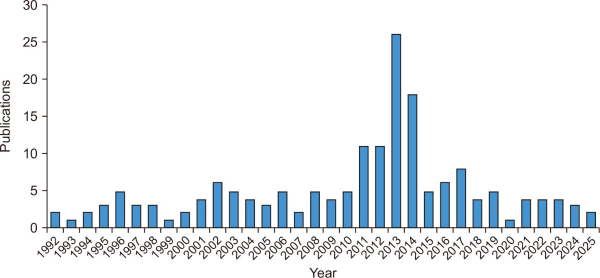
Schlögl was active in publishing between 1992 and his death in 2024. As a result of the delay in the publication process of some writings, documents are being published even after Schlögl’s passing (Fig. 1). There are peaks in the annual publication amount between 2011 and 2014 resulting from publishing short entries in a LIS lexicon. Apart from these short documents, Schlögl published about three to five documents annually on average.
Fig. 1
Time series of Schlögl’s publications (1992-2025). Data source: Uni Graz Online, updated; n=177 publications; data as of February 2025.
Schlögl published in both German-language and English-language journals (Table 4). His German-language articles concentrate on Information – Wissenschaft und Praxis (IWP), Zeitschrift für Bibliothekswesen und Bibliographie, VÖB Mitteilungen (Mitteilungen der Vereinigung Österreichischer Bibliothekarinnen & Bibliothekare), and Wirtschaftsinformatik. IWP is primarily dedicated to information science and practice, while the following two periodicals mentioned above focus more on library topics. Wirtschaftsinformatik is dedicated to research in information systems. The English-language articles are spread across many different journals, including Scientometrics, JISTaP, Journal of Informetrics, and Journal of Association for Information Science and Technology (formerly Journal of the American Society for Information Science and Technology).
Table 4
Schlögl’s preferred journals
| Journal | Number of articles by Schlögl |
|---|---|
| Information – Wissenschaft und Praxis | 20 |
| Scientometrics | 7 |
| Zeitschrift für Bibliothekswesen und Bibliographie | 4 |
| VÖB Mitteilungen | 3 |
| Journal of Information Science Theory and Practice | 2 |
| Journal of Informetrics | 2 |
| Journal of the American Society for Information Science and Technology | 2 |
| Wirtschaftsinformatik | 2 |
Besides his early works and encyclopedia contributions, Schlögl often worked and published in teams. His preferred co-authors include the two authors of this article and Juan Gorraiz from the University of Vienna, Austria (Table 5). To get an overview of Schlögl’s co-authors, we created a cluster of his co-authors with whom he frequently collaborated (Fig. 2). Here we see six different author subclusters (A1 to A6):
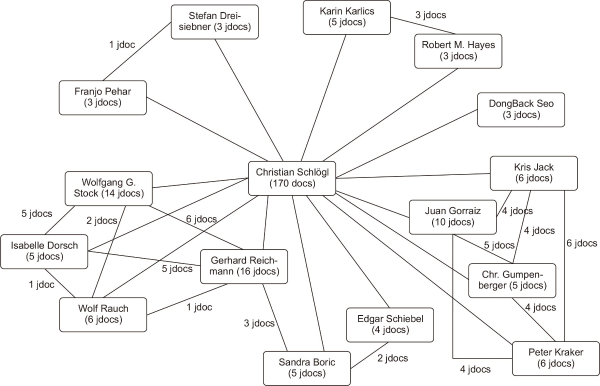
(A1) Schlögl – Dreisiebner – Pehar,
(A2) Schlögl – Karlics – Hayes,
(A3) Schlögl – Gorraiz – Jack – Kraker – Gumpenberger,
(A4) Schlögl – Reichmann – Boric – Schiebel,
(A5) Schlögl – Reichmann – Stock – Dorsch – Rauch, and
(A6) Schlögl – Seo.
The description of Schlögl’s citation identity (White, 2001), that is, authors cited by Schlögl, requires using a citation database. We chose Scopus because there is a search field for authors in cited references (REFAUTH). To find all self-citations of Schlögl, for instance, we worked with the following search argument:
AU-ID(“Schlögl, Christian” 6506241000) AND (REFAUTH(Schlögl) OR REFAUTH(Schlogl) OR REFAUTH(Schloegl)).
Applying the REFAUTH field, we had to search for all referenced authors individually, as there is no ranking functionality for cited authors in Scopus. Since we cannot be sure that we have searched for all highly cited authors in Schlögl’s publications, we should use the results cautiously. Schlögl’s top-cited authors are Schlögl himself (as expected, since Schlögl published very actively in his research areas), Stock, Gorraiz, Garfield, etc. (Table 6). The cited authors from Table 6 are either citation authorities in bibliometrics (e.g., Garfield, Rousseau, Thelwall, Bar-Ilan, or Cronin) or colleagues who knew Schlögl personally, as many of them were his co-authors (Table 5). Another problem with Scopus is that the number of Schlögl’s citing articles is stated here, regardless of how many articles by the cited author are mentioned in each document. For instance, in Schlögl and Stock (2004), four different works by Eugene Garfield are cited, but Scopus counts “1.”
We decided to analyze the title terms to describe the content of Schlögl’s publications. Here, we limited ourselves to the English-language titles to avoid translation errors and to the knowledge that only Schlögl’s English-language papers are often cited (see Table 7). Schlögl’s top topics are citation and journal, followed by information literacy, readership, and usage (Table 8).
In Fig. 3, we have created a cluster starting with Schlögl’s two most frequent English-language title terms, citation and journal. From this, it is possible to identify four topic subclusters (T1 to T4):
Fig. 3
Cluster of Schlögl’s topics around citation and journal. Topics from Table 8, which co-occur with citation or journal in three or more English-language document titles; in brackets: number of publications in Schlögl’s oeuvre; jdocs: number of co-occurrences of topics in titles; data as of February 2025. LIS, Library and Information Science.
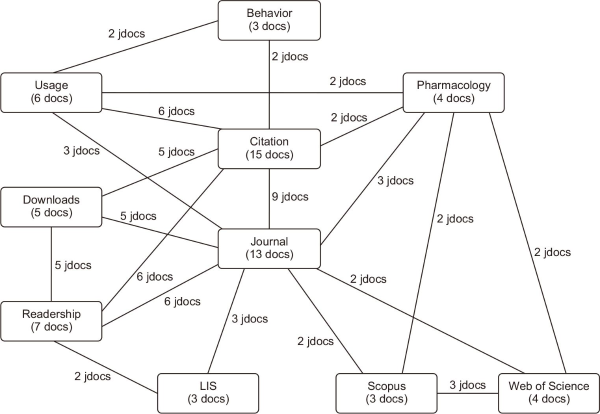
(T1) citation – journal – downloads – readership,
(T2) citation – usage – behavior,
(T3) journal – readership – LIS, and
(T4) citation – journal – usage – Scopus – WoS – pharmacology.
4. RESEARCH IMPACT
Scientometric analyses of research impact normally work with citation studies. The problem is that we are dependent on the large citation databases including WoS and Scopus (Pranckutė, 2021), which are unfortunately all incomplete in coverage of the research literature and partially only weakly indexed (Stock et al., 2023b). As a result, our data are only approximations of more accurate results.
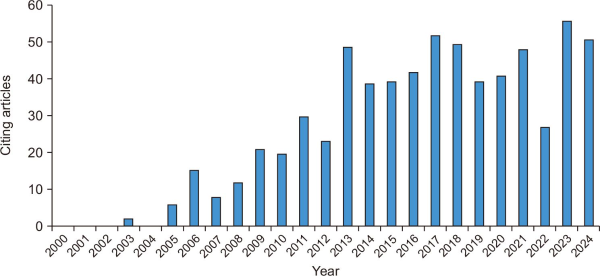
If we analyze Schlögl’s impact in terms of citations of his publications based on Scopus, we see a slow but steady increase in the annual numbers of citations until around 2013 (Fig. 4). Between 2014 and 2024, his Scopus-indexed publications attracted about 40 to 50 citations yearly (except in 2022, with fewer than 30 citations). All in all, Scopus counts 673 citations for Schlögl’s oeuvre.
Fig. 4
Time series of citations to Schlögl’s publications (2000-2024). Data source: Scopus; n=673 citations; data as of February 2025.
Who did Schlögl’s work cite? In the sense of White (2001), we asked for Schlögl’s citation image makers. For this, we conducted a cited reference search in WoS CC and found more than 200 authors citing aspects of Schlögl’s oeuvre (Table 9). Here, we did not use Scopus but rather WoS because there is elaborated cited reference search functionality.
The top citation image makers are Gorraiz (who is one of Schlögl’s preferred co-authors and also one of his top-cited colleagues), Schlögl himself (citing some earlier publications in newer articles), Gumpenberger, Costas, Glänzel, Reichmann, Thelwall, Haustein, Stock, and nine other authors with four to five citations each.
If we compare the lists of Schlögl’s preferred co-authors (Table 5), his most cited authors, that is, his citation identity (Table 6), and the most citing authors, that is, his citation image makers (Table 9), we see a remarkable similarity between the top positions of all three lists. Social circles are behind Schlögl’s references and citations (Milard, 2014). Schlögl often cited and was often cited by personally known colleagues. Those colleagues work, for instance, at the University of Graz (Reichmann and Boric) or the Know Center in Graz (Kraker), in other Austrian cites (e.g., Gorraiz in Vienna), or in institutions all around the world (e.g., Hayes in the USA, Jack in the UK, Sutheo in Hungary, Seo in Korea, Pehar in Croatia, and Stock as well as Dorsch in Germany). Overall, the top-cited and top-citing authors were socially connected to Schlögl (Johnson & Oppenheim, 2007). “Who will cite you back?” Daud et al. (2017) ask. For Schlögl’s oeuvre, there is a clear answer: The reciprocal citation behavior of the researchers around Schlögl is strongly influenced by their co-authorships. Cronin and Shaw (2002) found similarities between the authors’ citation identities and their citation image makers in their case studies; we have to add the vital role of the co-authors.
Table 5
Schlögl’s preferred co-authors
| Name of co-author | Country of co-author | Number of joint publications |
|---|---|---|
| Gerhard Reichmann | Austria | 16 |
| Wolfgang G. Stock | Germany | 14 |
| Juan Gorraiz | Austria, Spain | 10 |
| Kris Jack | UK | 6 |
| Peter Kraker | Austria | 6 |
| Wolf Rauch | Austria | 6 |
| Sandra Boric | Austria | 5 |
| Isabelle Dorsch | Germany | 5 |
| Christian Gumpenberger | Austria | 5 |
| Karin Karlics | Austria, Italy | 5 |
| Edgar Schiebel | Austria | 4 |
| Stefan Dreisiebner | Austria | 3 |
| Robert M. Hayes | United States | 3 |
| Franjo Pehar | Croatia | 3 |
| DongBack Seo | South Korea | 3 |
Table 6
Schlögl’s citation identity: top-cited authors in Schlögl’s articles
| Name of cited author | Number of citing articles |
|---|---|
| Christian Schlögl | 36 |
| Wolfgang G. Stock | 18 |
| Juan Gorraiz | 17 |
| Eugene Garfield | 14 |
| Ronald Rousseau | 14 |
| Mike Thelwall | 11 |
| Judit Bar-Ilan | 10 |
| Isabelle Dorsch | 10 |
| Christian Gumpenberger | 10 |
| Isabella Peters | 9 |
| Stefanie Haustein | 8 |
| Gerhard Reichmann | 8 |
| Ludo Waltman | 8 |
| Blaise Cronin | 6 |
| Wolfgang Glänzel | 6 |
| Chris Jack | 6 |
| Peter Kraker | 6 |
Table 7
Top-cited publications of Schlögl in different information services
| No. | Short title (year of publication) | Rank (number of citations) | ||
|---|---|---|---|---|
| Scopus | WoS CC | Google Scholar | ||
| 1 | A bibliometric analysis of pharmacology and pharmacy journals (2008) | 1 (84) | 1 (79) | 1 (175) |
| 2 | Comparison of citation and usage indicators (2010) | 2 (81) | 2 (73) | 4 (130) |
| 3 | Impact and relevance of LIS journals (2004) | 3 (75) | 3 (62) | 3 (136) |
| 4 | Comparison of downloads, citations and readership data (2014) | 4 (67) | 5 (51) | 6 (87) |
| 5 | Usage vs citation behavior (2014) | 5 (62) | 4 (52) | 5 (92) |
| 6 | Global usage vs global citation metrics (2011) | 6 (48) | 6 (42) | 7 (72) |
| 7 | Information and knowledge management (2005) | 7 (35) | 8 (26) | 2 (148) |
| 8 | Practitioners and academics (2008) | 8 (33) | 7 (31) | 8 (53) |
| 9 | Download vs citation vs readership data (2013) | 9 (24) | 10 (16) | - |
| 10 | LIS journals: an editor survey (2005) | 10 (22) | 9 (19) | 9 (46) |
| 11 | Visualization of co-readership (2015) | - | - | 10 (43) |
Table 8
Most frequent terms in the titles of Schlögl’s English-language articles
| Title term | Frequency |
|---|---|
| Citation | 15 |
| Journal | 13 |
| Information literacy | 7 |
| Readership | 7 |
| Usage | 6 |
| Austria | 5 |
| Bibliometrics | 5 |
| Downloads | 5 |
| Graz | 5 |
| Business administration | 4 |
| Pharmacology | 4 |
| Research evaluation | 4 |
| Research institution | 4 |
| Web of Science | 4 |
| Autonomous driving | 3 |
| Behavior | 3 |
| Information science | 3 |
| Library and Information Science | 3 |
| Scopus | 3 |
| Visualization | 3 |
Table 9
Schlögl’s top citation image makers
| Citing author | Number of articles citing Schlögl |
|---|---|
| Juan Gorraiz | 19 |
| Christian Schlögl | 18 |
| Christian Gumpenberger | 10 |
| Rodrigo Costas | 7 |
| Wolfgang Glänzel | 7 |
| Gerhard Reichmann | 7 |
| Mike Thelwall | 7 |
| Stefanie Haustein | 6 |
| Wolfgang G. Stock | 6 |
| Vincent Larivière | 5 |
| Pei-Shan Chi | 4 |
| Stefan Dreisiebner | 4 |
| Zhichao Fang | 4 |
| Peter Kraker | 4 |
| Isabella Peters | 4 |
| Cassidy R. Sugimoto | 4 |
| Daniel Torres-Salinas | 4 |
| Martin Wieland | 4 |
In Table 10, we show in which countries Schlögl’s research results took effect. The citation image makers’ countries of activity include countries from all over the world, starting with Austria and followed by the United States, Germany, China, England, the Netherlands, Canada, and many others.
Table 10
Countries of origin of Schlögl’s citation image makers
| Country of origin of citation image maker | Number of articles citing Schlögl |
|---|---|
| Austria | 41 |
| USA | 33 |
| Germany | 28 |
| China | 26 |
| England | 21 |
| The Netherlands | 16 |
| Canada | 15 |
| Australia | 10 |
| Belgium | 7 |
| India | 7 |
| Malaysia | 7 |
| Hungary | 6 |
| South Africa | 6 |
Using a very rough classification, WoS offers research topics of the citing literature. Schlögl’s citation image is dominated by bibliometrics and—to a much lesser extent—by information literacy and—even less—by knowledge management and entity resolution (Table 11). Obviously, his primary influence on the international research community was (and still is) in bibliometrics.
Table 11
Broad topic classification of articles citing Schlögl
| Web of Science topics | Number of articles citing Schlögl |
|---|---|
| Bibliometrics | 162 |
| Information literacy | 27 |
| Knowledge management | 7 |
| Entity resolution | 5 |
In Table 7, we get a more detailed picture of Schlögl’s research impact. We searched for the most cited publications by Schlögl in Scopus, WoS CC, and Google Scholar. Google Scholar revealed the most citations, followed by Scopus and WoS CC; however, the ranks of the top-cited publications are similar in the three information services. An exception is publication no. 7 on information and knowledge management, which ranks second on Google Scholar but seventh and eighth on Scopus and WoS.
Schlögl’s most cited publication is “A bibliometric analysis of pharmacology and pharmacy journals” (published in 2008), followed by “Comparison of citation and usage indicators” (2010) and “Impact and relevance of LIS journals” (2004). Because of their age, older publications have a greater chance of being cited than articles from recent years. Therefore, Table 7 is necessarily biased toward older writings. Apart from publication no. 7, which is on information and knowledge management, all frequently cited papers of Schlögl (from Table 7) are in the field of bibliometrics, which confirms the result from Table 11 with bibliometrics as the top-citing research branch.
The citations of Schlögl’s publications form an inverse-logistic distribution (Stock, 2006), meaning that there are several frequently cited documents and—below the turning point of the curve—many documents with low citation rates in the form of a long tail. A power-law distribution would have been more expected, as it is the most common in informetrics. There would be one highly cited work at the top of the curve and a steep drop in citation rates. In the context of indexing and retrieval, Peters and Stock (2010) speak about “power tags,” meaning the top terms of an inverse-logistic distribution of terms assigned to a document in an information service supporting user-created tags. In our case (Table 7), we can identify “power publications” that are the author’s most cited and, thus, most influential works.
5. RESEARCH TOPICS
What were Schlögl’s main research topics? We applied the scientometric results to find heuristics on essential themes. In this overview of a complete oeuvre of a researcher, we can only give brief information on the content of Schlögl’s research. We will concentrate on the research questions, applied methods, and main results. We also obtained comments on the research style of and collaboration with Christian Schlögl from former co-authors in the respective research area. However, examining the individual research aspects in more detail is a task for future studies.
5.1. Library and Information Science Journals: Authors, Readers, and Editors
We found this theme through articles no. 3, 8, and 10 in Table 7, topic cluster T3, and through parts of author cluster A5 (however, only connected with Stock). Here, the co-authors are Stock and a group of students of Graz and Cologne, who published under the pseudonym “Grazia Colonia.” The findings were published between 2002 and 2008.
This project aimed to analyze the relationships between citations and references to scientific journals on the one hand and the readership of the journals on the other (Grazia Colonia, 2002). Subjects of the study were international and German-language LIS periodicals. Schlögl and his research team formulated two research questions, namely (1) “What is the impact of LIS journals?” and (2) “What is the relevance of LIS periodicals to their readers?” (Schlögl & Stock, 2004, p. 1156). Grazia Colonia applied two empirical methods. Besides citation analysis, they worked with questionnaires. Data from the 40 international LIS journals were collected from the Journal Citation Reports, while the data for the German-language periodicals were counted manually—1,494 source articles with 10,520 references. The response rate of the reader survey with 257 usable questionnaires from German-speaking information specialists was relatively high. The main results include a negative correlation (-0.11) between the impact factor and the reading frequency for all analyzed 50 journals and a high correlation (+0.70) between the regional impact factor and the reading frequency of the 10 German-language LIS journals. There were huge differences between the reading behavior of researchers and practitioners (Schlögl & Stock, 2008). The correlation between the regional impact factor of the ten German-language periodicals and the reading frequency was +0.71 for the practitioners and -0.17 for the scientists because the latter preferred to read international journals and not German-language papers. Schlögl checked the results by conducting an empirical survey of editors; however, the editors confirmed the results concerning practitioners and scientists in their roles as readers as well as authors (Schlögl & Petschnig, 2005).
At the end of the project, Juchem et al. (2006, p. 32) determined five basic dimensions of the scientometrics of journals: (1) production (papers and their authors), (2) content (topics), (3) reception (readers), (4) formal research communication (references and citations), and (5) editorial work (editorial policies and publishing houses). These facets provided a template for the structure of Haustein’s famous book on multidimensional journal evaluation (Haustein, 2012).
Kerstin Wolff, née Juchem, was student at the University of Applied Sciences in Cologne, Germany, at this time and was one of the participants in the Grazia Colonia project. Now she is the head of two public school libraries in Kerpen, Germany. Wolff states,
As part of the ‘Grazia Colonia’ group and beyond, I had the opportunity to work with Christian Schlögl. Initially separated by the two location-based groups in Graz and Cologne and by the various tasks, one thing in particular became apparent in the ‘Grazia Colonia’ example: Christian Schlögl was passionate about his cause. Achieving a good result was, however, more of a pleasant side effect. In his dealings with ‘his’ students—among whom we students from Cologne can now count ourselves despite the border—he always had one thing in mind: He offered each and every person involved in the project help to help themselves, was always ready to support wherever help was needed or a perspective needed to be steered in a different direction. His unconventional manner and the way we met on equal terms turned us into a team with a common goal in mind (Wolff, personal communication, May 1, 2025).
5.2. Web of Science and Scopus as Tools for Bibliometric Analyses
We selected this research topic because the primary publication is highly cited (article no. 1 from Table 7 is Schlögl’s top-cited paper), and it is part of the author cluster A3 (however, it is only connected with Gorraiz). It is the theme of the topic cluster T4. The co-author of this research project is Gorraiz from the University of Vienna, Austria; the results were published in 2008.
The leading research question of this project is: How suitable are the citation databases WoS and Scopus for scientometric analyses (Gorraiz & Schloegl, 2008)? As the researchers’ publication and citation behavior depend on the scientific discipline, Gorraiz and Schlögl considered only one research field: pharmacology and pharmacy. In most cases, the impact factors of the journals were higher in Scopus than in WoS. However, since Scopus covers more journals than WoS, “a journal in Scopus has a higher chance of getting cited in general” (Gorraiz & Schloegl, 2008, p. 717). The authors could demonstrate that both WoS and Scopus have problems with the accuracy of data, e.g., concerning the correct determination of the articles’ document types. Furthermore, “the assignment of subject categories to journals is not always transparent and differs between Scopus and WOS” (Gorraiz & Schloegl, 2008, p. 723).
Juan Gorraiz remembers the projects with Schlögl:
I first met Christian Schlögl in Eisenstadt, where he had just begun laying the foundations for the Fachhochschule (University of Applied Sciences). At that time, I was teaching a few courses there, and it was during those early encounters that I had the opportunity to spark in him not only an interest but what I believe became a genuine passion for bibliometrics. That shared curiosity quickly turned into a rich and long-standing collaboration. At the time, I was still heading the Department of Information and User Services at the Central Physics Library in Vienna, so my time for research and publishing was limited. Christian more than made up for this. He developed into an ideal co-author—diligent, original, and full of energy—quickly finding his own style and applying bibliometric methods to topics close to his heart.
Our first joint project was in fact a small milestone: We were among the first to use Scopus as a data source in bibliometric analyses. We presented our results at the 11th International Society for Scientometrics and Informetrics (ISSI) Conference in Madrid in June 2007, where our work was met with strong interest and warmly received by the scientometrics community. It felt like a shared entrance onto a bigger stage. What followed were many discussions—often long and lively—whenever we met at conferences or university events. Some of the most memorable ones happened in the context of the University Course for Library and Information Studies, where we both contributed and exchanged views passionately. It was during these meetings that I came to appreciate even more his critical mind, his dry humor, and his generous collegiality.
Among the areas we worked on, usage metrics became our most focused domain—recognizing their importance alongside traditional citation metrics. Christian approached this topic with characteristic pragmatism and intellectual rigor. Later, with my new responsibilities as head of the newly established Bibliometrics Department at the Vienna University Library, our professional paths diverged. But we never lost touch (Gorraiz, personal communication, April 23, 2025).
5.3. Information Usage Behavior of Researchers: Citations, Downloads, and Reference Services
This theme is mirrored in articles no. 4 and 9, topic cluster T1, and author cluster A3. In this project, Schlögl worked together with Gorraiz, Gumpenberger (University of Vienna), and Jack (Mendeley). The publication from 2015 resulted from a cooperation between Schlögl, Jack, Lindstaedt, and Kraker (the latter from Know Center in Graz at the time of publication). The cooperation between Schlögl and Gorraiz on this project lasted between 2010 and 2015 and is strongly connected with the project from paragraph 5.2.; the other authors joined the publication activities on this research between 2013 and 2015.
With the offers of full-text articles and user-generated reference services, new retrieval and document delivery options have emerged as well as new means of scientometric research. Now, there is more data measuring research impact, including:
6. DISCUSSION AND CONCLUSION
6.1. The Œuvre of Christian Schlögl in a Nutshell
Our bibliometric analysis reveals that Christian Schlögl was an extremely active and respected researcher. Over the course of his academic career, he authored 177 publications, which have been cited almost 700 times to date (based on Scopus). It should be noted that only the 34 English-language journal articles recorded by this information service have a chance of being counted in the number of citations. The impact of all other publications, including numerous German-language journal articles as well as contributions to proceedings and edited books, cannot be quantified.
It seems positive that Christian Schlögl published relatively consistently over the years, thus showing no research fatigue even in his advanced career. Therefore, it can be assumed that numerous more publications would have appeared had his sudden death not abruptly ended all research activities.
The numerous collaborations and co-authorships are a strong indication that Christian Schlögl was an extremely cooperative and popular researcher. Collaborations were also a welcome opportunity for him to pass on his extensive knowledge to younger colleagues, as emphasized in several comments by co-authors.
Christian Schlögl’s research content was quite broad, as confirmed by the topic analysis. This is also reflected in the variety of publication venues he chose. The focus of his journal-based publications was not only information science journals, but also library and computer science journals. If one wanted to reduce the main research topics from the seven previously presented to two, this would be:
a) Scientometrics of journals, including the information behavior of their readers, and
b) Scientometrics of research institutions (which are on the scientometric meso level).
As part of his research activities, Christian Schlögl used a variety of empirical methods and data sources, such as publication analysis, citation analysis, co-citation analysis, questionnaires, semi-structured interviews, usage statistics, official statistics, tests (e.g., for information literacy), and content analysis, as well as altmetrics (Mendeley).
Isabelle Dorsch, one of his many co-authors, characterizes Schlögl’s research topics and his research style:
Based on my personal perception, our joint projects, and personal contact over the last decade, I would characterize Christian Schlögl’s research style as an empirical approach focusing on quantitative analysis within scientometrics. For his studies focusing on the micro or meso level, he utilized publication metadata that was self-obtained or provided by different information services. He contributed to the international and national body of information science research (Dorsch, personal communication, March 31, 2025).
Juan Gorraiz also states,
Christian, to me, embodied what a true colleague and co-author should be: sharp, curious, constructive, and always open to new ideas. He challenged me, supported me, and inspired me. Even now, I often find myself thinking of him when I reflect on a project or prepare a presentation. Just like the “invisible colleges” that shape the intellectual landscape of science, I believe in the presence of “invisible colleagues”—those who, though no longer with us, remain part of our professional and personal journey. Christian is, and will always be, one of those for me (Gorraiz, personal communication, April 23, 2025).
6.2. Scientometrics at the Micro Level: Strengths, Weaknesses, Opportunities, and Threats (SWOT)
Our final section is a SWOT analysis of scientometrics (Rousseau & Rousseau, 2021) in the service of the description of the oeuvre of an individual researcher. Fig. 5 exhibits the scientometric indicators which we applied. Concerning basic data, one must confirm that the lists of publications and citations are truebounded. As we have to work with information services, we should calculate the visibility of an ego’s oeuvre on different information services. The bibliometric picture of the research production is mirrored in the ego’s publications, their document types, and their time series. Given a truebounded publication list, one can easily determine the co-authors, the cluster of co-authors, and the preferred publication sources.
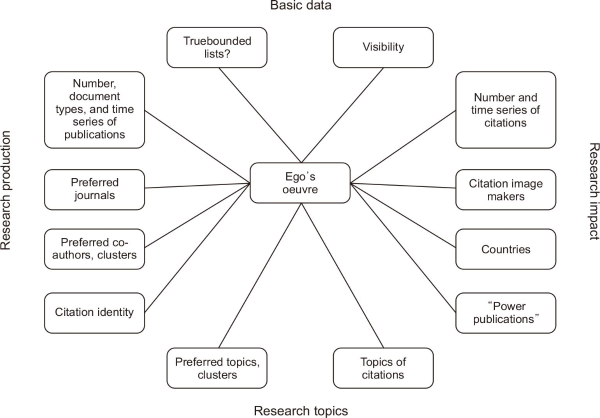
Additionally, we tried to find the ego’s citation identity, that is, the authors of the literature cited by the ego. Regarding the research impact, we searched for literature citing our ego and created a time series. The citation image makers are the authors who cited documents of the ego. Analyzing the countries of activity of the citation image makers, we obtained a picture of the diffusion of the ego’s research results all over the world. “Power publications” are the most-cited documents written by the ego. The research topics can be viewed from two perspectives: the ego’s publications and the citing literature.
Besides the truebounded Uni Graz Online information service, we applied WoS and Scopus, although underbounded, for data acquisition. The different search functionalities of both information services drove the decision for each.
The strength of a bibliometric approach on the micro level is the mostly easy handling of the basic data. However, we needed an appropriate database. For our case study, it was the institutional research repository (Uni Graz Online) and not the commonly used information services such as Scopus or WoS, as they all were incomplete. A further strength of this approach is the offer of citation data by the information services; however, we must assume that this information again is incomplete. But when it comes to citation data, there is nothing better. In line with Rousseau and Rousseau (2021, p. 1436), we can confirm that bibliometric studies are objective and reproducible as well as cost- and time-effective. Additionally, they allow for tracing the history of ideas, in our case, the history of the ideas of an individual researcher.
There are many weaknesses in bibliometrics (Stock et al., 2023b). The main problems are the incompleteness of information services and the absence of consistent indexing. While Scopus could identify Schlögl through a unique researcher number, all other used databases failed. They failed to correctly handle homonymy (showing and merging other researchers with the same or similar name) and synonymy (indexing name variants of the same author as different researchers, here, e.g., Schlögl, Schloegl, and Schlogl). In our case, Google Scholar was completely unusable. If researchers want to be correctly indexed in Google Scholar, they must necessarily correct their publication lists, that is, adding missing publications, merging synonymous author names, and deleting publications by other researchers with similar names.
It takes some time before a publication can be cited. Therefore, recent works initially have little chance of being highly cited, and so citation databases and, subsequently, bibliometrics are biased towards older publications. We did not find important recent articles by Schlögl via citation analysis but through author clusters or topic clusters. A further weakness is the missing functionality of information services such as WoS or Scopus. We were sorely missing a rank command for all the names of the cited authors when looking for Schlögl’s citation identity. However, Semantic Scholar offers ranked lists for a researcher’s citing authors, referenced authors, and co-authors. But we could not use these options as we failed to correctly identify Schlögl and his publications due to errors concerning synonymy and homonymy.
A great opportunity of bibliometrics, in contrast to other methods (e.g., interviews or literature studies), is the provision of a “big picture” (Rousseau & Rousseau, 2021, p. 1436) of the complete oeuvre of a researcher. This “big picture” will be complete if we use a complete database with all publications by an author (as in our case, Uni Graz Online); it will be sketchy and mutate into a threat if one applies information services such as WoS or Scopus. In our case study, these problems concern Schlögl’s citation identity, citations of his articles, citation image makers including their countries and topics, and Schlögl’s power publications.
We have to mention a practical limitation of the applied method. Concerning our illustrative example, our approach works well, especially as there is a reliable and (more or less) clean and complete digital database, which could be validated through collegial insight. However, our approach is not easily generalizable if there is not such a rich data source. Problems in data collection may arise through homonyms and synonyms of author names, researchers publishing in under-indexed languages, or missing institutional repositories or personal publication lists. Additionally, one has to find the best-fitting experts for interviews who are willing to share their knowledge. All the experts we interviewed provided us with their written texts, so no revisions or edits were necessary. We were very happy and grateful here. Our methods work only well when the researcher is well known and has a true-bounded publication list and when he had co-authors in order to provide contextual information.
As professional information services as WoS or Scopus are probably underbounded for all individual researchers, it is very helpful for all scientometric studies to have available truebounded online publication lists for the analyzed researchers, be it an institutional repository (Rothfritz et al., 2025) or personal publication lists (Dorsch et al., 2018).
It would be an interesting research topic to compare researchers’ “true” scientometric representations (based upon their time-dependent complete sets of publications and citations for a specific period of time) and their representations in single information services (e.g., WoS and Scopus) or in combinations of these information services. A reviewer of this article called such a representation a “scientometric personhood,” being “an algorithmic-bibliometric view of the academic self, shaped as much by indexing systems and visibility infrastructures as by the researcher’s own agency” (anonymous reviewer, personal communication, August 15, 2025). Such scientometric personhoods exhibit “how scholarly lives are represented—and sometimes reduced—by quantitative proxies” (anonymous reviewer, personal communication, August 15, 2025).
Scientometric indicators are appropriate for an overview of a researcher’s life work and provide us with heuristics for the researcher’s research production, research impact, and research topics. However, quantitative data on publications, citations, and topics are only the beginning of the description, analysis, and interpretation of the contents of an ego’s publications and the citations those publications attracted. At this point, we have to talk with colleagues and co-authors, and we have to read and understand all the literature that is recognized as important.
ACKNOWLEDGEMENTS
We want to thank our interviewed experts and former co-authors of Christian Schlögl for their valuable statements. Our thanks go in particular to Sandra Boric, Isabelle Dorsch, Stefan Dreisiebner, Juan Gorraiz, Karin Karlics, Peter Kraker, and Kerstin Wolff. Our thanks also go to the reviewers, whose valuable comments were all incorporated into our text.
REFERENCES
, , (2012) Indicators of scientific activity of individual researchers: A bibliometric profile of Eduardo Primo Yúfera, former president of CSIC9 Revista Española de Documentación Científica, 35, 209-237 https://doi.org/10.3989/redc.2012.2.887.
, , , , , (2014, October 20-23) Information Literacy: Lifelong Learning and Digital Citizenship in the 21st Century Springer Cham Assessing information literacy: Creating generic indicators and target group-specific questionnaires, 521-530, https://doi.org/10.1007/978-3-319-14136-7_55
, , (2024) Possibilities for ranking business schools and considerations concerning the stability of such rankings PLoS One, 19, e0295334 https://doi.org/10.1371/journal.pone.0295334. Article Id (pmcid)
, , (2022) Simulation of the H-index use at university departments within the bibliometrics-based heuristics framework: Can the indicator be used to compare individual researchers? Journal of Informetrics, 16, 101237 https://doi.org/10.1016/j.joi.2021.101237.
, (2002) Identity-creators and image-makers: Using citation analysis and thick description to put authors in their place Scientometrics, 54, 31-49 https://doi.org/10.1023/A:1015628320056.
, , , , , , (2017) Who will cite you back? Reciprocal link prediction in citation networks Library Hi Tech, 35, 509-520 https://doi.org/10.1108/lht-02-2017-0044.
(2017) Relative visibility of authors' publications in different information services Scientometrics, 112, 917-925 https://doi.org/10.1007/s11192-017-2416-9.
, , (2018) Truebounded, overbounded, or underbounded? Scientists' personal publication lists versus lists generated through bibliographic information services Publications, 6, 7 https://doi.org/10.3390/publications6010007.
, , , (2017) Research topics of the information science institutions in Düsseldorf and Graz Information - Wissenschaft & Praxis, 68, 320-328 https://doi.org/10.1515/iwp-2017-0060.
, (2019) Assessing disciplinary differences in information literacy teaching materials Aslib Journal of Information Management, 71, 392-414 https://doi.org/10.1108/ajim-07-2018-0183.
, , (2014) Usage versus citation behaviours in four subject areas Scientometrics, 101, 1077-1095 https://doi.org/10.1007/s11192-014-1271-1.
, (2008) A bibliometric analysis of pharmacology and pharmacy journals: Scopus versus Web of Science Journal of Information Science, 34, 715-725 https://doi.org/10.1177/0165551507086991.
Grazia Colonia (2002) [Information science journals in scientometric analysis] German. https://epb.bibl.th-koeln.de/frontdoor/deliver/index/docId/30/file/grazia.pdf
(2012) Multidimensional journal evaluation: Analyzing scientific periodicals beyond the impact factor De Gruyter Saur https://doi.org/10.1515/9783110255553
, , (2009) Paper presented at Research Resources in the Field of Information Science Konstanz, Germany An analysis of the Austrian information sector, German. https://doi.org/10.5281/zenodo.5506491,
, , , , , (2011) Information und Wissen: Global, sozial und frei? Proceedings des 12. Internationalen Symposiums für Informationswissenschaft Hülsbusch. German [The demand for information specialists in knowledge-intensive industries of the Austrian economy], pp. 309-320, https://zenodo.org/records/4134607
, , (2013) University libraries as a model for the determination of the need for information specialists in knowledge industries? An exploratory analysis of the information sector in Austria Information Processing & Management, 49, 1008-1018 https://doi.org/10.1016/j.ipm.2013.04.001.
(2018) The scientometric portrait of Eugene Garfield through the free ResearcherID service from the Web of Science Core Collection of 67 million master records and 1.3 billion references Scientometrics, 114, 545-555 https://doi.org/10.1007/s11192-017-2624-3.
, (2007) How socially connected are citers to those that they cite? Journal of Documentation, 63, 609-637 https://doi.org/10.1108/00220410710827727.
, , , , , , , , (2015, October 19-22) Information Literacy: Moving Toward Sustainability Springer Cham Perception of information literacy among faculty at the University of Graz, Tallinn University, and University of Zagreb, 467-477, https://doi.org/10.1007/978-3-319-28197-1_47
, , , (2015) Visualization of co-readership patterns from an online reference management system Journal of Informetrics, 9, 169-182 https://doi.org/10.1016/j.joi.2014.12.003.
, , (2017) Comparing information literacy of student beginners among different branches of study Libellarium, 9, 309-319 https://doi.org/10.15291/libellarium.v9i2.280.
, , , , (2009) Interviewing Experts Palgrave Macmillan UK The expert interview and changes in knowledge production, pp. 17-42, https://doi.org/10.1057/9780230244276_2
(2014) The social circles behind scientific references: Relationships between citing and cited authors in chemistry publications Journal of the Association for Information Science and Technology, 65, 2459-2468 https://doi.org/10.1002/asi.23149.
, (2010) "Power tags" in information retrieval Library Hi Tech, 28, 81-93 https://doi.org/10.1108/07378831011026706.
(2021) Web of Science (WoS) and Scopus: The titans of bibliographic information in today's academic world Publications, 9, 12 https://doi.org/10.3390/publications9010012.
, , , , , (2024) Development of a novel metric for productivity assessment of researchers using bibliometric data Annals of Library and Information Studies, 71(3), 319-330 https://doi.org/10.56042/alis.v71i3.9010.
(2024) Christian Schlögl Information - Wissenschaft und Praxis, 75, 202-204 https://doi.org/10.1515/iwp-2024-2021.
, (2022) On the possibilities of presenting the research performance of an institute over a long period of time: The case of the Institute of Information Science at the University of Graz in Austria Scientometrics, 127, 3193-3223 https://doi.org/10.1007/s11192-022-04377-8.
, , , (2024) The usefulness of personal publication lists in research evaluation The Journal of Academic Librarianship, 50, 102881 https://doi.org/10.1016/j.acalib.2024.102881.
, , , (2025) Current challenges and future directions for institutional repositories: A systematic literature review. An Annual Review of Information Science and Technology (ARIST) paper Journal of the Association for Information Science and Technology, 1-22 https://doi.org/10.1002/asi.70016.
, (2021) Bibliometric techniques and their use in business and economics research Journal of Economic Surveys, 35, 1428-1451 https://doi.org/10.1111/joes.12415.
, , , , , (2017, March 13-15) Everything Changes, Everything Stays the Same? Understanding Information Spaces. Proceedings of the 15th International Symposium of Information Science (ISI 2017) Verlag Werner Hülsbusch Comparing information literacy of students from University of Graz (Austria) and Chungbuk National University (Republic of Korea), 24-36, https://doi.org/10.18452/1454
(2001) Inventory of information management: A scientometric, qualitative and empirical analysis Gabler German. https://doi.org/10.1007/978-3-663-08276-7
(2003) Knowledge map of information management Wirtschaftsinformatik, 45, 7-16 https://doi.org/10.1007/BF03250879.
(2005) Information and knowledge management: Dimensions and approaches Information Research, 10, no http://InformationR.net/ir/10-4/paper235.html.
, , (2024) Publication and citation patterns of Austrian researchers in operations research and other sub-disciplines of business administration as indexed in Web of Science and Scopus Central European Journal of Operations Research, 32, 711-736 https://doi.org/10.1007/s10100-023-00877-x.
, (2010) Comparison of citation and usage indicators: The case of oncology journals Scientometrics, 82, 567-580 https://doi.org/10.1007/s11192-010-0172-1.
, , , (2003) Evaluating two Austrian university departments: Lessons learned Scientometrics, 56, 289-299 https://doi.org/10.1023/A:1022318618200.
, , , , (2014a) A comparison of citations, downloads and readership data for an information systems journal Research Trends, 1, art https://www.researchtrends.com/researchtrends/vol1/iss37/5.
, , , , (2014b) Comparison of downloads, citations and readership data for two information systems journals Scientometrics, 101, 1113-1128 https://doi.org/10.1007/s11192-014-1365-9.
, (2005) Library and information science journals: An editor survey Library Collections, Acquisitions, & Technical Services, 29, 4-32 https://doi.org/10.1080/14649055.2005.10766030.
, (2004) Impact and relevance of LIS journals: A scientometric analysis of international and German-language LIS journals-Citation analysis versus reader survey Journal of the American Society for Information Science and Technology, 55, 1155-1168 https://doi.org/10.1002/asi.20070.
, (2008) Practitioners and academics as authors and readers: The case of LIS journals Journal of Documentation, 64, 643-666 https://doi.org/10.1108/00220410810899691.
, , (2025) Scientometric evaluation of research institutions: Identifying the appropriate dimensions and attributes for assessment Journal of Information Science Theory and Practice, 13, 49-68 https://doi.org/10.1633/JISTaP.2025.13.2.4.
(2006) On relevance distributions Journal of the American Society for Information Science and Technology, 57, 1126-1129 https://doi.org/10.1002/asi.20359.
, , , (2023a) Labor productivity, labor impact, and co-authorship of research institutions: Publications and citations per full-time equivalents Scientometrics, 128, 363-377 https://doi.org/10.1007/s11192-022-04582-5.
, , , (2023b) Counting research publications, citations, and topics: A critical assessment of the empirical basis of scientometrics and research evaluation Journal of Information Science Theory and Practice, 11, 37-66 https://doi.org/10.1633/JISTaP.2023.11.2.4.
, , (2025) Investigating the research output of institutions Journal of Informetrics, 19, 101638 https://doi.org/10.1016/j.joi.2025.101638.
, , (2009) Peter Drucker on marketing: An exploration of five tenets Journal of the Academy of Marketing Science, 37, 47-60 https://doi.org/10.1007/s11747-008-0099-8.
, , , (2023) Science overlay maps: A tribute to Loet Leydesdorff Profesional de la información, 32, e320705 https://doi.org/10.3145/epi.2023.dic.05.
(2001) Author-centered bibliometrics through CAMEOs: Characterizations automatically made and edited online Scientometrics, 51, 607-637 https://doi.org/10.1023/A:1019607522125.
- Received
- 2025-05-03
- Revised
- 2025-08-21
- Accepted
- 2025-09-02
- Published
- 2025-12-30
- Downloaded
- Viewed
- 0KCI Citations
- 0WOS Citations