


- P-ISSN1229-0661
- E-ISSN1229-0661
- KCI
논문 상세
- 2026 (32권)
- 2025 (31권)
- 2024 (30권)
- 2023 (29권)
- 2022 (28권)
- 2021 (27권)
- 2020 (26권)
- 2019 (25권)
- 2018 (24권)
- 2017 (23권)
- 2016 (22권)
- 2015 (21권)
- 2014 (20권)
- 2013 (19권)
- 2012 (18권)
- 2011 (17권)
- 2010 (16권)
- 2009 (15권)
- 2008 (14권)
- 2007 (13권)
- 2006 (12권)
- 2005 (11권)
- 2004 (10권)
- 2003 (9권)
- 2002 (8권)
- 2001 (7권)
- 2000 (6권)
- 1999 (5권)
- 1998 (4권)
- 1997 (3권)
- 1995 (2권)
- 1994 (1권)
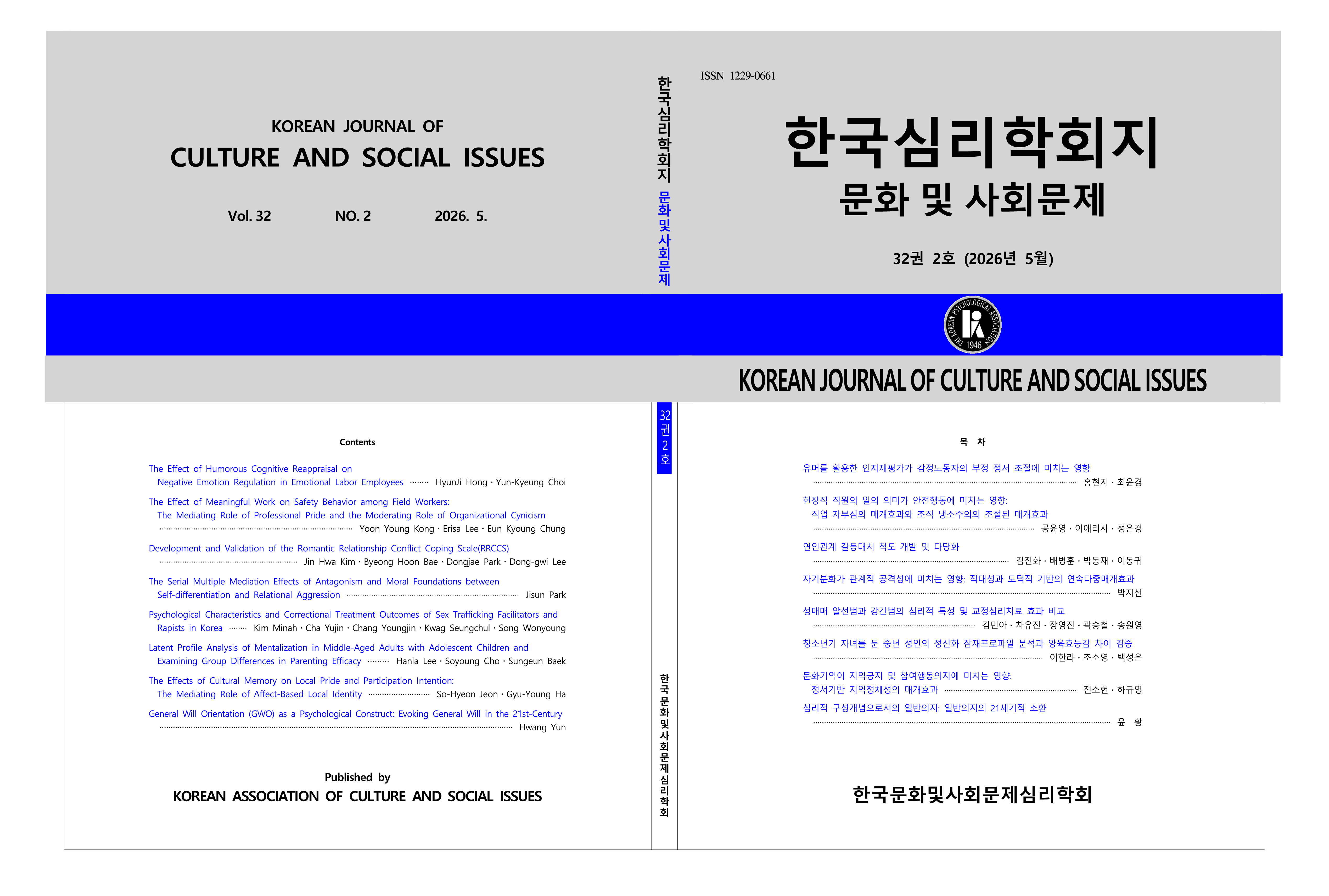
현장직 직원의 일의 의미가 안전행동에 미치는 영향: 직업 자부심의 매개효과와 조직 냉소주의의 조절된 매개효과
The Effect of Meaningful Work on Safety Behavior among Field Workers: The Mediating Role of Professional Pride and the Moderating Role of Organizational Cynicism
이애리사 (강원대학교)
정은경 (강원대학교)

초록
본 연구는 조절초점이론의 향상초점 관점에서 현장직 근로자의 일의 의미가 안전행동에 미치는 영향을 검증하고, 이 관계에서 직업 자부심의 매개효과와 조직 냉소주의의 조절효과를 확인하고자 하였다. 기존의 안전행동 연구가 주로 처벌과 규제 중심의 예방초점에 기반했다면, 본 연구는 의미와 성장을 강조하는 향상초점적 접근을 통해 안전행동을 증진시킬 수 있는 가능성을 탐색하였다. 생산직을 포함한 현장 업무 종사자 405명을 대상으로 설문조사를 실시하였으며, SPSS PROCESS Macro를 활용하여 매개효과, 조절효과, 조절된 매개효과를 검증하였다. 연구 결과, 첫째, 일의 의미는 안전행동에 정적인 영향을 미치는 것으로 나타났다. 둘째, 직업 자부심은 일의 의미와 안전행동 간의 관계에서 유의한 매개 경로로 작동하는 것이 확인되었다. 셋째, 조직 냉소주의는 직업 자부심과 안전행동 간의 관계를 조절하여, 조직 냉소주의가 낮을수록 직업 자부심이 안전행동에 미치는 긍정적 효과가 강화되었다. 넷째, 조직 냉소주의의 조절된 매개효과는 확인되지 않았다. 본 연구는 안전행동을 사고 예방의 소극적 행동이 아닌 개인의 성장과 조직 발전을 위한 적극적 행동으로 재개념화하였으며, 내재적 동기에 기반한 안전관리 접근의 중요성을 실증적으로 제시하였다. 연구 결과를 바탕으로 현장 안전관리를 위한 실무적 시사점과 후속 연구 방향을 논의하였다.
- keywords
- 일의 의미, 안전행동, 직업 자부심, 조직 냉소주의, 조절초점이론, 현장직 근로자
Abstract
This study examined the effect of meaningful work on safety behavior among field workers, adopting a promotion focus perspective based on regulatory focus theory. In addition, it investigated the mediating role of professional pride and the moderating role of organizational cynicism in this relationship. While previous research on safety behavior has primarily focused on punishment and regulation based prevention approaches, this study explored the potential for enhancing safety behavior through a promotion-focused approach that emphasizes meaning and growth. A survey was conducted with 405 field workers, including production workers, and the mediating, moderating, and moderated mediation effects were tested using the SPSS PROCESS Macro. The results showed that, first, meaningful work had a positive effect on safety behavior. Second, professional pride significantly mediated the relationship between meaningful work and safety behavior. Third, organizational cynicism moderated the relationship between professional pride and safety behavior, with the positive effect of professional pride on safety behavior being strengthened when organizational cynicism was low. Finally, the moderated mediation effect of organizational cynicism was not supported.. This study reconceptualized safety behavior not as a passive act of accident prevention but as a proactive behavior for personal growth and organizational development. It also empirically demonstrated the importance of intrinsic motivation-based approaches to safety management. Based on these findings, practical implications for field safety management and directions for future research were discussed.
- keywords
- meaningful work, safety behavior, professional pride, organizational cynicism, regulatory focus theory, field workers
- 투고일Received
- 2025-11-17
- 수정일Revised
- 2026-01-02
- 게재확정일Accepted
- 2026-03-16
- 출판일Published
- 2026-05-31
- 다운로드 수
- 조회수
- 0KCI 피인용수
- 0WOS 피인용수