
Korean Psychological Journal of Culture and Social Issues
- P-ISSN1229-0661
- E-ISSN1229-0661
- KCI
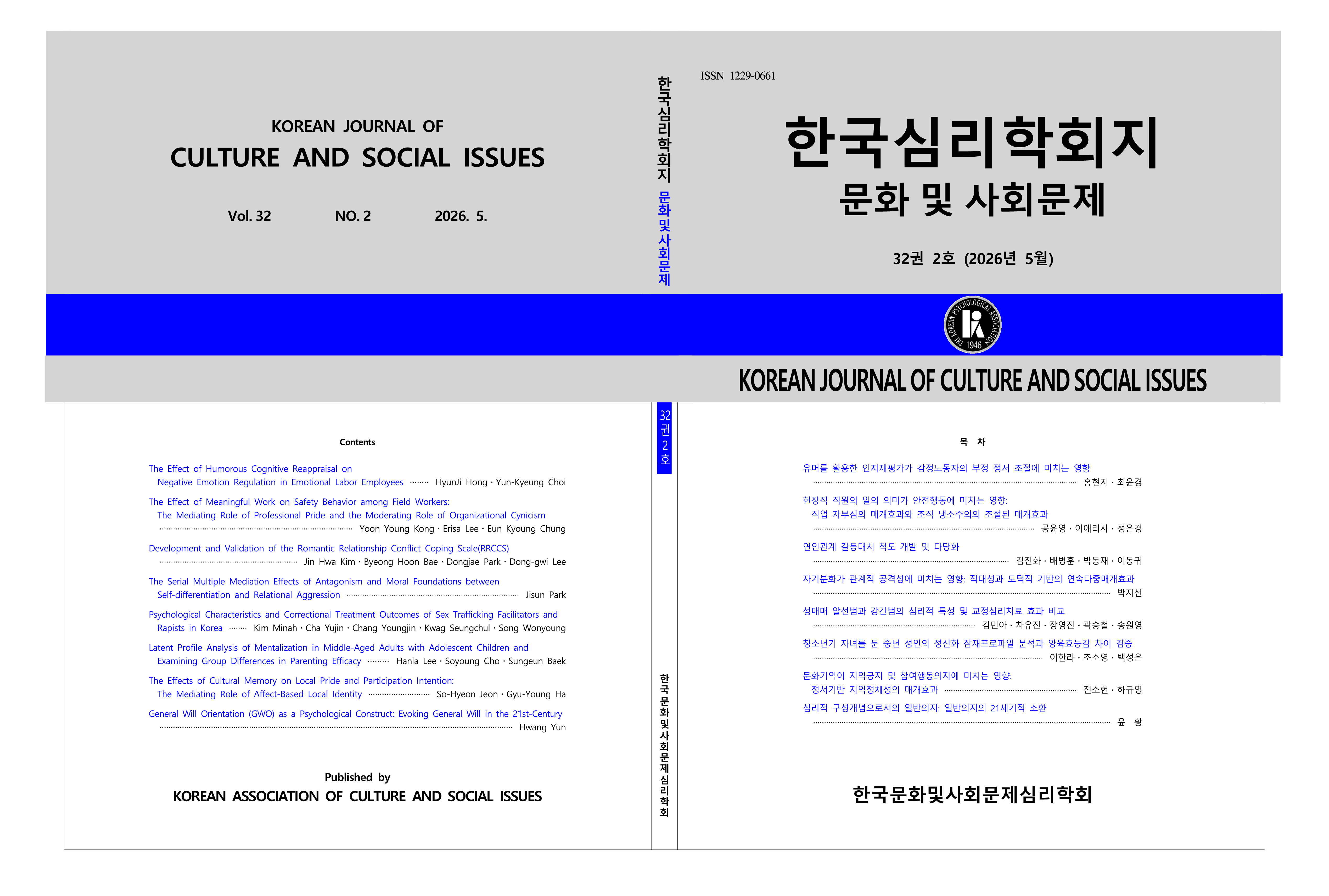
Article Contents
- 2026 (Vol.32)
- 2025 (Vol.31)
- 2024 (Vol.30)
- 2023 (Vol.29)
- 2022 (Vol.28)
- 2021 (Vol.27)
- 2020 (Vol.26)
- 2019 (Vol.25)
- 2018 (Vol.24)
- 2017 (Vol.23)
- 2016 (Vol.22)
- 2015 (Vol.21)
- 2014 (Vol.20)
- 2013 (Vol.19)
- 2012 (Vol.18)
- 2011 (Vol.17)
- 2010 (Vol.16)
- 2009 (Vol.15)
- 2008 (Vol.14)
- 2007 (Vol.13)
- 2006 (Vol.12)
- 2005 (Vol.11)
- 2004 (Vol.10)
- 2003 (Vol.9)
- 2002 (Vol.8)
- 2001 (Vol.7)
- 2000 (Vol.6)
- 1999 (Vol.5)
- 1998 (Vol.4)
- 1997 (Vol.3)
- 1995 (Vol.2)
- 1994 (Vol.1)
The Effects of Cultural Memory on Local Pride and Participation Intention: The Mediating Role of Affect-Based Local Identity

Abstract
This study examined the effects of cultural memory on local pride and participation intention through the mediating role of affect-based local identity among residents of Area A, a peripheral area of Seoul, using a structural equation modeling approach. The participants were 187 residents of four administrative neighborhoods in Area A (86 men and 101 women, aged 19 to 65 years). Data were collected from September to October 2025 through cooperation with local institutions as well as online communities and social networking services. Cultural memory, affect-based local identity, local pride, and participation intention were each measured with five items. Measurement model validation (EFA/CFA) and structural model analyses were conducted using SPSS 26.0 and AMOS 28.0. The results showed that cultural memory had a significant positive effect on affect-based local identity, and affect-based local identity had significant positive effects on both local pride and participation intention. Bootstrap analyses with 5,000 resamples indicated that the indirect effects of affect-based local identity were significant for both outcome variables. In contrast, the direct effect of cultural memory on local pride was not significant, whereas its direct effect on participation intention was significant, indicating different patterns across the two outcome variables. These findings suggest that cultural memory may extend to evaluative attitudes (local pride) and behavioral intent (participation intention) through affect-based local identity in an urban peripheral context. The study also provides implications for considering affect-based local identity as a contextual factor in counseling, coaching, and mental health practice.
- keywords
- cultural memory, affect-based local identity, local pride, participation intention, urban periphery
- Received
- 2026-04-16
- Revised
- 2026-05-04
- Accepted
- 2026-05-20
- Published
- 2026-05-31
- Downloaded
- Viewed
- 0KCI Citations
- 0WOS Citations