.png)
open access
메뉴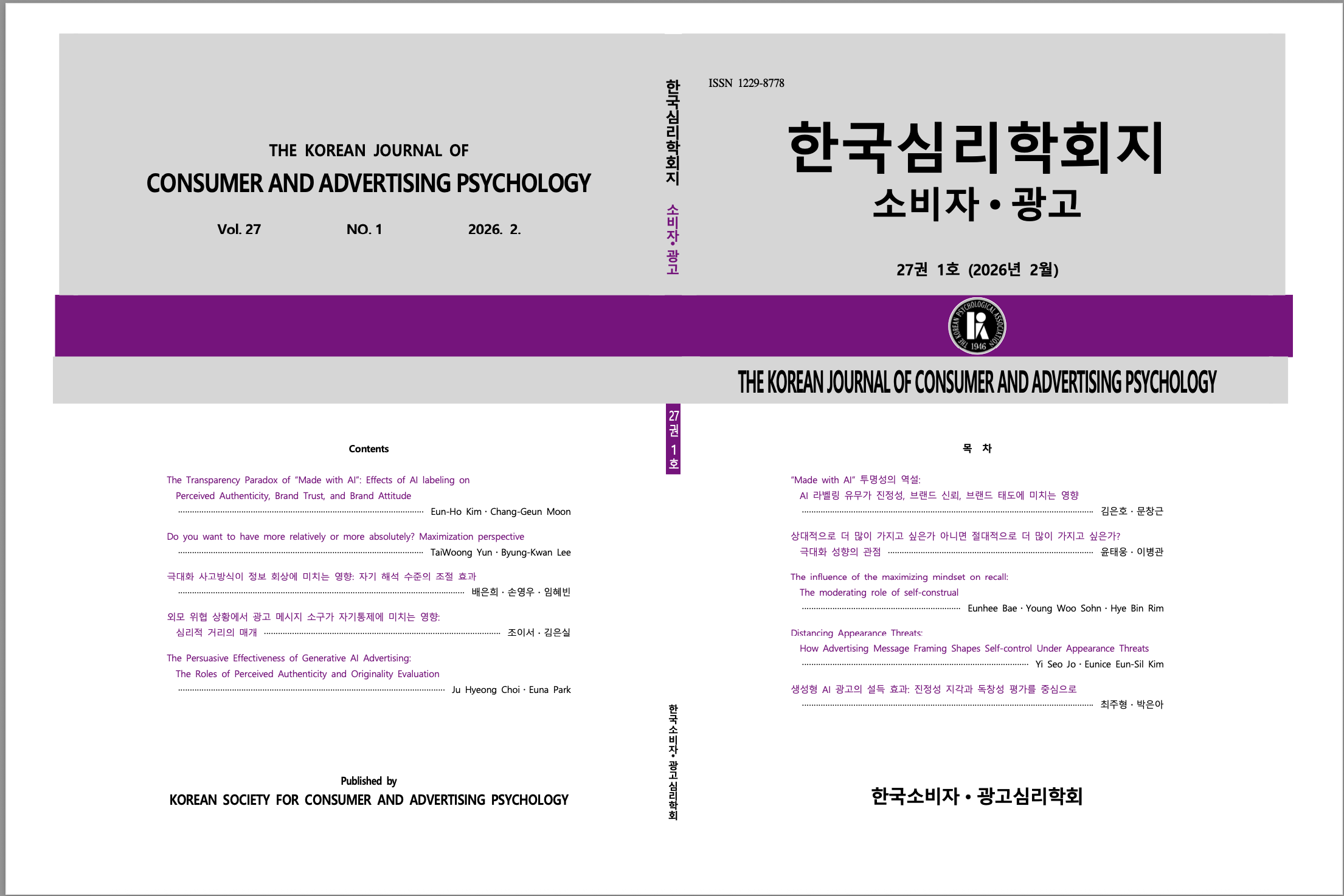

Physical appearance functions as a form of social capital, and perceived discrepancies between actual and ideal appearance can threaten self-control. This research investigates how consumers maintain or restore self-control under appearance threat by varying the compensation type (within-domain vs. across-domain) and message framing (concrete vs. abstract), and elucidates the underlying mechanisms and boundary conditions of these effects. Study 1 demonstrates that across-domain compensation preserves self-control more effectively than within-domain compensation. Within the appearance-relevant domain, abstract (vs. concrete) message framing increases self-control by promoting higher-level construal. Study 2 introduces regulatory focus as a boundary condition and psychological distance as the mediating mechanism. Abstract (vs. concrete) framing increases perceived distance and enhances self-control under promotion focus, whereas individuals under prevention focus show no framing differences. These findings reveal how compensation strategies and message design interact to regulate self-control under self-threat, offering an integrative framework that links compensatory consumption, construal level, and motivational orientation in advertising contexts.
