.png)
open access
메뉴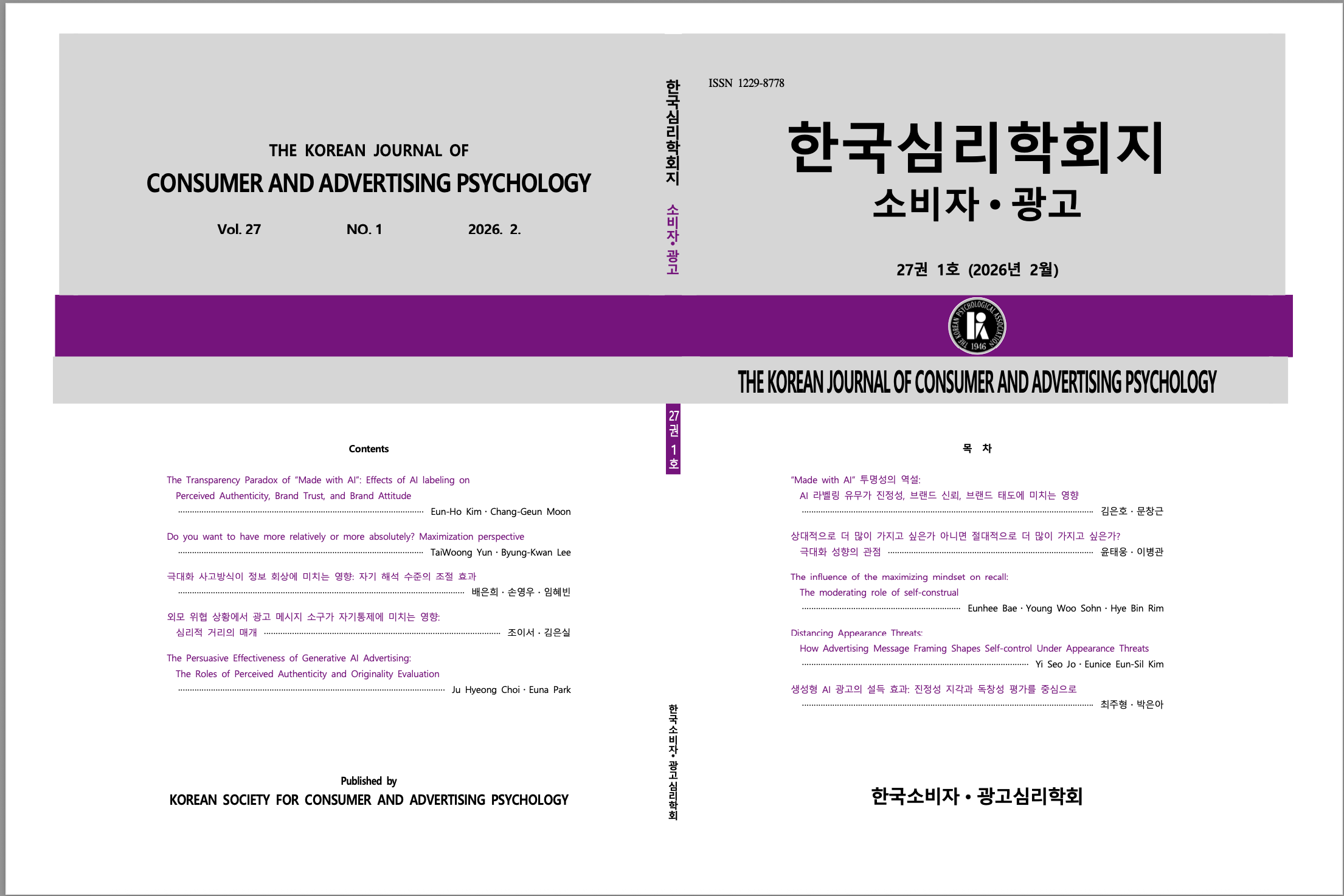
This study empirically examines the effects of disclosing the use of generative artificial intelligence (AI labeling) on consumers’ advertising responses and brand evaluations in a context where generative AI is widely adopted in advertising production. Specifically, the study analyzes the process through which AI labeling influences brand trust and brand attitude via perceived advertising authenticity, and investigates the moderating role of consumers’ AI literacy in this process. To this end, an experiment was conducted using fictitious laundry detergent advertisements created with generative AI, comparing conditions in which AI use was disclosed versus not disclosed. The results indicate that advertisements disclosing AI use elicit significantly lower perceived authenticity than those without such disclosure. Reduced authenticity, in turn, leads to a negative indirect effect on brand attitude through diminished brand trust. Moreover, this indirect effect is moderated by consumers’ AI literacy, such that the negative impact of AI labeling on perceived authenticity and subsequent brand attitude is amplified among consumers with higher levels of AI literacy. These findings demonstrate that, in an era where generative AI has become commonplace, transparency regarding AI use does not necessarily lead to positive consumer responses. By highlighting the transparency paradox in AI-generated advertising, this study extends the literature on AI advertising effects and offers meaningful theoretical and practical implications for the strategic use of generative AI in advertising.
Do we pursue more experiences and material things? Or do we pursue more than others, even if it is absolutely less? This study aimed to examine the influence of individual characteristics on the choice of experiences and material things from the perspective of maximization, which is an individual characteristic. A total of 94 subjects (60 males) participated in this study via Amazon MTurk. The results of the study showed that when it was related to experiences such as vacation periods, the place where the subjects wanted to live and the world they predicted to be happy were consistent, whereas in the case of material possessions such as luxury cars, there was a significant difference between the world where the subjects wanted to live and the world where they predicted to be happy. Furthermore, in relation to consumers’ vacation periods and car ownership, based on the consumer’s individual characteristics of maximization and the previous finding that consumers regret purchasing material products, we used multiple regression analysis to examine how consumers’ choices of vacation periods and the number of cars they owned were affected by their regret tendency. The results showed that subjects’ choices (where they wanted to live) for material products such as car ownership were positively related to consumers’ regret tendency, and the higher the regret tendency, the more they preferred world B, which was absolutely superior. In addition, the high standard and alternative search dimension, which are sub-dimensions of maximization tendency, were found to have marginally significant effects on the subjects' choices between the relative world and the absolute world. However, in the choice of vacation period related to experience, maximization tendency did not have significant effects, and only regret tendency had a negative effect.
Maximizers are individuals who search through many alternatives with the intention of gaining the best decisional outcome. Although significant empirical advances have been made in understanding the various characteristics typically associated with maximizers, much less is known about the impact of maximizing on memory. This study aimed to investigate the relationship between maximizing mindset and information recall, moderated by self-construal. We hypothesized that maximizing mindset would predict higher levels of recall of ranking information and that self-construal would moderate the effect. To test these hypotheses, an online study was conducted on Korean college students (N=179), in which the rank of different types of products was shown. They were later asked to recall the rank of the products after completing a filler task. As predicted, results demonstrate that under the maximizing mindset condition, individuals are more likely to recall the ranking information than those under the satisficing mindset condition. Moderation analysis found that higher level of independent self-construal compared to interdependent self-construal strengthened the relationship between maximizing mindset and ranking information recall. Underlying mechanisms and implications, as well as avenues for future research, are discussed.
Physical appearance functions as a form of social capital, and perceived discrepancies between actual and ideal appearance can threaten self-control. This research investigates how consumers maintain or restore self-control under appearance threat by varying the compensation type (within-domain vs. across-domain) and message framing (concrete vs. abstract), and elucidates the underlying mechanisms and boundary conditions of these effects. Study 1 demonstrates that across-domain compensation preserves self-control more effectively than within-domain compensation. Within the appearance-relevant domain, abstract (vs. concrete) message framing increases self-control by promoting higher-level construal. Study 2 introduces regulatory focus as a boundary condition and psychological distance as the mediating mechanism. Abstract (vs. concrete) framing increases perceived distance and enhances self-control under promotion focus, whereas individuals under prevention focus show no framing differences. These findings reveal how compensation strategies and message design interact to regulate self-control under self-threat, offering an integrative framework that links compensatory consumption, construal level, and motivational orientation in advertising contexts.
While Generative AI technology is revolutionizing the efficiency and creativity of video advertising production, consumer reactions remain mixed. This study focuses on the roles of authenticity and originality to elucidate the persuasive mechanism of AI-utilized advertising. Specifically, it empirically analyzes how the disclosure of ‘human involvement’ as the production agent affects consumer responses. To this end, an online survey was conducted targeting adults aged 20 to 34, collecting data from 379 participants (female = 59.4%, mean age = 22.5 years). The results are as follows: First, consumers perceived lower authenticity as the labeled degree of AI usage in the production process increased. Second, authenticity was found to fully mediate the effect of the level of AI usage on advertising attitude and purchase intention. In other words, the fact of AI usage itself did not have a direct effect on consumer responses, but it indirectly led to negative outcomes by diminishing perceived authenticity. Third, the analysis of the moderated mediation effect of originality revealed that in the ‘100% AI production’ condition, high originality backfired by exacerbating the decrease in authenticity, thereby reducing purchase intention. Conversely, in the ‘expert’s use of AI’ condition, the presence of human involvement buffered the decline in authenticity, significantly mitigating the negative effect of originality. In conclusion, this study suggests that ‘visible human involvement,’ which highlights the role of humans as creators rather than the technology itself, is a key factor in reducing consumer psychological resistance and enhancing persuasive effectiveness in AI advertising strategies.
