

- P-ISSN 2671-8197
- E-ISSN 2733-936X
_한글.jpg)
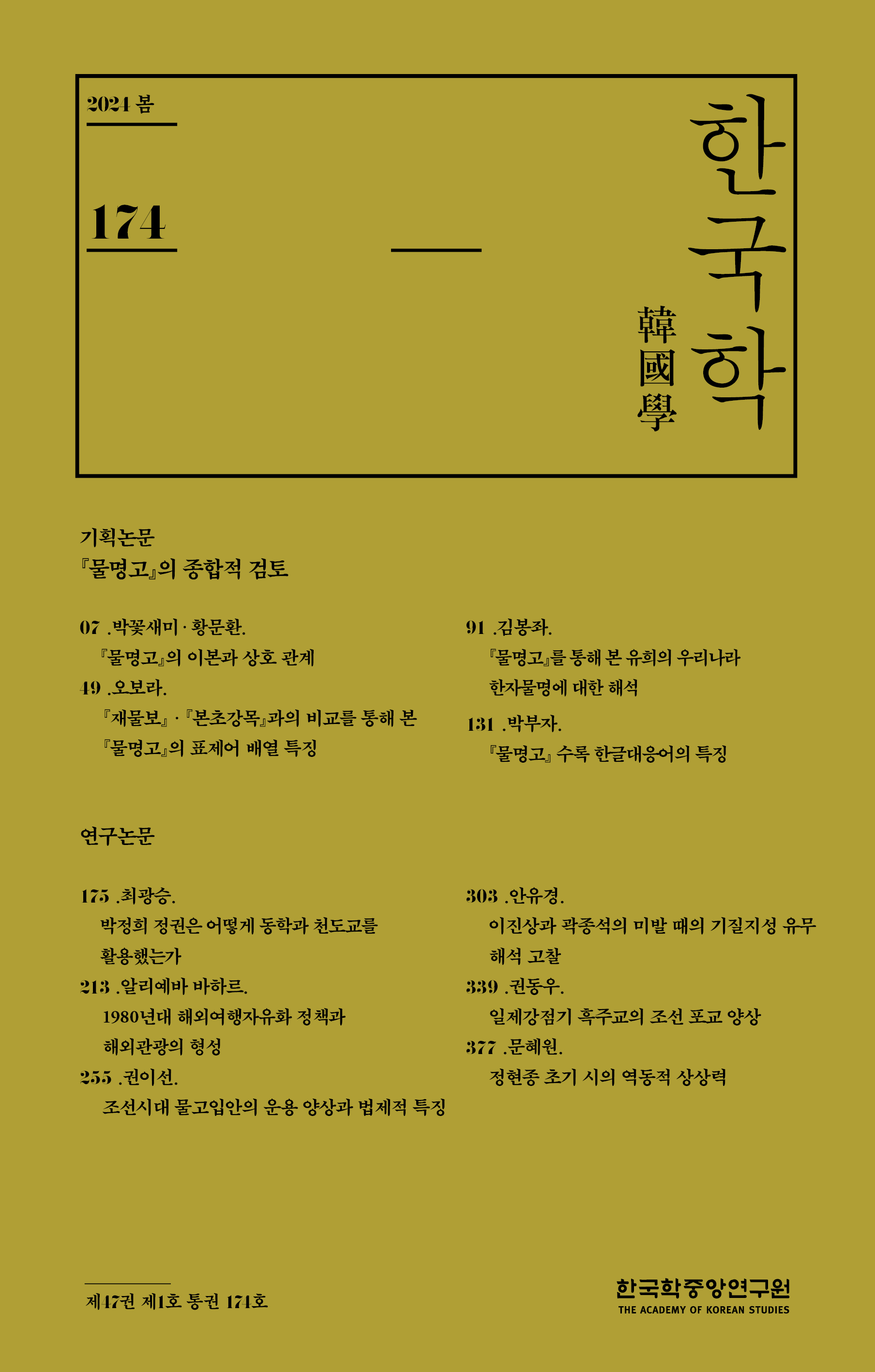
정현종의 초기 시는 타자에 대한 관심을 보여 주고 있으며, 특히 사물을 ‘타자’ 로 규정한다는 점에서 주목된다. 그는 사물을 포함한 타자와의 교감을 ‘신체’로써 가능한 것으로 표현하고 있다. 이것은 신체성을 근거로 해서 주체-타자의 상호성을 주장한 메를로-퐁티의 현상학과 연관지어 논의할 수 있는 대목이다. 정현종은 ‘사물(thing)’에 인간의 도구가 되는 물건 외에 슬픔, 기쁨 같은 정서나 추상적인 명사까지를 포함시킨다. 사물은 스스로의 존재 이유와 계기를 가지는 ‘자기동일성’이 있으며, 시인은 이러한 사물의 자기동일성을 지지하는 사람이다. 정현종은 사물의 독립성을 최대한 유지하기 위해서 주체의 개입을 최소화해야 한다고 주장한다. 초기 시에서 자주 나타나는 재귀적인 표현은 사물의 자기동일성을 표현하면서, 주체의 해석을 최대한 배제하려는 창작 방법이다. 그의 시에서 주체와 타자의 관계는 물질적인 상상력을 통해 주제-타자, 타자-타자 간의 교감과 융합으로 표현된다. 초기 시에 등장하는 ‘살’은 실제의 개별적인 신체를 의미하기도 하지만, 주체와 타자가 교감하는 환경으로서의 ‘살’을 지향하고 있다. 이때 ‘살’은 주체와 타자의 상호적인 관계를 가능하게 하는 공통적 환경인 메를로-퐁티의 ‘살’이라는 개념에 가깝다. 초기시에 나타나는 타자에 대한 태도는 중기 이후 정현종 시에서도 일관되게나타난다. 그러므로 초기 시의 주체-타자 관계에 대한 연구는 정현종 시의 전반을 설명하는 데 있어서도 중요한 단서가 될 수 있을 것이다.
Jeong Hyeon-jong’s early poems show an interest in the other, and are particularly noteworthy in their definition of objects as “the other.” He thinks that communication with the other, including objects, is possible as a “body.” This point can be discussed in relation to the phenomenology of Merleau-Ponty, who insisted on the reciprocity of the subject and the other based on physicality. Jeong Hyeon-jong includes emotions such as sadness and joy in addition to objects that become human tools in “things.” “Things” have a “self-identity” with their own reasons, and the poet supports the self-identity of “things.” Jeong Hyeonjong argues that the intervention of the subject should be minimized in order to maintain the maximum independence of “things.” The recursive expression and tautology that appear frequently in early poems are creative methods to exclude the interpretation of the subject as much as possible while expressing the self-identity of “things.” The communication between the subject and the other is embodied as a fusion through material imagination in poems. The “flesh” actually refers to an individual body, but it is aiming for “Chair” as an environment in which the subject and the other interact. At this time, the “flesh” is similar to Merleau-Ponty’s “Chair,” which is a common environment that enables the mutual relationship between the subject and the other. The attitude toward “the other” in the early poems also appears consistently in the poems of Jeong Hyeon-jong after the middle period. Therefore, the study of the subject-the other relationship in the early poems can be an important clue in explaining the entire works of Jeong Hyeon-jong.


학술지 홈페이지 이용 환경은 크롬 브라우저 사용을 권장합니다.