
- P-ISSN 1225-0163
- E-ISSN 2288-8985



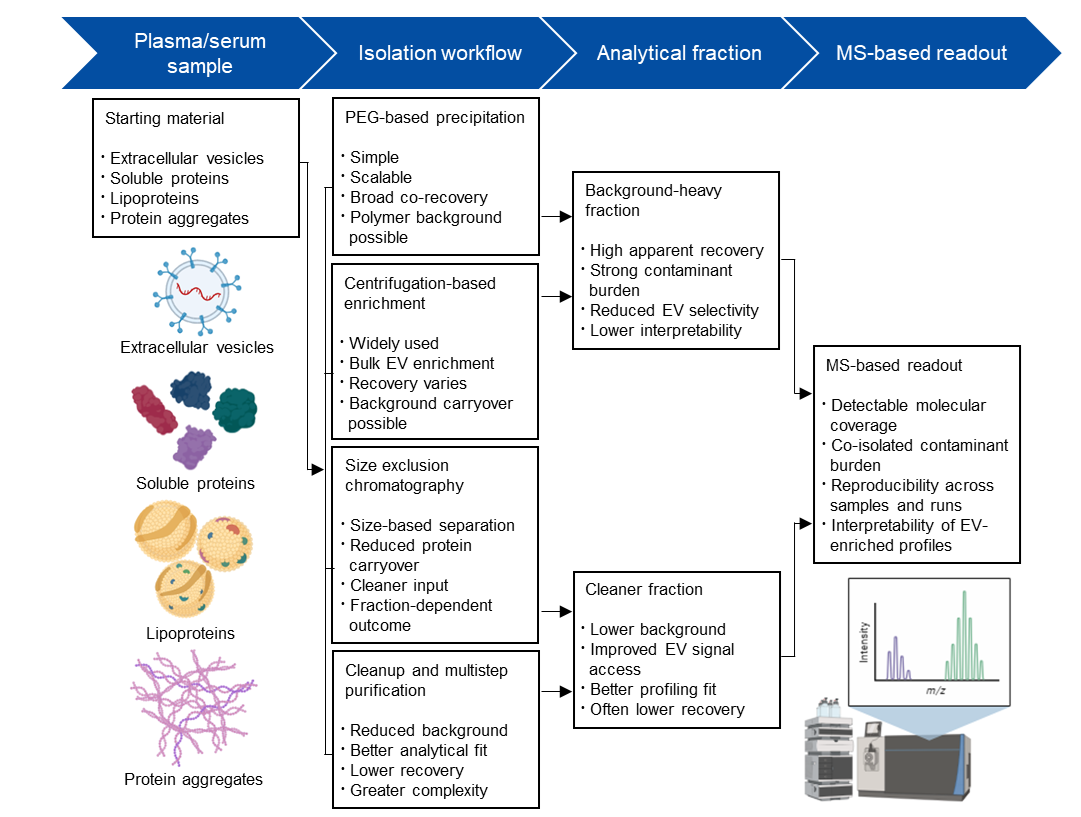
Extracellular vesicle (EV) isolation critically influences data quality in mass spectrometry (MS)-based omics. Common descriptors such as recovery and purity are insufficient to predict analytical performance, particularly in biofluid-derived samples where co-isolated non-vesicular background can dominate molecular readouts. Thus, the key issue is not only EV recovery but also the extent to which background components are carried into the final fraction. This review treats EV isolation as part of the analytical system rather than a neutral preparative step. Precipitation-, size exclusion chromatography-, and centrifugation-based workflows are evaluated based on EV enrichment, background carryover, reproducibility, and measurable molecular coverage. Notably, high recovery does not necessarily translate into improved analytical depth if dominant background remains unresolved. Precipitation-based methods illustrate this trade-off clearly: while advantageous for scalability and low-input samples, they often co-enrich substantial background, limiting EV-specific interpretation. Accordingly, their use is best considered in combination with additional cleanup steps or with appropriate analytical caution. Overall, workflow selection should be guided by analytical suitability rather than yield alone. For MS-based EV omics, the most effective approach is the one that produces a reproducible and interpretable fraction with sufficient access to EV-associated molecular features.







This website recommended the use the Chrome browser for journal website.