
- P-ISSN 1225-0163
- E-ISSN 2288-8985



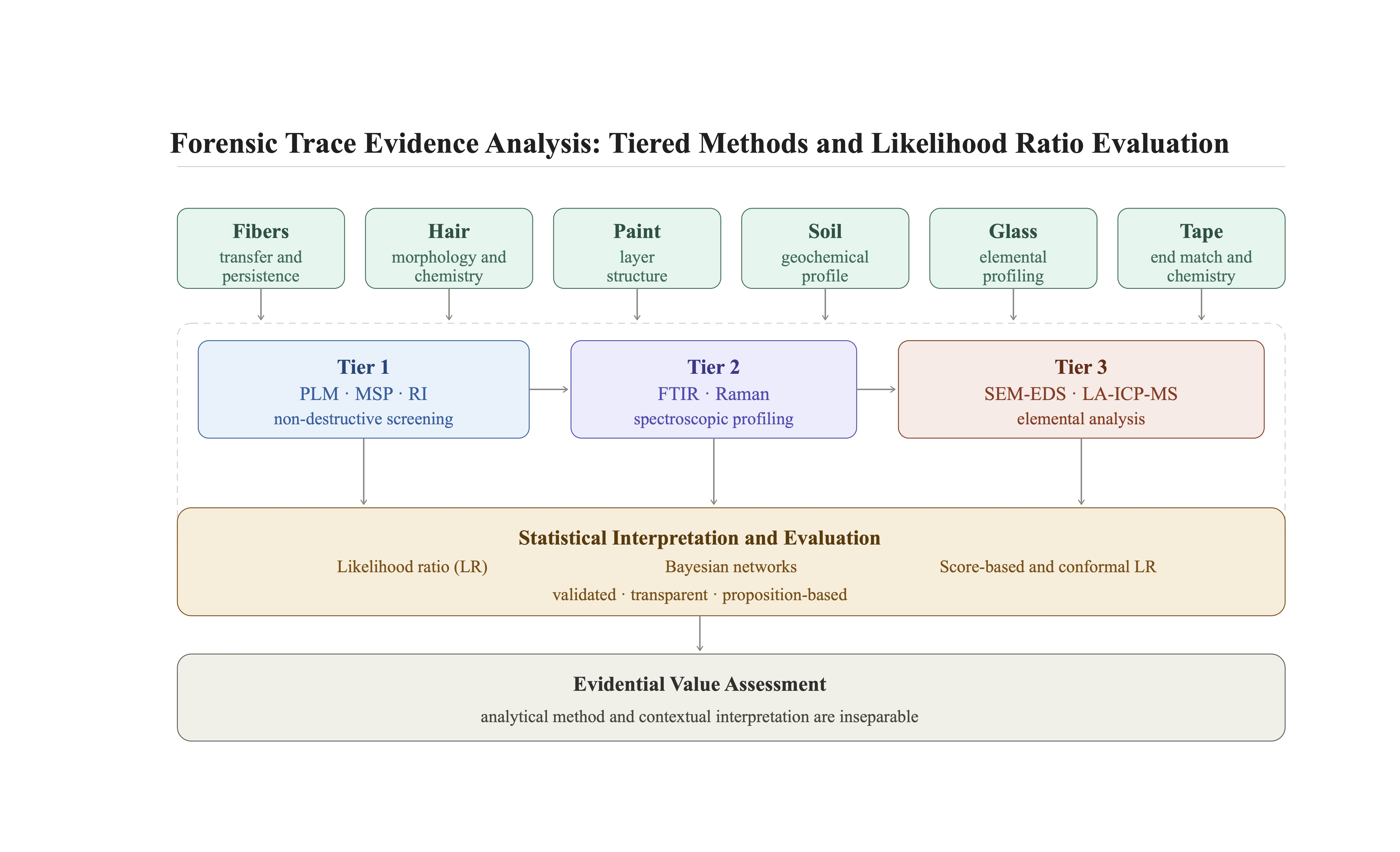
Trace evidence encompasses the physical remnants that arise from contact between persons, objects, and locations, which may be recovered to support the reconstruction of criminal events. This review aims to provide an integrated and critical overview of six major categories of trace evidence: fiber, hair, paint, soil, glass, and tape. For each category, forensic significance (including transfer and persistence considerations), collection strategies, tiered examination methodologies, and emerging artificial intelligence (AI)-assisted applications are addressed within a unified framework. This review covers the institutional infrastructure that governs examination practices, including the standards and guidelines produced by the Scientific Working Group for Materials Analysis, Organization of Scientific Area Committees, European Network of Forensic Science Institutes, INTERPOL, Asia Forensic Science Network, and American Society for Testing and Materials. We address data interpretation in depth, with particular attention paid to the likelihood ratio (LR) framework and the conditions required for its defensible implementation, alongside emerging approaches, including Bayesian networks, score-based LR, and conformal prediction, and maintain a critical perspective. Advances in analytical capabilities and AI do not automatically translate into stronger forensic evidence, and the adoption of any method in operational casework must be preceded by rigorous validation, interlaboratory studies, and judicial scrutiny. The tiered analytical workflow and comparative method performance assessment presented here provide a structured basis for evidence-based instrument selection and responsible LR implementation in forensic casework.







This website recommended the use the Chrome browser for journal website.