

- P-ISSN 1225-0163
- E-ISSN 2288-8985



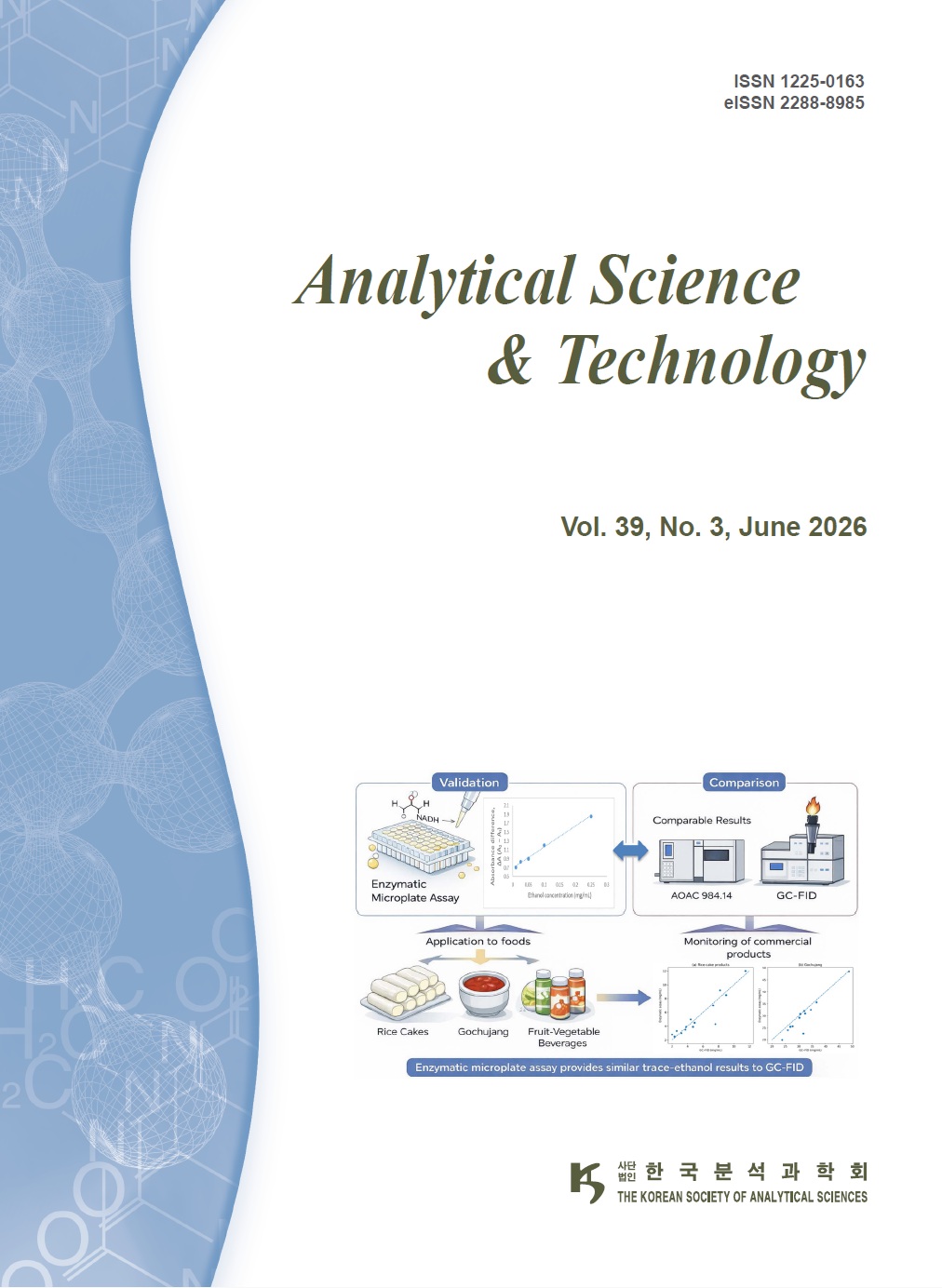
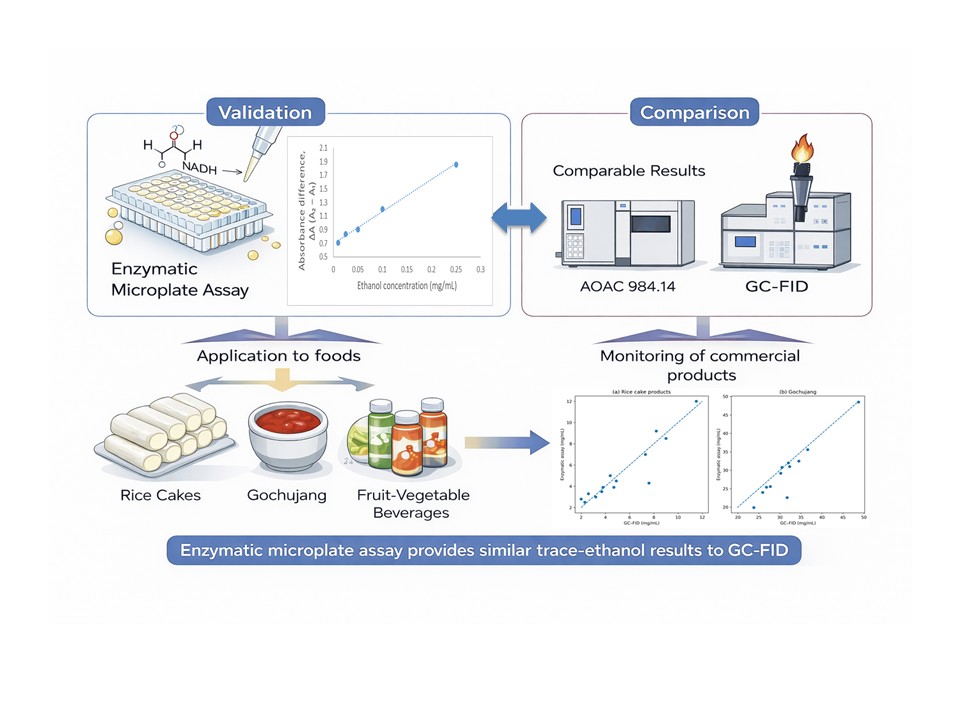
에탄올은 자연 발효, 원료 유입, 보존제 사용 등으로 다양한 식품에 존재할 수 있으며, 미량 수준이라도 할랄 인증 및 무알코올/저알코올(no- and low-alcohol) 표시 관리 측면에서 중요하다. 본 연구에서는 쌀떡, 고추장, 과·채 혼합음료를 대상으로 효소 기반 미세플레이트 분석법의 밸리데이션을 수행하고, AOAC INTERNATIONAL 공인시험법을 기반으로 한 GC–FID 방법과 성능을 비교하였다. 효소분석법의 정량한계는 0.030–0.076 mg/mL로 평가되었으며, GC–FID(0.037–0.109 mg/mL)와 동등하거나 일부 매트릭스에서 더 우수하였다. 보정곡선은 0.01–0.25 mg/mL 범위에서 양호한 직선성(R² ≥ 0.991)을 보였고, 저·중·고 3수준 스파이크 농도에서 기저 에탄올 농도를 보정한 회수율은 약 95–105% 범위, 정밀도 또한 기준을 만족하였다. GC–FID 분석법 역시 우수한 직선성(R² ≥ 0.9998)과 전반적으로 낮은 RSD를 나타냈다. 추가로 시판 제품 모니터링(쌀떡 n = 14, 고추장 n = 12, 과·채 혼합음료 n = 18)을 수행한 결과, 효소분석법은 다양한 매트릭스에서 GC–FID와 유사한 정량 결과를 제공하며 일상적 모니터링 적용 가능성을 확인하였다. 본 연구 결과는 효소분석법이 미량 에탄올의 모니터링을 위한 실용적 대안이 될 수 있음을 시사한다.
Ethanol may be present in a wide range of foods due to natural fermentation, carry-over from ingredients, or the use of ethanol-containing preservatives, and even trace levels are important for halal compliance and “no- and low-alcohol (NoLo)” labeling. In this study, a single-laboratory validation of an enzymatic microplate assay was conducted for three Korean food matrices (rice cake, gochujang, and fruit–vegetable beverages) and the performance was compared with that of a GC–FID method based on an AOAC INTERNATIONAL (AOAC). The enzymatic assay showed limits of quantification (LOQs) of 0.030–0.076 mg/mL, which were comparable to or lower than those of GC–FID (0.037–0.109 mg/mL) depending on the matrix. Calibration curves were linear over 0.01–0.25 mg/mL with acceptable linearity (R² ≥ 0.991), and spike recoveries (after correcting for background ethanol) were approximately 95–105% across low, medium, and high levels with practical precision. GC–FID also provided excellent linearity (R² ≥ 0.9998) and generally lower RSDs. In addition, commercial product monitoring data were generated for rice cake (n = 14), gochujang (n = 12), and fruit beverages (n = 18), showing that the enzymatic microplate assay provides comparable quantitative results to GC–FID across diverse matrices, supporting its utility for routine trace-ethanol monitoring.







학술지 홈페이지 이용 환경은 크롬 브라우저 사용을 권장합니다.