


- ENGLISH
- P-ISSN1229-070X
- E-ISSN2713-9581
- KCI
논문 상세
- 2026 (31권)
- 2025 (30권)
- 2024 (29권)
- 2023 (28권)
- 2022 (27권)
- 2021 (26권)
- 2020 (25권)
- 2019 (24권)
- 2018 (23권)
- 2017 (22권)
- 2016 (21권)
- 2015 (20권)
- 2014 (19권)
- 2013 (18권)
- 2012 (17권)
- 2011 (16권)
- 2010 (15권)
- 2009 (14권)
- 2008 (13권)
- 2007 (12권)
- 2006 (11권)
- 2005 (10권)
- 2004 (9권)
- 2003 (8권)
- 2002 (7권)
- 2001 (6권)
- 2000 (5권)
- 1999 (4권)
- 1998 (3권)
- 1997 (2권)
- 1996 (1권)
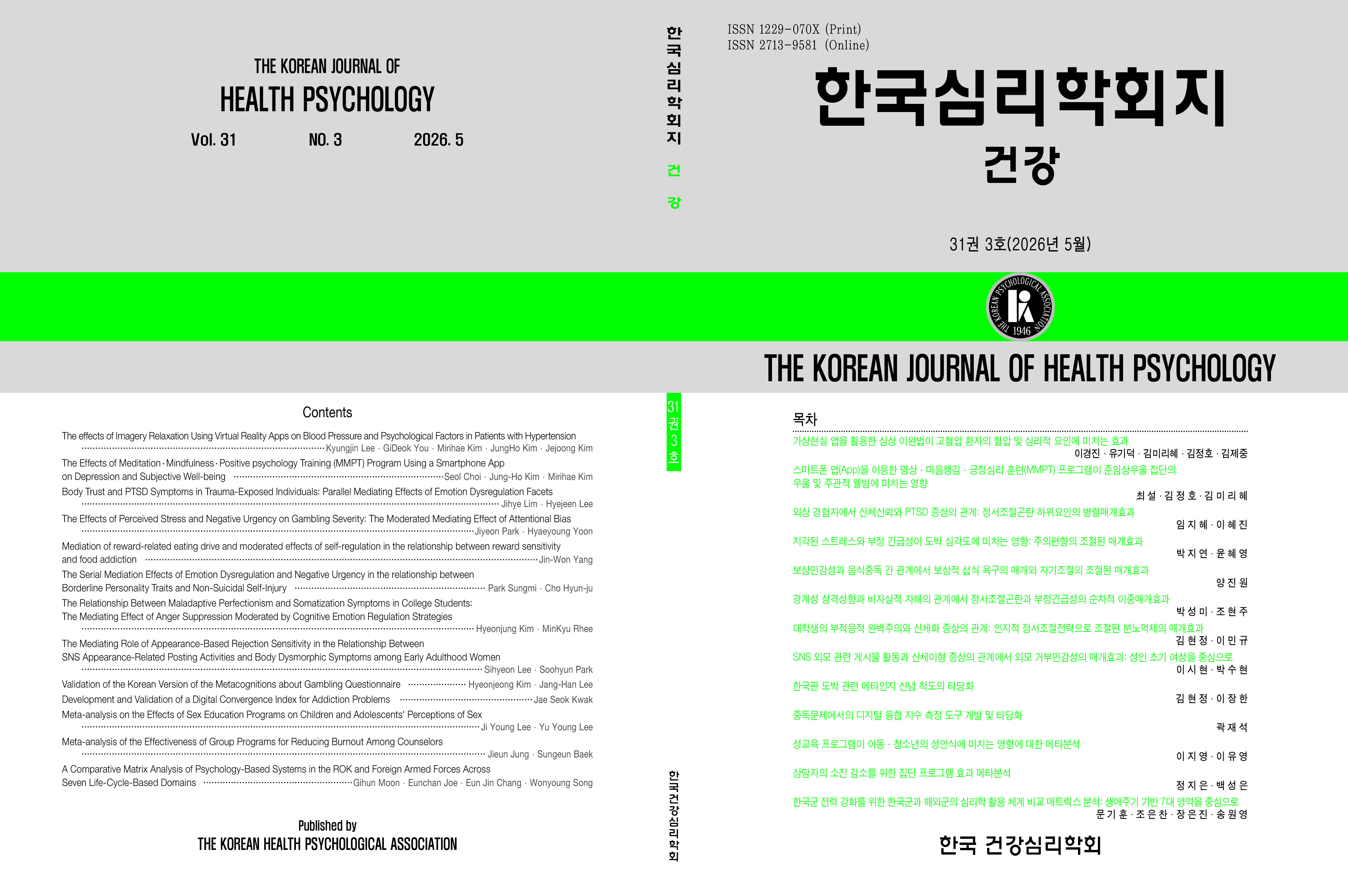
보상민감성과 음식중독 간 관계에서 보상적 섭식 욕구의 매개와 자기조절의 조절된 매개효과
Mediation of reward-related eating drive and moderated effects of self-regulation in the relationship between reward sensitivity and food addiction

초록
본 연구의 목적은 보상민감성과 음식중독 간 관계에서 보상적 섭식 욕구가 매개 역할을 하고, 이 경로가 자기조절 수준에 따라 달라지는지를 검증하는 것이다. 이를 위해 대학생 496명을 대상으로 자기보고 설문 연구를 실시하였고, PROCESS macro를 통해 분석하였다. 연구 결과, 보상민감성은 음식중독에 직접 영향을 미치지 않았으나, 보상적 섭식 욕구를 통한 완전매개효과가 유의하게 나타났다. 또한 자기조절은 보상민감성에서 음식중독으로 이어지는 간접경로를 유의하게 조절하는 것으로 나타났다. 조건부 간접효과 분석 결과, 자기조절 수준이 높은 경우 간접효과가 유의하게 나타났으나, 자기조절 수준이 낮은 경우에는 간접효과가 유의하지 않았다. 이러한 결과는 자기조절은 항상 보호적으로 작용한다는 관점과는 달리, 맥락에 따라 간접효과의 크기를 변화시킬 수 있는 이중적 기능을 할 수 있음을 시사한다. 본 연구는 음식중독의 개입에서 보상민감성이라는 기질적 요인과 자기조절이라는 성격 특성을 통합적으로 고려한 접근의 필요성을 제안한다.
- keywords
- 보상민감성, 보상적 섭식 욕구, 음식중독, 자기조절
Abstract
This study aimed to investigate whether reward-related eating drive mediates the relationship between reward sensitivity and food addiction, and whether this mediation differs based on self-regulation levels. To achieve this, a self-report survey was conducted with 496 university students, and the data were analyzed using the PROCESS macro. The results indicated that reward sensitivity does not directly affect food addiction; however, a full mediation effect through reward-related eating drive was confirmed. Furthermore, self-regulation significantly moderated this ediation pathway. Analysis of conditional indirect effects revealed that the indirect effect was stronger at high levels of self-regulation, while it was non-significant at low levels. These findings suggest that self-regulation does not always have a protective role, but can serve dual functions depending on the context. Consequently, intervention strategies for food addiction should take into account individual temperament and personality traits.
- keywords
- reward sensitivity, self-regulation, reward-related eating drive, food addiction
- 투고일Received
- 2025-11-07
- 수정일Revised
- 2025-11-28
- 게재확정일Accepted
- 2026-03-30
- 출판일Published
- 2026-05-30
- 다운로드 수
- 조회수
- 0KCI 피인용수
- 0WOS 피인용수