


- ENGLISH
- P-ISSN1229-070X
- E-ISSN2713-9581
- KCI
논문 상세
- 2026 (31권)
- 2025 (30권)
- 2024 (29권)
- 2023 (28권)
- 2022 (27권)
- 2021 (26권)
- 2020 (25권)
- 2019 (24권)
- 2018 (23권)
- 2017 (22권)
- 2016 (21권)
- 2015 (20권)
- 2014 (19권)
- 2013 (18권)
- 2012 (17권)
- 2011 (16권)
- 2010 (15권)
- 2009 (14권)
- 2008 (13권)
- 2007 (12권)
- 2006 (11권)
- 2005 (10권)
- 2004 (9권)
- 2003 (8권)
- 2002 (7권)
- 2001 (6권)
- 2000 (5권)
- 1999 (4권)
- 1998 (3권)
- 1997 (2권)
- 1996 (1권)
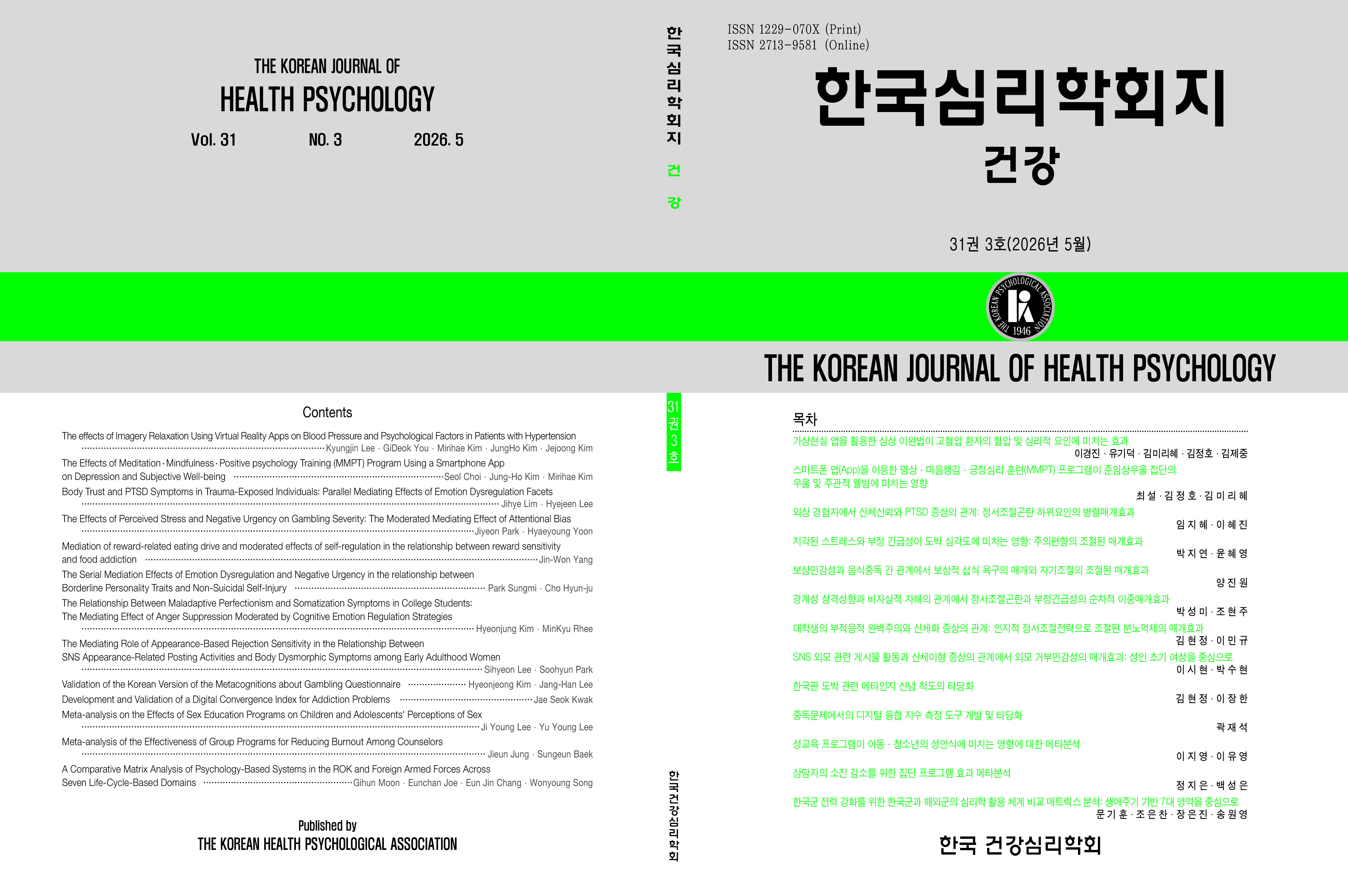
중독문제에서의 디지털 융합 지수 측정 도구 개발 및 타당화
Development and Validation of a Digital Convergence Index for Addiction Problems

초록
본 연구의 목적은 디지털 환경에서 서로 다른 중독 행동과 물질이 연결·중첩·확산되는 현상을 설명하는 중독문제에서의 디지털 융합을 조작적으로 정의하고, 이를 측정할 수 있는 측정도구를 개발하는 것이다. 이를 위해 2단계 연구를 수행하였다. 연구 1에서는 내러티브 리뷰와 X(Twitter) 기반 텍스트 네트워크 분석을 통합하여 조작적 정의와 지표를 도출하고, 전문가 내용타당도 평가와 예비조사(n=100)를 통해 문항을 선별하였다. 연구 2에서는 본조사(n=250)를 통해 요인구조, 내적 합치도, 검사-재검사 신뢰도, 수렴 및 준거 타당도를 검토하였다. 연구 결과, 중독문제에서의 디지털 융합은 디지털 기술 및 플랫폼의 융합으로 인해 중독에 대한 수용성, 가용성, 접근성이 높아지고 행동 및 물질 중독 간 상호 연결을 강화하여 복합적인 중독문제를 촉진하는 현상으로 정의되었다. 최종적으로 13문항이 선정되었으며, 척도의 내적 합치도는 수용 가능한 수준이었고, 단일요인 구조가 확인되었다. 검사-재검사 신뢰도는 .725(Spearman’s rho, p<.001)로 나타났다. 또한 수렴 및 준거 타당도 검토에서 게임이용장애, 도박문제, 성중독, 알코올사용장애와 유의한 정적 관련성을 보여 지지되었으나, 물질사용장애와의 관련성은 유의하지 않았다. 결과를 바탕으로 논의에서는 본 도구가 디지털 환경에서 중독문제의 연결과 확산 가능성을 포착하는 환경적 위험지표로 활용될 수 있음을 제안하였다.
- keywords
- 행동 중독, 물질 중독, 디지털 융합, 측정 도구
Abstract
This study aimed to define digital convergence in addiction problems—where various addictive behaviors and substances intersect and merge within digital environments—and to create a scale for measuring this concept. To achieve this, a two-stage study was conducted. In Study 1, we derived an operational definition and indicators by integrating a narrative review with a text network analysis based on X (Twitter). We selected items through expert content validity evaluation and a pilot survey (n=100). In Study 2, we examined the scale's factor structure, internal consistency, test-retest reliability, and both convergent and criterion-related validity using a main survey (n=250). The results indicated that digital convergence in addiction problems refers to how the integration of digital technologies and platforms enhances the acceptability, availability, and accessibility of addictive targets, strengthens connections between behavioral and substance addictions, and contributes to complex addiction issues. Ultimately, we selected thirteen items for the scale, which demonstrated acceptable internal consistency and a unidimensional structure. The test-retest reliability was found to be .725 (Spearman's rho, p<.001). Furthermore, the scale showed significant positive correlations with internet gaming disorder, gambling issues, sexual addiction, and alcohol use problems, while the association with substance use disorder was not significant. These findings suggest that the developed scale could act as an environmental risk indicator, capturing the connectivity and diffusion potential of addiction problems within digital contexts.
- keywords
- behavioral addiction, substance addiction, digital convergence, scale development
- 투고일Received
- 2026-04-06
- 수정일Revised
- 2026-04-29
- 게재확정일Accepted
- 2026-04-29
- 출판일Published
- 2026-05-30
- 다운로드 수
- 조회수
- 0KCI 피인용수
- 0WOS 피인용수