
Korean Journal of Health Psychology
- KOREAN
- P-ISSN1229-070X
- E-ISSN2713-9581
- KCI
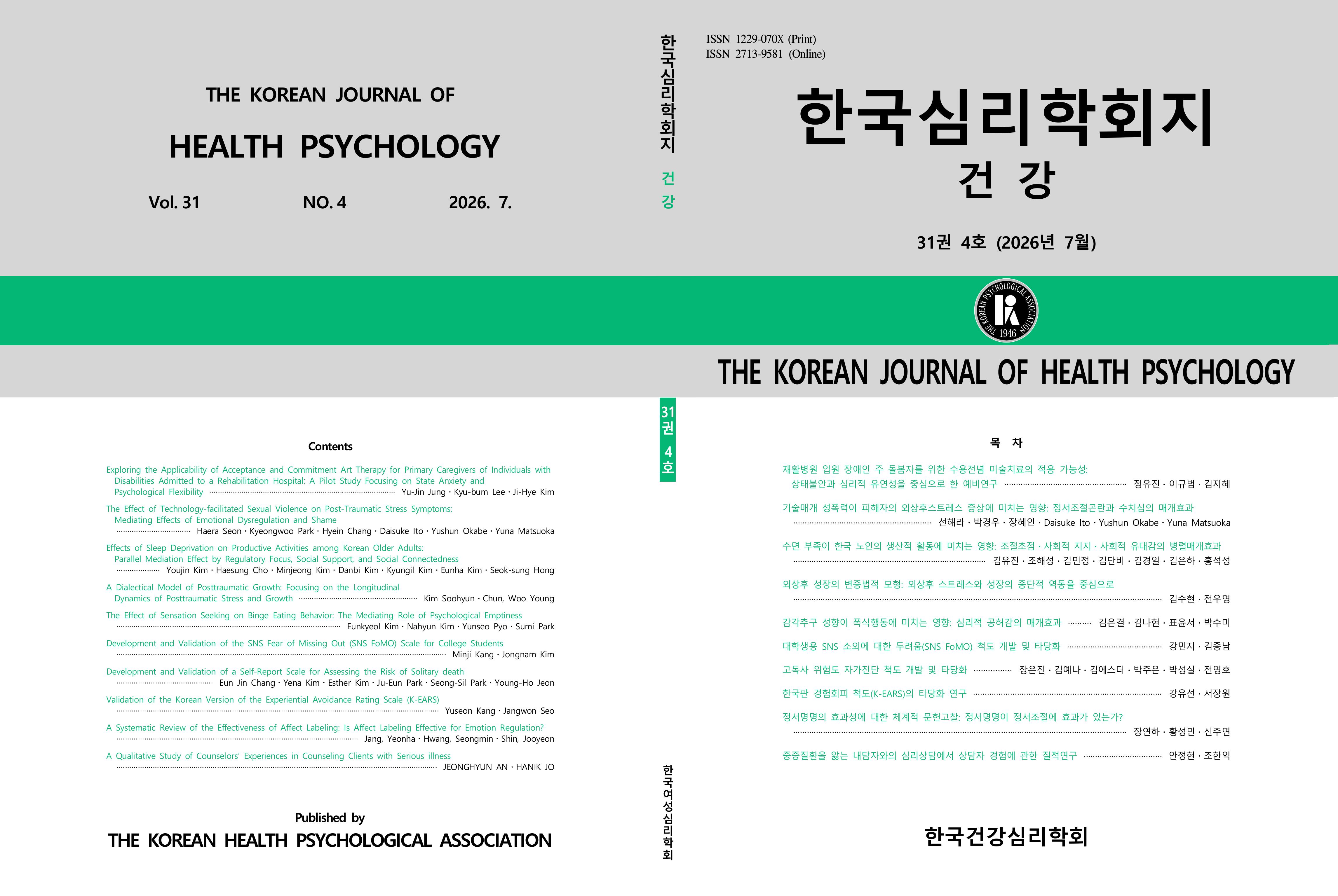
Article Contents
- 2026 (Vol.31)
- 2025 (Vol.30)
- 2024 (Vol.29)
- 2023 (Vol.28)
- 2022 (Vol.27)
- 2021 (Vol.26)
- 2020 (Vol.25)
- 2019 (Vol.24)
- 2018 (Vol.23)
- 2017 (Vol.22)
- 2016 (Vol.21)
- 2015 (Vol.20)
- 2014 (Vol.19)
- 2013 (Vol.18)
- 2012 (Vol.17)
- 2011 (Vol.16)
- 2010 (Vol.15)
- 2009 (Vol.14)
- 2008 (Vol.13)
- 2007 (Vol.12)
- 2006 (Vol.11)
- 2005 (Vol.10)
- 2004 (Vol.9)
- 2003 (Vol.8)
- 2002 (Vol.7)
- 2001 (Vol.6)
- 2000 (Vol.5)
- 1999 (Vol.4)
- 1998 (Vol.3)
- 1997 (Vol.2)
- 1996 (Vol.1)
A Dialectical Model of Posttraumatic Growth: Focusing on the Longitudinal Dynamics of Posttraumatic Stress and Growth
Woo Young Chun (Dept. of Psychology, Chungnam National University)

Abstract
This study sought to conceptualize Posttraumatic Growth (PTG) as a dynamic, dialectical process where distress and growth interact and evolve, moving beyond the simplistic ‘constructive’ versus ‘illusory’ growth debate. We analyzed longitudinal data from 228 individuals across three waves, approximately 32 months following the Hebei Spirit oil spill in Taean. The findings empirically validated our proposed dialectical transition model of PTG. Initially, we observed the ambivalence of growth in the early stages, where PTG correlated positively with posttraumatic stress and negatively with subjective well-being. This suggests PTG may function as a defensive mechanism to cope with distress. Second, coping styles mediated this dialectical transition. While avoidant coping initially contributed to growth, ‘positive reinterpretation’ emerged as the primary driver moving growth toward constructive maturity over time. Third, by 32 months post-trauma, the correlation between distress and growth disappeared, and PTG significantly predicted subjective well-being. This indicates a state of dialectical synthesis, where the traumatic experience is fully integrated into the individual's life narrative. This research is significant for providing longitudinal evidence that PTG is not a static outcome but a dynamic transitional process achieved through an intense struggle with distress. Moreover, it offers a theoretical basis for time-specific health psychology interventions aimed at supporting the long-term adaptation of trauma survivors.
- keywords
- posttraumatic growth, posttraumatic stress, dialectical model, longitudinal study, cop-ing styles, ambivalence
- Received
- 2026-03-27
- Revised
- 2026-04-20
- Accepted
- 2026-04-20
- Published
- 2026-07-30
- Downloaded
- Viewed
- 0KCI Citations
- 0WOS Citations