
Korean Journal of Health Psychology
- KOREAN
- P-ISSN1229-070X
- E-ISSN2713-9581
- KCI
Article Contents
- 2026 (Vol.31)
- 2025 (Vol.30)
- 2024 (Vol.29)
- 2023 (Vol.28)
- 2022 (Vol.27)
- 2021 (Vol.26)
- 2020 (Vol.25)
- 2019 (Vol.24)
- 2018 (Vol.23)
- 2017 (Vol.22)
- 2016 (Vol.21)
- 2015 (Vol.20)
- 2014 (Vol.19)
- 2013 (Vol.18)
- 2012 (Vol.17)
- 2011 (Vol.16)
- 2010 (Vol.15)
- 2009 (Vol.14)
- 2008 (Vol.13)
- 2007 (Vol.12)
- 2006 (Vol.11)
- 2005 (Vol.10)
- 2004 (Vol.9)
- 2003 (Vol.8)
- 2002 (Vol.7)
- 2001 (Vol.6)
- 2000 (Vol.5)
- 1999 (Vol.4)
- 1998 (Vol.3)
- 1997 (Vol.2)
- 1996 (Vol.1)
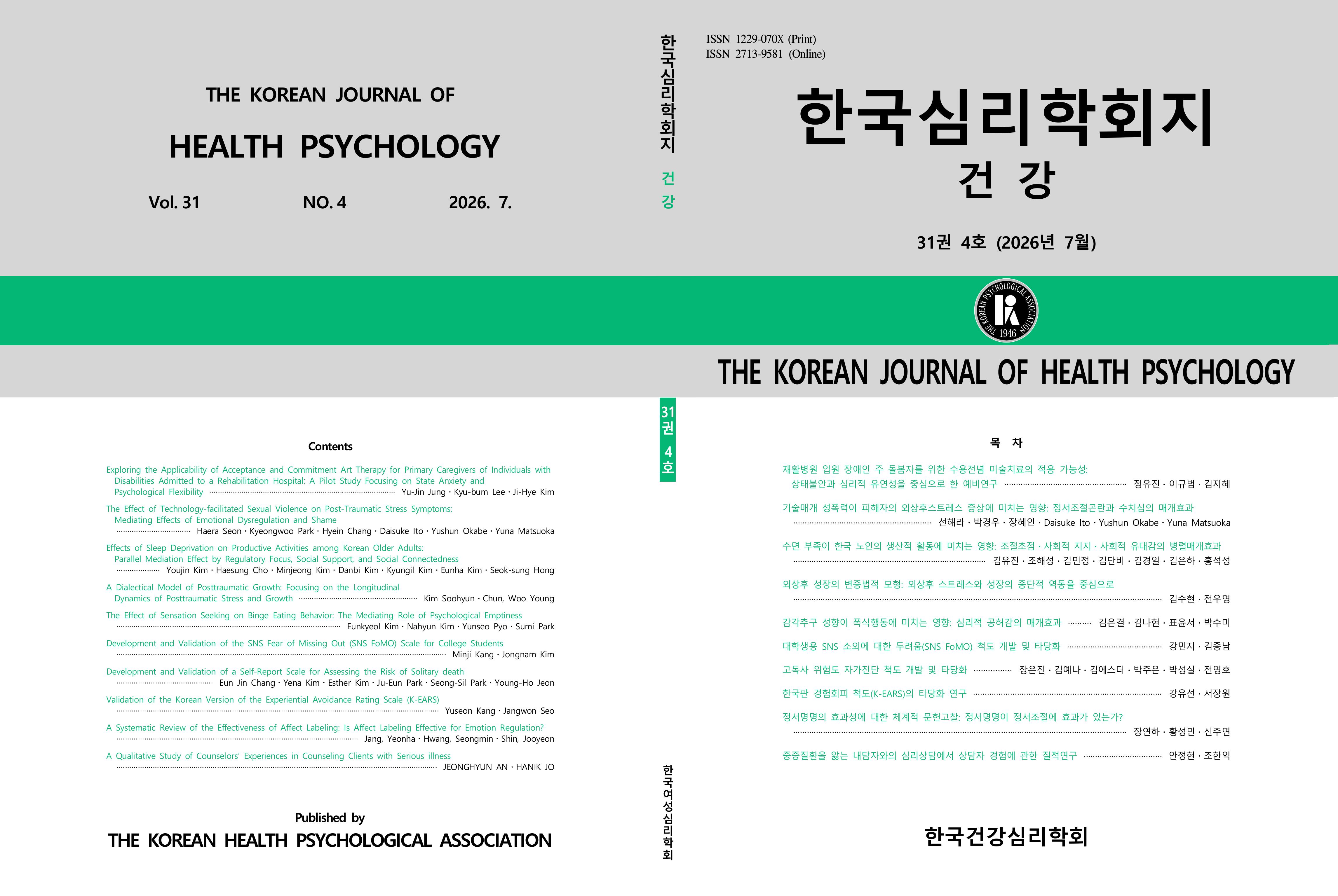
Development and Validation of a Self-Report Scale for Assessing the Risk of Solitary death
Yena Kim (Department of Counseling Psychology, Korea Baptist Theological University/Seminary)
Esther Kim (Korea Addiction Forum)
Ju-Eun Park (Korea Baptist Theological University/ Seminary)
Seong-Sil Park (Korea Baptist Theological University/ Seminary)
Young-Ho Jeon (Korea Social Security Information Service)

Abstract
This study aimed to develop and validate a self-report screening scale to help individuals easily assess their risk of solitary death. We began by conducting a comprehensive literature review and expert consultations to establish the conceptual framework and subdomains of solitary death risk, from which 22 preliminary items were generated. After expert content validity evaluation and a pilot study involving 600 adults from an online panel, eight final items were selected.A main survey with a separate sample of 600 adults was then conducted to evaluate the scale's reliability and validity. The results supported a unidimensional structure comprising the eight items, and confirmatory factor analysis indicated that the modified model demonstrated an overall acceptable fit. The scale exhibited high internal consistency (Cronbach's α = .91). Furthermore, the scale showed significant positive correlations with loneliness, social isolation, depression, and anxiety, and significant negative correlations with social network and subjective well-being, thereby supporting both convergent and discriminant validity. Test-retest reliability was also statistically significant, indicating the scale's temporal stability. These findings suggest that the developed scale is a reliable and valid instrument that comprehensively captures the multidimensional nature of solitary death risk. The study's implications, practical applications, and limitations are discussed in detail.
- keywords
- solitary death, social isolation, loneliness, scale development, validation, self-report
- Received
- 2026-04-09
- Revised
- 2026-06-08
- Accepted
- 2026-06-08
- Published
- 2026-07-30
- Downloaded
- Viewed
- 0KCI Citations
- 0WOS Citations