


- ENGLISH
- P-ISSN1229-070X
- E-ISSN2713-9581
- KCI
논문 상세
- 2026 (31권)
- 2025 (30권)
- 2024 (29권)
- 2023 (28권)
- 2022 (27권)
- 2021 (26권)
- 2020 (25권)
- 2019 (24권)
- 2018 (23권)
- 2017 (22권)
- 2016 (21권)
- 2015 (20권)
- 2014 (19권)
- 2013 (18권)
- 2012 (17권)
- 2011 (16권)
- 2010 (15권)
- 2009 (14권)
- 2008 (13권)
- 2007 (12권)
- 2006 (11권)
- 2005 (10권)
- 2004 (9권)
- 2003 (8권)
- 2002 (7권)
- 2001 (6권)
- 2000 (5권)
- 1999 (4권)
- 1998 (3권)
- 1997 (2권)
- 1996 (1권)
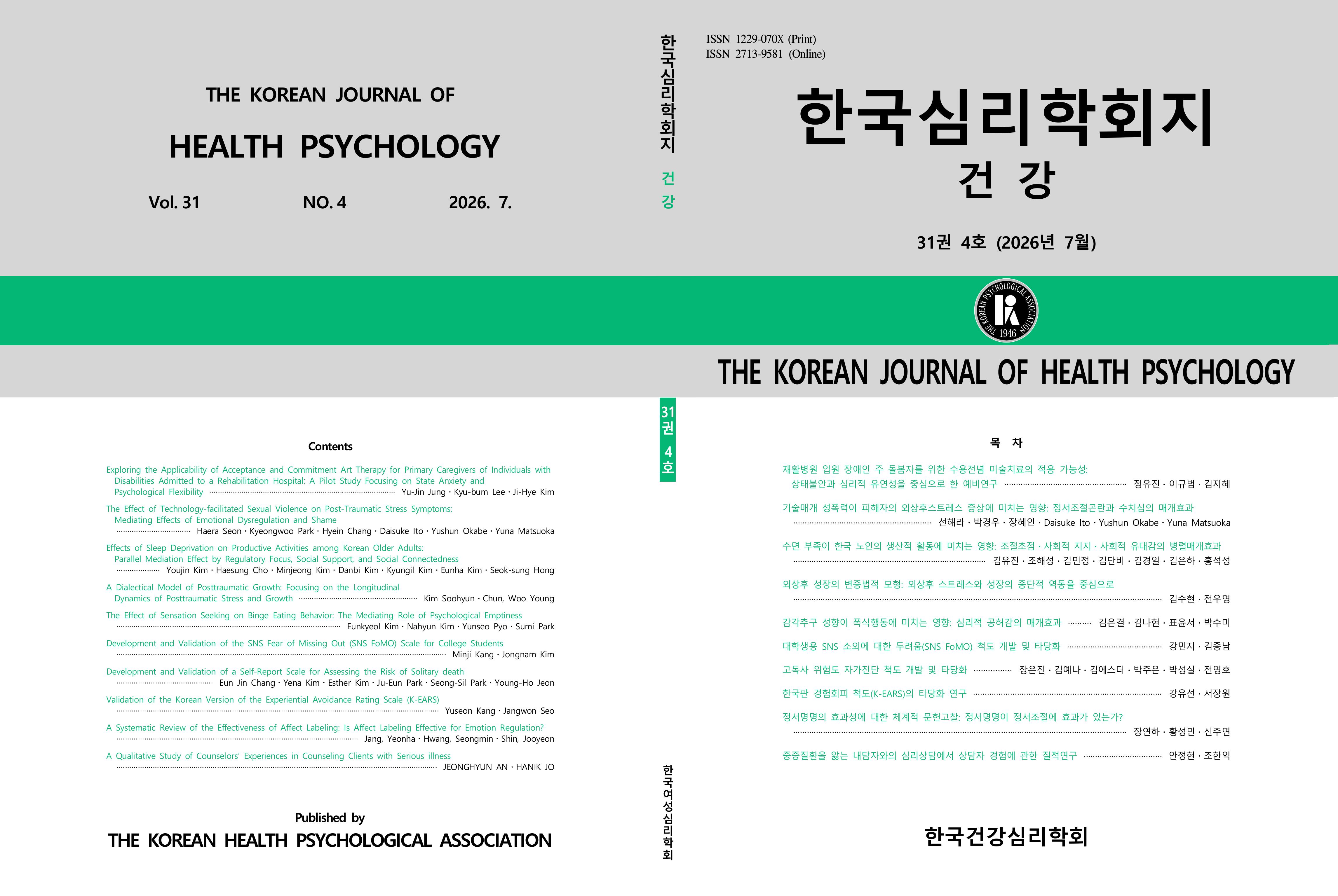
고독사 위험도 자가진단 척도 개발 및 타당화
Development and Validation of a Self-Report Scale for Assessing the Risk of Solitary death
김예나(Yena Kim) (한국침례신학대학교)
김에스더(Esther Kim) (사단법인 중독포럼)
박주은(Ju-Eun Park) (한국침례신학대학교)
박성실(Seong-Sil Park) (한국침례신학대학교)
전영호(Young-Ho Jeon) (한국사회보장정보원)

초록
본 연구의 목적은 개인이 스스로 고독사와 관련된 심리사회적 취약성 및 위험 징후를 간편하게 점검할 수 있는 자가진단형 척도를 개발하고, 그 심리측정학적 속성을 검증하는 데 있다. 이를 위해 문헌검토와 전문가 자문을 통해 고독사 위험의 개념과 하위요인을 도출하고, 22개의 예비문항을 구성하였다. 이후 전문가에 의한 내용타당도 검토와 온라인 성인 패널 600명을 대상으로 한 예비조사를 실시하여 8개의 최종문항을 선정하였으며, 추가로 성인 패널 600명을 대상으로 본조사를 수행하여 척도의 신뢰도와 타당도를 검증하였다. 연구 결과, 최종 8문항으로 구성된 단일요인 구조의 척도가 도출되었다. 확인적 요인분석 결과, 모형 수정 후 전반적으로 양호한 적합도를 보였으며, 척도의 내적합치도는 .91로 나타났다. 또한 외로움, 사회적 고립, 우울 및 불안과는 유의한 정적 상관을, 사회적 관계망 및 행복감과는 유의한 부적 상관을 보여 수렴타당도와 변별타당도가 지지되었다. 나아가 검사-재검사 신뢰도 역시 통계적으로 유의하게 나타나, 척도의 시간적 안정성이 확인되었다. 이러한 결과는 본 척도가 고독사 위험의 다차원적 특성을 통합적으로 반영하는 신뢰롭고 타당한 도구임을 시사한다. 끝으로 본 연구의 의의와 시사점 및 한계점을 논의에서 자세히 제시하였다.
- keywords
- 고독사, 사회적 고립, 외로움, 척도개발, 타당화, 자가보고
Abstract
This study aimed to develop and validate a self-report screening scale to help individuals easily assess their risk of solitary death. We began by conducting a comprehensive literature review and expert consultations to establish the conceptual framework and subdomains of solitary death risk, from which 22 preliminary items were generated. After expert content validity evaluation and a pilot study involving 600 adults from an online panel, eight final items were selected.A main survey with a separate sample of 600 adults was then conducted to evaluate the scale's reliability and validity. The results supported a unidimensional structure comprising the eight items, and confirmatory factor analysis indicated that the modified model demonstrated an overall acceptable fit. The scale exhibited high internal consistency (Cronbach's α = .91). Furthermore, the scale showed significant positive correlations with loneliness, social isolation, depression, and anxiety, and significant negative correlations with social network and subjective well-being, thereby supporting both convergent and discriminant validity. Test-retest reliability was also statistically significant, indicating the scale's temporal stability. These findings suggest that the developed scale is a reliable and valid instrument that comprehensively captures the multidimensional nature of solitary death risk. The study's implications, practical applications, and limitations are discussed in detail.
- keywords
- solitary death, social isolation, loneliness, scale development, validation, self-report
- 투고일Received
- 2026-04-09
- 수정일Revised
- 2026-06-08
- 게재확정일Accepted
- 2026-06-08
- 출판일Published
- 2026-07-30
- 다운로드 수
- 조회수
- 0KCI 피인용수
- 0WOS 피인용수