
Korean Journal of Health Psychology
- KOREAN
- P-ISSN1229-070X
- E-ISSN2713-9581
- KCI
Article Contents
- 2026 (Vol.31)
- 2025 (Vol.30)
- 2024 (Vol.29)
- 2023 (Vol.28)
- 2022 (Vol.27)
- 2021 (Vol.26)
- 2020 (Vol.25)
- 2019 (Vol.24)
- 2018 (Vol.23)
- 2017 (Vol.22)
- 2016 (Vol.21)
- 2015 (Vol.20)
- 2014 (Vol.19)
- 2013 (Vol.18)
- 2012 (Vol.17)
- 2011 (Vol.16)
- 2010 (Vol.15)
- 2009 (Vol.14)
- 2008 (Vol.13)
- 2007 (Vol.12)
- 2006 (Vol.11)
- 2005 (Vol.10)
- 2004 (Vol.9)
- 2003 (Vol.8)
- 2002 (Vol.7)
- 2001 (Vol.6)
- 2000 (Vol.5)
- 1999 (Vol.4)
- 1998 (Vol.3)
- 1997 (Vol.2)
- 1996 (Vol.1)
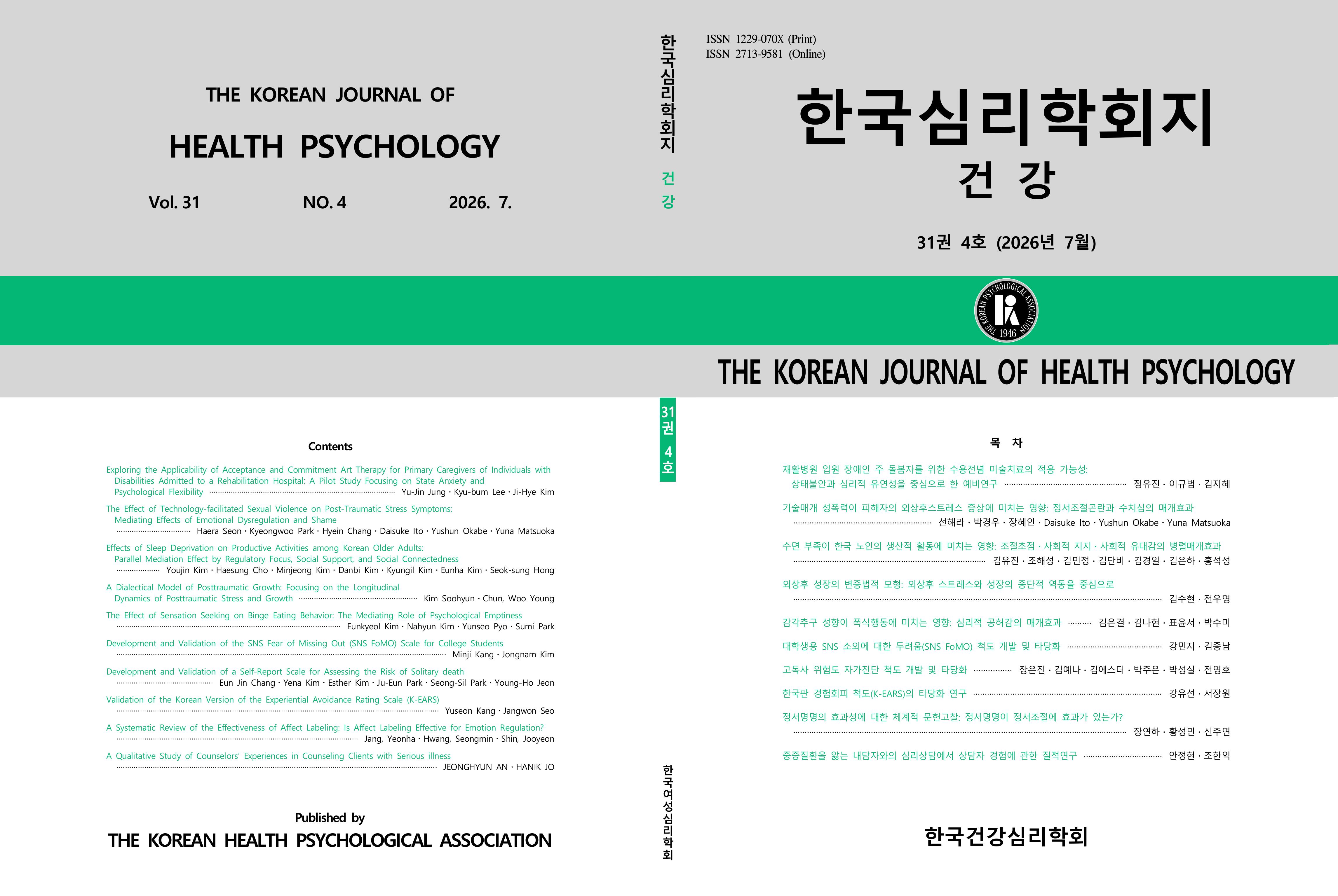
Validation of the Korean Version of the Experiential Avoidance Rating Scale (K-EARS)
Jangwon Seo (Department of Psychology, Jeonbuk National University)

Abstract
Experiential avoidance refers to a behavioral tendency to avoid contact with unwanted internal experiences and to alter their form or frequency, and has been identified as a key process contributing to the development and maintenance of various psychological disorders. As the importance of this construct has become increasingly recognized, several instruments have been developed to assess experiential avoidance. However, existing measures have shown limitations in terms of factor-structural stability. To address these limitations, the Experiential Avoidance Rating Scale (EARS) was recently developed. The present study aimed to translate the EARS into Korean and examine its psychometric properties. Data were collected from 800 Korean adults aged 19 years and older. Internal consistency and factor structure were examined, and measurement invariance across gender and age groups was tested to determine whether the structural properties of the scale differed across subgroups. In addition, convergent, discriminant, and concurrent validity were evaluated by examining associations with related and distinct constructs. Incremental validity was further examined using hierarchical regression analyses. Results indicated that the Korean version of the EARS demonstrated good internal consistency and a unidimensional factor structure consistent with the original scale. Measurement invariance across gender and age groups was supported, indicating that comparisons across subgroups are appropriate. Convergent, discriminant, concurrent, and incremental validity were all found to be satisfactory. These findings suggest that the Korean version of the EARS is a promising instrument for the valid assessment of experiential avoidance.
- keywords
- experiential avoidance, Experiential Avoidance Rating Scale, Reliability, Validity
- Received
- 2026-03-13
- Revised
- 2026-05-14
- Accepted
- 2026-06-15
- Published
- 2026-07-30
- Downloaded
- Viewed
- 0KCI Citations
- 0WOS Citations