


- ENGLISH
- P-ISSN1229-070X
- E-ISSN2713-9581
- KCI
논문 상세
- 2026 (31권)
- 2025 (30권)
- 2024 (29권)
- 2023 (28권)
- 2022 (27권)
- 2021 (26권)
- 2020 (25권)
- 2019 (24권)
- 2018 (23권)
- 2017 (22권)
- 2016 (21권)
- 2015 (20권)
- 2014 (19권)
- 2013 (18권)
- 2012 (17권)
- 2011 (16권)
- 2010 (15권)
- 2009 (14권)
- 2008 (13권)
- 2007 (12권)
- 2006 (11권)
- 2005 (10권)
- 2004 (9권)
- 2003 (8권)
- 2002 (7권)
- 2001 (6권)
- 2000 (5권)
- 1999 (4권)
- 1998 (3권)
- 1997 (2권)
- 1996 (1권)
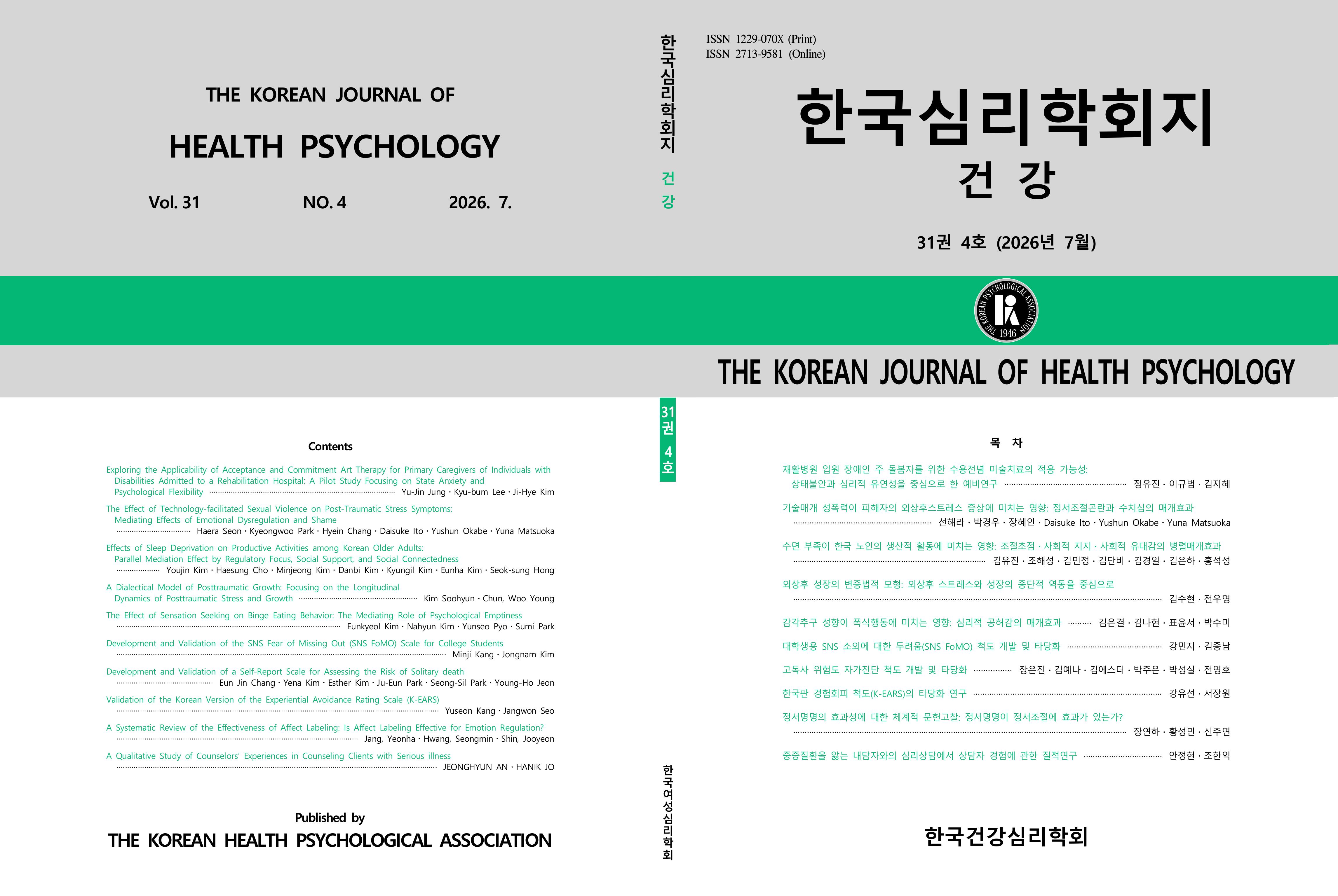
한국판 경험회피 척도(K-EARS)의 타당화 연구
Validation of the Korean Version of the Experiential Avoidance Rating Scale (K-EARS)
서장원(Jangwon Seo) (전북대학교)

초록
경험회피는 불편한 내적 경험과의 접촉을 회피하고 그 형태나 빈도를 변화시키려는 행동 경향이며, 다양한 심리장애의 발달과 유지에 기여하는 것으로 확인되었다. 개념의 중요성이 확인됨에 따라 경험회피를 측정하는 도구들이 다양하게 개발되었지만, 그동안 개발된 도구들은 요인 구조의 안정성 측면에서 한계가 있는 것으로 나타났다. 이러한 한계를 보완하기 위하여, 최근 경험회피 척도(Experiential Avoidance Rating Scale: EARS)가 개발되었다. 이에 본 연구에서는 EARS를 한국어로 번안하여 타당화하고자 하였다. 이를 위해 국내 만 19세 이상 성인 800명을 대상으로 자료를 수집하였으며, 내적 일치도와 요인 구조를 탐색하였다. 특히 성별 및 연령에 대한 측정동일성 검정을 실시하여 성별 및 연령에 따라 측정 도구의 구조적 특성이 달라지는지 확인하였다. 또한 관련이 있거나 구분되는 개념들과의 관계성을 분석하여 수렴타당도와 변별타당도, 공존 타당도를 검토하였다. 또한 위계적 회귀분석을 통해 EARS의 추가 설명력을 확인하고자 증분타당도를 검토하였다. 분석 결과, 한국판 EARS는 양호한 내적 일치도를 보였으며, 원척도와 동일한 1요인 구조를 나타내었다. 성별 및 연령 집단 간 측정동일성 또한 확인되어 하위 집단 간 점수 비교가 가능한 것으로 나타났다. 수렴타당도, 변별타당도, 공존타당도 및 증분타당도 역시 양호한 것으로 확인되었다. 이러한 결과는 한국판 EARS가 경험회피를 타당하게 평가할 수 있는 유력한 도구임을 시사한다.
- keywords
- 경험회피, 경험회피 척도, 신뢰도, 타당도
Abstract
Experiential avoidance refers to a behavioral tendency to avoid contact with unwanted internal experiences and to alter their form or frequency, and has been identified as a key process contributing to the development and maintenance of various psychological disorders. As the importance of this construct has become increasingly recognized, several instruments have been developed to assess experiential avoidance. However, existing measures have shown limitations in terms of factor-structural stability. To address these limitations, the Experiential Avoidance Rating Scale (EARS) was recently developed. The present study aimed to translate the EARS into Korean and examine its psychometric properties. Data were collected from 800 Korean adults aged 19 years and older. Internal consistency and factor structure were examined, and measurement invariance across gender and age groups was tested to determine whether the structural properties of the scale differed across subgroups. In addition, convergent, discriminant, and concurrent validity were evaluated by examining associations with related and distinct constructs. Incremental validity was further examined using hierarchical regression analyses. Results indicated that the Korean version of the EARS demonstrated good internal consistency and a unidimensional factor structure consistent with the original scale. Measurement invariance across gender and age groups was supported, indicating that comparisons across subgroups are appropriate. Convergent, discriminant, concurrent, and incremental validity were all found to be satisfactory. These findings suggest that the Korean version of the EARS is a promising instrument for the valid assessment of experiential avoidance.
- keywords
- experiential avoidance, Experiential Avoidance Rating Scale, Reliability, Validity
- 투고일Received
- 2026-03-13
- 수정일Revised
- 2026-05-14
- 게재확정일Accepted
- 2026-06-15
- 출판일Published
- 2026-07-30
- 다운로드 수
- 조회수
- 0KCI 피인용수
- 0WOS 피인용수