


- ENGLISH
- P-ISSN1229-070X
- E-ISSN2713-9581
- KCI
논문 상세
- 2026 (31권)
- 2025 (30권)
- 2024 (29권)
- 2023 (28권)
- 2022 (27권)
- 2021 (26권)
- 2020 (25권)
- 2019 (24권)
- 2018 (23권)
- 2017 (22권)
- 2016 (21권)
- 2015 (20권)
- 2014 (19권)
- 2013 (18권)
- 2012 (17권)
- 2011 (16권)
- 2010 (15권)
- 2009 (14권)
- 2008 (13권)
- 2007 (12권)
- 2006 (11권)
- 2005 (10권)
- 2004 (9권)
- 2003 (8권)
- 2002 (7권)
- 2001 (6권)
- 2000 (5권)
- 1999 (4권)
- 1998 (3권)
- 1997 (2권)
- 1996 (1권)
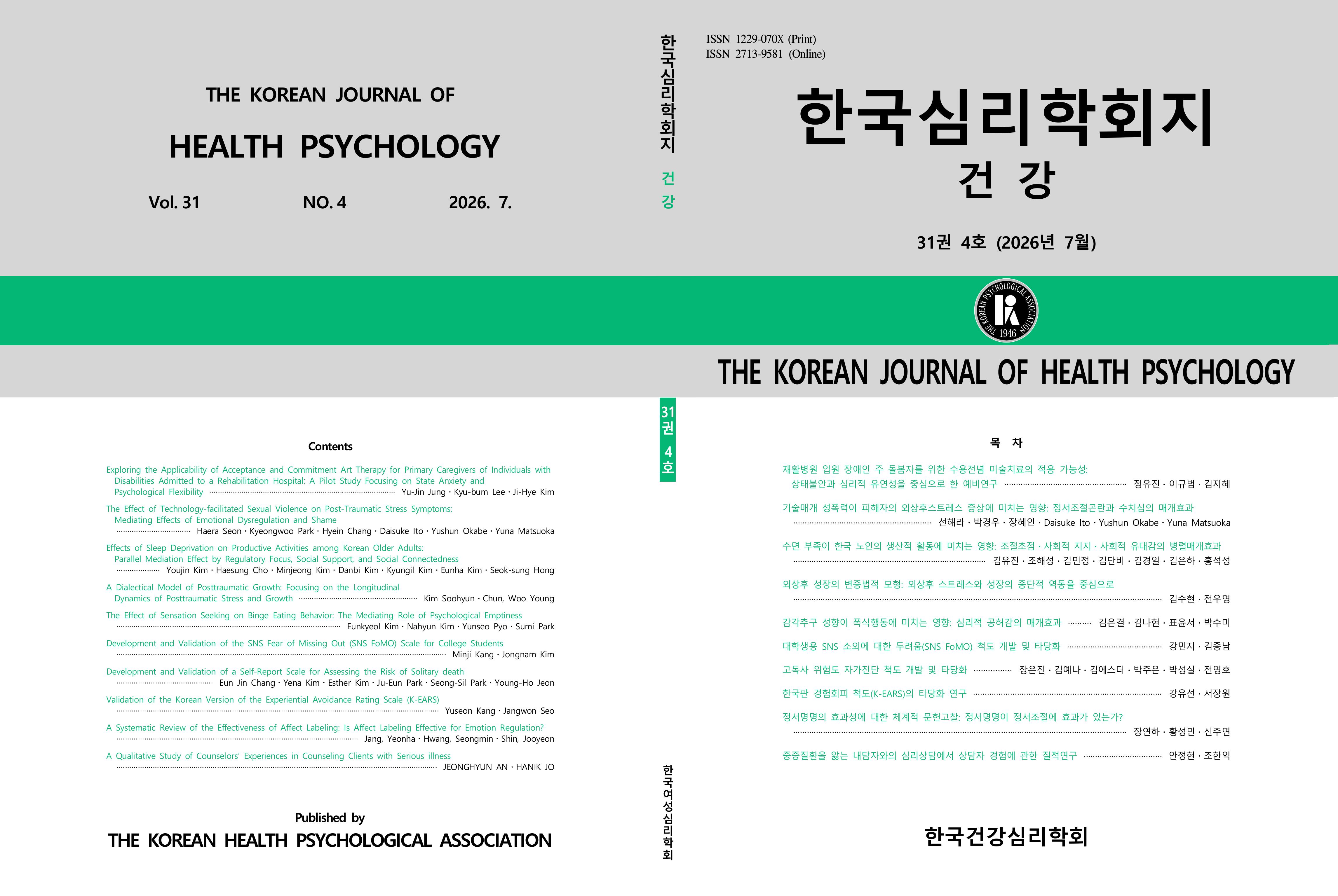
재활병원 입원 장애인 주 돌봄자를 위한 수용전념 미술치료의 적용 가능성: 상태불안과 심리적 유연성을 중심으로 한 예비연구
Exploring the Applicability of Acceptance and Commitment Art Therapy for Primary Caregivers of Individuals with Disabilities Admitted to a Rehabilitation Hospital: A Pilot Study Focusing on State Anxiety and Psychological Flexibility
이규범(Kyu-bum Lee) (서울재활병원 재활의학과)
김지혜(Ji-Hye Kim) (서울재활병원 가족지원센터)

초록
본 연구는 재활병원에 입원 중인 장애인 주 돌봄자를 대상으로 수용전념 미술치료(Acceptance and Commitment Art Therapy: ACAT)의 적용 가능성과 초기 효과를 탐색하기 위한 예비연구이다. 연구 설계는 비동등성 대조군 사전·사후 설계를 적용하였으며, 연구 참여자는 서울 소재 재활병원에 입원 중인 장애인의 돌봄자 17명으로, 처치집단(9명)과 비교집단(8명)으로 구성되었다. 처치집단은 주 1회, 회기당 40분씩 총 8회기의 개별 ACAT에 참여하였으며, 비교집단에는 동일 기간 동안 무처치 상태를 유지하였다. ACAT 적용 전후의 변화를 살펴보기 위해 상태불안, 심리적 유연성 및 타액 코르티솔을 사전·사후 측정하였고, 소표본의 특성을 고려하여 비모수 통계 검정을 실시하였다. 연구 결과, 처치집단은 상태불안이 유의하게 감소하고 심리적 유연성이 유의하게 증가한 반면, 비교집단에서는 두 변인 모두 유의한 변화가 관찰되지 않았다. 집단 간 변화량 비교에서 상태불안의 차이는 통계적으로 유의하지 않았으나, 심리적 유연성 변화량에서는 유의한 차이가 나타났다. 그러나 사전점수를 보정한 추가분석에서는 상태불안, 심리적 유연성 및 타액 코르티솔 모두에서 집단 간 차이가 유의하지 않았다. 타액 코르티솔은 두 집단 모두에서 유의한 변화가 확인되지 않았다. 본 연구는 재활병원의 장애인 주 돌봄자를 대상으로 ACAT를 적용함으로써 가족 심리 지원의 가능성을 탐색했다는 점에서 의의를 지닌다. 또한 본 연구의 결과는 재활병원 임상 현장의 장애인 가족 돌봄자를 위한 맞춤형 심리 지원 프로그램 체계화를 위한 기초 자료를 제공한다.
- keywords
- 수용전념 미술치료(ACAT), 장애인 돌봄자, 재활병원, 상태불안, 심리적 유연성
Abstract
This pilot study investigated the applicability of Acceptance and Commitment Art Therapy (ACAT) for primary caregivers of individuals with disabilities in a rehabilitation hospital, focusing on state anxiety and psychological flexibility. We employed a nonequivalent control group pretest-posttest design. Seventeen primary caregivers of individuals with disabilities admitted to a rehabilitation hospital in Seoul, South Korea, were assigned to either the treatment group (n=9) or the comparison group (n=8). The treatment group received eight weekly 40-minute individual ACAT sessions, while the comparison group received no intervention during the same period. To examine changes before and after ACAT, state anxiety, psychological flexibility, and salivary cortisol levels were measured at pretest and posttest. Due to the small sample size, nonparametric statistical methods were used for data analysis. Results showed that the treatment group experienced significant within-group decreases in state anxiety and significant within-group increases in psychological flexibility, while the comparison group showed no significant changes in these variables. Although the between-group difference in state anxiety changes was not statistically significant, there was a significant between-group difference in the change in psychological flexibility. However, in the additional analysis controlling for pretest scores, no significant between-group differences were found in state anxiety, psychological flexibility, or salivary cortisol. No significant changes in salivary cortisol levels were observed in either group. These findings indicate the applicability of ACAT for primary caregivers of individuals with disabilities in rehabilitation hospitals and offer preliminary data for systematizing tailored psychological support programs in rehabilitation settings.
- keywords
- Acceptance and Commitment Art Therapy (ACAT), primary caregivers of individuals with disabilities, rehabilitation hospital, state anxiety, psychological flexibility
- 투고일Received
- 2026-06-04
- 수정일Revised
- 2026-07-02
- 게재확정일Accepted
- 2026-07-02
- 출판일Published
- 2026-07-30
- 다운로드 수
- 조회수
- 0KCI 피인용수
- 0WOS 피인용수