


- ENGLISH
- P-ISSN1229-070X
- E-ISSN2713-9581
- KCI
논문 상세
- 2026 (31권)
- 2025 (30권)
- 2024 (29권)
- 2023 (28권)
- 2022 (27권)
- 2021 (26권)
- 2020 (25권)
- 2019 (24권)
- 2018 (23권)
- 2017 (22권)
- 2016 (21권)
- 2015 (20권)
- 2014 (19권)
- 2013 (18권)
- 2012 (17권)
- 2011 (16권)
- 2010 (15권)
- 2009 (14권)
- 2008 (13권)
- 2007 (12권)
- 2006 (11권)
- 2005 (10권)
- 2004 (9권)
- 2003 (8권)
- 2002 (7권)
- 2001 (6권)
- 2000 (5권)
- 1999 (4권)
- 1998 (3권)
- 1997 (2권)
- 1996 (1권)
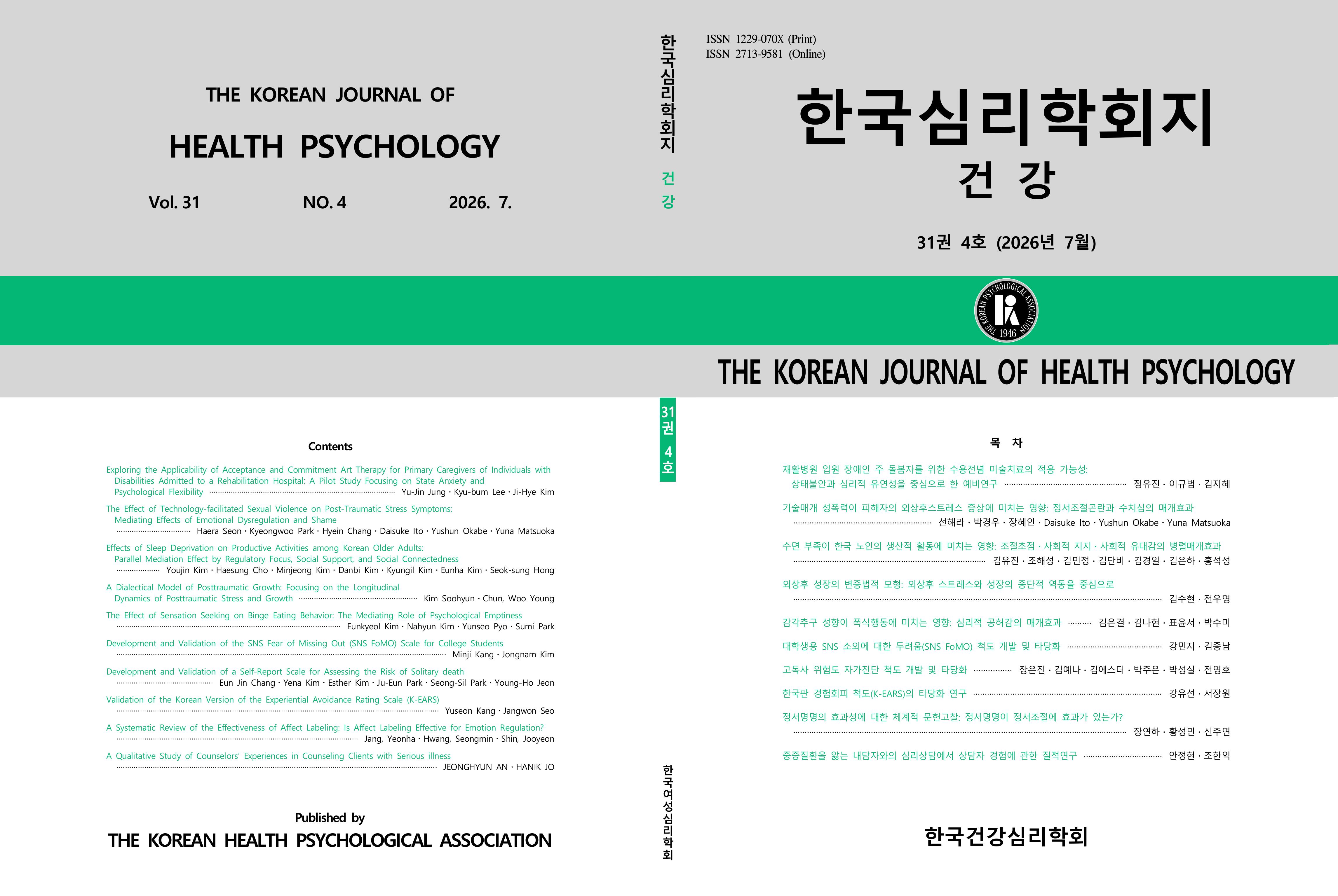
기술매개 성폭력이 피해자의 외상후스트레스 증상에 미치는 영향: 정서조절곤란과 수치심의 매개효과
The Effect of Technology-facilitated Sexual Violence on Post-Traumatic Stress Symptoms: Mediating Effects of Emotional Dysregulation and Shame
박경우(Kyeongwoo Park) (성균관대학교 응용심리연구소)
장혜인(Hyein Chang) (성균관대학교)
ItoDaisuke(Daisuke Ito) (Hyogo University of Teacher Education)
OkabeYushun(Yushun Okabe) (Kitasato University, School of Allied Health Sciences)
MatsuokaYuna(Yuna Matsuoka) (Hyogo University of Teacher Education)

초록
기술매개 성폭력(Technology-facilitated sexual violence: TFSV)은 온라인 및 디지털 커뮤니케이션 기술을 매개로 발생하는 성폭력을 지칭하며, 그 발생이 증가하고 있으나 피해자들의 정신건강에 미치는 영향과 그 메커니즘은 많이 연구되지 않았다. 본 연구는 기술매개 성폭력에 노출된 경험과 외상후스트레스 증상의 관계를 살펴보고, 이 과정에서 정서조절곤란과 수치심의 역할을 확인하고자 하였다. 한국 성인 315명을 대상으로 기술매개 성폭력 피해 경험, 외상후스트레스장애 증상, 수치심 및 정서조절곤란을 자기보고식 질문지를 통해 측정하였다. 구조방정식 분석 결과, 기술매개 성폭력 피해 경험이 외상후스트레스 증상에 유의한 정적 영향을 미치는 것으로 나타났으며, 이 관계를 정서조절곤란이 유의하게 매개하였다. 수치심의 매개효과는 유의하지 않았으나, 정서조절곤란과 수치심의 순차매개효과는 유의하였다. 이는 기술매개 성폭력 피해가 정서조절의 어려움을 유발하고, 수치심이 심화되어 외상후스트레스 증상 수준의 증가로 이어짐을 의미한다. 본 연구는 기술매개 성폭력이 피해자의 정신건강에 미치는 영향과 심리적 기제를 살펴봄으로써 최근 증가하고 있는 기술매개 성폭력 피해에 대한 사회적 관심을 환기하고, 치료 표적을 제시한다는 임상적 함의를 가진다.
- keywords
- 기술매개 성폭력, 정서조절곤란, 수치심, 외상후스트레스 증상
Abstract
Technology-facilitated sexual violence (TFSV) refers to sexual violence that occurs through online and digital communication technology. Although its incidence is increasing, the effects on victims' mental health and the underlying mechanisms have not been extensively studied. This study examined the relationship between TFSV exposure and post-traumatic stress disorder, and attempted to identify the roles of emotion dysregulation and shame in this process. The experiences of TFSV, post-traumatic stress symptoms, emotion dysregulation, and shame were measured through a self-report questionnaire completed by 315 Korean adults. Structural equation modeling revealed a positive TFSV and post-traumatic stress symptoms, a relationship significantly mediated by emotion dysregulation. While the mediating effect of shame was not significant, the sequential mediating effect of emotion dysregulation and shame on the relationship between TFSV and post-traumatic stress symptoms was significant. This finding indicates that TFSV leads to emotional dysregulation, which in turn intensifies shame, contributing to an increase in post-traumatic stress symptoms. This study has clinical implications, as it aims to draw social interest to the rising damage caused by TFSV and proposes treatment targets by examining its effects on victims' mental health and psychological mechanisms.
- keywords
- Technology-Facilitated Sexual Violence, post-traumatic stress symptoms, shame, emotion dysregulation
- 투고일Received
- 2025-09-01
- 수정일Revised
- 2026-03-04
- 게재확정일Accepted
- 2026-05-12
- 출판일Published
- 2026-07-30
- 다운로드 수
- 조회수
- 0KCI 피인용수
- 0WOS 피인용수