


- ENGLISH
- P-ISSN1229-070X
- E-ISSN2713-9581
- KCI
논문 상세
- 2026 (31권)
- 2025 (30권)
- 2024 (29권)
- 2023 (28권)
- 2022 (27권)
- 2021 (26권)
- 2020 (25권)
- 2019 (24권)
- 2018 (23권)
- 2017 (22권)
- 2016 (21권)
- 2015 (20권)
- 2014 (19권)
- 2013 (18권)
- 2012 (17권)
- 2011 (16권)
- 2010 (15권)
- 2009 (14권)
- 2008 (13권)
- 2007 (12권)
- 2006 (11권)
- 2005 (10권)
- 2004 (9권)
- 2003 (8권)
- 2002 (7권)
- 2001 (6권)
- 2000 (5권)
- 1999 (4권)
- 1998 (3권)
- 1997 (2권)
- 1996 (1권)
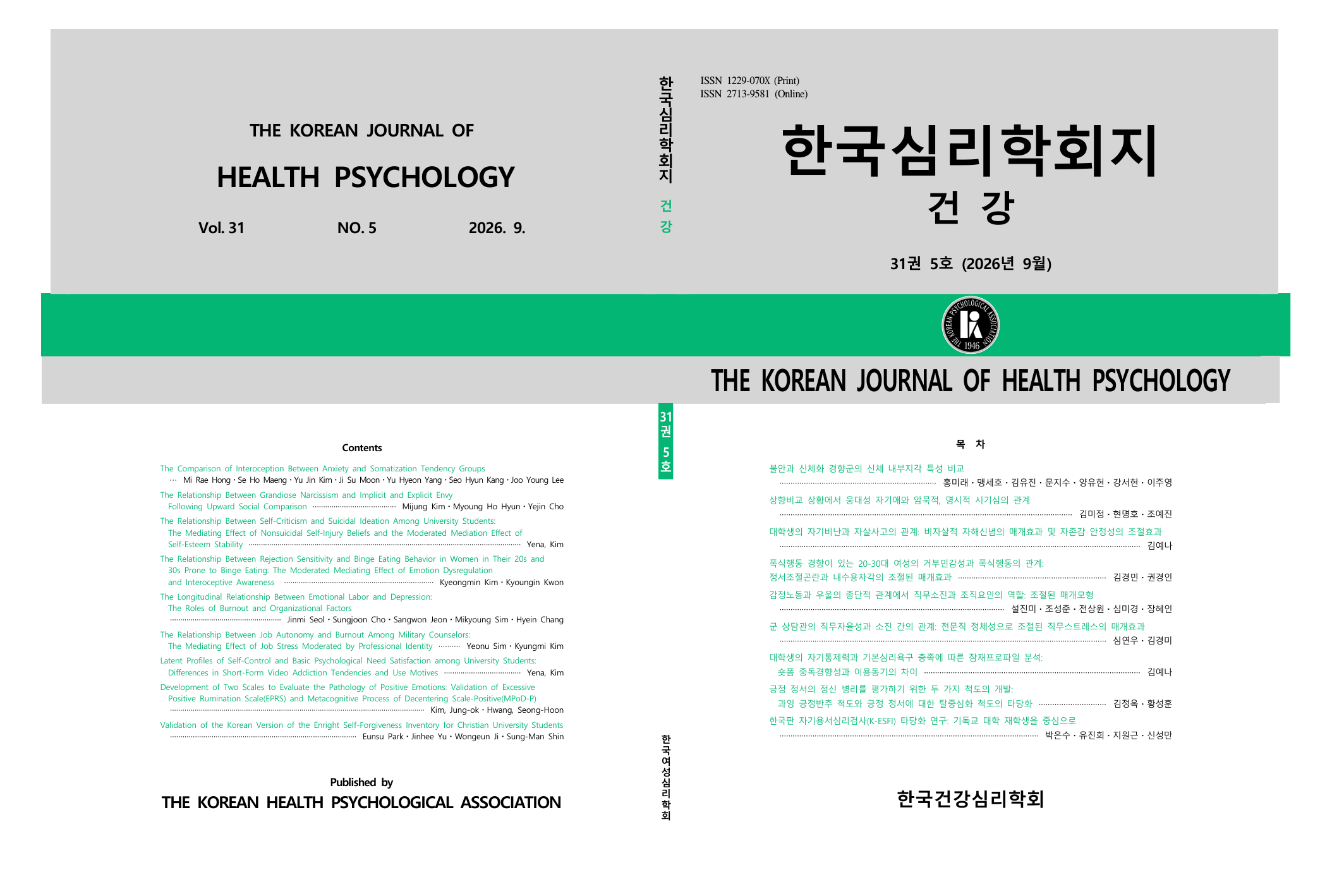
상향비교 상황에서 웅대성 자기애와 암묵적, 명시적 시기심의 관계
The Relationship Between Grandiose Narcissism and Implicit and Explicit Envy Following Upward Social Comparison
현명호(Myoung Ho Hyun) (중앙대학교)
조예진(Yejin Cho) (인제대학교)

초록
본 연구는 웅대성 자기애와 시기심의 관련성에 대한 경험연구와 임상적 관점의 상이한 주장을 통합적으로 이해하고자 실시되었다. 웅대성 자기애에서 명시적 반응과 암묵적 반응이 불일치하는 경향이 있다는 기존 연구를 바탕으로, 시기심을 자기보고를 통한 명시적 시기심과 정서 오귀인 절차(Affect Misattribution Procedure)를 사용한 암묵적 시기심으로 구분하여 측정하였다. 상향비교 상황에서 웅대성 자기애 수준에 따라 암묵적 시기심과 명시적 시기심, 그리고 두 시기심 간 차이가 어떻게 달라지는지를 확인하였다. 총 114명의 대학생이 본 연구에 참여하였으며, 상향비교와 중립비교 처치조건에 각각 56명과 58명이 배치되었다. 처치 이후 명시적 시기심(설문지)과 암묵적 시기심(정서 오귀인 절차)을 측정하였다. 연구 결과, 처치조건이 명시적 시기심에 미치는 영향에서는 웅대성 자기애의 조절효과가 확인되지 않았다. 반면 처치조건이 암묵적 시기심에 미치는 영향에서는 웅대성 자기애의 조절효과가 확인되었으며, 암묵적 시기심과 명시적 시기심 간 차이에 대해서도 웅대성 자기애의 조절효과가 나타났다. 이는 웅대성 자기애의 우월한 자기상이 내면의 취약한 자기를 방어하고 은폐한다는 마스크 모델(mask model)을 지지하는 결과이다.
- keywords
- 웅대성 자기애, 명시적 시기심, 암묵적 시기심, 사회비교
Abstract
This study addressed the conflict between empirical and clinical accounts of the relationship between grandiose narcissism and envy. Because earlier findings point to a discrepancy between explicit and implicit responses, envy was assessed at both levels: explicit envy with a self-report questionnaire and implicit envy with the Affect Misattribution Procedure (AMP). A total of 114 undergraduate students took part in either an upward social comparison condition (n=56) or a neutral comparison condition (n=58). Grandiose narcissism did not moderate the effect of the comparison condition on explicit envy. It did, however, significantly moderate the effects of the comparison condition on implicit envy and on the discrepancy between implicit and explicit envy. These findings support the mask model, according to which the grandiose self serves to defend against and conceal an underlying vulnerable self.
- keywords
- grandiose narcissism, explicit envy, implicit envy, upward social comparison
- 투고일Received
- 2026-07-31
- 수정일Revised
- 2026-08-18
- 게재확정일Accepted
- 2026-08-18
- 출판일Published
- 2026-09-30
- 다운로드 수
- 조회수
- 0KCI 피인용수
- 0WOS 피인용수