
Korean Journal of Health Psychology
- KOREAN
- P-ISSN1229-070X
- E-ISSN2713-9581
- KCI
Article Contents
- 2026 (Vol.31)
- 2025 (Vol.30)
- 2024 (Vol.29)
- 2023 (Vol.28)
- 2022 (Vol.27)
- 2021 (Vol.26)
- 2020 (Vol.25)
- 2019 (Vol.24)
- 2018 (Vol.23)
- 2017 (Vol.22)
- 2016 (Vol.21)
- 2015 (Vol.20)
- 2014 (Vol.19)
- 2013 (Vol.18)
- 2012 (Vol.17)
- 2011 (Vol.16)
- 2010 (Vol.15)
- 2009 (Vol.14)
- 2008 (Vol.13)
- 2007 (Vol.12)
- 2006 (Vol.11)
- 2005 (Vol.10)
- 2004 (Vol.9)
- 2003 (Vol.8)
- 2002 (Vol.7)
- 2001 (Vol.6)
- 2000 (Vol.5)
- 1999 (Vol.4)
- 1998 (Vol.3)
- 1997 (Vol.2)
- 1996 (Vol.1)
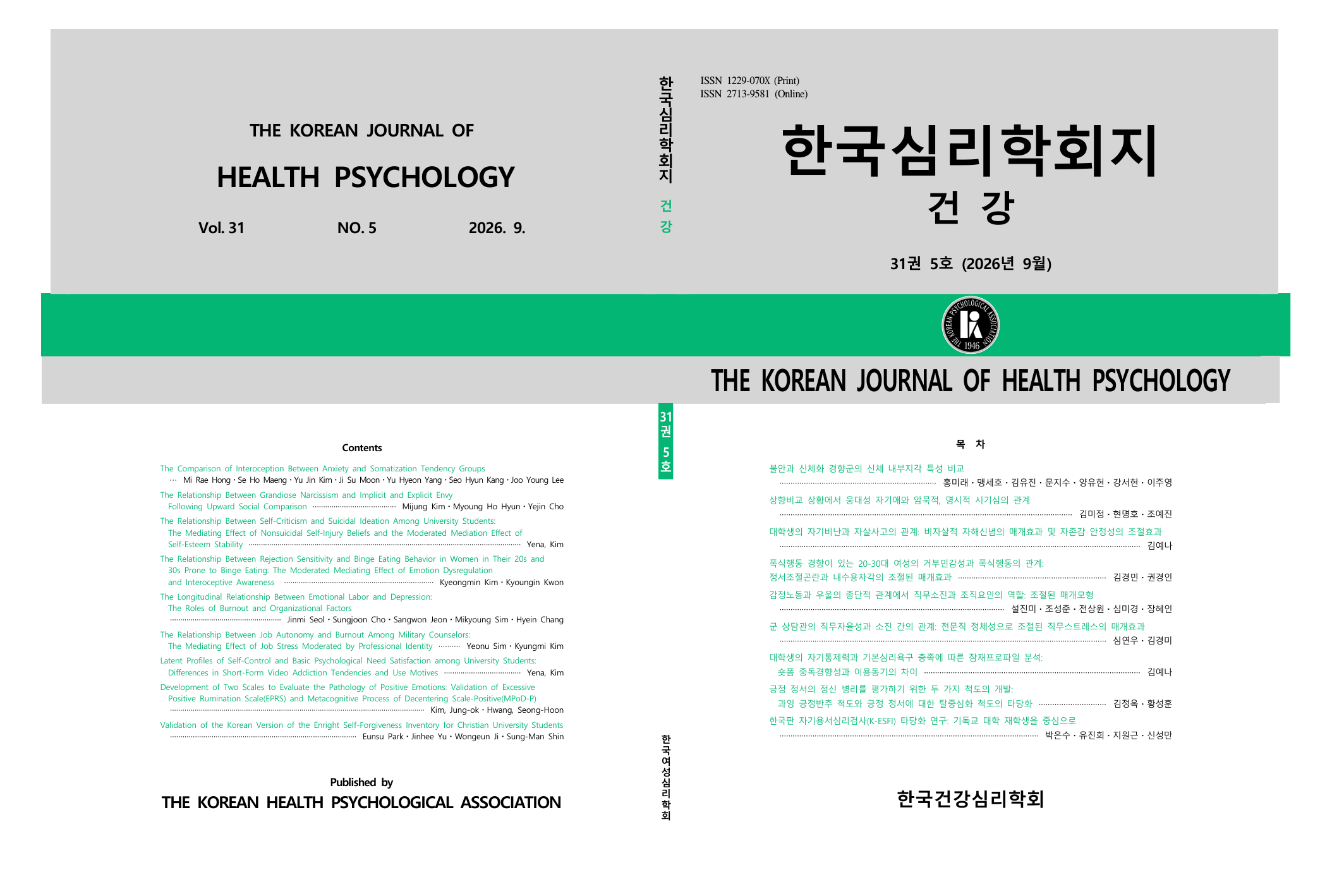
The Longitudinal Relationship Between Emotional Labor and Depression: The Roles of Burnout and Organizational Factors
Sungjoon Cho (Kangbuk Samsung Hospital)
Sangwon Jeon (Kangbuk Samsung Hospital)
Mikyoung Sim (Seoul Educational Policy Institute)
Hyein Chang (Sungkyunkwan University)

Abstract
This study examined the roles of burnout and organizational factors in the longitudinal relationship between emotional labor and depression. A total of 412 emotional labor workers (149 men, 263 women; Mage = 33.07, SDage = 6.76) completed self-report measures of emotional labor, burnout, depression, and organizational factors - organizational surveillance and monitoring, and the lack of a supportive and protective system within the organization - at two time points approximately 18 months apart. A moderated mediation model was tested with burnout (T1) as the mediator and the organizational factors (T1) as moderators. Burnout significantly mediated the longitudinal association between emotional labor and depression, whereas the direct effect was not significant. Organizational surveillance and monitoring strengthened the association between emotional labor and burnout, whereas the lack of a supportive and protective system weakened it. The indirect effect of emotional labor on depression through burnout therefore varied across levels of the organizational factors. These results suggest that emotional labor may be associated with subsequent depression through burnout and that this process unfolds differently depending on the organizational context. The study underscores how much organizational environments matter in understanding and safeguarding the mental health of emotional labor workers.
- keywords
- emotional labor, depression, burnout, organizational factors
- Received
- 2026-07-06
- Revised
- 2026-07-20
- Accepted
- 2026-08-14
- Published
- 2026-09-30
- Downloaded
- Viewed
- 0KCI Citations
- 0WOS Citations