
Korean Journal of Health Psychology
- KOREAN
- P-ISSN1229-070X
- E-ISSN2713-9581
- KCI
Article Contents
- 2026 (Vol.31)
- 2025 (Vol.30)
- 2024 (Vol.29)
- 2023 (Vol.28)
- 2022 (Vol.27)
- 2021 (Vol.26)
- 2020 (Vol.25)
- 2019 (Vol.24)
- 2018 (Vol.23)
- 2017 (Vol.22)
- 2016 (Vol.21)
- 2015 (Vol.20)
- 2014 (Vol.19)
- 2013 (Vol.18)
- 2012 (Vol.17)
- 2011 (Vol.16)
- 2010 (Vol.15)
- 2009 (Vol.14)
- 2008 (Vol.13)
- 2007 (Vol.12)
- 2006 (Vol.11)
- 2005 (Vol.10)
- 2004 (Vol.9)
- 2003 (Vol.8)
- 2002 (Vol.7)
- 2001 (Vol.6)
- 2000 (Vol.5)
- 1999 (Vol.4)
- 1998 (Vol.3)
- 1997 (Vol.2)
- 1996 (Vol.1)
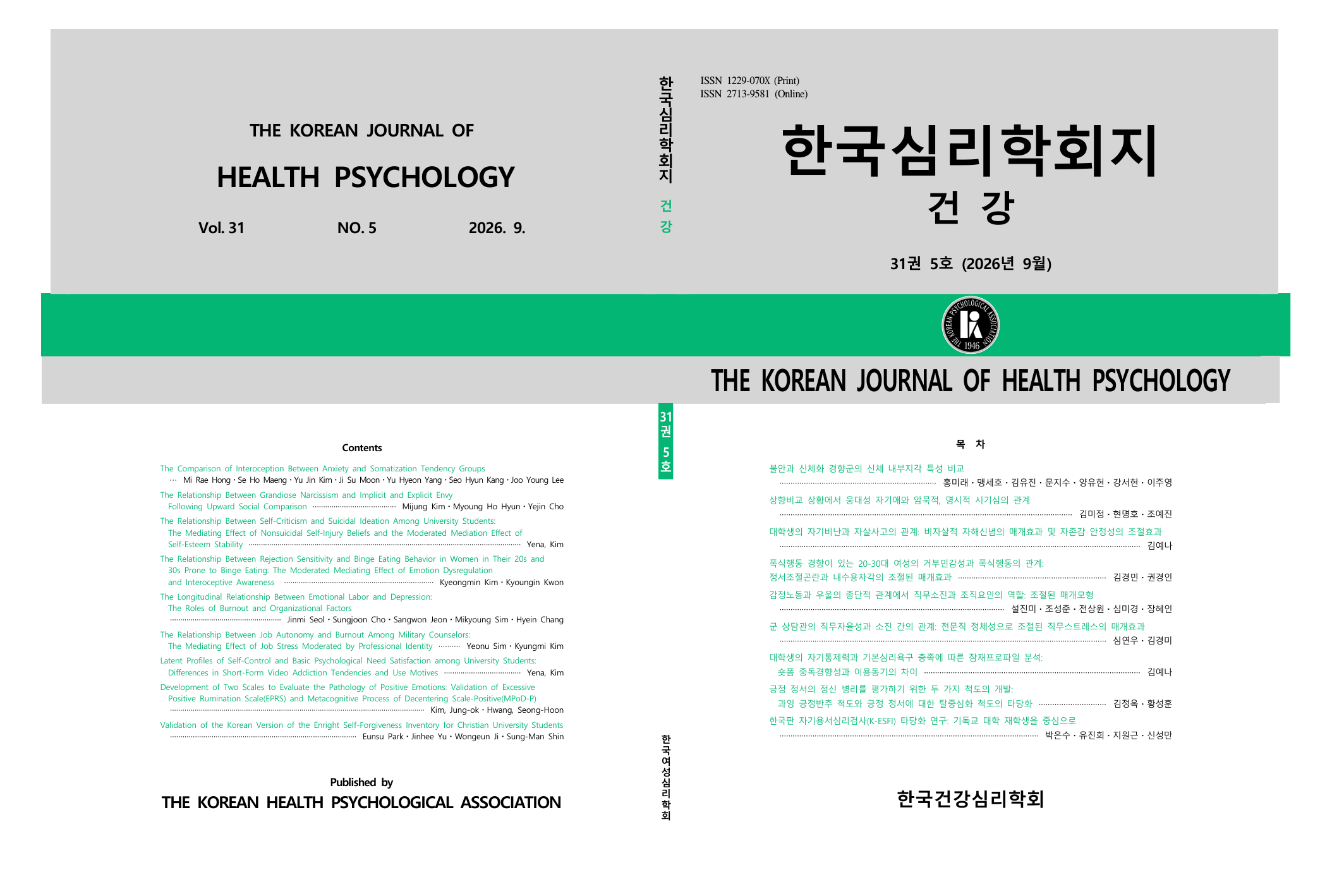
The Relationship Between Rejection Sensitivity and Binge Eating Behavior in Women in Their 20s and 30s Prone to Binge Eating: The Moderated Mediating Effect of Emotion Dysregulation and Interoceptive Awareness
Kyoungin Kwon (Kwangwoon University)

Abstract
Binge eating behavior is a maladaptive eating pattern in which an excessive amount of food is consumed within a discrete period of time, accompanied by a loss of control. It heightens the risk of progression to an eating disorder and is closely associated with depression, anxiety, self-harm, and suicidal ideation. The present study examined whether emotion dysregulation mediates the effect of rejection sensitivity on binge eating behavior and whether interoceptive awareness moderates the association between rejection sensitivity and emotion dysregulation—that is, a moderated mediation model—in women in their 20s and 30s prone to binge eating. Previous research has shown that rejection sensitivity influences both emotion dysregulation and binge eating behavior and that emotion dysregulation itself significantly predicts binge eating behavior. Few studies, however, have combined these variables in a single model to examine the direct and indirect effects of rejection sensitivity on binge eating behavior simultaneously, and the role of interoceptive awareness in this process remains unclear. Of 637 women in their 20s and 30s who were screened, data from the 196 classified as prone to binge eating (Bulimia Test-Revised score≥88) were analyzed using SPSS 26 and the PROCESS Macro. Higher rejection sensitivity was associated with greater emotion dysregulation, which in turn was associated with more severe binge eating behavior. The association between rejection sensitivity and emotion dysregulation weakened as the level of interoceptive awareness rose. Both the partial mediating role of emotion dysregulation and the moderated mediating role of interoceptive awareness were thus confirmed. By tracing this psychological pathway in women prone to binge eating—a group at elevated risk of progressing to a clinical condition—the study provides empirical grounds for preventive intervention and suggests that strengthening emotion regulation through enhanced interoceptive awareness may help attenuate binge eating behavior.
- keywords
- Binge Eating Behavior, Rejection Sensitivity, Emotion Dysregulation, Interoceptive Awareness, Women in Their 20s and 30s Prone to Binge Eating
- Received
- 2026-06-12
- Revised
- 2026-08-04
- Accepted
- 2026-08-04
- Published
- 2026-09-30
- Downloaded
- Viewed
- 0KCI Citations
- 0WOS Citations