


- ENGLISH
- P-ISSN1229-070X
- E-ISSN2713-9581
- KCI
논문 상세
- 2026 (31권)
- 2025 (30권)
- 2024 (29권)
- 2023 (28권)
- 2022 (27권)
- 2021 (26권)
- 2020 (25권)
- 2019 (24권)
- 2018 (23권)
- 2017 (22권)
- 2016 (21권)
- 2015 (20권)
- 2014 (19권)
- 2013 (18권)
- 2012 (17권)
- 2011 (16권)
- 2010 (15권)
- 2009 (14권)
- 2008 (13권)
- 2007 (12권)
- 2006 (11권)
- 2005 (10권)
- 2004 (9권)
- 2003 (8권)
- 2002 (7권)
- 2001 (6권)
- 2000 (5권)
- 1999 (4권)
- 1998 (3권)
- 1997 (2권)
- 1996 (1권)
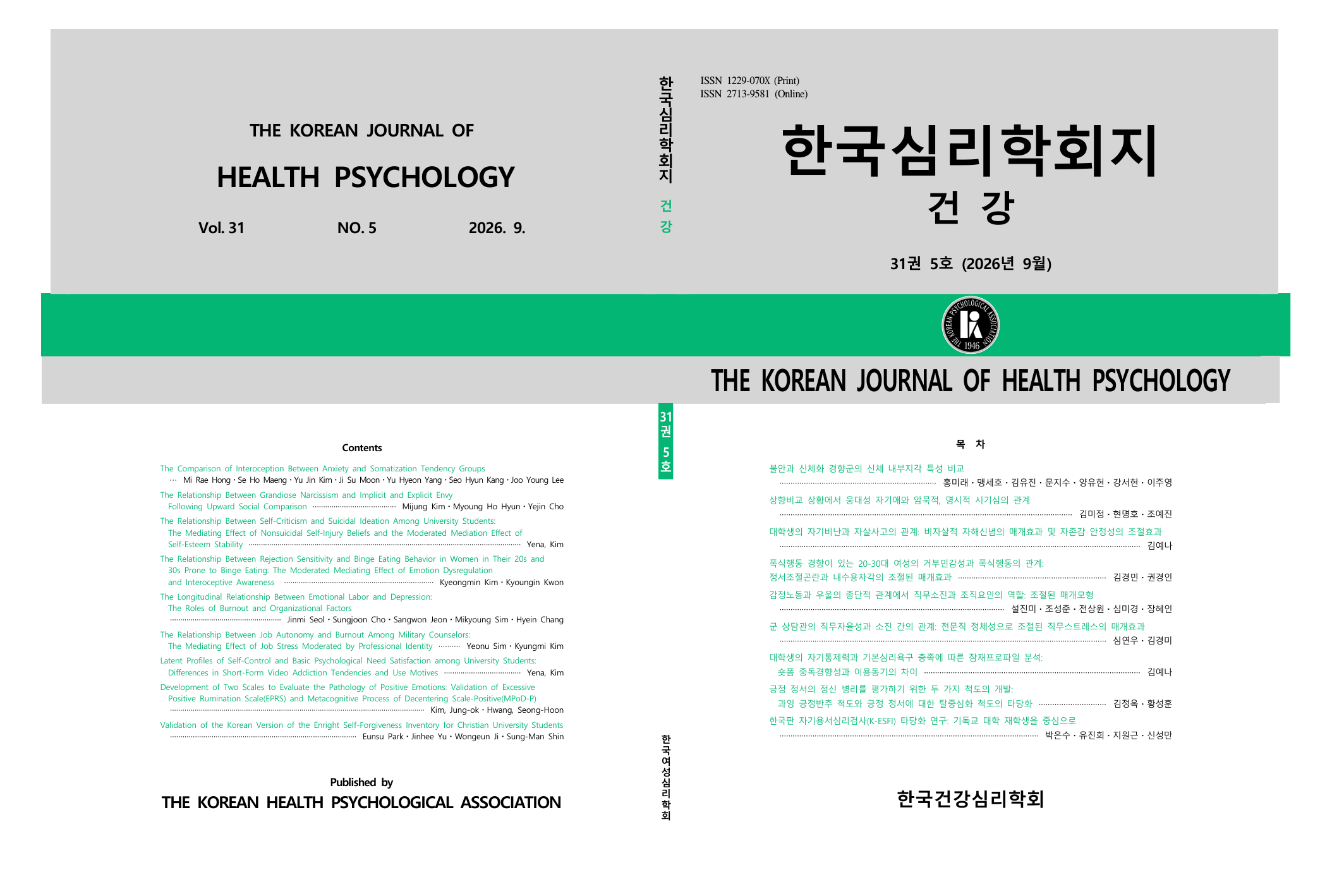
폭식행동 경향이 있는 20-30대 여성의 거부민감성과 폭식행동의 관계: 정서조절곤란과 내수용자각의 조절된 매개효과
The Relationship Between Rejection Sensitivity and Binge Eating Behavior in Women in Their 20s and 30s Prone to Binge Eating: The Moderated Mediating Effect of Emotion Dysregulation and Interoceptive Awareness
권경인(Kyoungin Kwon) (광운대학교)

초록
폭식행동은 통제력을 상실한 채 일정 시간 동안 과도한 양의 음식을 섭취하는 부적응적 섭식행동으로, 섭식장애로의 이행 위험을 높이고 우울․불안․자해 및 자살사고와도 밀접하게 관련된다. 본 연구는 폭식행동 경향이 있는 20-30대 여성을 대상으로 거부민감성이 정서조절곤란을 매개로 폭식행동에 미치는 영향을 확인하고, 거부민감성이 정서조절곤란에 미치는 영향에서 내수용자각이 갖는 조절효과, 그리고 내수용자각의 조절된 매개효과를 검증하고자 하였다. 선행연구들은 거부민감성이 정서조절곤란과 폭식행동에 각각 영향을 미치고, 정서조절곤란 또한 폭식행동에 대한 유의한 예측변인임을 보고하였다. 그러나 이들 변인을 하나의 모형으로 통합하여 거부민감성이 폭식행동에 미치는 직․간접 효과를 동시에 검증하고, 그 과정에서 내수용자각의 역할을 일관되게 규명한 연구는 부족한 실정이다. 이에 본 연구에서는 20-30대 여성 637명 중, 폭식행동 척도(BULIT-R) 88점 이상인 폭식행동 경향군 196명의 자료를 SPSS 26과 PROCESS Macro로 분석하였다. 분석 결과, 거부민감성이 높을수록 정서조절곤란이 심화되어 폭식행동이 증가하는 것으로 나타났다. 또한, 거부민감성이 정서조절곤란에 미치는 영향은 내수용자각 수준이 높을수록 감소하는 것으로 확인되었다. 이를 통해 정서조절곤란의 부분 매개 역할과 내수용자각의 조절된 매개 역할이 확인되었다. 본 연구는 임상군으로의 이행 위험이 높은 폭식행동 경향군을 대상으로 이 심리적 경로를 확인함으로써, 예방적 개입에 필요한 실증 자료를 제공하고 내수용자각 향상을 통한 정서조절 개선이 폭식행동 완화에 기여할 수 있는 가능성을 시사하였다는 점에서 의의가 있다.
- keywords
- 폭식행동, 거부민감성, 정서조절곤란, 내수용자각, 폭식행동 경향이 있는 20-30대 여성
Abstract
Binge eating behavior is a maladaptive eating pattern in which an excessive amount of food is consumed within a discrete period of time, accompanied by a loss of control. It heightens the risk of progression to an eating disorder and is closely associated with depression, anxiety, self-harm, and suicidal ideation. The present study examined whether emotion dysregulation mediates the effect of rejection sensitivity on binge eating behavior and whether interoceptive awareness moderates the association between rejection sensitivity and emotion dysregulation—that is, a moderated mediation model—in women in their 20s and 30s prone to binge eating. Previous research has shown that rejection sensitivity influences both emotion dysregulation and binge eating behavior and that emotion dysregulation itself significantly predicts binge eating behavior. Few studies, however, have combined these variables in a single model to examine the direct and indirect effects of rejection sensitivity on binge eating behavior simultaneously, and the role of interoceptive awareness in this process remains unclear. Of 637 women in their 20s and 30s who were screened, data from the 196 classified as prone to binge eating (Bulimia Test-Revised score≥88) were analyzed using SPSS 26 and the PROCESS Macro. Higher rejection sensitivity was associated with greater emotion dysregulation, which in turn was associated with more severe binge eating behavior. The association between rejection sensitivity and emotion dysregulation weakened as the level of interoceptive awareness rose. Both the partial mediating role of emotion dysregulation and the moderated mediating role of interoceptive awareness were thus confirmed. By tracing this psychological pathway in women prone to binge eating—a group at elevated risk of progressing to a clinical condition—the study provides empirical grounds for preventive intervention and suggests that strengthening emotion regulation through enhanced interoceptive awareness may help attenuate binge eating behavior.
- keywords
- Binge Eating Behavior, Rejection Sensitivity, Emotion Dysregulation, Interoceptive Awareness, Women in Their 20s and 30s Prone to Binge Eating
- 투고일Received
- 2026-06-12
- 수정일Revised
- 2026-08-04
- 게재확정일Accepted
- 2026-08-04
- 출판일Published
- 2026-09-30
- 다운로드 수
- 조회수
- 0KCI 피인용수
- 0WOS 피인용수