

JOURNAL OF INFORMATION SCIENCE THEORY AND PRACTICE
- P-ISSN2287-9099
- E-ISSN2287-4577
- SCOPUS, KCI

Exploring Platform-Mediated Health Information Behavior: ADHD Self-Diagnosis Intention on Video-Based Social Media Among Korean Young Adults


Jee Yeon Lee (Department of Library and Information Science, Yonsei University, Seoul, Korea)

Abstract
Amidst growing concerns about the quality of video-based social media (VSM) information and rising adult attention-deficit/hyperactivity disorder (ADHD) diagnoses, this study empirically investigates the structural mechanisms of platform-mediated health information behavior. Specifically, the authors examine how pre-existing psychosocial vulnerabilities (including metacognitive beliefs about health anxiety, medical mistrust, and anticipated stigma), platform-mediated channels, and platform affordances relate to the intention to self-diagnose ADHD. Data were collected via an online survey from 216 South Korean young adults in their 20s and 30s without prior formal diagnoses. Multiple regression and bootstrapping-based mediation analyses were conducted to explore these structural relationships. Key findings indicate that social media dependency, exposure frequency, and a user preference for short-form videos are significantly and positively associated with the intention to self-diagnose. Notably, the analyses reveal that information-seeking intention, social media dependency, and exposure frequency significantly mediate the relationship between the users’ pre-existing vulnerabilities and their self-diagnosis intention. Rather than viewing this phenomenon merely as a passive internalization of misinformation, these results reframe VSM-based self-diagnosis as an active, compensatory information behavior utilized to navigate offline social barriers. Consequently, this study highlights the urgent need for algorithm-conscious health information curation by information professionals and targeted e-health literacy interventions to guide vulnerable users toward evidence-based clinical support.
- keywords
- video-based social media, online mental health information, self-diagnosis, adult attention-deficit/hyperactivity disorder, health information behavior, information seeking
1. INTRODUCTION
Video-based social media (VSM), encompassing platforms like YouTube and TikTok, has become a primary information source for contemporary users, fundamentally reshaping the landscape of information creation and consumption (Gallup Korea, 2023; Zheng et al., 2025). These platforms, characterized by algorithmically curated multimodal content (Fu et al., 2024), provide users with unprecedented access to a vast array of topics, among which mental health has emerged as a particularly prominent and rapidly expanding area (Caron, 2022).
1.1. Video-Based Social Media in the Health Information Context
Moving beyond mere entertainment, VSM has firmly established itself as a pivotal channel for health and medical information, deeply influencing how individuals seek, perceive, and manage their well-being. The accessibility and familiarity of VSM have significantly heightened public awareness of mental disorders, including those previously under-recognized in certain demographics, such as adult attention-deficit/hyperactivity disorder (ADHD) (Boseley, 2021; Caron, 2022; Eagle & Ringland, 2023). This digital environment offers benefits like reducing the stigma associated with mental health conditions (Caron, 2022) and providing support for individuals facing barriers to traditional medical care (Eagle & Ringland, 2023).
However, the structural characteristics of VSM, where content engagement often outweighs factual accuracy, raise significant concerns about the quality and reliability of the health information being disseminated (Marengo et al., 2021; Yeung et al., 2022; Zhou et al., 2021). Much of the health-related content, particularly on platforms like TikTok, is based on personal experiences, which, while subjectively valid, often misaligns with established clinical criteria or presents oversimplified narratives (Aragon-Guevara et al., 2025; Fraticelli et al., 2021). For instance, studies have found that a significant portion of popular VSM content on ADHD is misleading (Yeung et al., 2022) and that such inaccurate content frequently achieves higher engagement than evidence-based information (McCashin & Murphy, 2023; Thapa et al., 2018). The frequent exposure to such information, amplified by platform algorithms, can shape users’ perceptions and subsequent health behaviors (Zeballos Rivas et al., 2021). This “infodemic” can lead to paradoxical outcomes where users’ confidence in their knowledge increases even as their accurate understanding of a disorder decreases (Schiros et al., 2025), fostering misplaced confidence and anxiety (Boseley, 2021; Gupta & Ariefdjohan, 2021; Yeung et al., 2022).
1.2. Need for the Study: The Rise of Platform-Mediated Self-Diagnosis
Within this challenging information environment, platform-mediated health information behavior (HIB) has emerged as a critical area of study. In this research, the authors explicitly define this concept as the processes by which users seek, evaluate, and act upon health information within algorithmically structured digital environments, where the platform itself actively shapes the conditions of information exposure and users’ subsequent decision-making. One of the most significant subsequent behaviors to emerge from these platform-mediated processes is the user’s tendency to engage in self-diagnosis (Boseley, 2021; Caron, 2022; Eagle & Ringland, 2023). The current study approaches self-diagnosis not as a purely medical phenomenon, but as a complex information-driven behavior. It results directly from users’ exposure to and interaction with online content and involves problem-solving processes central to information behavior research, such as information seeking, evaluation (or lack thereof), and the personal application of information (Kim & Grunig, 2011). The potential for such behavior to cause harm—ranging from pathologizing normal experiences (Yeung et al., 2022) and fostering distrust in medical professionals (Boseley, 2021; Gupta & Ariefdjohan, 2021) to causing individuals to avoid or delay professional diagnosis and appropriate treatment (Eagle & Ringland, 2023)—underscores the urgent need to understand its drivers.
This phenomenon is particularly evident with ADHD, which has become notably prominent on VSM platforms, garnering over 20.6 billion views globally (Hartnett & Cummings, 2024). Although historically diagnosed in childhood, the rate of adult ADHD diagnoses has risen substantially, a trend likely exacerbated by the increasing availability of self-diagnosis information on platforms like TikTok and YouTube (Babcock, 2021; Boseley, 2021; Gilmore et al., 2022). Driven by concerns over the potential harms of this trend, prevalent clinical and educational discourses have often adopted a deficit-based perspective, characterizing VSM-based self-diagnosis merely as a passive internalization of misinformation or the over-pathologizing of normal experiences (Foster & Ellis, 2024; Shashua, 2025). However, reducing this phenomenon to an irrational trend or passive susceptibility overlooks the active information-seeking processes of users. While recent psychological and sociological studies have attempted to overcome this limitation by qualitatively exploring users’ identity exploration or the affective characteristics of the platforms (Holroyd, 2026; Rouffaer, 2024), there remains a critical gap in empirically elucidating the structural mechanisms through which users’ internal vulnerabilities and social barriers translate into concrete HIB. Consequently, there is an urgent need for an empirical investigation that structurally analyzes this phenomenon from an information behavior perspective, identifying the multi-dimensional factors that drive the intention to self-diagnose (ISD).
1.3. Objectives and Scope of the Study
To address this need, rather than proposing a new theoretical model, the primary objective of this study is to construct and test an exploratory empirical framework that traces the sequential pathway of platform-mediated HIB, utilizing VSM-based ADHD self-diagnosis as a case. Adopting a multidisciplinary approach, this research draws upon established concepts from media system dependency theory, the elaboration likelihood model (ELM), health psychology, and sociology. By applying these concepts, this study examines how users’ pre-existing psychosocial vulnerabilities, digital channel usage, and platform affordances predict the ISD, further exploring the potential pathways linking these multi-dimensional factors. By elucidating the mechanisms that lead individuals from information exposure to self-diagnosis intention, this study seeks to provide a foundational understanding of an emergent digital health phenomenon, offering crucial insights for information scientists, healthcare professionals, and platform designers navigating this new information ecosystem. The scope of this study is specifically focused on young adults in their 20s and 30s who actively use VSM and have not received a prior formal diagnosis of ADHD, as this demographic is situated at the center of the current digital self-diagnosis trend (Boseley, 2021; Gilmore et al., 2022; Lee, 2023).
2. LITERATURE REVIEW
2.1. Social Media and Adult Attention-Deficit/Hyperactivity Disorder
ADHD, characterized by inattention, hyperactivity, and impulsiveness, is now recognized to persist into or even begin in adulthood (Agnew-Blais et al., 2016; Das et al., 2012; Moffitt et al., 2015; Song et al., 2021). Social media (SM) has significantly increased ADHD awareness, offering timely and anonymous information that can reduce stigma and promote help-seeking (Boseley, 2021; Hartnett & Cummings, 2024; Yeung et al., 2022).
However, the VSM information environment surrounding ADHD is complex and often problematic. Unfiltered information can lead to misinformation, self-mislabeling, and avoidance of professional diagnosis and appropriate treatment (Eagle & Ringland, 2023). A significant portion of ADHD content, particularly on platforms like TikTok and YouTube, is considered misleading as it is often created by non-experts. Alarmingly, this inaccurate content frequently achieves higher popularity and engagement than evidence-based information, receiving significantly more views, likes, and shares (McCashin & Murphy, 2023; Yeung et al., 2022; Zhou et al., 2021). There are also broader concerns about this trend contributing to ADHD overdiagnosis (Kazda et al., 2021) and misdiagnosis (Yeung et al., 2022), and delays between online information exposure and professional consultation can make individuals resistant to other treatments (Foster & Ellis, 2024).
Beyond these concerns regarding content quality and popularity, recent empirical studies have further illuminated the structural and psychological mechanisms that facilitate these self-diagnostic behaviors. Research has explored the “affective economy” of ADHD-related content on TikTok, where personal narratives of neurodivergence create validating spaces that encourage users to adopt diagnostic labels (Holroyd, 2026). The role of algorithmic curation has been identified as a critical driver in this process, as artificial intelligence (AI)-powered recommendation systems personalize health information environments and reinforce users’ health-related intentions (Zheng et al., 2025). This environment is further complicated by the fact that platforms like TikTok remain significantly under-utilized by public health authorities and medical professionals, leaving the health discourse largely to individual creators (McCashin & Murphy, 2023). From a practical perspective, these SM-inspired self-diagnoses have begun to significantly impact professional psychological practices, presenting both challenges and opportunities for clinical validation (Foster & Ellis, 2024).
Driven by these interwoven algorithmic, psychological, and informational dynamics, this multifaceted environment necessitates a deeper understanding of the processes by which users adopt and act upon online health information. A significant behavioral outcome of this information adoption process is the tendency toward self-diagnosis (Gupta & Ariefdjohan, 2021), which appears prevalent but is not yet comprehensively explored from an information behavior perspective. The current study examines how various individual, platform, and social factors are associated with users’ information-seeking intentions (IIS) and, subsequently, their ISD.
To address this research question, the subsequent literature review systematically explores these multifaceted variables through an integrated theoretical lens. This study first establishes an overarching theoretical framework grounded in library and information science (LIS) to contextualize platform-mediated information behavior (Section 2.2). Following this conceptual foundation, the remaining subsections are presented sequentially to align with the empirical development of the exploratory research questions, structured around three overarching dimensions of the platform-mediated information environment. First, the review explores pre-existing psychosocial vulnerabilities, encompassing internal cognitive states (Section 2.3) and socio-cultural barriers (Sections 2.4, 2.8). Second, it examines platform-mediated information channels, focusing on Social media dependency (SMD) (Section 2.5) and social media exposure (SME) (Section 2.7). Finally, the analysis turns to information evaluation and platform affordances (Section 2.6). Together, by anchoring these multidimensional factors within the established theoretical framework, this study investigates how they concurrently relate to the ISD, while also exploring the dynamic structural associations among them.
2.2. Platform-Mediated Health Information Behavior: An Extension of Library and Information Science Information Behavior Models
While psychological and media theories offer valuable insights into specific aspects of digital health behaviors, incorporating an overarching framework from LIS can provide a more comprehensive understanding of the VSM self-diagnosis process. To this end, this study adopts an integrative LIS perspective, bridging foundational concepts from early information behavior models with contemporary frameworks of nonlinear and platform-mediated information seeking.
According to Wilson (1999), human information behavior is often driven by secondary needs arising from underlying psychological, cognitive, or affective motives within a specific context. Wilson (1999) suggests that various “intervening variables”—such as psychological, demographic, interpersonal, and environmental factors—can act as either barriers or facilitators to information seeking. In the context of this study, pre-existing psychosocial vulnerabilities, including health anxiety associated with metacognitive beliefs (MCBs), medical mistrust (MM), and anticipated stigma, are considered as potential intervening variables. While these factors may traditionally act as barriers that discourage individuals from seeking professional medical advice, within the digital landscape, they might serve as facilitators. They can prompt individuals to engage in alternative information-seeking behaviors to resolve their cognitive uncertainty.
While Wilson (1999)’s macro-model provides a foundational understanding of how psychological barriers can trigger alternative information seeking, the specific dynamics within the VSM environment can be more clearly elucidated by integrating the nonlinear model of information-seeking behavior (Foster, 2004). Foster (2004) conceptualizes information behavior not as a sequential, step-by-step search, but as a dynamic, iterative, and holistic process where information is often acquired through opportunistic encounters. In this model, a user’s “internal context”—comprising their cognitive and affective states, such as feelings of anxiety or mistrust—continuously interacts with the external information environment. In the VSM context, algorithmic curation facilitates these nonlinear encounters, potentially leading users with underlying psychosocial vulnerabilities—such as MM or anticipated stigma—to passively discover and interact with ADHD content without an explicit initial search query (Foster, 2004).
Furthermore, recent literature extending HIB frameworks into the SM context heavily emphasizes the interplay between user perceptions and platform characteristics. According to systematic reviews of health information-seeking models, contemporary frameworks increasingly incorporate media-specific variables, reflecting the critical role that affective factors and platform trust play in shaping digital health behaviors (Lalazaryan & Zare-Farashbandi, 2014; Jia et al., 2021). This perspective aligns with recent empirical findings indicating that younger generations, as digital natives, exhibit significantly higher engagement with online health information, where their behaviors are distinctly driven by risk perceptions (e.g., salience) and critical evaluations of channel characteristics, such as platform trustworthiness (Chang et al., 2024). Building upon this academic shift, the current study seeks to move beyond examining isolated individual psychological factors by explicitly integrating platform-specific variables—namely, SME and the unique characteristics of VSM (e.g., short-form video formats [SFVs])—into its empirical framework.
Ultimately, the culmination of these complex information behaviors—often conceptualized in LIS as the “information processing and use” stage (Wilson, 1999)—can be directly linked to the ISD in this study. From this integrated LIS perspective, VSM-based self-diagnosis may not be solely a passive acceptance of misinformation. Instead, it can be viewed as an active, albeit constrained, information processing behavior where users, driven by offline social barriers and guided by dynamic platform affordances, evaluate and apply algorithmically curated health information to their personal circumstances.
2.3. Metacognitive Beliefs on Health Anxiety
Metacognition is “thinking about thinking,” and MCBs are beliefs people hold about their thought processes (Keen et al., 2022). Negative MCBs, for example, include the conviction that thoughts are uncontrollable or can cause illness (Wells, 2002). Negative MCBs have been shown to be associated with cyberchondria, a symptom characterized by excessive online medical searches and health anxiety (Fergus & Spada, 2017). Individuals with high health anxiety strongly believe they cannot fully control their beliefs or thoughts about illnesses, which leads them to excessively worry and ruminate about their own health conditions (Bailey & Wells, 2015). Beyond remaining a mere belief, such thoughts can also lead individuals to perceive the necessity of engaging in repeated online health information searches until the perceived information deficit is resolved (Brown et al., 2020). Moreover, individuals who believe they cannot control their own minds and do not trust their judgments may prefer SM use over offline interactions (e.g., face-to-face conversations and social relationships), potentially triggering problematic SM use (Balıkçı et al., 2020).
Thus, individuals with negative MCBs about health are predicted to persistently acquire disease-related information on SM (Fergus & Spada, 2018). Furthermore, they may not only passively accept such information but also deeply rely on it. By driving these persistent and reliant online information behaviors, negative MCBs ultimately increase the likelihood of self-perception and self-diagnosis of mental disorders based on their own physical symptoms and lifestyle habits rather than seeking expert consultation or clinical diagnosis offline. Therefore, this study explores how negative MCBs about health anxiety (MCB-HA) are associated with the ISD ADHD via VSM.
2.4. Medical Mistrust
Offline social belief systems often translate into online behaviors. For instance, recent research has shown that strong sociocultural factors such as religiosity and social conformity significantly predict online information sharing and verification behaviors (Khalil et al., 2025). Similarly, pre-existing social beliefs like MM and anticipated stigma can act as powerful drivers for individuals to seek health information and engage in self-diagnosis through VSM. Tendencies to mistrust the medical system (MMS) and healthcare providers (MMP) can heighten susceptibility to misinformation found on SM (Pierre, 2020) and appear to influence behaviors related to seeking professional medical help (Nah et al., 2024).
In the digital information environment, the shift of information trust toward user-generated content (UGC) is a widely observed behavioral trend across various domains; for example, studies have shown that users often perceive UGC as possessing higher validity and legitimacy than conventional formal sources (Aydin, 2020; Kitsios et al., 2022). This tendency extends to the health domain, where users increasingly determine the information quality and trustworthiness of health content based on peer experiences, relatability, and visually appealing formats, rather than relying on verified medical expertise (Freeman et al., 2023). For individuals harboring high MM, this reliance on UGC is significantly amplified. Because they actively doubt the intentions and reliability of formal healthcare providers, they are even more likely to completely reallocate their trust toward UGC and uncritically accept the health information shared by their peers. However, placing such unchecked trust in online health information without engaging in critical assessment can exacerbate problematic behaviors, including excessive health-related searching and a propensity to self-diagnose—often conceptualized as cyberchondria (Laato et al., 2020; Zheng & Tandoc, 2022; Zheng et al., 2023).
MMS not only refers to a lack of trust in healthcare itself but also stems from the belief that healthcare professionals and institutions may act against rather than for the best interests of patients (Jaiswal & Halkitis, 2019). While historically examined within specific marginalized communities (Brenick et al., 2017; Kalichman et al., 2016; Thorburn et al., 2012), MM is increasingly recognized as a broader phenomenon among the general public, often fueled by concerns over illness-related stigma or systemic instabilities in healthcare (Jaiswal & Halkitis, 2019). Given this context, individuals harboring such mistrust may be more inclined to seek alternative health information outside formal medical channels. In today’s digital landscape, this tendency could naturally extend to a greater reliance on UGC on algorithmic platforms like VSM. Therefore, it is plausible that heightened MM is associated with alternative online information seeking, which in turn may relate to a higher ISD. With these points in mind, this research investigates the ways in which MMS and MMP relate to users’ VSM-based ISD for ADHD.
2.5. Social Media Dependency
SMD, a concept derived from media system dependency theory proposed by Ball-Rokeach and DeFleur (1976), generally refers to the extent to which individuals perceive that SM helps achieve important goals in daily life (Kim & Jung, 2017). The relationship of dependency between users and mass media develops based on the intensity of motivations to obtain information believed to be useful in achieving personal goals within specific contexts (Ball-Rokeach et al., 1984). Higher dependency on media, therefore, suggests the increased effectiveness of media messages (Morton & Duck, 2001) and indicates that individuals may be more susceptible to their behaviors and beliefs being affected by opinions disseminated in the media (Ho et al., 2015).
In the context of COVID-19, Handarkho et al. (2022)’s study, which assumed that individuals who consider SM as a primary source of information trust the content shared on platforms, highlighted that SMD had a significant and immediate impact on personal trust in COVID-19 information. Additionally, Kim and Jung (2017) found that individuals with a high tendency toward SMD are more likely to actively engage as storytellers on SM and pay more attention to and discuss topics that have been exposed on SM, even in the offline domain. Building on this previous research, this study assumes that strong SMD may be associated with practical and active health-related behaviors, thereby seeking to determine how SMD correlates with VSM-based ISD for ADHD.
2.6. Platform Characteristics
The characteristics of VSM platforms—spanning creators, content, and physical format—are critical in shaping users’ self-diagnosis intentions. Users are often more drawn to content from creators sharing personal experiences than to information from experts, as these narratives are perceived as more relatable and trustworthy (Freeman et al., 2023; Yeung et al., 2022). However, this preference carries significant risks, as UGC can oversimplify complex conditions and spread misinformation, thereby increasing the likelihood of inaccurate self-diagnosis (Aragon-Guevara et al., 2025).
The influence of video length further complicates this dynamic, a concept well-explained by the ELM (Petty & Cacioppo, 1986). While long-form videos (LFVs) may allow for the deep, critical evaluation associated with central route processing, the fast-paced and emotionally engaging nature of SFVs encourages peripheral route processing. This makes users more susceptible to persuasion by compelling but potentially misleading heuristic cues, such as personal anecdotes, rather than objective facts (Fu et al., 2024; Petty & Cacioppo, 1986). This interplay of preferred creator types, content styles, and video formats likely influences the ISD. Accordingly, this study seeks to identify how specific platform characteristics—namely, creator type, content type, and video length—differentiate the degree of VSM-based ISD for ADHD.
2.7. Social Media Exposure
While SMD focuses on a user’s internal psychological dependency, SME refers to the external and environmental frequency of encountering specific content. In the VSM ecosystem, SME is primarily driven by algorithmic curation, which determines the objective volume and repetition of information exposure regardless of the user’s initial psychological intent. Unlike traditional health information seeking, AI-powered SM platforms employ an ‘information finds me’ approach, passively pushing content based on users’ past engagement traces (Zheng et al., 2025). VSM algorithms tailor audiovisual content to users’ preferences, enhancing engagement but not filtering for quality, leading to frequent exposure to inaccurate information (Yeung et al., 2022). Consequently, this algorithmic exposure frequently creates echo chambers, trapping users in homophilic health content loops (Zheng et al., 2025). Furthermore, users often perceive these algorithmic feeds (e.g., TikTok’s For You Page) as a “runaway train” over which they have little control, constantly inundating them with mental health content once initial engagement occurs, while prioritizing popularity and engagement metrics over clinical validity (Milton et al., 2023).
Additionally, by contributing to selective exposure to content, these algorithms exacerbate users’ tendency to accept information that aligns with their existing beliefs and attitudes while ignoring contradictory information (van Strien et al., 2016). Given that the quality of health information disseminated on almost all VSM platforms is generally poor (Suarez-Lledo & Alvarez-Galvez, 2021), frequent exposure to such information is more likely to lead users to match their physical and mental symptoms with those of ADHD as discussed on SM, while disregarding other possibilities. Moreover, prolonged exposure to harmful or inaccurate content has been associated with worse mental health symptoms (Fekih-Romdhane et al., 2020; Mongkhon et al., 2021), and continued exposure to SM content created by users who actually suffer from mental illness may increase the risk of developing psychopathology in individuals who are relatively vulnerable from a mental health perspective (Griffith & Stein, 2021; McCashin & Murphy, 2023). This empirical evidence suggests that the frequency of exposure to SM content about mental disorders could influence the perception of symptoms or lead individuals to believe they have such symptoms. Accordingly, this study aims to clarify the relationship between the frequency of exposure to ADHD content on VSM (SME) and the ISD.
2.8. Anticipated Stigma
Anticipated psychiatric stigma remains a significant barrier to seeking formal medical help (Clement et al., 2015; Magaard et al., 2017; Schomerus et al., 2019). When individuals perceive themselves as potentially belonging to a stigmatized category, such as those with mental illnesses, they often attempt to conceal it, leading to internal distress and social isolation (Pachankis, 2007). However, the intrinsic desire to understand and alleviate one’s psychological symptoms may persist even when formal clinical avenues are intentionally avoided. In this context, VSM may function as a compensatory information environment. Platforms like YouTube and TikTok can offer a sense of relative anonymity and algorithmically curated communities where users might explore mental health content without the perceived risk of offline exposure (Milton et al., 2023). By bypassing traditional medical gatekeepers, individuals with high anticipated stigma may safely consume validating narratives from peers who share similar hidden struggles (Eagle & Ringland, 2023; Holroyd, 2026). Consequently, this reliance on VSM as a safe haven for health information seeking—linked to the fear of societal stigma—is likely to be positively associated with a higher ISD, potentially serving as an accessible alternative to professional medical evaluation. Accordingly, this study aims to explore how anticipated psychiatric stigma relates to VSM-based ISD for ADHD.
2.9. Summary of Research Questions
Based on the multidisciplinary literature reviewed above, this study explores the structural mechanisms of platform-mediated HIB without positing predetermined directional hypotheses, reflecting the exploratory nature of this emergent phenomenon. The specific research questions guiding this study are consolidated as follows:
RQ1. How do pre-existing psychosocial vulnerabilities, platform-mediated information channels, and platform affordances relate to the information behaviors of VSM users regarding ADHD, specifically in association with their IIS and subsequent ISD?
RQ2. How are negative MCB-HA associated with the ISD ADHD via VSM?
RQ3. In what ways do MMS and MMP relate to users’ VSM-based ISD for ADHD?
RQ4. How does SMD correlate with VSM-based ISD for ADHD?
RQ5. How do specific platform characteristics—namely, creator type (RQ5a), content type (RQ5b), and video length (RQ5c)—differentiate the degree of VSM-based ISD for ADHD?
RQ6. What is the relationship between the frequency of exposure to ADHD content on VSM (SME) and the ISD?
RQ7. How does anticipated psychiatric stigma relate to VSM-based ISD for ADHD?
3. METHODOLOGY
3.1. Methods
ADHD has long been known as a disorder that manifests in childhood. However, there has been a recent increase in self-diagnosis and screening rates for ADHD among young adults. Some suggest that this trend may be influenced by the abundance of ADHD-related content on SM (Boseley, 2021; Lee, 2023). Therefore, this study focuses on adult users, particularly those in their 20s and 30s. To ensure relevance, the sample was limited to VSM users who had not previously received a professional ADHD diagnosis or treatment.
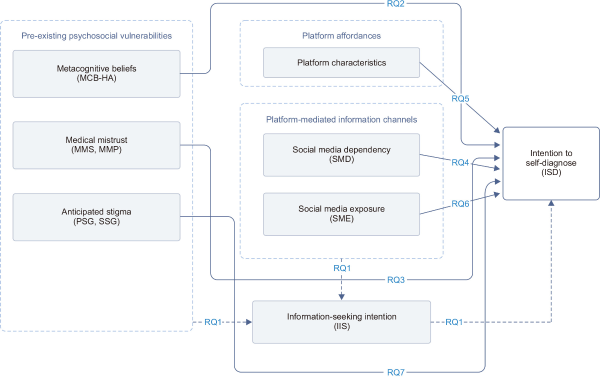
Based on the theoretical framework and research questions established in the previous sections, the conceptual model for this study is presented in Fig. 1. This framework explicitly illustrates the proposed associations between pre-existing psychosocial vulnerabilities, platform-mediated channels, and the subsequent ISD ADHD, providing a visual roadmap for empirical testing.
Fig. 1
Conceptual framework. Solid lines represent direct relational pathways to ISD evaluated in this study (RQs 2-7); dashed lines represent the overarching proposed mediation pathways via information-seeking intention (RQ1). MCB-HA, metacognitive beliefs on health anxiety; MMS, mistrust in the medical system; MMP, mistrust in medical providers; PSG, primary social group; SSG, secondary social group.
3.2. Composition of Survey Tool
The survey items for the study were chosen as described below. Excluding the introductory questions on demographic characteristics, general VSM usage, prior medical history, and specific exposure checks to the stimulus videos, the survey consisted of a total of 71 structured items measured on a Likert scale. To ensure the cross-cultural validity of the original English scales utilized in this study, the translation process involved rigorous consultation with English language and literature majors and professional translators to maintain both semantic equivalence and contextual appropriateness.
To assess MCB-HA, the authors used five items from the Korean version of the Metacognitions Questionnaire-Health Anxiety (Bailey & Wells, 2015), validated by Kim (2021). These items, focusing specifically on the belief that thoughts can cause illness, were rated on a 5-point Likert scale and have demonstrated acceptable reliability (Cronbach’s α=0.72-0.78).
MM was measured across two dimensions: MMS and MMP. For the former, this study used a robust seven-item factor (α=0.76) from the Korean-translated Medical Mistrust Inventory (LaVeist et al., 2009). For the latter, the authors adapted the Wake Forest Trust in Physicians Scale (Hall et al., 2002) to measure public trust, a method that has shown high reliability (α=0.87-0.88) in previous research (Gao et al., 2023).
SMD was evaluated using 21 items from Kim and Jung (2017), where participants rated SM’s usefulness on a 5-point scale. To measure preferences for platform characteristics, participants viewed actual ADHD-related videos from platforms like YouTube and TikTok before rating their preferences regarding creator, content, and physical attributes. SME was self-reported based on methods from Olagoke et al. (2020) capturing total and platform-specific use over the past week.
Anticipated stigma was measured using two factors from the Endorsed and Anticipated Stigma Inventory (Vogt et al., 2014). The authors adapted the terminology to distinguish between concerns of stigma from “primary social groups” (e.g., family and friends) and “secondary social groups” (e.g., school and workplace). Finally, IIS was assessed with items adapted from Kim and Grunig (2011), while the dependent variable, ISD, was measured using five modified items from Park (2023) on a 7-point Likert scale. Park (2023)’s original generic self-diagnosis items were structurally modified to be strictly ADHD-focused.
Prior to the main data collection, a pre-test was conducted with a panel of five individuals representing the target demographic. This step was taken to evaluate the face validity, clarity of the translated phrasing, and overall comprehension of the questionnaire. Minor wording adjustments were subsequently made based on their feedback to ensure the survey’s reliability and natural flow in Korean.
3.3. Sample and Procedure
Data were collected via an online survey distributed for three weeks in May 2024 on platforms popular with young adults in South Korea. While VSM platforms such as YouTube and TikTok operate globally, this empirical investigation focuses on the information behavior of users within the socio-cultural context of South Korea. This study was conducted in strict adherence to ethical principles for research involving human subjects. Prior to participation, all respondents were provided with a detailed information sheet and gave their informed consent. The survey began with a consent form that clearly outlined the study’s purpose, ensured the anonymity of responses, and affirmed the voluntary nature of participation, including the right to withdraw at any time. To ensure data quality, the authors removed duplicates and overly fast responses, and also excluded eight participants with prior ADHD medical consultations, resulting in a final sample of 216 valid responses. Although there are no fixed rules for determining sample sizes in questionnaire validation, the current sample (n=216) is deemed statistically robust. Methodological studies demonstrate that factor stability relies fundamentally on absolute sample size and strong factor loadings (>0.60) rather than the subject-to-item ratio (Guadagnoli & Velicer, 1988), a standard widely adopted in contemporary empirical research (e.g., Theocharis et al., 2023).
This study strictly complied with the official ethical review procedures of the affiliated institution. In accordance with the institutional policy, researchers are required to complete an online self-assessment to determine whether a study qualifies for an exemption based on its low-risk nature. For such categories, the university delegates the authority for ethical review and formal determination to the respective departmental review committee. Prior to the initiation of the study, the research plan underwent a review by the departmental committee at Yonsei University. In accordance with the institution's internal regulations at the time, the committee determined that the study was exempt from a full Institutional Review Board review, precluding the issuance of a specific Institutional Review Board exemption number.
To encourage involvement, participants were offered a chance to win various prizes. This study’s sample (see Table 1) was predominantly female (82.9%) and in their mid-20s (26.4%). The majority held a bachelor’s degree (55.6%). YouTube was the primary VSM platform for 74.1% of respondents. This demographic data, consistent with broader trends among individuals in their 20s and 30s, suggests the sample is representative (Gallup Korea, 2023).
Table 1
Demographic and social media usage characteristics of respondents (n=216)
| Variable | Value |
|---|---|
| Sex | |
| Male | 37 (17.1) |
| Female | 179 (82.9) |
| Age (yr) | |
| 20-23 | 32 (14.8) |
| 24-26 | 57 (26.4) |
| 27-29 | 48 (22.2) |
| 30-33 | 47 (21.8) |
| 34-36 | 17 (7.9) |
| 37-39 | 15 (6.9) |
| Educational level | |
| Middle school or lower | 0 (0.0) |
| High school graduate | 5 (2.3) |
| University enrolled | 54 (25.0) |
| University graduate | 120 (55.6) |
| Postgraduate degree | 37 (17.1) |
| Primary video-based social media | |
| YouTube | 160 (74.1) |
| 49 (22.7) | |
| X | 2 (0.9) |
| TikTok | 5 (2.3) |
| Other | 0 (0.0) |
3.4. Validity and Reliability
To ensure the validity of the measurement model, an exploratory factor analysis (EFA) was conducted using IBM SPSS Statistics 27 (IBM Co., Armonk, NY, USA). While principal component analysis (PCA) is technically a data reduction technique, it is extensively employed as a practical alternative to common factor analysis in the exploratory phases of social science and information research. The robustness of this widespread convention is supported by seminal methodological guidelines, such as Hair et al.’s Multivariate Data Analysis, which remains one of the most cited methodological references (Black & Babin, 2019). Furthermore, contemporary methodological literature indicates that PCA and common factor analysis are statistically highly similar and typically yield essentially identical pattern solutions and substantive interpretations in practical applications (Sarstedt & Mooi, 2019). The analysis employed PCA with varimax rotation. The Kaiser–Meyer–Olkin test for sampling adequacy yielded a value of 0.86, well above the 0.5 threshold, and Bartlett’s test of sphericity was significant (p<0.001), confirming the data’s suitability for factor analysis. After removing seven items that compromised validity, the remaining multi-item constructs all demonstrated acceptable internal consistency, with Cronbach’s alpha coefficients exceeding the 0.70 threshold. To enhance the transparency and replicability of the construct operationalization, the final mapping between the latent constructs and their retained measurement items, along with their factor loadings, is consolidated in Table 2. Furthermore, the reliability coefficients for these final measures are presented in Table 3.
Table 2
Validity
| Variable | Measurement items | 1 | 2 | 3 | 4 | 5 | 6 | 7 |
|---|---|---|---|---|---|---|---|---|
| AS (PSG) | Would avoid talking to me | 0.829 | 0.047 | 0.255 | -0.061 | 0.058 | 0.032 | 0.088 |
| Would avoid being around me | 0.815 | 0.028 | 0.270 | 0.064 | 0.020 | 0.087 | -0.008 | |
| Would think I am faking it | 0.813 | 0.153 | 0.070 | -0.029 | 0.055 | 0.080 | 0.089 | |
| Would be afraid of me | 0.796 | 0.159 | 0.139 | 0.002 | -0.049 | 0.015 | -0.013 | |
| Would consider me untrustworthy | 0.790 | 0.019 | 0.338 | 0.058 | 0.047 | 0.011 | 0.110 | |
| Would feel uncomfortable around me | 0.743 | 0.110 | 0.339 | 0.074 | 0.045 | 0.056 | -0.108 | |
| Would think less of me | 0.715 | 0.146 | 0.026 | 0.083 | -0.006 | 0.065 | -0.130 | |
| MMP | Do everything possible | -0.019 | 0.801 | 0.036 | 0.000 | -0.007 | -0.018 | 0.040 |
| Thorough and careful | 0.249 | 0.788 | 0.033 | -0.071 | -0.067 | 0.024 | 0.099 | |
| Level of medical skills | 0.218 | 0.783 | -0.013 | -0.028 | -0.008 | 0.019 | 0.050 | |
| Puts the patient first | 0.047 | 0.760 | 0.129 | 0.067 | -0.011 | 0.053 | 0.202 | |
| Trust in their medical decisions | 0.179 | 0.675 | 0.037 | 0.032 | 0.147 | 0.129 | -0.023 | |
| Total honesty | 0.040 | 0.671 | 0.109 | 0.085 | 0.120 | 0.064 | 0.310 | |
| Prioritizes convenience over medical needs | 0.058 | 0.650 | 0.140 | 0.041 | 0.066 | 0.033 | 0.312 | |
| Complete trust in the doctor | -0.009 | 0.573 | 0.294 | -0.158 | 0.165 | 0.251 | 0.094 | |
| AS (SSG) | Limit my work opportunities | 0.129 | 0.114 | 0.816 | 0.101 | 0.093 | -0.027 | 0.127 |
| Assign me less important tasks | 0.103 | 0.103 | 0.787 | 0.117 | 0.175 | 0.016 | 0.059 | |
| Uncomfortable around me | 0.466 | 0.048 | 0.739 | -0.004 | -0.026 | 0.124 | 0.009 | |
| Think I am unable to work | 0.114 | 0.073 | 0.735 | 0.159 | 0.069 | -0.011 | 0.131 | |
| Would treat me unfairly | 0.272 | 0.156 | 0.732 | 0.064 | -0.011 | 0.031 | 0.051 | |
| Would avoid being around me | 0.513 | 0.084 | 0.716 | 0.004 | 0.026 | -0.002 | 0.076 | |
| Would avoid talking to me | 0.490 | 0.082 | 0.678 | -0.013 | -0.006 | -0.004 | 0.048 | |
| ISD | Help judge my condition | 0.074 | -0.083 | 0.028 | 0.844 | 0.064 | 0.139 | 0.071 |
| Determine if I have ADHD | 0.011 | -0.072 | 0.078 | 0.843 | -0.028 | 0.051 | 0.043 | |
| Accept opinions on my symptoms | -0.002 | 0.047 | 0.076 | 0.826 | 0.091 | 0.165 | 0.034 | |
| Compare with my symptoms | -0.005 | 0.025 | 0.121 | 0.785 | 0.123 | 0.215 | -0.001 | |
| Suspect having ADHD symptoms | 0.040 | 0.104 | 0.096 | 0.694 | 0.162 | 0.293 | 0.023 | |
| MCB-HA | Belief that thoughts cause sickness | 0.111 | 0.062 | 0.065 | 0.055 | 0.830 | 0.065 | 0.089 |
| Worrying leads to disease | 0.160 | 0.010 | 0.039 | 0.074 | 0.795 | 0.038 | 0.024 | |
| Thoughts directly harm health | -0.158 | 0.109 | 0.129 | 0.117 | 0.780 | -0.026 | -0.013 | |
| Thoughts affect health status | -0.018 | 0.052 | 0.026 | 0.077 | 0.724 | -0.030 | 0.080 | |
| IIS | Intend to check updated info | 0.110 | 0.122 | 0.057 | 0.323 | -0.021 | 0.844 | -0.003 |
| Intend to visit other SM | 0.059 | 0.117 | -0.012 | 0.347 | 0.062 | 0.843 | 0.078 | |
| Intend to search for more info | 0.163 | 0.148 | 0.003 | 0.399 | -0.012 | 0.757 | 0.102 | |
| MMS | Covers up mistakes | -0.064 | 0.255 | 0.203 | 0.063 | 0.065 | 0.035 | 0.748 |
| Deceives or misleads patients | -0.046 | 0.251 | 0.123 | 0.063 | 0.142 | 0.008 | 0.689 | |
| Conducts harmful experiments | 0.299 | 0.349 | -0.075 | 0.015 | -0.108 | 0.166 | 0.550 | |
| Protects patient privacy | -0.064 | 0.454 | 0.270 | 0.064 | 0.131 | 0.033 | 0.475 |
AS, anticipated stigma; PSG, primary social group; MMP, mistrust in medical providers; SSG, secondary social group; ISD, intention to self-diagnose; ADHD, attention-deficit/hyperactivity disorder; MCB-HA, metacognitive beliefs on health anxiety; IIS, information-seeking intention; SM, social media; MMS, mistrust in the medical system.
3.5. Data Analysis
To examine the research questions, the authors adopted a sequential analytical pipeline comprising EFA, followed by multiple regression and bootstrapping-based mediation analyses. This specific approach was strategically selected for two primary methodological reasons.
First, given the exploratory nature of applying various psychological and media constructs to the novel context of VSM-based ADHD self-diagnosis, EFA was deemed the most appropriate initial step to clearly establish and validate the underlying factor structure of the adapted measures. Following the validation of the measurement model, and prior to the main analyses, Harman’s single-factor test was conducted to address potential common method variance (CMV) arising from single-source self-report data. An unrotated PCA of all study variables yielded a single factor explaining only 25.10% of the total variance, well below the 50% threshold, indicating that CMV is not a major concern in this study. Second, utilizing composite scores derived from the EFA in the PROCESS macro (v4.2) with 5,000 bootstrap resamples provides a highly robust and focused method for testing the specific indirect (mediating) pathways central to the research questions, thereby maximizing statistical power.
Following the validation of the measurement model, this study conducted regression analyses to identify the most salient predictors. While the initial inclusion of all predictor variables was strictly theory-driven based on the multidisciplinary framework, backward stepwise elimination was employed to identify the most parsimonious model. Methodologically, backward elimination is preferred over other stepwise methods for exploratory purposes as it reduces the risk of excluding important suppressor variables (Field, 2013). To ensure the robustness of this final model, methodological assumptions including the absence of severe multicollinearity among the retained predictors were carefully evaluated (Sarstedt & Mooi, 2019).
Subsequently, utilizing composite scores derived from the EFA, mediation analyses were performed using the PROCESS macro (v4.2) to evaluate the sequential relationships. Employing 5,000 bootstrap resamples provides a highly robust and focused method for testing the specific indirect (mediating) pathways central to the research questions, thereby maximizing statistical power. Given the novelty of platform-mediated ADHD self-diagnosis, this overarching sequential approach was strategically utilized to explore the structural pathways. Therefore, the resulting model should be interpreted as an exploratory identification rather than a definitive confirmatory model, underscoring the need for future studies to validate these findings using confirmatory approaches with independent samples (Stefana et al., 2025).
4. RESULTS
RQ1 posits that factors associated with users’ VSM-based ADHD self-diagnosis may be related to ADHD’s ISD through the mediating role of IIS. To investigate this potential pathway, the authors examined the mediating effect of IIS on the relationship between individual, platform, and social factors and ISD. The authors performed a mediation analysis using the PROCESS macro v4.2 program with bootstrap verification. The bootstrap was set to 5,000 iterations with a 95% confidence interval. The relationships showing significant indirect effects are presented in Table 4. When conducting each mediation analysis, to isolate the unique indirect effect of the focal predictor, the remaining independent variables within the conceptual model (e.g., MM, MCBs, or anticipated stigma, depending on the specific model) were entered as covariates. This control mitigates potential confounding effects among the concurrent psychosocial factors. The results showed that IIS mediated the relationship between the three predictors (MMS, MMP, and anticipated stigma [primary social group]) and the outcome variable (ISD).
Table 4
Mediation analysis results
RQ2, RQ3, RQ4, RQ6, and RQ7 aim to explore the direct and indirect relationships between pre-existing psychosocial vulnerabilities, platform-mediated channels, and users’ VSM-based ADHD self-diagnosis. Based on the correlation analysis results, multiple regression and mediation analyses were conducted using predictor variables that showed significant correlations with the outcome variable. All statistical analyses were performed using IBM SPSS Statistics 27, and the results are presented in Tables 5 and 6.
Table 5
Multiple regression analysis results
Table 6
Mediation analysis results
| Predictor | Mediator | Outcome | B | SE | 95% CI | |
|---|---|---|---|---|---|---|
| LL | UL | |||||
| MCB-HA | SMD | ISD | 0.0828*** | 0.0313 | 0.0290 | 0.1498 |
| SME | ISD | 0.0380* | 0.0199 | 0.0034 | 0.0811 | |
| MMS | SMD | ISD | 0.0678** | 0.0269 | 0.0223 | 0.1290 |
| SME | ISD | 0.0598** | 0.0227 | 0.0202 | 0.1096 | |
| MMP | SMD | ISD | 0.0470* | 0.0267 | 0.0000 | 0.1047 |
| SME | ISD | 0.0454* | 0.0220 | 0.0046 | 0.0910 | |
| Anticipated stigma (PSG) | SME | ISD | 0.0773** | 0.0277 | 0.0269 | 0.1353 |
| Anticipated stigma (SSG) | SME | ISD | 0.0534** | 0.0209 | 0.0174 | 0.1000 |
The lower bound of 0.0000 for the MMP → SMD → ISD pathway reflects the default four-decimal truncation of the SPSS PROCESS macro. This indicates a microscopic positive value that does not cross zero, maintaining marginal statistical significance.
Predictor, predictor variable; Outcome, outcome variable; SE, standard error; CI, confidence interval; LL, lower limit; UL, upper limit; MCB-HA, metacognitive beliefs on health anxiety; SMD, social media dependency; SME, social media exposure; ISD, intention to self-diagnose; MMS, mistrust in the medical system; MMP, mistrust in medical providers; PSG, primary social group; SSG, secondary social group.
Addressing RQ2, the results indicate that the relationship between MCB-HA and VSM-based ADHD self-diagnosis was significantly mediated by SMD and SME. Similarly, concerning RQ3, MM was linked to self-diagnosis through the mediation of SMD, SME, and IIS. Regarding RQ4 and RQ6, the multiple regression analysis revealed significant positive associations. Among all factors, SMD showed the strongest association with ISD (β=0.264), followed by SME (β=0.243). These findings suggest that greater dependency on and exposure to ADHD information on SM are associated with higher self-diagnosis intentions. A stepwise regression model, using backward elimination, explained 17.2% of the variance in ISD (R²=0.172, adjusted R²=16.1%). Prior to interpreting the multiple regression models, key diagnostic assumptions were rigorously verified. Variance inflation factor (VIF) values were all well below the conventional threshold of 10 (maximum VIF=1.05), indicating the absence of severe multicollinearity. The independence of residuals was confirmed by a Durbin-Watson statistic of 1.86, which falls within the ideal range of 1.5 to 2.5. Furthermore, visual inspections of the normal P-P plots and scatterplots of standardized residuals confirmed that the assumptions of normality and homoscedasticity were adequately met.
Finally, an independent samples t-test was conducted to address RQ5, exploring potential differences in ISD based on content characteristics. While creator and content type showed no significant effect on ISD, a significant difference was found based on video length (t=2.173, p<0.05). Specifically, a preference for SFVs was associated with a significantly higher level of ISD (M=4.1873) compared to LFVs (M=3.7492). Consequently, while creator and content types did not yield significant differences, a distinct association was observed regarding video length preference (Table 7). The analysis results are summarized in Fig. 2.
Fig. 2
Path diagram displaying the indirect and direct effects on intention to self-diagnose. Predictor variables=light green ellipses; mediator variables=light blue ellipses; outcome variable=light red rectangle. Paths are labeled with corresponding Research Question (RQ) numbers. Values denoted as ‘Ind. B’ represent the unstandardized indirect effects from the bootstrapping mediation analysis (Tables 4 and 6). Direct relationships are presented with standardized coefficients (β) or t-values. SFVs, short-form videos; MCB-HA, metacognitive beliefs on health anxiety; MMS, mistrust in the medical system; MMP, mistrust in medical providers; PSG, primary social group; SSG, secondary social group; SMD, social media dependency; SME, social media exposure; IIS, information-seeking intention; ISD, intention to self-diagnose. *p<0.05, **p<0.01, ***p<0.001.
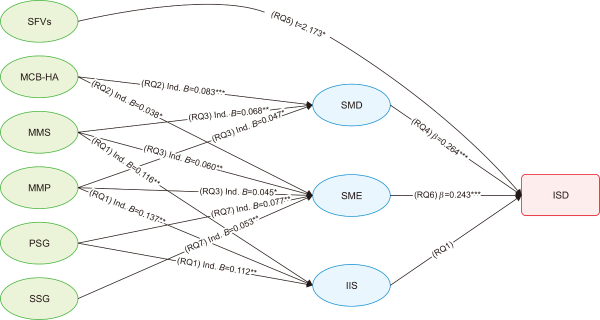
Table 7
Comparison of mean differences in ISD by video length preference (n=216)
| Outcome | Group | Sample size | M | SD | t | p-value |
|---|---|---|---|---|---|---|
| ISD | SFVs | 157 | 4.1873 | 1.27152 | 2.173* | 0.031 |
| LFVs | 59 | 3.7492 | 1.44346 |
5. DISCUSSION
This study provides an empirical lens into the complex information behaviors on VSM and their consequential relationship with users’ health perceptions and intentions, with the tendency toward ADHD self-diagnosis serving as a critical outcome. The findings of this study illuminate how VSM functions as a powerful information environment where user dependency, exposure frequency, and platform characteristics converge to predict significant health-related cognitions and behaviors.
5.1. The Centrality of Video-Based Social Media Dependency and Exposure
The results reveal that dependency on SM is the most potent predictor of the ISD. This suggests that as users come to perceive VSM as integral to achieving daily goals (Kim & Jung, 2017), this reliance naturally extends into the critical domain of health information. Crucially, this dependency is not arbitrary but emerges as a key information pathway for individuals with pre-existing beliefs, such as MM and negative MCB-HA. This suggests that VSM is actively chosen as an alternative information source by users who are already skeptical of or anxious about traditional healthcare systems. Consequently, these individuals may become highly dependent on VSM for health guidance, a behavior that is associated with self-diagnosis and subsequent engagement in non-evidence-based or non-professional treatments (Schiros et al., 2025). Similarly, users who believe their thoughts can cause illness may find the relatable, experiential content on VSM particularly compelling, deepening their dependency and potentially contributing to issues such as symptom overgeneralization (Yeung et al., 2022) or heightened anxiety. Parallel to dependency, the sheer frequency of exposure to ADHD-related content on VSM is directly associated with self-diagnosis intention. This finding is consistent with research showing that repeated exposure to specific media content can heighten users’ perceived vulnerability and risk perceptions regarding the targeted health issues (Olagoke et al., 2020).
5.2. Psychosocial Pathways: Bypassing Traditional Healthcare Barriers
Within the digital “infodemic,” the constant stream of content appears to be linked to user perceptions and behaviors through sheer volume and repetition, potentially altering their understanding of what is normative (Qin et al., 2025; Zeballos Rivas et al., 2021). Mediation results reveal a critical dynamic in this process: VSM exposure provides the primary pathway through which anticipated stigma is associated with self-diagnosis intention. Individuals who fear the social repercussions of seeking formal medical help (Clement et al., 2015) appear to utilize the readily accessible information on VSM as a substitute, effectively using the platform as a discreet information-seeking tool to bypass perceived social barriers.
Crucially, these findings must be interpreted within the context of the study’s specific sample—predominantly young Korean women who are already active VSM users. The pronounced associations between anticipated stigma, SMD, and self-diagnosis intention may be particularly salient in this demographic. This reflects the intersection of their high digital literacy, existing algorithmic familiarity, and the specific socio-cultural context of Korea, where collective norms and mental health stigma remain significant. Furthermore, because the respondents were already consumers of ADHD-related content, their baseline receptivity to such information was likely higher than that of the general public. Thus, rather than representing a universal VSM user experience, the results more accurately illuminate the specific associative pathways through which a highly engaged, digitally fluent, and potentially vulnerable demographic navigates sociocultural barriers to health information.
While utilizing VSM allows these individuals to bypass such immediate social barriers, the downstream consequences of these information-driven behaviors remain deeply complex. The outcomes can be varied, potentially including the misidentification of other health conditions as ADHD, facing new barriers to formal care even after an accurate informal assessment, or contributing to broader narratives of overdiagnosis. Because the fear of stigma actively directs users toward VSM—where they are vulnerable to frequent exposure to potentially misleading ADHD content—it becomes essential to consider interventions that simultaneously address both the quality of online information and the underlying social deterrents to professional care.
5.3. Implications for Information Practice and Clinical Care
This necessity is further underscored by the role of platform architecture and its association with information outcomes. The findings of this study that a preference for SFVs is associated with a significantly higher ISD highlights how the brief and engaging format encourages reliance on heuristic cues rather than deep, critical evaluation. This reliance on superficial cues, a key dynamic in online health information adoption (Jin et al., 2025), can foster immediate identification with presented symptoms, reinforcing the risk of pathologizing normal experiences. Consequently, there is a critical need for media literacy interventions tailored to the specific cognitive challenges posed by SFV content.
In light of these architectural and social challenges, the proactive involvement of librarians and health information professionals appears warranted. The results indicate that individuals exhibiting high MM and anticipated stigma choose VSM as an alternative pathway to bypass perceived barriers. Thus, libraries and public health information centers should transition toward developing “verified health information curation” specifically designed for the SFV format. For groups skeptical of the medical establishment, public institutions might consider “algorithm-based information outreach” to infiltrate the VSM ecosystem with evidence-based content and rectify information imbalances.
Finally, the findings suggest that healthcare professionals should reconsider patients’ self-diagnostic attempts as a proactive manifestation of “e-health literacy” rather than primarily a challenge to clinical authority. Rather than framing these digital information practices strictly in terms of risk or dysfunction, symptom recognition and VSM-based health information seeking can also function as adaptive entry points to professional care. By utilizing the VSM content patients encounter as a clinical tool to build rapport, practitioners can effectively bridge the gap between initial online exposure and formal consultation, guiding users toward evidence-based clinical care.
6. CONCLUSION
In conclusion, this study provides an empirical exploration of how established psychosocial and media theories apply to the emerging context of platform-mediated HIB, utilizing the ISD ADHD within the VSM ecosystem as a focused case. Moving beyond general observations, the analysis demonstrates that interpretive health judgments do not occur in a vacuum but emerge from a sequential and compounding information pathway: Pre-existing vulnerabilities, such as MM and anticipated stigma, foster SMD and direct users toward repeated, algorithmically curated exposure to ADHD content. When this frequent exposure intersects with the heuristic information processing encouraged by SFV formats, users are significantly more likely to map online narratives onto their own experiences, facilitating the self-attribution of symptoms. By framing self-diagnosis as a complex outcome of digital information consumption, this research underscores the profound influence of platform design, algorithmic exposure, and user trust on health-related behaviors. Understanding these specific dynamics is essential for mitigating the potential risks associated with an increasingly user-driven health information landscape.
Building upon these findings, this study empirically demonstrates that the ISD ADHD via VSM is not merely a product of algorithm-driven exposure, but rather a complex interaction between users’ underlying psychosocial vulnerabilities—particularly anticipated stigma and MM—and their dependency on these digital platforms. Consequently, this research suggests shifting away from the deficit-based perspective that views VSM-based health information seeking merely as a passive acceptance of misinformation or an irrational judgment. Instead, it should be recognized as an adaptive coping mechanism and a deliberate information behavior utilized by individuals to navigate existing social barriers. By illuminating these associative pathways, the findings underscore the dual nature of VSM as both a potential risk for symptom overgeneralization and an adaptive gateway to professional care. As digital HIB continue to evolve, it is imperative for health information professionals and clinicians to move beyond deficit-based views. Instead, stakeholders must collaboratively develop algorithm-conscious information curation and tailored e-health literacy interventions that effectively guide vulnerable users from informal online exploration toward evidence-based clinical support.
7. LIMITATIONS AND FUTURE RESEARCH
Despite these contributions, this study has several limitations. First, the cross-sectional, self-reported design precludes strict causal inferences and cannot entirely eliminate CMV or potential reverse causation (e.g., users with prior suspicions actively seeking ADHD content). Second, by capturing only the ISD, the proposed model (which explains a modest 17.2% of variance) leaves actual clinical outcomes and other unmeasured determinants—such as true subclinical symptoms or offline influences—for future investigation. Finally, the sample’s skewness toward young Korean females limits broad generalizability. Given these constraints and the explicitly exploratory nature of this analysis, future studies must employ longitudinal designs, more diverse samples, and confirmatory factor analysis to formally validate the preliminary patterns identified herein.
ACKNOWLEDGEMENTS
This work was supported by the Ministry of Education of the Republic of Korea and the National Research Foundation of Korea (NRF-2025S1A5C3A05025824). The funders had no role in the study design; in the collection, analysis, and interpretation of data; in the writing of the report; or in the decision to submit the article for publication.
REFERENCES
, , , , , (2016) Evaluation of the persistence, remission, and emergence of attention-deficit/hyperactivity disorder in young adulthood JAMA Psychiatry, 73(7), 713-720 https://doi.org/10.1001/jamapsychiatry.2016.0465.
, , , (2025) The reach and accuracy of information on autism on TikTok Journal of Autism and Developmental Disorders, 55(6), 1953-1958 https://doi.org/10.1007/s10803-023-06084-6.
(2020) Social media engagement and organic post effectiveness: A roadmap for increasing the effectiveness of social media use in hospitality industry Journal of Hospitality Marketing & Management, 29(1), 1-21 https://doi.org/10.1080/19368623.2019.1588824.
, (2015) Development and initial validation of a measure of metacognitive beliefs in health anxiety: The MCQ-HA Psychiatry Research, 230(3), 871-877 https://doi.org/10.1016/j.psychres.2015.11.035.
, (1976) A dependency model of mass-media effects Communication Research, 3(1), 3-21 https://doi.org/10.1177/009365027600300101.
, , , , (2020) The relationship between dysfunctional metacognitive beliefs and problematic social networking sites use Scandinavian Journal of Psychology, 61(5), 593-598 https://doi.org/10.1111/sjop.12634.
(2021) TikTok accidentally detected my ADHD. For 23 years everyone missed the warning signs, https://www.theguardian.com/commentisfree/2021/jun/04/tiktok-accidentally-detected-my-adhd-for-23-years-everyone-missed-the-warning-signs
, , , (2017) Understanding the influence of stigma and medical mistrust on engagement in routine healthcare among black women who have sex with women LGBT Health, 4(1), 4-10 https://doi.org/10.1089/lgbt.2016.0083.
, , (2020) Online health research and health anxiety: A systematic review and conceptual integration Clinical Psychology: Science and Practice, 27(2), e12299 https://doi.org/10.1111/cpsp.12299.
(2022) Teens turn to TikTok in search of a mental health diagnosis, https://www.nytimes.com/2022/10/29/well/mind/tiktok-mental-illness-diagnosis.html
, , , (2024) Generational differences in health information behaviors during the COVID-19 crisis: A Hong Kong study Global Media and China, 9(3), 303-324 https://doi.org/10.1177/20594364241238635.
, , , , , , , , , (2015) What is the impact of mental health-related stigma on help-seeking? A systematic review of quantitative and qualitative studies Psychological Medicine, 45(1), 11-27 https://doi.org/10.1017/S0033291714000129.
, , , , (2012) A population-based study of attention deficit/hyperactivity disorder symptoms and associated impairment in middle-aged adults PloS One, 7(2), e31500 https://doi.org/10.1371/journal.pone.0031500.
, , , , (2023, October 22-25) ASSETS ‘23: Proceedings of the 25th International ACM SIGACCESS Conference on Computers and Accessibility Association for Computing Machinery “You can’t possibly have ADHD”: Exploring validation and tensions around diagnosis within unbounded ADHD social media communities, 1-17,
, , , , (2020) Prevalence and predictors of PTSD during the COVID-19 pandemic: Findings from a Tunisian community sample Psychiatry Research, 290, 113131 https://doi.org/10.1016/j.psychres.2020.113131.
, (2017) Cyberchondria: Examining relations with problematic Internet use and metacognitive beliefs Clinical Psychology & Psychotherapy, 24(6), 1322-1330 https://doi.org/10.1002/cpp.2102.
, (2018) Moving toward a metacognitive conceptualization of cyberchondria: Examining the contribution of metacognitive beliefs, beliefs about rituals, and stop signals Journal of Anxiety Disorders, 60, 11-19 https://doi.org/10.1016/j.janxdis.2018.09.003.
(2004) A nonlinear model of information‐seeking behavior Journal of the American Society for Information Science and Technology, 55(3), 228-237 https://doi.org/10.1002/asi.10359.
, (2024) TikTok-inspired self-diagnosis and its implications for educational psychology practice Educational Psychology in Practice, 40(4), 491-508 https://doi.org/10.1080/02667363.2024.2409451.
, , , , , , , , (2021) Characterizing the content related to oral health education on TikTok International Journal of Environmental Research and Public Health, 18(24), 13260 https://doi.org/10.3390/ijerph182413260.
, , (2023) How adolescents trust health information on social media: A systematic review Academic Pediatrics, 23(4), 703-719 https://doi.org/10.1016/j.acap.2022.12.011.
, , (2024) Text, short video, or long video? Effects of attention to various types of social media on public knowledge of dual carbon: A multigroup comparison based on environmental concern levels Environmental Communication, 18(5), 610-627 https://doi.org/10.1080/17524032.2023.2298939.
Gallup Korea (2023) Market 70 2023 (2) Utilization of 18 types of media, contents, and social network services #SNS, https://www.gallup.co.kr/gallupdb/reportContent.asp?seqNo=1430
, , , (2023) Exploring the relationship between intolerance of uncertainty and trust in physicians from spousal and parent-child perspectives Psychology Research and Behavior Management, 16, 2173-2186 https://doi.org/10.2147/PRBM.S413821.
, , , , , (2022) Is TikTok increasing the number of self-diagnoses of ADHD in young people? European Psychiatry, 65(S1), S571 https://doi.org/10.1192/j.eurpsy.2022.1463.
, (2021) Behind the hashtag: Online disclosure of mental illness and community response on Tumblr American Journal of Community Psychology, 67(3-4), 419-432 https://doi.org/10.1002/ajcp.12483.
, (1988) Relation of sample size to the stability of component patterns Psychological Bulletin, 103(2), 265-275 https://doi.org/10.1037/0033-2909.103.2.265.
, (2021) Mental illness on Instagram: A mixed method study to characterize public content, sentiments, and trends of antidepressant use Journal of Mental Health (Abingdon, England), 30(4), 518-525 https://doi.org/10.1080/09638237.2020.1755021.
, , , , , , (2002) Measuring patients’ trust in their primary care providers Medical Care Research and Review, 59(3), 293-318 https://doi.org/10.1177/1077558702059003004.
, , (2022) The effect of the social aspect, media dependency, and uncertainty against the formation of trust toward information in social network sites: A case study of COVID-19 information in Indonesia The Electronic Journal of Information Systems in Developing Countries, 88(1), e12196 https://doi.org/10.1002/isd2.12196.
, (2024) Social media and ADHD: Implications for clinical assessment and treatment Irish Journal of Psychological Medicine, 41(1), 132-136 https://doi.org/10.1017/ipm.2023.40.
, , (2015) Applying the theory of planned behavior and media dependency theory: Predictors of public pro-environmental behavioral intentions in Singapore Environmental Communication, 9(1), 77-99 https://doi.org/10.1080/17524032.2014.932819.
(2026) ‘Why is everyone self-diagnosing with ADHD nowadays?’: The affective economy of ADHD TikTok Continuum, 40(2), 238-251 https://doi.org/10.1080/10304312.2025.2544777.
, (2019) Towards a more inclusive and dynamic understanding of medical mistrust informed by science Behavioral Medicine (Washington, D.C.), 45(2), 79-85 https://doi.org/10.1080/08964289.2019.1619511.
, , (2021) Online health information seeking behavior: A systematic review Healthcare (Basel, Switzerland), 9(12), 1740 https://doi.org/10.3390/healthcare9121740.
, , (2025) Do the certainty tone and seniority of physicians matter in patients’ information adoption in online health communities? Information Technology & People, 38(1), 442-471 https://doi.org/10.1108/itp-01-2022-0034.
, , , , , (2016) Race-based medical mistrust, medication beliefs and HIV treatment adherence: Test of a mediation model in people living with HIV/AIDS Journal of Behavioral Medicine, 39(6), 1056-1064 https://doi.org/10.1007/s10865-016-9767-1.
, , , , , (2021) Overdiagnosis of attention-deficit/hyperactivity disorder in children and adolescents: A systematic scoping review JAMA Network Open, 4(4), e215335 https://doi.org/10.1001/jamanetworkopen.2021.5335.
, , (2022) A systematic review evaluating metacognitive beliefs in health anxiety and somatic distress British Journal of Health Psychology, 27(4), 1398-1422 https://doi.org/10.1111/bjhp.12609.
, , , (2025) Trust but verify: The effect of religiosity and social conformity on verification of content shared via social media Information Technology & People, 38(1), 70-86 https://doi.org/10.1108/itp-11-2022-0827.
, (2011) Problem solving and communicative action: A situational theory of problem solving Journal of Communication, 61(1), 120-149 https://doi.org/10.1111/j.1460-2466.2010.01529.x.
, (2017) SNS dependency and interpersonal storytelling: An extension of media system dependency theory New Media & Society, 19(9), 1458-1475 https://doi.org/10.1177/1461444816636611.
, , , (2022) User-generated content behavior and digital tourism services: A SEM-neural network model for information trust in social networking sites International Journal of Information Management Data Insights, 2(1), 100056 https://doi.org/10.1016/j.jjimei.2021.100056.
, , , (2020) What drives unverified information sharing and cyberchondria during the COVID-19 pandemic? European Journal of Information Systems, 29(3), 288-305 https://doi.org/10.1080/0960085x.2020.1770632.
, (2014) A review of models and theories of health information seeking behavior International Journal of Health System and Disaster Management, 2(4), 193-203 https://doi.org/10.4103/2347-9019.144371.
, , (2009) Mistrust of health care organizations is associated with underutilization of health services Health Services Research, 44(6), 2093-2105 https://doi.org/10.1111/j.1475-6773.2009.01017.x.
(2023) ‘Do I have ADHD too?’...Self-diagnosis and psychiatry visit 2030↑, https://www.yna.co.kr/view/AKR20231108127400004
, , , (2017) Factors associated with help-seeking behaviour among individuals with major depression: A systematic review PloS One, 12(5), e0176730 https://doi.org/10.1371/journal.pone.0176730.
, , , , (2021) Examining the links between active Facebook use, received likes, self-esteem and happiness: A study using objective social media data Telematics and Informatics, 58, 101523 https://doi.org/10.1016/j.tele.2020.101523.
, (2023) Using TikTok for public and youth mental health-a systematic review and content analysis Clinical Child Psychology and Psychiatry, 28(1), 279-306 https://doi.org/10.1177/13591045221106608.
, , , , , , , , , , , , , , , (2015) Is adult ADHD a childhood-onset neurodevelopmental disorder? Evidence from a four-decade longitudinal cohort study The American Journal of Psychiatry, 172(10), 967-977 https://doi.org/10.1176/appi.ajp.2015.14101266.
, , , , , , , (2021) Exposure to COVID-19-related information and its association with mental health problems in Thailand: Nationwide, cross-sectional survey study Journal of Medical Internet Research, 23(2), e25363 https://doi.org/10.2196/25363.
, (2001) Communication and health beliefs: Mass and interpersonal influences on perceptions of risk to self and others Communication Research, 28(5), 602-626 https://doi.org/10.1177/009365001028005002.
, , , , , (2024) The roles of social media use and medical mistrust in black Americans’ COVID-19 vaccine hesitancy: The RISP model perspective Health Communication, 39(9), 1833-1846 https://doi.org/10.1080/10410236.2023.2244169.
, , (2020) Exposure to coronavirus news on mainstream media: The role of risk perceptions and depression British Journal of Health Psychology, 25(4), 865-874 https://doi.org/10.1111/bjhp.12427.
(2007) The psychological implications of concealing a stigma: A cognitive-affective-behavioral model Psychological Bulletin, 133(2), 328-345 https://doi.org/10.1037/0033-2909.133.2.328.
(2020) Mistrust and misinformation: A two-component, socio-epistemic model of belief in conspiracy theories Journal of Social and Political Psychology, 8(2), 617-641 https://doi.org/10.5964/jspp.v8i2.1362.
, , , , (2025) Social perceptions going online: Exploring the impact of social media food content exposure on perceptions of food norms Appetite, 206, 107803 https://doi.org/10.1016/j.appet.2024.107803.
, , (2025) Misinformation mayhem: The effects of TikTok content on ADHD knowledge, stigma, and treatment-seeking intentions European Child & Adolescent Psychiatry, 34(11), 3521-3533 https://doi.org/10.1007/s00787-025-02769-8.
, , , , , , , (2019) Stigma as a barrier to recognizing personal mental illness and seeking help: A prospective study among untreated persons with mental illness European Archives of Psychiatry and Clinical Neuroscience, 269(4), 469-479 https://doi.org/10.1007/s00406-018-0896-0.
(2025) Scroll, self-diagnose, repeat: TikTok, ADHD misinformation, and the rise of illusory symptoms, https://papers.ssrn.com/sol3/papers.cfm?abstract_id=5399427
, , , , , , Global Health Epidemiology Reference Group (GHERG) (2021) The prevalence of adult attention-deficit hyperactivity disorder: A global systematic review and meta-analysis Journal of Global Health, 11, 04009 https://doi.org/10.7189/jogh.11.04009.
, , , , , , (2025) Psychological, psychiatric, and behavioral sciences measurement scales: Best practice guidelines for their development and validation Frontiers in Psychology, 15, 1494261 https://doi.org/10.3389/fpsyg.2024.1494261.
, (2021) Prevalence of health misinformation on social media: Systematic review Journal of Medical Internet Research, 23(1), e17187 https://doi.org/10.2196/17187.
, , , , , , (2018) YouTube lens to attention deficit hyperactivity disorder: A social media analysis BMC Research Notes, 11(1), 854 https://doi.org/10.1186/s13104-018-3962-9.
, , , (2023) Platform affordances and political participation: How social media reshape political engagement West European Politics, 46(4), 788-811 https://doi.org/10.1080/01402382.2022.2087410.
, , , (2012) Medical mistrust and discrimination in health care: A qualitative study of Hmong women and men Journal of Community Health, 37(4), 822-829 https://doi.org/10.1007/s10900-011-9516-x.
, , , (2016) How attitude strength biases information processing and evaluation on the web Computers in Human Behavior, 60, 245-252 https://doi.org/10.1016/j.chb.2016.02.057.
, , , , , (2014) Endorsed and Anticipated Stigma Inventory (EASI): A tool for assessing beliefs about mental illness and mental health treatment among military personnel and veterans Psychological Services, 11(1), 105-113 https://doi.org/10.1037/a0032780.
(1999) Models in information behaviour research Journal of Documentation, 55(3), 249-270 https://doi.org/10.1108/eum0000000007145.
, , (2022) TikTok and attention-deficit/hyperactivity disorder: A cross-sectional study of social media content quality Canadian Journal of Psychiatry, 67(12), 899-906 https://doi.org/10.1177/07067437221082854.
, , , , , (2021) Social media exposure, risk perception, preventive behaviors and attitudes during the COVID-19 epidemic in La Paz, Bolivia: A cross sectional study PloS One, 16(1), e0245859 https://doi.org/10.1371/journal.pone.0245859.
, , , (2023) How does health information seeking from different online sources trigger cyberchondria? The roles of online information overload and information trust Information Processing & Management, 60(4), 103364 https://doi.org/10.1016/j.ipm.2023.103364.
, , , , (2025) The algorithmic influence: What drives people to use AI-powered social media as a source of health information? International Journal of Human-Computer Interaction, 41(23), 15145-15157 https://doi.org/10.1080/10447318.2025.2495115.
, (2022) Calling Dr. Internet: Analyzing news coverage of cyberchondria Journalism Practice, 16(5), 1001-1017 https://doi.org/10.1080/17512786.2020.1824586.
, , , (2021) Characterizing the dissemination of misinformation on social media in health emergencies: An empirical study based on COVID-19 Information Processing & Management, 58(4), 102554 https://doi.org/10.1016/j.ipm.2021.102554.
- 투고일Received
- 2026-02-11
- 수정일Revised
- 2026-03-17
- 게재확정일Accepted
- 2026-03-20
- 출판일Published
- 2026-06-30
- 다운로드 수
- 조회수
- 0KCI 피인용수
- 0WOS 피인용수