

- P-ISSN 1225-0163
- E-ISSN 2288-8985



Gas sensors play an important role in various areas, including industrial safety, environmental monitoring, gas infrastructure and medical diagnostics. These sensors identify and measure the concentration of specific gases in various environments, ensuring operational safety and efficiency by providing accurate on site measurement. Gas sensors are engineered for high sensitivity, stability, and reliability, while also being required to be cost-effective, responsive, and compact. To respond these needs, the volumetric image gas sensor based on volumetric measurement is developed. The sensor works by quantifying the volume of gas based on the emitted gas. This sensor is capable of determining gas uptake, solubility and diffusivity in gas-charged polymers under high pressure. The sensor delivers quick responses within a second and can detect gas concentrations from 0.01 wt·ppm to 1400 wt·ppm, with changeable sensitivity and measurement ranges. Performance testing verifies the reliability of the sensor, its ability to adapt to different measurement ranges and its stability under temperature and pressure variations. As a result, this sensor system enables real-time detection and analysis of gas transport properties in pure gases like H₂, He, N₂, O₂, and Ar, making it ideal for pure gas sensing applications.
Gas sensing is essential for safety, especially in environments with hazardous gases like hydrogen or carbon monoxide.1-10 Early detection of gas emissions and leaks can prevent accidents, fires and other risks. It is vital for environmental monitoring, the detection of pollutants and the preservation of air quality. An accurate gas sensor is key to optimize operations, especially for renewable energy sources such as hydrogen. By ensuring precise measurement of H2 gas emission, it improves safety, efficiency, and performance across the hydrogen production, storage and distribution stages.11-22
Polymer materials play a crucial role in hydrogen infrastructure.23-45 Polymer materials like O-ring seal, gasket, liner and non-metallic pipeline are widely used. It is built to endure hydrogen-rich environments. However, these polymers are subjected to harsh conditions including wide temperature fluctuations and pressure variations. These conditions can cause seal damage, poor contact with gloves and gas permeation through polymer seals, potentially leading to hydrogen leakage.46-52
Gas permeation including hydrogen in polymers also occurs when gases pass through the polymer matrix due to diffusion. This process is influenced by factors such as temperature, pressure and the chemical nature of both gas and polymer.53-55 In addition, the permeation rate can vary based on the polymer’s structure, composition, filler content and the type of gas involved, with amorphous polymers typically having higher permeability compared to crystalline ones. Gas permeation is an important consideration in applications like gas storage and delivery, where polymers need to have low gas diffusion/permeability to avoid leakage and maintain system integrity.
Gas sensors are crucial for precisely detecting gas concentrations and leaks in applications like fuel cells, storage facilities, and transportation systems.56,57 Various gas sensors are employed based on different sensing principles with its own characteristic. Infrared (IR) gas sensing58-66 works on the principle that gas molecules absorb infrared light of specific wavelengths. The intensity of the absorbed light is measured and correlated to the concentration of the target gas. IR gas sensing offers key benefits such as high sensitivity, selectivity, and ability to detect gases across a broad concentration range. For example, it is widely used in industrial safety systems to monitor gas leaks in chemical plants. However, its performance can be influenced by environmental factors like temperature and humidity, necessitating regular calibration to maintain accuracy.
Semiconductor gas sensors67-78 operate based on the principle that gas molecules interact with the surface of a semiconductor (typically metal oxides), causing a change in its electrical resistance. The change in resistance is measured and intercorrelated to concentration of the target gas. These sensors have advantages like low cost, fast response, and compact size, making them ideal for applications like air quality monitoring in urban environments. However, they can be affected by factors like temperature, pressure, and humidity. For instance, in industrial settings, these sensors may show cross-sensitivity to gases like methane, which can impact their accuracy in detecting specific pollutants.
Catalytic combustion gas sensors79-85 work by detecting gases through the catalytic oxidation of the target gas on a heated catalyst surface, which generates heat. This heat change is measured and used to determine the gas concentration. These sensors offer high sensitivity to combustible gases and reliable detection of flammable gases at low concentrations. However, their lifespan is limited, particularly when exposed to poisons such as silicone or lead, and they may need frequent maintenance to maintain accuracy.
An optical spectroscopy gas sensor86-99 works by the principle that gas molecules absorb or emit light at specific wavelengths. When light passes through a gas sample or is reflected from it, the gas molecules absorb light at characteristic absorption bands corresponding to their molecular structure. The amount of absorbed light is then measured, which is related to the gas concentration. Optical spectroscopy gas sensors offer high sensitivity, non-destructive measurement, and accurate detection of low gas concentrations. They can identify a broad spectrum of gases and are generally unaffected by interference from other substances. However, they can be influenced by environmental factors like temperature, pressure, and the presence of other gases in complex mixtures. These sensors are commonly used in air quality monitoring and environmental research, where precise gas detection is essential.
An electrochemical gas sensor100-118 detects gases through a chemical reaction between the target gas and electrodes in an electrolyte, generating an electrical current proportional to the gas concentration. These sensors have high sensitivity, low power consumption and excellent selectivity for specific gases. However, they can be affected by temperature and humidity and their lifespan may be shortened due to electrode or electrolyte degradation. Electrochemical sensors are commonly used in personal gas detectors for safety in industrial environments, where quick, accurate gas detection is critical.
Finally, gas chromatography119-134 and mass spectrometry135-147 provide highly precise analysis and commonly are used in research and laboratory settings. Gas chromatography separates from gas mixtures and analyzes individual components, while mass spectrometry identifies gas molecules based on their mass after ionization. However, these sensing systems are expensive and require regular maintenance, making them unsuitable for real-time field monitoring.
The conventional gas sensing technologies face challenges in specimen size, sensitivity, selectivity and environmental stability. These limitations highlight the need for advanced gas sensors that are compact, have rapid response times, high sensitivity and robust performance to ensure safety in real-time gas monitoring.
Thus, the volumetric gas sensors with the performance to meet these requirements is proposed based on the image processing algorithm and digital camera and graduated cylinder.5,148 This sensing system aims to provide the real-time monitoring by connecting to a computer via a GPIB interface and using a diffusion analysis program149-151 to accurately calculate gas concentration/diffusion in the polymer specimen with the insensitivity to temperature/pressure changes. This detection system can easily measure gas concentration and diffusion in the polymer specimen in real-time on-site without any chemical interactions with gas.
The developed gas sensor system has demonstrated versatility in detecting and analyzing gases such as H2, He, O₂, N₂, and Ar, while monitoring gas adsorption and diffusion in polymers in real-time. It offers consistent performance in sensitivity, stability and response time. The sensor technology presented provides a compact, portable solution that can replace bulky equipment. It has potential applications not only in hydrogen infrastructure safety management but also in the gas industry for real-time gas detection. We represented the principles, procedures, results and characteristics of this sensing method. Thus, the developed gas sensing method provides valuable insights into the diffusion properties, leakage and sealing capabilities of O-rings under high-pressure conditions.
The developed gas sensor measures gas concentration and diffusion coefficient during the desorption process of gases exposed to high pressure from polymer specimens. The polymers tested include low-density polyethylene (LDPE), commonly used for containers, plastic bags and gas transport pipes due to its gas-barrier properties. Ethylene propylene diene monomer (EPDM) is used in O-ring seal materials for high-pressure gas storage vessel. This gas detection system enables the determination of permeation properties (solubility, diffusivity and permeability) of the polymer samples.
The LDPE specimen was produced by King Plastic Corporation, utilizing advanced antimicrobial technology. Details on the composition and density of the polymer samples are available in prior studies.3,151 The EPDM was degassed by heat treatment at 60 °C for 48 hours. The polymer samples were prepared in the following cylindrical shapes and dimensions:
−LDPE : radius (R) 9.51 mm, thickness (T) 4.89 mm, 1.57 mm
−EPDM : radius (R) 9.51 mm, thickness (T) 2.56 mm
For high-pressure gas exposure, a SUS 316 chamber with specific volume was used at room temperature and specified pressure conditions. The gas exposure was performed in the pressure ranging from 2 MPa to 10 MPa. The purity of the gases used was as:
• H₂: 99.999 %, He: 99.999 %, N₂: 99.999 %, O₂: 99.99 %, Ar: 99.999 %
Before gas exposure, the chamber was purged three times with the corresponding gas from 0.5 MPa to 1 MPa. Samples were then exposed to the gas at the specified pressure for 24-48 hours, with H₂ and He exposed for 24 hours due to their fast diffusion rates, while N₂, O₂, and Ar were exposed for 48 hours due to their slower diffusion rates. A maximum gas exposure of 48 hours was sufficient to reach the equilibrium for gas sorption into specimen. Additionally, since thicker specimens require a longer exposure time, LDPE specimens of 4.89 mm thickness were used for H₂ and He, while 1.57 mm thick specimens were used for N₂, O₂, and Ar to minimize the difference in gas exposure time.
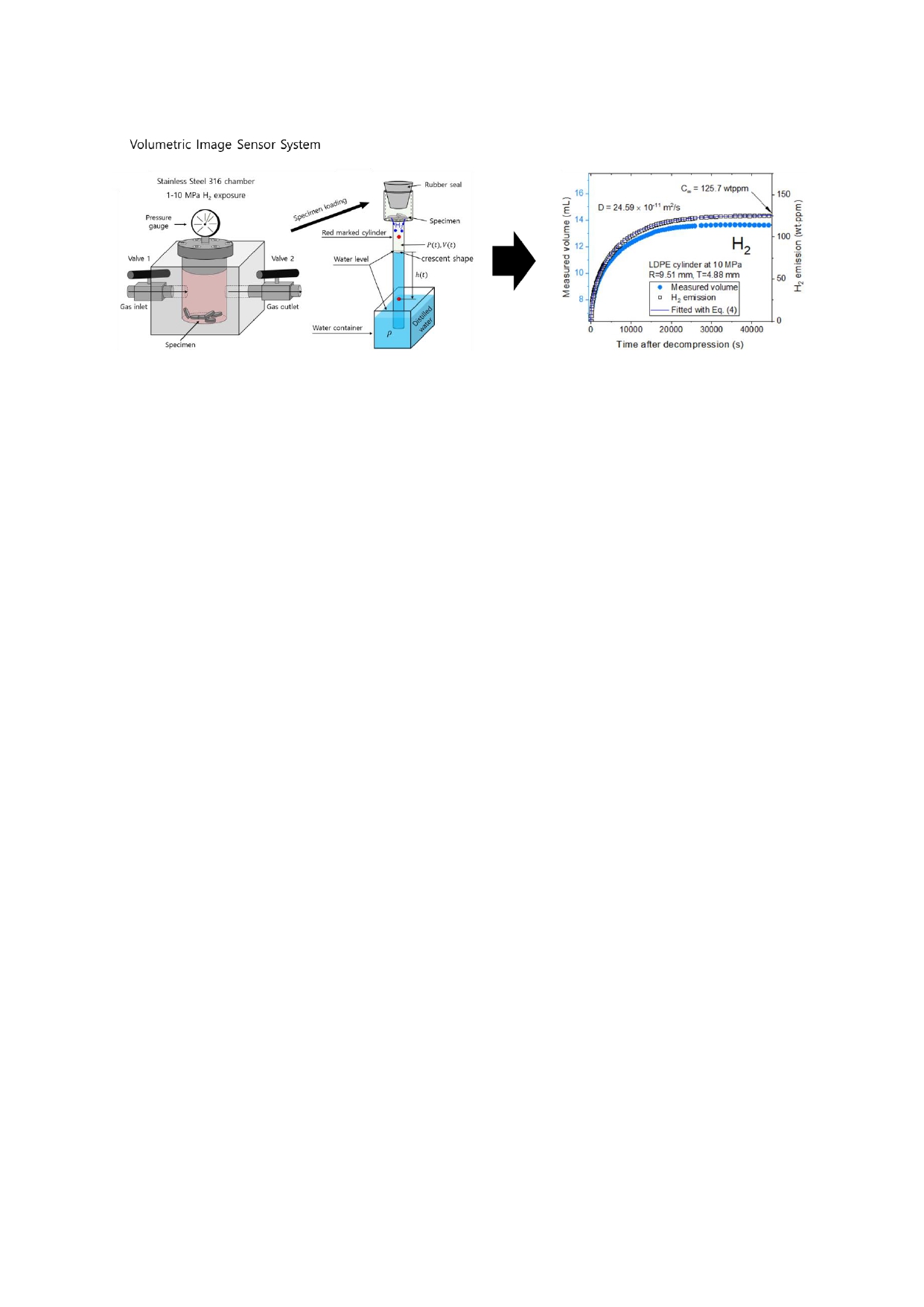
A volumetric measurement (VM) technique was developed to assess gas diffusion and permeation. This method involves measuring the gas concentration released from a specimen after high-pressure gas charging and decompression. Fig. 1 shows the volumetric image sensor system used to quantify the released gas at room temperature. The system includes a high-pressure chamber (Fig. 1(a)) for gas exposure and a cylinder (Fig. 1(b)) immersed in a water container.
After high-pressure gas charging and decompression, the specimen was placed in the upper air space of a cylinder, as shown in Fig. 1(b). The gas released from the specimen caused the water level in the cylinder to gradually decrease. As a result, the pressure (P) and volume (V) of the gas inside the cylinder changed over time. The water level in cylinder has crescent shape, as shown in Fig. 1(b).
The gas in the cylinder follows the ideal gas law, PV = nRT, where R is the gas constant (8.20544 × 10⁻⁵ m³·atm/(mol·K)), T is the temperature inside the cylinder and n is the number of moles of gas released. The changes in pressure P(t) and volume V(t) of the gas in the cylinder can be described as follows:152
P(t) = Po(t) − ρgh(t), V(t) = Vo − Vs − Vh(t) (1)
where Po is the external pressure outside the cylinder, g is the gravitation acceleration and ρ is the density of distilled water. The h(t) indicates water level within the graduated cylinder over time, while Vo is the combined volume of gas and water inside the cylinder, measured relative to the water level in the container. Vh(t) is the time-dependent volume of water in the cylinder, and Vs indicates the volume occupied by the sample.
The amount of gas released by the polymer specimen was quantified by tracking the water level position [Vh(t)] over time. The total moles of gas released [n(t))] were then calculated by measuring the total gas volume [V(t)] in the cylinder, which corresponds to the decrease in the water level, as expressed by the following:152
with
In Eq. (2), T0 and P0 are the initial temperature and pressure of the gas in the graduated cylinder, respectively. V(t) is the total volume, consisting of the remaining initial air volume (VA) and the released gas volume [VH(t)], so that V(t) = VA + VH(T). nA denotes the initial mole number of air and nH(t) refers to the time-dependent mole number of gas corresponding to the increase in gas volume due to its release. Therefore, nH(t)was converted to the gas concentration, [C(t) emitted per unit mass from the specimen as :
For example, the molar mass of H2 gas, mH2 [g/mol] is 2.016 g/mol. The molar mass of nitrogen gas mN2 [g/mol] is 28.013 g/mol. msample is the specimen mass. In Eqs. (2) and (3), the time-dependent mole number of gas, nH(t), was converted to the gas mass concentration, [C(t)], by the factor, \(\begin{align}k=\left[\frac{m_{\text {Gas }}}{m_{\text {sample }}}\right] . n_{H}(t)\end{align}\) and C(t) are affected by the fluctuations of temperature and pressure in the laboratory environments. To ensure precise measurements, it's essential to compensate for these variations. This compensation can be achieved through automated programs according to Eq. (3). That is., the terms, V(t)(β(t) - α(t)), is the volume change in the VH(t), caused by the temperature and pressure change. The compensation indicates the application of V(t)(β(t) - α(t)) calculation in Eq. (3). Thus, the insensitivity of the sensor to variations in temperature/pressure indicates application of automatic compensation by program.
The release of gas was tracked by monitoring changes in water level measurement using image processing algorithm via digital camera in front of the graduated cylinder. The procedure for obtaining the water level (emitted gas volume) from water level measurement is described in previous works.5,148
Gas emission from the gas-exposed sample follows Fickian diffusion, thus, the concentration of the emitted gas, CE(t), is calculated as :153,154
where βn represents root of zeroth-order Bessel function, J0(βn). This equation corresponds to solution of Fick’s second diffusion equation for a cylindrical shaped specimen. ce(t = 0) = 0 and ce(t = ∞) = c∞ is saturated gas concentration at infinite time, indicating total gas uptake (emission content). D is the gas diffusivity. l and ρ are thickness and radius of cylindrical sample, respectively.
To accurately calculate using Eq. (4), many terms in the product of two summations are involved. Therefore, a dedicated diffusion analysis program was developed to precisely calculates C∞ and D. This program uses a nonlinear optimization algorithm142,155 to accurately compute CE(t) and D from the experimental data by solving the complicated Eq. (4).
After decompressing a specimen enriched with nitrogen under high pressure, the released gas concentration and diffusivity were determined using the VM method with a graduated cylinder (Fig. 1). The water level in VM method is measured by employing image processing algorithm and a digital camera.148 Fig. 2 displays the measured and fitted results for five gases (H2, He, N₂, O₂ and Ar) in the cylindrical LDPE specimen determined from the water level measurement by VM. The left sides of Fig. 2(a) through (e) show corresponding emitted gas volume (blue filled circle) transferred from water level measurement. The right sides of Fig. 2(a) through (e) represent corresponding gas emission data (black open square). The diffusion parameters, D and C∞, are derived by a diffusion program by Eq. (4). The blue line in Fig. 2 represents the fitted result using Eq. (4), with diffusivity and the total gas uptake marked by a blue arrow. As shown in Fig. 2(a) through (e), single-mode gas emission behaviors for all gases in LDPE were observed under time-varying gas emission measurement. The single-mode gas emission in LDPE results from gas diffusion into the amorphous phase.
In similarity with Figs. 2 and 3(a) through (e) display the measured and fitted results for five gases in the cylindrical EPDM specimen determined from VM measurement. The left and right sides of Fig. 3(a) through (e) show corresponding gas volume (blue filled circle) and gas emission content (black open square), respectively. The right sides of Fig. 3(a) through (e) represent the diffusion parameters, D and C∞ , derived using a diffusion program by Eq. (4). The blue line in Fig. 3 represents the fitted data using Eq. (4), with diffusivity and the total gas uptake marked by a blue arrow. As shown in Fig. 3(a) through (e), single-mode gas emission behaviors for all gases in EPDM were observed under time-varying gas emission measurement.
Fig. 4 show the corresponding gas uptake and diffusivity of LDPE as a function of exposed pressure for five distinct gases. As shown in Fig. 4(a), the black line linearly fitted to the gas uptake data has squared correlation coefficients of R2 > 0.98, indicating that LDPE absorbs the all gas molecules in their molecular state without undergoing dissociation or chemical reactions, following Henry’s law. In Fig. 4(b), the diffusivity does not exhibit a substantial dependence on the exposed pressure. The black error bars in Fig. 4(a) and (b) represent the expanded measurement uncertainty of 10 %, as estimated in an earlier study. In Fig. 4(a), the slope of gas uptake for the exposed pressure is represented by a slope value. The diffusivity in Fig. 4(b) is represented by the average value (Dave) of the three data points, as indicated by the black horizontal line.
Fig. 5 depict the gas uptake and diffusivity versus the exposed pressure for EPDM for five gases. The gas absorption behavior of EPDM in Fig. 5(a) satisfactorily follows Henry’s law to a maximum of 10 MPa, as indicated by the black line, R2 > 0.98. As displayed in Fig. 5(b), the diffusivity is not pressure dependent. Thus, the average diffusivity is taken, as indicated by the black horizontal line.
Moreover, gas solubility (S) is obtained from gas uptake versus pressure from Figs. 4 and 5 as follows:149,156-158
mg is molar mass of the enriched gas and d is density of the sample. The solubility and diffusivity in volumetric sensor determined for H2, He, N2, O2 and Ar gases in LDPE and EPDM sample are shown in Tables 1 and 2, respectively. Clear differences in permeation parameters depending on the gas species were observed for both LDPE and EPDM samples. For all tested samples, gas solubility consistently decreased in the following order: SAr > SO2 > SN2 > SH2 > SHe. Although various factors contribute to gas permeation properties, solubility is known to have a linear relationship with the critical temperature of the gas [38, 42]. The critical temperatures of the gases are H₂: 33.0 K, He: 3.4 K, N₂: 126.2 K, O₂: 154.6 K, and Ar: 150.7 K. These data confirm that solubility tends to increase with higher critical temperatures.
In the analysis of diffusivity, emphasis was placed on the effective molecular size rather than the critical temperature. The diffusivity in LDPE and EPDM samples decreased in the order: DHe > DH2 > DO2 > DAr > DN2. The effective molecular size of permeating gases significantly influences diffusivity, and the logarithm of diffusivity is known to correlate linearly with the kinetic diameter of gas molecules [38, 42]. The kinetic diameters of the gases are as follows: H₂: 0.289 nm, He: 0.260 nm, N₂: 0.364 nm, O₂: 0.346 nm, and Ar: 0.343 nm. These diameters represent the effective size of the interaction zone that can cause molecular scattering, directly relating to the mean free path of molecules in a gas. Therefore, diffusivity generally decreases as the kinetic diameter of the gas molecules increases.
In Tables 1 and 2, the solubility and diffusivity in two specimens for volumetric sensor have 10 % relative expanded uncertainty for measured value. The solubility and diffusivity results obtained from the volumetric method will be compared with those obtained from manometric method with corresponding estimated relative uncertainty.
The performance of the volumetric gas sensing system using an image processing algorithm and a digital camera was evaluated. The performance test results, including sensitivity, resolution, stability, measuring range, response time and figure of merit (FOM), are shown in Table 3. Sensitivity in the VM sensor is defined as the change in mass concentration relative to the change in measured volume. The obtained sensitivity was 16.43 wt·ppm/mL. A sensor with higher sensitivity typically offers better resolution. The resolution of the VM sensor is determined by the minimum measurable volume of 0.005 mL, corresponding to a mass concentration of 0.08 wt·ppm. To further improve the resolution, the inner volume of the graduated cylinder can be reduced, or the number of specimens can be increased, which would enhance both sensitivity and resolution.
The stability of the volumetric sensor is quantified by the standard deviation of measurements taken over 24 hours after gas emission from the specimen is completed. This was determined to be below 0.2 % of the mass concentration for the VM sensor. The measuring range in VM sensor is obtained as the maximum allowable concentration per mass of specimen within graduated cylinder with inner volumes. The measuring range for VM was 1400 wt·ppm which can be adjusted by varying the sample mass and cylinder volume. The gas sensor’s volume response is almost instantaneous, occurring within ~1 second of gas emission. FOM is defined as the standard deviation between measured data and theoretical value calculated using Eq. (4). FOM value below 0.4 % for VM sensor, indicates an excellent agreement between the theoretical and measured values. Additionally, the measurable range, resolution and sensitivity can be fine-tuned by adjusting the sample number and cylinder inner volume.
Gas sensors are crucial for ensuring safety and protecting property in gas-related facilities. We have developed gas sensing system that utilizes volumetric measurements with a graduated cylinder, coupled with an image processing algorithm and a digital camera. The variation in the water level, observed through pixel shifts in the graduated cylinder, is directly linked to changes in water volume caused by the released gas, allowing for precise measurement of gas concentration. By integrating a diffusion-permeation analysis program, this volumetric image-based gas sensor is capable of detecting not only gas concentrations but also solubility/ diffusivity from gas-enriched specimens under highpressure conditions.
The portable volumetric gas sensor systems showcased several key performance metrics: a low detection limit for gas content, a measurable range of up to 1400 wt·ppm, stability of 0.2 % and a rapid responsing time within 1 second. Additionally, the sensors' insensitivity to temperature and pressure fluctuations made them highly reliable for gas detection. The high-performance systems, utilizing volumetric measurements, successfully demonstrated real-time monitoring and characterization of pure gases such as H₂, He, N₂, O₂ and Ar. The sensors effectively measured gas uptake and diffusivity, considering influencing factors and calculating expanded uncertainty. The main features of developed gas sensing method are summarized as:
− Cost-effective and simple techniques: The volumetric method provides affordable and straightforward solutions for evaluating gas uptake and diffusivity in gas charged polymers.
− Stability against temperature and pressure variations: The volumetric method is stable under fluctuations in temperature and pressure. The method is independent on a specimen sizes, shapes and gas types.
− Adjustable sensitivity and range: The volumetric method offers adjustable sensitivity, resolution, and measuring range, allowing for customization based on specific application requirements.
− No chemical interaction: The sensing method functions without any interaction between the gas molecules and the sensor, ensuring accurate mea- surements without altering the composition of the gas.
− Visible gas release monitoring: The volumetric method provides visual gas monitoring of gas release by changes in water level.
Although the proposed sensor exhibits limited selectivity for distinguishing specific gases, its rapid response and high sensitivity make it highly effective for initial monitoring in mixed-gas environments, particularly for rapid detection of gas leaks. Future studies will focus on optimizing the sensor structure to further improve its performance, expanding its potential for practical real-time gas leak detection applications.
Z. Wang, L. Zhu, J. Zhang, J. Wang, X. Cui, X. Chen, W. Liu, H. Ma, J. Wang, and W. Yan, Sens. Actuators B Chem., 418, 136276 (2024). https://doi.org/10.1016/j.snb.2024.136276 https://doi.org/10.1016/j.snb.2024.136276
B. C. Yadav and P. Kumar, In 'Compex and Composite Metal Oxides for Gas, VOC and Humidity Sensors', p133-157, Elsevier, 2024. https://doi.org/10.1016/C2021-0-02857-13 https://doi.org/10.1016/C2021-0-02857-13
J. K. Jung, I. G. Kim, K. S. Chung, and U. B. Baek, Mater. Chem. Phys., 267, 124653 (2021). https://doi.org/10.1016/j.matchemphys.2021.124653 https://doi.org/10.1016/j.matchemphys.2021.124653
J. K. Jung and J. H. Lee, Sci. Rep., 14(1), 1967 (2024). https://doi.org/10.1038/s41598-024-52168-3 https://doi.org/10.1038/s41598-024-52168-3
J. Li, Y. Li, and W. Zeng, Sens. Actuators A Phys., 365, 114890 (2024). https://doi.org/10.1016/j.sna.2023.114890 https://doi.org/10.1016/j.sna.2023.114890
Y. Yang, S. Zheng, X. Fu, and H. Zhang, Optik, 158, 602-609 (2018). https://doi.org/10.1016/j.ijleo.2017.12.151 https://doi.org/10.1016/j.ijleo.2017.12.151
P. Mohapatra, S. Panigrahi, and J. Amamcharla, J. Food Meas. Charact., 9(2), 121-129 (2015). https://doi.org/10.1007/s11694-014-9200-9 https://doi.org/10.1007/s11694-014-9200-9
J. K. Jung, I. G. Kim, and K. T. Kim, Current Applied Physics, 21, 43-49 (2021). https://doi.org/10.1016/j.cap.2020.10.003 https://doi.org/10.1016/j.cap.2020.10.003
T. J. Johnson, R. L. Sams, and S. W. Sharpe, Proceedings of the Chemical and Biological Point Sensors for Homeland Defense, SPIE, Bellingham, WA, USA, 159-167 (2004). https://doi.org/10.1117/12.515604 https://doi.org/10.1117/12.515604
J. K. Jung, I. G. Kim, K. T. Kim, U. B. Baek, and S. H. Nahm, Current Applied Physics, 26, 9-15 (2021). https://doi.org/10.1016/j.cap.2021.03.005 https://doi.org/10.1016/j.cap.2021.03.005
S. E. Kayacık, A. H. Schrotenboer, E. Ursavas, and I. F. A. Vis, Sustain. Energy Grids Netw., 38, 101394 (2024). https://doi.org/10.1016/j.segan.2024.101394 https://doi.org/10.1016/j.segan.2024.101394
I. Amez, B. Castells, D. León, and R. Paredes, Fuel, 381, 133663 (2025). https://doi.org/10.1016/j.fuel.2024.133663 https://doi.org/10.1016/j.fuel.2024.133663
M. Wu, L. Bai, F. Deng, J. He, K. Song, and H. Li, Coord. Chem. Rev., 523, 216259 (2025). https://doi.org/10.1016/j.ccr.2024.216259 https://doi.org/10.1016/j.ccr.2024.216259
M. Tang, C. Qin, X. Sun, M. Li, Y. Wang, J. Cao, and Y. Wang, Appl. Phys. A, 130(10), 741 (2024). https://doi.org/10.1007/s00339-024-07905-w https://doi.org/10.1007/s00339-024-07905-w
H. M. Kang, J. W. Bae, J. H. Lee, Y. M. Yun, S. K. Jeon, N. K. Chung, J. K. Jung, U. B. Baek, J. H. Lee, Y. W. Kim, and M. C. Choi, Polymers, 16(8), 1065 (2024). https://doi.org/10.3390/polym16081065 https://doi.org/10.3390/polym16081065
A. Tom, D. K. Singh, V. K. Shaw, P. V. Abhijith, S. Sajana, P. S. Kirandas, V. Dixit, V. Kamble, S. P. Pai, and D. Jaiswal-Nagar, Rev. Sci. Instrum., 95(8), 085003 (2024). https://doi.org/10.1063/5.0202940 https://doi.org/10.1063/5.0202940
R. Venkatesan, R. Harun, H. M. Yusoff, and M. A. Razak, Process Saf. Prog., 43(S1), S161-S169 (2024). https://doi.org/10.1002/prs.12590
J. K. Jung, K. T. Kim, N. K. Chung, U. B. Baek, and S. H. Nahm, Polymers, 14(7), 1468 (2022). https://doi.org/10.3390/polym14071468 https://doi.org/10.3390/polym14071468
J. N. Lu, Y. Huang, Y. S. Xia, L. Z. Dong, L. Zhang, J. J. Liu, L. G. Xie, J. Liu, and Y. Q. Lan, Carbon Energy, 6(3), e396 (2024). https://doi.org/10.1002/cey2.396 https://doi.org/10.1002/cey2.396
W. J. Buttner, M. B. Post, R. Burgess, and C. Rivkin, Int. J. Hydrog. Energy, 36(3), 2462-2470 (2011). https://doi.org/10.1016/j.ijhydene.2010.04.176 https://doi.org/10.1016/j.ijhydene.2010.04.176
Y. Wang, Y. Pang, H. Xu, A. Martinez, and K. S. Chen, Energy Environ. Sci., 15(6), 2288-2328 (2022). https://doi.org/10.1039/D2EE00790H https://doi.org/10.1039/D2EE00790H
H. Fujiwara, H. Ono, K. Onoue, and S. Nishimura, Int. J. Hydrog. Energy, 45(53), 29082-29094 (2020). https://doi.org/10.1016/j.ijhydene.2020.07.215 https://doi.org/10.1016/j.ijhydene.2020.07.215
B. L. Choi, J. K. Jung, U. B. Baek, and B. H. Choi, Polymers, 14(5), 861 (2022). https://doi.org/10.3390/polym14050861 https://doi.org/10.3390/polym14050861
E. R. Duranty, T. J. Roosendaal, S. G. Pitman, J. C. Tucker, S. L. Owsley, J. D. Suter, and K. J. Alvine, Rev. Sci. Instrum., 88(9), 095114 (2017). https://doi.org/10.1063/1.5001836 https://doi.org/10.1063/1.5001836
H. M. Kang, M. C. Choi, J. H. Lee, Y. M. Yun, J. S. Jang, N. K. Chung, S. K. Jeon, J. K. Jung, J. H. Lee, J. H. Lee, Y. W. Chang, and J. W. Bae, Polymers, 14(6), 1151 (2022). https://doi.org/10.3390/polym14061151 https://doi.org/10.3390/polym14061151
I. Profatilova, F. Fouda-Onana, M. Heitzmann, T. Bacquart, A. Morris, J. Warren, F. Haloua, and P.-A. Jacques, Int. J. Hydrog. Energy, 65, 837-843 (2024). https://doi.org/10.1016/j.ijhydene.2024.04.055 https://doi.org/10.1016/j.ijhydene.2024.04.055
C. H. Lee, J. K. Jung, S. K. Jeon, K. S. Ryu, and U. B. Baek, Journal of Magnetics, 22(3), 478-482 (2017). https://doi.org/10.4283/JMAG.2017.22.3.478 https://doi.org/10.4283/JMAG.2017.22.3.478
T. Iijima, T. Abe, and H. Itoga, Synthesiology, 8(2), 62-69 (2015). https://doi.org/10.5571/syntheng.8.2_61 https://doi.org/10.5571/syntheng.8.2_61
S. U. Zhanguo, W. Zhang, A. Abdulwahab, S. Saleem, Y. Yao, A. Deifalla, and M. Taghavi, Process Saf. Environ. Prot., 173, 317-331 (2023). https://doi.org/10.1016/j.psep.2023.03.015 https://doi.org/10.1016/j.psep.2023.03.015
J. K. Jung, J. H. Lee, S. K. Jeon, U. B. Baek, S. H. Lee, C. H. Lee, and W. J. Moon, Polymers, 15(1), 162 (2023). https://doi.org/10.3390/polym15010162 https://doi.org/10.3390/polym15010162
J. K. Jung, U. B. Baek, S. H. Lee, M. C. Choi, and J. W. Bae, J. Polym. Sci., 61(6), 460-471 (2022). https://doi.org/10.1002/pol.20220494 https://doi.org/10.1002/pol.20220494
S. Toghyani, E. Baniasadi, and E. Afshari, Int. J. Hydrog. Energy, 46(47), 24271-24285 (2021). https://doi.org/10.1016/j.ijhydene.2021.05.026 https://doi.org/10.1016/j.ijhydene.2021.05.026
Y.-H. Percival Zhang, J.-H. Xu, and J.-J. Zhong, Int. J. Energy Res., 37(7), 769-779 (2013). https://doi.org/10.1002/er.2897 https://doi.org/10.1002/er.2897
B. Flamm, C. Peter, F. N. Büchi, and J. Lygeros, Appl. Energy, 281, 116031 (2021). https://doi.org/10.1016/j.apenergy.2020.116031 https://doi.org/10.1016/j.apenergy.2020.116031
W. Kuang, W. D. Bennett, T. J. Roosendaal, B. W. Arey, A. Dohnalkova, G. Petrossian, and K. L. Simmons, Tribol. Int., 153, 106627 (2021). https://doi.org/10.1016/j.triboint.2020.106627 https://doi.org/10.1016/j.triboint.2020.106627
J.-H. Lee, Y.-W. Kim, and J.-K. Jung, Polymers, 15(19), 4019 (2023). https://doi.org/10.3390/polym15194019 https://doi.org/10.3390/polym15194019
J. H. Lee, Y. W. Kim, D. J. Kim, N. K. Chung, and J. K. Jung, Polymers, 16(2), 280 (2024). https://doi.org/10.3390/polym16020280 https://doi.org/10.3390/polym16020280
J. H. Lee, Y. W. Kim, N. K. Chung, H. M. Kang, W. J. Moon, M. Chan Choi, and J. K. Jung, Polymer, 311, 127552 (2024). https://doi.org/10.1016/j.polymer.2024. https://doi.org/10.1016/j.polymer.2024
C. H. Lee, J. K. Jung, K. S. Kim, and C. J. Kim, Sci. Rep., 14(1), 5319 (2024). https://doi.org/10.1038/s41598-024-55101-w https://doi.org/10.1038/s41598-024-55101-w
J. K. Jung, J. H. Lee, J. S. Jang, N. K. Chung, C. Y. Park, U. B. Baek, and S. H. Nahm, Sci. Rep., 12(1), 3328 (2022). https://doi.org/10.1038/s41598-022-07321-1 https://doi.org/10.1038/s41598-022-07321-1
Y. Moon, H. Lee, J. Jung, and H. Han, Sci. Rep., 13(1), 7846 (2023). https://doi.org/10.1038/s41598-023-34565-2 https://doi.org/10.1038/s41598-023-34565-2
G.-H. Kim, Y.-I. Moon, J.-K. Jung, M.-C. Choi, and J. W. Bae, Polymers, 14(1), 155 (2022). https://doi.org/10.3390/polym14010155 https://doi.org/10.3390/polym14010155
J. K. Jung, C. H. Lee, U. B. Baek, M. C. Choi, and J. W. Bae, Polymers, 14(3), 592 (2022). https://doi.org10.3390/polyml4030592 https://doi.org/10.3390/polyml4030592
D. B. Smith, B. J. Frame, L. M. Anovitz, and C. Makselon, Proceedings of the ASME 2016 Pressure Vessels and Piping Conference. Volume 6B: Materials and Fabrication, American Society of Mechanical Engineers, Vancouver, British Columbia, Canada, V06BT06A036 (2016). https://doi.org/10.1115/PVP2016-63683 https://doi.org/10.1115/PVP2016-63683
Y.-S. Chou and J. W. Stevenson, J. Power Sources, 191(2), 384-389 (2009). https://doi.org/10.1016/j.jpowsour.2009.02.052 https://doi.org/10.1016/j.jpowsour.2009.02.052
G. Li, J. Zhang, J. Chai, Z. Ni, and Y. Yan, Int. J. Hydrog. Energy, 89, 738-745 (2024). https://doi.org/10.1016/j.ijhydene.2024.09.361 https://doi.org/10.1016/j.ijhydene.2024.09.361
S. Yuan, S. Zhang, J. Wei, Y. Gao, Y. Zhu, and H. Wang, Int. J. Hydrog. Energy, 91, 555-573 (2024). https://doi.org/10.1016/j.ijhydene.2024.10.066 https://doi.org/10.1016/j.ijhydene.2024.10.066
S. Tanaka, A. Higashitani, K. Sugie, and M. Esashi, IEEJ Trans. Sens. Micromachines, 123(9), 340-345 (2003). https://doi.org/10.1541/ieejsmas.123.340 https://doi.org/10.1541/ieejsmas.123.340
J. LePree, Chem. Eng., 116(6), 19-22 (2009). https://doi.org/10.2174/138620709787581738 https://doi.org/10.2174/138620709787581738
R. Checchetto, M. Scarpa, M. G. De Angelis, and M. Minelli, J. Membr. Sci., 659, 120768 (2022). https://doi.org/10.1016/j.memsci.2022.120768 https://doi.org/10.1016/j.memsci.2022.120768
S. K. Jeon, J. K. Jung, N. K. Chung, U. B. Baek, and S. H. Nahm, Polymers, 14, 2233 (2022). https://doi.org/10.3390/polym14112233 https://doi.org/10.3390/polym14112233
D. Brown, S. Neyertz, M. J. T. Raaijmakers, and N. E. Benes, J. Membr. Sci., 577, 113-128 (2019). https://doi.org/10.1016/j.memsci.2019.01.039 https://doi.org/10.1016/j.memsci.2019.01.039
G. Sun, C. Wang, J. Jia, H. Zhang, Y. Hu, Y. Liu, and D. Zhang, J. Electron. Mater., 53(7), 3426-3437 (2024). https://doi.org/10.1007/s11664-024-11146-1 https://doi.org/10.1007/s11664-024-11146-1
J.-H. Lo, K. M. Smits, Y. Cho, G. P. Duggan, and S. N. Riddick, Environ. Pollut., 341, 122810 (2024). https://doi.org/10.1016/j.envpol.2023.122810 https://doi.org/10.1016/j.envpol.2023.122810
S. A. Sadovnikov, S. V. Yakovlev, N. S. Kravtsova, O. A. Romanovskii, and D. A. Tuzhilkin, Sens. Int., 6, 100307 (2025). https://doi.org/10.1016/j.sintl.2024.100307 https://doi.org/10.1016/j.sintl.2024.100307
J. Meng, S. Balendhran, Y. Sabri, S. K. Bhargava, and K. B. Crozier, Microsyst. Nanoeng., 10, 74 (2024). https://doi.org/10.1038/s41378-024-00697-2 https://doi.org/10.1038/s41378-024-00697-2
H. Schlicke, R. Maletz, C. Dornack, and A. Fery, Small, 20(48), 2403502 (2024). https://doi.org/10.1002/smll. https://doi.org/10.1002/smll
J. F. D. S. Petruci, P. R. Fortes, V. Kokoric, A. Wilk, I. M. Raimundo, A. A. Cardoso, and B. Mizaikoff, Analyst, 139(1), 198-203 (2014). https://doi.org/10.1039/C3AN01793 https://doi.org/10.1039/C3AN01793
A. Theodosiou, K. Kalli, and O. Sapir-Henderson, IEEE Sens. J., 24(13), 20669-20673 (2024). https://doi.org/10.1109/JSEN.2024.3400369 https://doi.org/10.1109/JSEN.2024.3400369
M. A. Z. Chowdhury and M. A. Oehlschlaeger, Sensors, 24(6), 1873 (2024). https://doi.org/10.3390/s24061873 https://doi.org/10.3390/s24061873
C. Mitmit, E. Goldenberg, and E. M. M. Tan, Sens. Actuators A Phys., 351, 114164 (2023). https://doi.org/10.1016/j.sna.2023.114164 https://doi.org/10.1016/j.sna.2023.114164
G. Li, K. Ma, Y. Jiao, X. Zhang, Z. Zhang, Y. Wu, and Z. Yan, Microw. Opt. Technol. Lett., 65(5), 1047-1053 (2023). https://doi.org/10.1002/mop.33115 https://doi.org/10.1002/mop.33115
B. Molleman, E. Alessi, F. Passaniti, and K. Daly, Inf. Process. Agric., 11(4), 573-580 (2024). https://doi.org/10.1016/j.inpa.2023.11.001 https://doi.org/10.1016/j.inpa.2023.11.001
S.-K. Kwon, J.-N. Kim, H.-G. Byun, and H.-J. Kim, Electrochem. Commun., 169, 107834 (2024). https://doi.org/10.1016/j.elecom.2024.107834 https://doi.org/10.1016/j.elecom.2024.107834
M. Eshkobilova, Z. Smanova, J. Begimqulov, S. Suvankulov, and E. Abdurakhmanov, AIP Conf. Proc., 3244(1), 050007 (2024). https://doi.org/10.1063/5.0242048 https://doi.org/10.1063/5.0242048
M. T. N. Nguyen and J. S. Lee, Chemosensors, 12(11), 233 (2024). https://doi.org/10.3390/chemosensors12110233 https://doi.org/10.3390/chemosensors12110233
A. Alaghmandfard, S. Fardindoost, A. L. Frencken, and M. Hoorfar, Ceram. Int., 50(17), 29026-29043 (2024). https://doi.org/10.1016/j.ceramint.2024.05.259 https://doi.org/10.1016/j.ceramint.2024.05.259
Y. Li, Z. Yuan, H. Ji, F. Meng, and H. Wang, IEEE Trans. Ind. Electron., 71(9), 11661-11670 (2024). https://doi.org/10.1109/TIE.2023.3329254 https://doi.org/10.1109/TIE.2023.3329254
Z. Liao, Z. Yuan, H. Gao, and F. Meng, Sens. Actuators B Chem., 412, 135825 (2024). https://doi.org/10.1016/j.snb.2024.135825 https://doi.org/10.1016/j.snb.2024.135825
L. Gao, Y. Tian, A. Hussain, Y. Guan, and G. Xu, Anal. Bioanal. Chem., 416(16), 3697-3715 (2024). https://doi.org/10.1007/s00216-024-05213-z https://doi.org/10.1007/s00216-024-05213-z
G. Korotcenkov, Sensors, 24(12), 3861 (2024). https://doi.org/10.3390/s24123861 https://doi.org/10.3390/s24123861
H. Ji, H. Zhu, R. Zhang, Z. Yuan, and F. Meng, Sens. Actuators B Chem., 408, 135553 (2024). https://doi.org/10.1016/j.snb.2024.135553 https://doi.org/10.1016/j.snb.2024.135553
T. Sahoo and P. Kale, Adv. Mater. Interfaces, 8(23), 2100649 (2021). https://doi.org/10.1002/admi.202100649 https://doi.org/10.1002/admi.202100649
C. Schultealbert, J. Amann, T. Baur, and A. Schütze, Atmosphere, 12(3), 366 (2021). https://doi.org/10.3390/atmos12030366 https://doi.org/10.3390/atmos12030366
X. Zhang, B. Ojha, H. Bichlmaier, I. Hartmann, and H. Kohler, Sensors, 23(10), 4679 (2023). https://doi.org/10.3390/s23104679 https://doi.org/10.3390/s23104679
S. Tamura and N. Imanaka, Bunseki Kagaku, 70(6), 327-334 (2021). https://doi.org/10.2116/bunsekikagaku.70.327 https://doi.org/10.2116/bunsekikagaku.70.327
P. Rodlamul, S. Tamura, and N. Imanaka, Bull. Chem. Soc. Jpn., 92(3), 585-591 (2019). https://doi.org/10.1246/bcsj.20180284 https://doi.org/10.1246/bcsj.20180284
W. Jang, J.-S. Park, K.-W. Lee, and Y. Roh, Micro Nano Syst. Lett., 6(1), 7 (2018). https://doi.org/10.1186/s40486-018-0069-y https://doi.org/10.1186/s40486-018-0069-y
H. Oigawa, M. Shimojima, T. Tsuno, and T. Ueda, Sens. Mater., 30(5), 1103-1114 (2018). https://doi.org/10.18494/SAM.2018.1906 https://doi.org/10.18494/SAM.2018.1906
H. Hadano, A. Miyagi, T. Okuno, Y. Nagawa, and Y. Ishiguro, ECS Trans., 75(16), 195-198 (2016). https://doi.org/10.1149/07516.0195ecsta https://doi.org/10.1149/07516.0195ecsta
R. Xie, S. Guan, and Z. Tan, Opt. Commun., 574, 131105 (2025). https://doi.org/10.1016/j.optcom.2024.131105 https://doi.org/10.1016/j.optcom.2024.131105
Y. Zhang, M. Wang, P. Yu, and Z. Liu, Sensors, 22(20), 7949 (2022). https://doi.org/10.3390/s22207949 https://doi.org/10.3390/s22207949
Y. I. Moon, J. K. Jung, G. H. Kim, and K. S. Chung, Phys. B Condens. Matter., 608, 412870 (2021). https://doi.org/10.1016/j.physb.2021.412870 https://doi.org/10.1016/j.physb.2021.412870
J. Cao, K. Zhang, R. Yang, and Z. Wang, Proceedings of the 8th World Congress on Intelligent Control and Automation, IEEE, Jinan, China, 7021-7025 (2010). https://doi.org/10.1109/WCICA.2010.5554250 https://doi.org/10.1109/WCICA.2010.5554250
M. Gruber, M. Bohling, H. Knuppertz, M. Mogl, and H. Winkelmann, Latin America Optics and Photonics Conference, OSA, MB32 (2010). https://doi.org/10.1364/LAOP.2010.MB32 https://doi.org/10.1364/LAOP.2010.MB32
A. van Brakel, E. Austin, C. Grivas, M. N. Petrovich, and D. J. Richardson, Proceedings of SPIE - The International Society for Optical Engineering, SPIE, 70046A (2008). https://doi.org/10.1117/12.786114 https://doi.org/10.1117/12.786114
A. Yarai and T. Nakanishi, Rev. Sci. Instrum., 75(10), 3237-3241 (2004). https://doi.org/10.1063/1.1791338 https://doi.org/10.1063/1.1791338
J. P. Dakin, H. O. Edwards, and B. H. Weigl, Sens. Actuators B Chem., 29(1-3), 87-93 (1995). https://doi.org/10.1016/0925-4005(95)01667-8 https://doi.org/10.1016/0925-4005(95)01667-8
J. K. Jung, Y. I. Moon, K. S. Chung, and K. T. Kim, MACROMOLECULAR RESEARCH, 28, 596-604 (2020). https://doi.org/10.1007/s13233-020-8080-6 https://doi.org/10.1007/s13233-020-8080-6
Z. Weiss, J. Čapek, Z. Kačenka, O. Ekrt, J. Kopeček, M. Losertová, and D. Vojtěch, J. Anal. At. Spectrom., 39(4), 996-1003 (2024). https://doi.org/10.1039/D3JA00434 https://doi.org/10.1039/D3JA00434
D. Bizyaev, Mon. Not. R. Astron. Soc. Lett., 528(1), L146-L151 (2024). https://doi.org/10.1093/mnrasl/slad186 https://doi.org/10.1093/mnrasl/slad186
M. Mazzaglia, L. Celona, S. Gammino, E. Naselli, R. Reitano, G. Torrisi, and D. Mascali, Nuovo Cimento Soc. Ital. Fis. Sez. C, 44(2-3), 58 (2021). https://doi.org/10.1393/ncc/i2021-21058-9 https://doi.org/10.1393/ncc/i2021-21058-9
C. Lee, N. Leconte, J. Kim, D. Cho, I.-W. Lyo, and E. J. Choi, Carbon, 103, 109-114 (2016). https://doi.org/10.1016/j.carbon.2016.03.008 https://doi.org/10.1016/j.carbon.2016.03.008
J. R. Saffell and N. A. Martin, J. Test. Eval., 52(5), 2675-2684 (2024). https://doi.org/10.1520/JTE20230675 https://doi.org/10.1520/JTE20230675
W. M. Seleka, K. E. Ramohlola, K. D. Modibane, and E. Makhado, Int. J. Hydrog. Energy, 68, 940-954 (2024). https://doi.org/10.1016/j.ijhydene.2024.04.240 https://doi.org/10.1016/j.ijhydene.2024.04.240
S. R. Mishra, V. Gadore, and M. Ahmaruzzaman, Mater. Lett., 359, 135946 (2024). https://doi.org/10.1016/j.matlet.2024.135946 https://doi.org/10.1016/j.matlet.2024.135946
T. Cowen, S. Grammatikos, and M. Cheffena, Analyst, 149(8), 2428-2435 (2024). https://doi.org/10.1039/D4AN00045E https://doi.org/10.1039/D4AN00045E
A. Asilian and S. M. Zanjani, Majlesi J. Electr. Eng., 18(1), 21-32 (2024). https://doi.org/10.30486/mjee.2023.1988651.1157 https://doi.org/10.30486/mjee.2023.1988651.1157
W. Chen, D. Liao, and S. Wu, J. Electrochem. Soc., 171(11), 117519 (2024). https://doi.org/10.1149/1945-7111/ad8f67 https://doi.org/10.1149/1945-7111/ad8f67
S. I. Kaya, L. Karadurmus, M. Yence, M. G. Caglayan, and S. A. Ozkan, In 'Recent Trends and Perspectives on Electrochemical Sensors for Environmental Monitoring', pp551-575, S. A. Ozkan, Ed., Elsevier, Cambridge, 2024. https://doi.org/10.1016/B978-0-443-13388-6.00017-6 https://doi.org/10.1016/B978-0-443-13388-6.00017-6
R. Lakhmi, J.-P. Viricelle, R. Alrammouz, and M. Rieu, Sensors, 24(2), 658 (2024). https://doi.org/10.3390/s24020658 https://doi.org/10.3390/s24020658
Y. Ha, J. Kwon, S. Choi, and D. Jung, J. Sens. Sci. Technol., 32(5), 290-294 (2023). https://doi.org/10.46670/JSST.2023.32.5.290 https://doi.org/10.46670/JSST.2023.32.5.290
Y. Wang, Y. Pan, Y. Jiang, M. Xu, and J. Jiang, Microchem. J., 190, 108715 (2023). https://doi.org/10.1016/j.microc.2023.108715 https://doi.org/10.1016/j.microc.2023.108715
A. K. Farquhar, G. S. Henshaw, and D. E. Williams, Sens. Actuators A Phys., 354, 114254 (2023). https://doi.org/10.1016/j.sna.2023.114254 https://doi.org/10.1016/j.sna.2023.114254
N. Ma, S. Halley, K. Ramaiyan, F. Garzon, and L.-k. Tsui, ECS Sens. Plus, 2(1), 011402 (2023). https://doi.org/10.2139/ssrn.4328217 https://doi.org/10.2139/ssrn.4328217
A. S. Kalyakin and A. N. Volkov, Chim. Techno Acta, 10(1), 202310109 (2023). https://doi.org/10.1016/j.jtice.2024.105940 https://doi.org/10.1016/j.jtice.2024.105940
T. Adrikowski, Prz. Elektrotech., 99(3), 79-85 (2023). http://dx.doi.org/10.15199/48.2023.03.12 https://doi.org/10.15199/48.2023.03.12
T. Puttasakul, C. Tancharoen, W. Sukjee, and C. Sangma, IEEE Sens. J., 22(23), 22368-22373 (2022). https://doi.org/10.1109/JSEN.2022.3214067 https://doi.org/10.1109/JSEN.2022.3214067
Y. Triana, G. Ogata, and Y. Einaga, Curr. Opin. Electrochem., 36, 101113 (2022). https://doi.org/10.1016/j.coelec.2022.101113 https://doi.org/10.1016/j.coelec.2022.101113
S.-J. Kweon, J.-H. Park, C.-O. Park, H.-J. Yoo, and S. Ha, Sensors, 22(11), 3965 (2022). https://doi.org/10.3390/s22113965 https://doi.org/10.3390/s22113965
A. S. Kalyakin, D. A. Medvedev, and A. N. Volkov, J. Electrochem. Soc., 169(5), 057530 (2022). https://doi.org/10.1149/1945-7111/ac725d https://doi.org/10.1149/1945-7111/ac725d
A. K. Farquhar, G. S. Henshaw, and D. E. Williams, ACS Sensors, 6(3), 1295-1304 (2021). https://doi.org/10.1021/acssensors.0c02589 https://doi.org/10.1021/acssensors.0c02589
J. K. Jung, I. G. Kim, K. S. Chung, Y.-I. Kim, and D. H. Kim, Sci. Rep., 11(1), 17092 (2021). https://doi.org/10.1038/s41598-021-96266-y https://doi.org/10.1038/s41598-021-96266-y
J. K. Jung, I. G. Kim, K. S. Chung, and U. B. Baek, Sci. Rep., 11(1), 4859 (2021). https://doi.org/10.1038/s41598-021-83692-1 https://doi.org/10.1038/s41598-021-83692-1
J. K. Jung, K.-T. Kim, and K. S. Chung, Mater. Chem. Phys., 276, 125364 (2022). https://doi.org/10.1016/j.matchemphys.2021.125364 https://doi.org/10.1016/j.matchemphys.2021.125364
J. K. Jung, I. G. Kim, K. T. Kim, K. S. Ryu, and K. S. Chung, Polym. Test., 93, 107016 (2021). https://doi.org/10.1016/j.polymertesting.2020.107016 https://doi.org/10.1016/j.polymertesting.2020.107016
R. Slater, K. Tharmaratnam, S. Belnour, M. K.-H. Auth, R. Muhammed, C. Spray, D. Wang, B. de Lacy Costello, M. García-Fiñana, S. Allen, and C. Probert, Sensors, 24(15), 5079 (2024). https://doi.org/10.3390/s24155079 https://doi.org/10.3390/s24155079
K.-W. Lou, C.-L. Ho, and Y.-P. Ho, 2023 IEEE 16th International Conference on Nano/Molecular Medicine & Engineering (NANOMED), IEEE, Okinawa, Japan, 194-198 (2023). https://doi.org/10.1109/NANOMED59780.2023.10404347 https://doi.org/10.1109/NANOMED59780.2023.10404347
M. Koehne, E. Djaw, M. Schoellner, T. Sauerwald, and G. Zeh, 2024 IEEE International Instrumentation and Measurement Technology Conference (I2MTC), IEEE, Glasgow, United Kingdom, 1-6 (2024). https://doi.org/10.1109/I2MTC60896.2024.10561210 https://doi.org/10.1109/I2MTC60896.2024.10561210
F. Hardoyono and K. Windhani, Flavour Fragr. J., 38(6), 451-463 (2023). https://doi.org/10.1002/ffj.3759 https://doi.org/10.1002/ffj.3759
Z. Huang, W. Yang, Y. Zhang, J. Yin, X. Sun, J. Sun, G. Ren, S. Tian, P. Wang, and H. Wan, Anal. Chem., 96(45), 17960-17968 (2024). https://doi.org/10.1021/acs.analchem.4c02561 https://doi.org/10.1021/acs.analchem.4c02561
A. Hinojo, E. Lujan, J. Abella, and S. Colominas, Fusion Eng. Des., 204, 114483 (2024). https://doi.org/10.1016/j.fusengdes.2024.114483 https://doi.org/10.1016/j.fusengdes.2024.114483
J. Hu, H. Qu, W. Pang, and X. Duan, Sensors, 21(20), 6800 (2021). https://doi.org/10.3390/s21206800 https://doi.org/10.3390/s21206800
A. H. Alinoori and S. Masoum, Anal. Chem., 90(11), 6635-6642 (2018). https://doi.org/10.1021/acs.analchem.8b00426 https://doi.org/10.1021/acs.analchem.8b00426
S. Y. Oh, Phytochem. Anal., 29(3), 275-283 (2018). https://doi.org/10.1002/pca.2740 https://doi.org/10.1002/pca.2740
D. Yadav, A. Shrivastava, A. Sircar, P. Dhorajiya, A. Muniya, and R. P. Bhattacharyay, Fusion Eng. Des., 200, 114189 (2024). https://doi.org/10.1016/j.fusengdes.2024.114189 https://doi.org/10.1016/j.fusengdes.2024.114189
H.-C. Lau, J.-B. Yu, H.-W. Lee, J.-S. Huh, and J.-O. Lim, Sensors, 17(8), 1783 (2017). https://doi.org/10.3390/s17081783 https://doi.org/10.3390/s17081783
C. Wang, J. Yang, J. Li, C. Luo, X. Xu, and F. Qian, Int. J. Hydrog. Energy, 48(80), 31377-31391 (2023). https://doi.org/10.1016/j.ijhydene.2023.04.167 https://doi.org/10.1016/j.ijhydene.2023.04.167
J. K. Jung, I. G. Kim, S. K. Jeon, and K. S. Chung, Rubber Chem. Technol., 94(4), 688-703 (2021). https://doi.org/10.5254/rct.21.79880 https://doi.org/10.5254/rct.21.79880
X. Zhu, W. Ahmed, K. Schmidt, R. Barroso, S. J. Fowler, and C. F. Blanford, IEEE Trans. Instrum. Meas., 73(99), 1-8 (2024). https://doi.org/10.1109/TIM.2024.3485428 https://doi.org/10.1109/TIM.2024.3485428
L. Quercia, I. Khomenko, R. Capuano, M. Tonezzer, R. Paolesse, E. Martinelli, A. Catini, F. Biasioli, and C. Di Natale, Sens. Actuators B Chem., 347, 130580 (2021). https://doi.org/10.1016/j.snb.2021.130580 https://doi.org/10.1016/j.snb.2021.130580
Y. R. Shaltaeva, B. I. Podlepetsky, and V. S. Pershenkov, Eur. J. Mass Spectrom., 23(4), 217-224 (2017). https://doi.org/10.1177/1469066717720795 https://doi.org/10.1177/1469066717720795
J. A. Imonigie, R. N. Walters, and M. M. Gribb, Instrum. Sci. Technol., 34(6), 677-695 (2006). https://doi.org/10.1080/10739140600964010 https://doi.org/10.1080/10739140600964010
C. Pérès, F. Begnaud, and J.-L. Berdagué, Anal. Chem., 74(10), 2279-2283 (2002). https://doi.org/10.1021/ac0111558 https://doi.org/10.1021/ac0111558
P. Li, S. Li, W. Zhao, A. Zhang, J. Liu, Y. Wang, X. Zhang, and J. Liu, J. Future Foods, 5(1), 50-56 (2025). https://doi.org/10.1016/j.jfutfo.2024.01.004 https://doi.org/10.1016/j.jfutfo.2024.01.004
P. D. Zander, F. Rubach, and A. Martínez-García, Rapid Commun. Mass Spectrom., 39(3), e9943 (2025). https://doi.org/10.1002/rcm.9943 https://doi.org/10.1002/rcm.9943
X. He and H. H. Jeleń, Food Chem., 465, 142004 (2025). https://doi.org/10.1016/j.foodchem.2024.142004 https://doi.org/10.1016/j.foodchem.2024.142004
G. Feng, J. Li, J. Liu, and R. Tan, Food Chem., 465, 142012 (2025). https://doi.org/10.1016/j.foodchem.2024. https://doi.org/10.1016/j.foodchem.2024
B. Quintanilla-Casas, B. Torres-Cobos, R. Bro, F. Guardiola, S. Vichi, and A. Tres, Curr. Opin. Food Sci., 61, 101235 (2025). https://doi.org/10.1016/j.cofs.2024.101235 https://doi.org/10.1016/j.cofs.2024.101235
J. Hao, F. Xu, D. Yang, B. Wang, Y. Qiao, and Y. Tian, Renew. Sustain. Energy Rev., 208, 115090 (2025). https://doi.org/10.1016/j.rser.2024.115090 https://doi.org/10.1016/j.rser.2024.115090
M. Vinaixa, A. Vergara, C. Duran, E. Llobet, C. Badia, J. Brezmes, X. Vilanova, and X. Correig, Sens. Actuators B Chem., 106(1), 67-75 (2005). https://doi.org/10.1016/j.snb.2004.05.038 https://doi.org/10.1016/j.snb.2004.05.038
J. H. Lee and J. K. Jung, Sensors, 24(23), 7699 (2024). https://doi.org/10.3390/s24237699 https://doi.org/10.3390/s24237699
J. K. Jung, I. G. Kim, S. K. Jeon, K.-T. Kim, U. B. Baek, and S. H. Nahm, Polym. Test., 99, 107147 (2021). https://doi.org/10.1016/j.polymertesting.2021.107147 https://doi.org/10.1016/j.polymertesting.2021.107147
J. K. Jung, J. H. Lee, S. K. Jeon, N. H. Tak, N. K. Chung, U. B. Baek, S. H. Lee, C. H. Lee, M. C. Choi, H. M. Kang, J. W. Bae, and W. J. Moon, Int. J. Mol. Sci., 24(3), 2865 (2023). https://doi.org/10.3390/ijms24032865 https://doi.org/10.3390/ijms24032865
J. K. Jung, K.-T. Kim, and U. B. Baek, Curr. Appl. Phys., 37, 19-26 (2022). https://doi.org/10.1016/j.cap.2022.02.005 https://doi.org/10.1016/j.cap.2022.02.005
J. K. Jung, Polymers, 16(5), 723 (2024). https://doi.org/10.3390/polym16050723 https://doi.org/10.3390/polym16050723
A. Demarez, A. G. Hock, and F. A. Meunier, Acta Metall., 2(2), 214-223 (1954). https://doi.org/10.1016/0001-6160(54)90162-5 https://doi.org/10.1016/0001-6160(54)90162-5
J. A. Nelder and R. Mead, Comput. J., 7(4), 308-313 (1965). https://doi.org/10.1093/comjnl/7.4.308 https://doi.org/10.1093/comjnl/7.4.308
J. K. Jung, J. H. Lee, Y. W. Kim, and N. K. Chung, Sens. Actuators B Chem., 418, 136240 (2024). https://doi.org/10.1016/j.snb.2024.136240 https://doi.org/10.1016/j.snb.2024.136240
J. K. Jung, C. H. Lee, M. S. Son, J. H. Lee, U. B. Baek, K. S. Chung, M. C. Choi, and J. W. Bae, Polymers, 14(4), 700 (2022). https://doi.org/10.3390/polym14040700 https://doi.org/10.3390/polym14040700
J. K. Jung, K. T. Kim, U. B. Baek, and S. H. Nahm, Polymers, 14(4), 756 (2022). https://doi.org/10.3390/polym14040756 https://doi.org/10.3390/polym14040756







This website recommended the use the Chrome browser for journal website.


