
- P-ISSN 1225-0163
- E-ISSN 2288-8985



This study evaluates the Denitrification-Decomposition (DNDC) and Rothamsted Carbon (RothC) models for simulating carbon and nitrogen compound transformations in the forest-steppe soils of the Middle Volga region. The research holds significance for agriculture, particularly with the growing focus on carbon farming and the requirement to model the climate effect over years depending on the selected practice. Three scenarios were chosen to compare the models: no-till since 2014, no-till since 2017, and conventional tillage. The DNDC model revealed a strong correlation between modeled and measured Soil Organic Carbon (SOC) in the 0-10 cm soil layer. The highest SOC levels were found in the soils under no-till since 2017. In 2021, CO2 emissions were highest under conventional tillage (1119.2 kg C ha−1) and significantly lower in no-till systems: 544.9 kg C ha−1 (since 2017) and 473.1 kg C ha⁻¹ (since 2014). The DNDC model showed the highest annual microbial biomass carbon (MBC) in forest soils (129.4 kg C ha−1). In croplands, no-till sunflower fields had higher MBC (73.3 vs. 53.0 kg C ha⁻¹). N₂O emissions were lowest in no-till fields since 2017 (0.516 kg N ha−1), while conventional tillage and no-till since 2014 showed similar emissions (1.366 and 1.340 kg N ha−1). The DNDC model outperformed RothC in modeling plant growth, SOC, MBC, and emission dynamics for NH₄⁺, NO₃⁻, CO₂, N₂O, NH₃, and CH₄. These differences in the modeled results can cause ambiguity in terms of forecasting climatic effect. That is why it is necessary either to choose a generally accepted model whose results will be acceptable in international projects or organise specific research to see which model provides for better results.
The application of low-emission technologies and the sequestration of greenhouse gases (GHG) are considered fundamental and effective practices for reducing GHG emissions. In the absence of specific technologies, focusing on GHG sequestration can lead to a consistent and systematic decrease in emissions, thereby helping to prevent climate change. Over the last decade, the international community has increasingly recognized soils as a potential carbon sequestration reservoir due to their ability to form biomass and stabilize soil structure (Smith et al., 2014; Smith et al., 2007; Ivanov et al., 2019; Romanovskaya et al., 2020; Ivanov et al., 2021). However, the global soil crisis and erosion are undermining this potential. As a result, it has become clear that a new agricultural paradigm is needed. This new approach, known as Conservation Agriculture (CA), includes practices that can restore degraded soils and sequester between 0.2 and 1 ton of CO2 per hectare per year (Ivanov et al., 2021; Orlov et al., 2021; Lee et al., 2009). The United Nations has identified CA as a key strategy to achieve its Sustainable Development Goals, emphasizing its three core principles: no-till farming, promoting biodiversity, and maintaining constant soil cover with plant residues (Derpsch et al., 2009). Adopting this approach helps restore soil fertility and reduce carbon dioxide emissions. However, the ongoing effects of climate change make long-term SOC sequestration more challenging due to the increased risk of extreme weather events such as droughts, dust storms, and heavy rainfall. Conversely, conservation agriculture practices can support sustainable SOC sequestration when applied in suitable climatic conditions and agricultural systems. The transition from one agricultural system to another can significantly alter SOC sequestration dynamics.
This is especially important due to the global spread agenda of climate change policies and rise of climatic projects and carbon markets that presuppose the need to forecast and quantify the decrease of GHG emissions and SOC sequestration. The dynamics of SOC are influenced by the chosen agricultural system and tillage practices, but to achieve a significant positive impact, a systematic, research-based approach is necessary. This approach should consider specific soil-climatic conditions to select the most appropriate practices, including biological treatments, tailored to the specific farm where conservation agriculture is to be implemented. The potential of natural and agricultural soils is primarily determined by climatic conditions, the chosen agricultural system, tillage practices, soil genesis, and the soil's physical, chemical, and microbiological properties. Therefore, comprehensive interdisciplinary research in specific agroecological conditions is needed to identify the causal relationships and mechanisms that determine SOC sequestration dynamics, ensuring the sustainable effectiveness of no-till and other conservation agriculture practices.
Studying GHG flows using instrumental methods is not always feasible or economically viable. In such cases, mathematical models are used to estimate emissions and sequestration volumes, relying on indirect data to calculate approximate values based on previous research. However, modeled results are inherently less accurate than direct measurements because they rely on average values that may not fully capture the specifics of a particular area. Improving model accuracy by refining land characteristics and conducting additional on-site research can lead to more precise results, but it also increases monitoring costs. In fact, it is the high cost of instrumental methods that has driven the need for the application of models (Orlov et al., 2021; Cowi et al., 2021; Coleman et al., 1996; Lembaid et al., 2022). A balance between modeling and direct measurements can be achieved by combining both approaches, where modeled results are verified through instrumental methods. In the analysis and forecasting of biochemical processes related to soil carbon and nitrogen transformations, the DNDC and RothC models are among the most widely used computer modeling tools (Li et al., 1997). The DNDC model has been developed to account for the specifics of carbon and nitrogen transformation in agricultural ecosystems. Daily temperature, precipitation, wind speed, solar radiation, and relative humidity are used as input climatic parameters. Additionally, soil type, SOC and nitrogen content, tillage practices, crops, and other land-use data are specified to characterize agricultural practices. As a result, biochemical processes such as organic matter mineralization, nitrification, denitrification, soil respiration, and direct CO₂ and N₂O emissions are modeled based on climatic, soil, and anthropogenic factors. Instrumental measurement of these processes requires considerable time and effort, making models the best alternative for obtaining timely and accurate results to analyze soil transformation processes (Babu et al., 2006; Balashov et al., 2010; Hergoualc'h et al., 2009; Lembaid et al., 2022; Smith, 2008). Furthermore, the modeled results enable efficient planning of on-land research to specify process dynamics.
The DNDC model consists of two parts. The first part includes sub-models for climate, crops, and mineralization (Decomposition). This allows for forecasting plant growth as well as the dynamics of SOC, MBC, mineralized nitrogen (NH₄⁺, NO₃⁻), and CO₂ emissions. The second part of the DNDC model includes denitrification and nitrification sub-models used to forecast N₂O, NH₃, and CH₄ emissions (Babu et al., 2006; Balashov et al., 2010; Cai et al., 2003; Beheydt et al., 2007; Ludwig et al., 2011).
The RothC model has been developed to forecast the dynamics of SOC and its basic forms, as well as plant residue decomposition. Average monthly temperature, total monthly precipitation, average open water precipitation, silt content, and topsoil layer width are used as the basic input data. The model has been successfully used for many years to forecast SOC dynamics (Francaviglia et al., 2012; Wan et al., 2011).
Both models have been widely used over a long period of time to assess carbon dioxide fluxes as well soil carbon sequestration potential when specific agricultural practices are applied. For example, DNDC model has been used for the VCS Protocols, American Carbon Register, while RothC is recommended by FAO in its GSOC MRV Protocol: A protocol for measurement, monitoring, reporting and verification of soil organic carbon in agricultural landscapes.
The major difference between DNDC and RothC lies in the gases modeled. Thus, DNDC is used to model the fluxes of CO2, N2O, NH3 and CH4, while RothC can assess only CO2 and SOC. Besides, DNDC allows for more factors in terms of soil, climate and agricultural practices (tillage depth, types of fertilizers, types of crops and cover-crops, irrigation) to be included. However, RothC model has a longer history in terms of application as the data has been collected in the experiment for more than one hundred years.
Nevertheless, the soil, especially arable soil, appears to be a too complex system to be modeled with a perfect accuracy. That is why parametrization is necessary for specific soil and climate conditions. On the other hand, today we witness a global rise of climatic projects especially in agriculture. In this context models provide for the data that is practically impossible to collect for a commercial farm.
This study aims to compare and assess the efficiency of the DNDC and RothC models in predicting SOC and nitrogen biochemical transformation dynamics in the forest-steppe region of the Middle Volga.
Experimental research and modeling were carried out at the carbon research site “Agro Engineering” at the Orlovka-AIC farm in the Samara region of Russia, which has practiced no-till farming since 2012. The farm has been used for agricultural purposes since 1929. Before the farm has started to implement no-till, conventional tillage to a depth of 23-25 cm was practiced. Orlovka-AIC began implementing conservation agriculture (CA) practices, increasing their area from 1.0 to 3.6 thousand hectares. The crop rotation at the farm includes five crops: soy, wheat, sunflower, sorghum, and barley. The farm is mainly located on flat and undulating interfluves dominated by typical and alkaline black soils formed on brown loam and clay marl. The climate is moderately continental, with an average annual temperature of 5.7 °C and annual precipitation of 527 mm, peaking in June and July, with frequent summer droughts. In 2021, the research year, precipitation was only 91 mm, negatively impacting plant growth, yields, and soil physical properties.
Methodologies developed by the IPCC, FAO, and Verra (FAO, 2021; Verra, 2022) were used to plan the research and conduct a preliminary evaluation of SOC and carbon dioxide emissions at the site. Wet oxidation and dry combustion methods, as recommended by the FAO (2019; 2021), were applied to measure organic carbon (wet oxidation) and total carbon (dry combustion) content. Total carbon content was also measured using a Vario EL III CHNS analyzer (Germany). Standardised working methods recommended by FAO (2019; 2021) were used to determine total and organic carbon (Sobsh and Sorgh) in soils. The Sobsh analysis was performed using an automatic CHNS analyser Vario EL III (Germany). Soil composite density was calculated as the mass of dry soil (natural composite) per unit volume, sampled using 88 cm3 ‘cutting’ cylinders. Ammonium (N-NH+4) and nitrate (N-NO3) nitrogen content in soil was determined according to standardized CINAO methods using a UNICO spectrophotometer (USA). Greenhouse gas (GHG) emissions from soil were determined by the closed chamber method using a portable gas chromatograph ‘PIA’ (Russia) to analyse CO2 and CH4 concentrations.
An Agilent 7890 A chromatograph with a 5975C mass selective detector was used to analyse N2O concentration. The rate of GHG emission was calculated from the increase of their concentration inside the chamber (volume 6.8 l) for a fixed period of time: 3-5 min for CO2 and 40 min for N2O and CH4. Simultaneously with the measurement of GHG emission, soil temperature was recorded using a Checktemp sensor (Germany) and soil samples were taken to determine their moisture content using the gravimetric method. For plant samples (aboveground and root biomass), carbon and nitrogen contents were determined by dry combustion method (CHNS analyser Vario EL III), phosphorus - by photometric method (spectrophotometer PE-3000UV) and potassium - by flame photometric method (flame photometer PAGE-2). Meteodata (daily average, minimum and maximum air temperature and precipitation) for 2021 used for modelling with DNDC and RothC models were provided by AIC Orlovka Ltd.
Daily average, minimum, and maximum temperatures, as well as the amount of precipitation from the Orlovka, AIC meteorological station, were taken as input climatic data for the year 2021 to carry out modeling at the site (see Fig. 1(a), (b)). Open water evaporation, required for the RothC model, was calculated by the DNDC model based on the site's input data. This parameter is mainly determined by climatic data and does not vary for sites located close to each other. The dynamics of open water evaporation are represented in Fig. 1(c).
DNDC modeling did not show any significant differences in the carbon sequestration dynamics in plant biomass (roots and leaves) between no-till and conventional tillage systems. For the 2021 season, it was modeled that sunflower biomass would sequester 874 and 857 kg C ha⁻¹ for the no-till and conventional tillage systems, respectively (see Table 1), with the amount for wheat being 886 kg C ha−1. Modeling carbon sequestration dynamics for sunflower roots also did not show any significant differences between no-till and conventional tillage (777 vs. 762 kg C ha⁻¹). However, wheat roots were modeled to accumulate significantly less carbon than sunflower roots (644 kg C ha⁻¹). On the other hand, RothC modeling demonstrated different results, with the largest sequestration rate being typical of sunflower biomass in the conventional tillage system (1.45 t C ha⁻¹), while the carbon sequestration rate for wheat and sunflower in the no-till system was significantly lower (up to 0.3 t C ha⁻¹).
Plant sequestration of SOC is a crucial parameter for calculating total SOC and GHG. In the study of organic carbon of the above ground part of the studied crops, no statistical differences were found (p > 0.05). The lower values in the RothC modelling could be due to the lack of fertilizer input data, which may play a key role in yield and hence total carbon. Testing of this hypothesis is planned for the next phase of research, which will include comparative analysis of crop yields in fields under different tillage systems. This discrepancy between models suggests differences in their underlying algorithms and assumptions regarding tillage practices, crop-specific dynamics, and carbon turnover rates in biomass and soil. This shows that a comprehensive study of changes in all system parameters is necessary for a correct assessment of the dynamics of carbon sequestration by soils with different methods of tillage. As mentioned above it can be crucial in terms of climate project assessment, because DNDC suggests that no-till increases SOC sequestration, while RothC suggests the opposite.
DNDC modeling demonstrated that the no-till system, implemented since 2017, was characterized in 2021 by the highest total carbon (TC) content for the 0-10 cm and 10-20 cm soil layers, with over 50 t C ha⁻¹ for sunflower and up to 42 t C ha⁻¹ for wheat. The lowest TC was modeled for sunflower in the conventional tillage system, with up to 39 t C ha⁻¹. A significant correlation was found between TC modeling and instrumentally received data for the 0-10 cm layer, with the highest amount observed for sunflower in the no-till system since 2017 (55 t C ha⁻¹) and the lowest for sunflower in the conventional tillage system (47 t C ha⁻¹). Sunflower in the no-till system since 2014 held an intermediate position (53 t C ha⁻¹). The total carbon calculated for the forest soil in the 0 – 10 cm layer was characterized by a maximum value and corresponded to 60.7 t C ha⁻¹. The maximum content of total carbon is confirmed by the experimental method (the measured amount reached 74 t C ha⁻¹). This suggests that the duration of no-till implementation plays a critical role in carbon accumulation, with longer periods allowing for greater sequestration. The findings also underscore the sensitivity of sunflower systems to tillage practices, potentially due to sunflower’s root dynamics and their interaction with soil organic matter stabilization under reduced disturbance conditions. These insights emphasize the importance of adopting no-till practices for carbon farming and soil health enhancement. The estimated values of SOC and TC in percent and kg Cm−2 are given in Table 2 and 3, respectively.
Comparative analysis of modeled and measured carbon showed an 82-100 % correlation for different types of soil cultivation (see Table 4). The highest level of correlation was found for the no-till system implemented since 2017, while the lowest correlation was observed in conventional tillage (94.0 %) and forest soils (92.4 %). The major cause of these differences can be attributed to drawbacks in soil sampling and transportation, as well as inconsistencies in planning the soil sampling itself, which should be done according to the IPCC standard methodology. Otherwise, the samples may not fully reflect the actual landscape. For example, if a field is located on a surface with a large variety of soil types (different types of bedrock, SOC, and exposure to water erosion), soil sampling should be made given these specifics. Such discrepancies can significantly impact the accuracy of model validation, as non-representative samples may not align with modeled data, leading to reduced correlation.
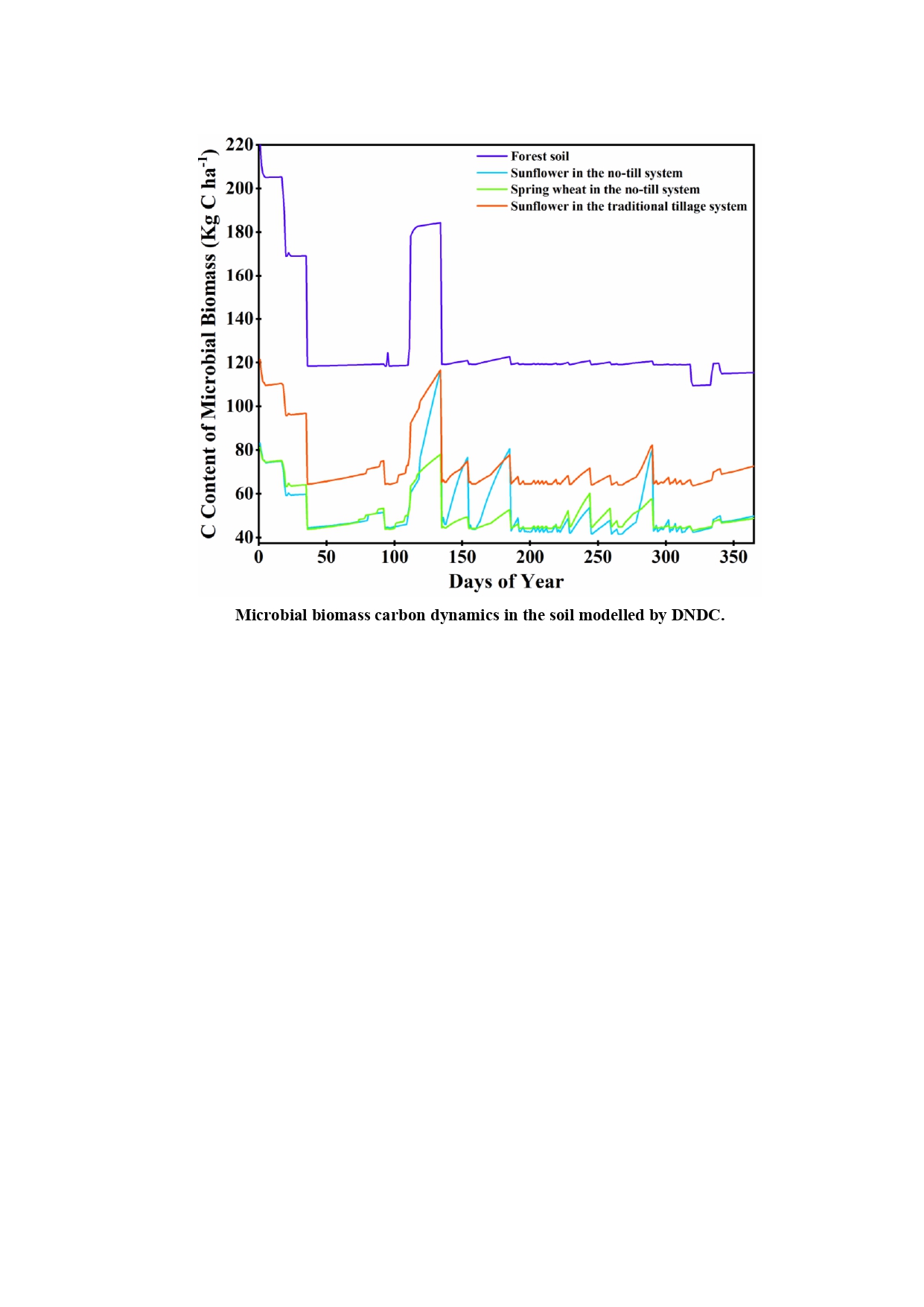
According to DNDC modeling, sunflower in the no-till system since 2017 is characterized by the largest total soil respiration of 643 kg C ha⁻¹. The total soil respiration for wheat in the no-till system and sunflower in the conventional tillage system amounted to 643 kg C ha⁻¹ and 487 kg C ha⁻¹, respectively. These results demonstrate that no-till establishes more favorable conditions for the microbial community compared to traditional practices, likely due to reduced soil disturbance, better moisture retention, and improved organic matter availability. Microbial biomass carbon (MBC) dynamics modeled by DNDC for wheat, sunflower, and forest are represented in Fig. 2. The maximum average MBC was modeled for the forest, amounting to 129.4 kg C ha⁻¹. The maximum MBC for croplands was also instrumentally measured for sunflower in the no-till system since 2017, amounting to 73.61 kg C ha⁻¹, while for sunflower in the traditional system and wheat in the no-till system since 2014, it was 53.07 and 50.91 kg C ha⁻¹, respectively. These differences highlight the benefits of prolonged no-till practices in maintaining or enhancing microbial communities in agricultural soils. Additionally, the cropland microbial communities exhibited greater variability than the forest community during the growing season, indicating more stressful conditions that microbes must adapt to in anthropogenic landscapes. MBC varied for sunflower in the no-till system, wheat in the no-till system, and sunflower in the traditional system, ranging from 64-116, 44-78, and 44-116 kg C ha⁻¹, respectively. The increase in MBC for the croplands mostly correlated with rainfall, while no such strong correlation was found for the forest.
Thus, the comparative analysis of MBC for croplands has shown that the no-till system implemented since 2017 has established the most favorable conditions for the microbial community. These results are consistent with the data published by Li et al. (Li et al., 2020).
RothC modeling has shown similar but higher absolute results. Thus, MBC for sunflower in the no-till system, wheat in the no-till system, and sunflower in the traditional system was modeled to be 0.673, 0.529, and 0.531 kg C ha⁻¹, respectively.
Microbiological activity is one of the most important and difficult parameters to measure. On the one hand it is a soil health indicator but on the other hand it corresponds with carbon dioxide emission that make pure data on CO2 emission impossible to interpret. Today, the scientific challenge to differentiate between so called negative and positive emission has not yet been solved. One of the possible ways is to measure soil respiration with and without vegetation. The difference will constitute the “negative” portion of the emission.
The results show a high degree of variability throughout the year, with the largest amount of carbon losses in the form of CO2 emission found in the conventional tillage system (1119.2 kg C ha⁻¹). The fields using no-till since 2017 and 2014 were modeled to lose 544.9 and 473.1 kg C ha⁻¹, respectively. Tillage leads to air penetration into the 0-25 cm layer, fostering mineralization processes and increasing the CO2 emission rate. In contrast, no-till technology decreases the SOC mineralization rate by approximately a half. This demonstrates the role of no-till systems in mitigating soil carbon losses and reducing CO2 emissions. The repeated disruption of soil aggregates in conventional tillage further exacerbates carbon mineralization by exposing previously protected organic carbon to microbial attack.
Direct N₂O emissions characterize the soil microbial community that regulates nitrification and denitrification processes in both aerobic and anaerobic conditions. Physical, hydro-physical, physicochemical, and agrochemical soil properties primarily determine the rate of these nitrification and denitrification processes, which are directly influenced by climatic and anthropogenic factors. Table 4 and Table 5 present data on direct N₂O emissions modeled by DNDC for cropland and forest soils. The model results show that the no-till system implemented since 2017 is characterized by the lowest rate of N2O losses. This cultivation system provides the most favorable conditions for the microbial community involved in nitrogen transformation. No significant difference in terms of N2O emissions has been found between the no-till system since 2014 and conventional tillage, with emissions of 1.366 and 1.340 kg N ha⁻¹, respectively. This requires further research to understand why a longer period of no-till decreases the initial effect.
A high variability of ammonium (NH₄⁺) and nitrate (NO₃⁻) nitrogen was modeled for croplands by DNDC. The highest NH₄⁺ content (up to 10-15 kg N ha⁻¹) correlates with the spring fertilizer input. This peak reflects the immediate availability of ammonium from fertilizers, which serves as a primary nitrogen source for crop uptake early in the growing season. Meanwhile, the highest NH₄⁺ content in forest soils was calculated for the winter season, which can be explained by the alkaline soil environment and subsequent nitrate nitrogen transformation. In contrast, forest soils exhibited the highest NH₄⁺ levels during the winter, likely due to differences in nitrogen cycling processes. The alkaline soil environment in forests promotes the conversion of nitrate (NO₃⁻) back to ammonium through biological processes, such as dissimilatory nitrate reduction. The absence of active plant uptake during winter further allows NH₄⁺ to accumulate. The average NH₄⁺ content amounted to 1.65 kg N ha⁻¹ for spring wheat in the no-till system, 3.69 kg N ha⁻¹ for sunflower in the no-till system, 1.93 kg N ha⁻¹ for sunflower in the conventional tillage system, and 3.97 kg N ha⁻¹ for the forest. Thus, the highest NH₄⁺ content for croplands was modeled for sunflower in the no-till system emphasizing the benefits of reduced tillage for maintaining soil nitrogen availability. Overall, these findings illustrate the intricate interactions between management practices, soil properties, and seasonal factors in shaping nitrogen availability. The results underscore the importance of tailoring fertilizer strategies to align with specific cropping systems and environmental conditions to optimize nitrogen use efficiency and minimize losses.
A high degree of variability has also been observed in DNDC-modeled NO−3 content in agricultural soils. The highest NO−3 content (up to 24 kg N ha−1) correlates with both spring fertilizer input and root exudates mineralization during the summer period. Simultaneously, the highest NO−3 content in forest soils (up to 10 kg N ha−1) has been modeled for the spring period, following snowmelt. The average NO−3 content amounted to 1.31 kg N ha−1 for spring wheat in the no-till system, 2.38 kg N ha−1 for sunflower in the no-till system, 5.61 kg N ha−1 for sunflower in the conventional tillage system, and 4.97 kg N ha−1 for the forest. Thus, the highest NO−3 content for croplands was modeled for sunflower in the conventional tillage system.
Phosphorus dynamics modeled by DNDC has shown no difference between the two no-till systems but demonstrated a significantly lower phosphorus content in tilled soils. The average modeled organic P content was 145.82 kg P ha−1 for spring wheat in the no-till system, 145.55 kg P ha−1 for sunflower in the no-till system, and 82.92 kg P ha−1 for sunflower in the conventional tillage system. The average modeled labile P content was 0.18 kg P ha−1 for spring wheat in the no-till system, 0.21 kg P ha−1 for sunflower in the no-till system, and 0.11 kg P ha−1 for sunflower in the conventional tillage system. The average modeled adsorbed P content was 72.01 kg P ha−1 for spring wheat in the no-till system, 72.18 kg P ha−1 for sunflower in the no-till system, and 43.03 kg P ha−1 for sunflower in the conventional tillage system. Thus, the highest P content for croplands was modeled for the no-till system, which provides more favorable conditions for organic, labile, and adsorbed phosphorus.
The presented data show that the correlations between the empirical data and the modeling data are satisfactory. At the same time, similar empirical results are presented in previous works (Smith et al., 2014; Smith et al., 2007; Ivanov et al., 2019; Romanovskaya et al., 2020; Ivanov et al., 2021).
The study aims to evaluate the effectiveness of the DNDC and RothC models in simulating the dynamics of carbon and nitrogen compound transformations in the forest-steppe soils of the Middle Volga region. The study was conducted on the territory of Orlovka AIC LLC in the Samara region, which has practiced no-tillage since 2012.
The results of DNDC modeling of total SOC content have shown a strong correlation with the results of instrumental soil sample analysis and calculations for the 0 − 10 cm layer, with maximum SOC stocks observed in soils where no-till has been practiced since 2017. According to the modeling results, the highest level of direct CO2 emissions from the soil in 2021 was detected in the conventional tillage system (1119.2 kg C ha−1), while for the no-till system, these fluxes were approximately half as high (544.9 kg C ha−1 for no-till since 2017 and 473.1 kg C ha−1 for no-till since 2014).
DNDC modeling has shown that the average annual MBC is highest in forest soils (129.4 kg C ha−1). In croplands where sunflower was cultivated, the MBC was significantly higher in no-till fields (73.3 kg C ha−1) compared to tilled fields (53.0 kg C ha−1). Similar trends were observed for N2O emissions, with the lowest cumulative emissions being modeled and measured for the no-till system since 2017 (0.516 kg N ha−1), while the conventional tillage and no-till systems since 2014 showed no statistically significant differences (1.366 kg N ha−1 and 1.340 kg N ha−1, respectively). It was also demonstrated that the DNDC model is more efficient than RothC in modeling plant growth, SOC, MBC, NH+4, NO−3, CO2, N2O, NH3, and CH4 emission dynamics.
The differences in the modeled data show that RothC and DNDC models can give opposite results in several areas that make it questionable in terms of practical use especially when it comes to carbon economy and forecasting climate effect. That is why specific on-field experiments are required to test the model accuracy.
All authors have read, understood, and have complied as applicable with the statement on “Ethical responsibilities of Authors” as found in the Instructions forAuthors.
Y. J. Babu, C. Li, C., S. Frolking, D. R. Nayak, and T. K. Adhya, Nutr. Cycling Agroecosyst., 74, 157-174 (2006). https://doi.org/10.1007/s10705-005-6111-5 https://doi.org/10.1007/s10705-005-6111-5
D. Beheydt, P. Boeckx, S. Sleutel, C. Li, and O. V. Cleemput, Atmos. Environ., 41(29), 6196-6211 (2010). https://doi.org/10.1016/j.atmosenv.2007.04.003 https://doi.org/10.1016/j.atmosenv.2007.04.003
Z. Cai, T. Sawamoto, C. Li, G. Kang, J. Boonjawat, A. Mosier, R. Wassmann, and H. Tsuruta, Global Biogeochemical Cycles, 17(4), 1107 (2003). https://doi.org/10.1029/2003GB002046 https://doi.org/10.1029/2003GB002046
K. Coleman and D. S. Jenkinson, Evaluation of Soil Organic Matter Models, 38, 237-246 (1996). https://doi.org/10.1007/978-3-642-61094-3_17 https://doi.org/10.1007/978-3-642-61094-3_17
K. E. Dobbie and K. A. Smith, Global Chang. Biol., 9(2), 204-218 (2003). https://doi.org/10.1046/j.1365-2486.2003.00563.x https://doi.org/10.1046/j.1365-2486.2003.00563.x
R. Francaviglia, K. Coleman, A. P. Whitmore, L. Doro, G. Urracci, M. Rubino, and L. Ledda, Agricultural Systems, 112, 48-54 (2012). http://dx.doi.org/10.1016/j.agsy.2012.07.001 https://doi.org/10.1016/j.agsy.2012.07.001
K. Hergoualc'h, J.M. Harmand, P. Cannavo, U. Skiba, R. Oliver, and C. Hénault, Soil Biol. Biochem., 41(11), 2343-2355 (2019). https://doi.org/10.1016/j.soilbio.2009.08.023 https://doi.org/10.1016/j.soilbio.2009.08.023
A. L. Ivanov and V. S. Stolbovoy, Dokuchaev Soil Bulletin, 98, 185-202 (2019). https://doi.org/10.19047/0136-1694-2019-98-185-202 https://doi.org/10.19047/0136-1694-2019-98-185-202
A. L. Ivanov, I. Savin, V. S. Stolbovoy, Y. A. Duhanin, and D. N. Kozlov, Bulletin of V.V. Dokuchaev Soil Science Institute, 108, 175-218 (2021). https://doi.org/10.19047/0136-1694-2021-108-175-218 https://doi.org/10.19047/0136-1694-2021-108-175-218
J. Lee, J. W. Hopmans, C. V. Kessel, A. P. King, K. J. Evatt, D. Louie, D. E. Rolston, and J. Six, Agric. Ecosyst. Environ., 129(4), 378-390 (2019). https://doi.org/10.1016/j.agee.2008.10.012 https://doi.org/10.1016/j.agee.2008.10.012
I. Lembaid, R. Moussadek, R. Mrabet, and A. Bouhaouss, Climate, 10(2), 23 (2022). https://doi.org/10.3390/cli10020023 https://doi.org/10.3390/cli10020023
C. Li, S. Frolking, G. J. Crocker, P. R. Grace, J. Klír, M. Körchens, and P. R. Poulton, Geoderma, 81(1-2), 45-60 (1997). https://doi.org/10.1016/S0016-7061(97)00080-3 https://doi.org/10.1016/S0016-7061(97)00080-3
Y. Li, Q. Zhang, Y. Cai, Q. Yang, and S. X. Chang, Sci. Total Environ., 716, 137164 (2020). https://doi.org/10.1016/j.scitotenv.2020.137164 https://doi.org/10.1016/j.scitotenv.2020.137164
B. Ludwig, N. Jäger, E. Priesack, and H. Flessa, Journal of Plant Nutrition and Soil Science, 174(3), 350-358 (2011). https://doi.org/10.1002/jpln.201000040 https://doi.org/10.1002/jpln.201000040
A. A. Romanovskaya, V. N. Korotkov, P. D. Polumieva, A. Trunov, and V. Yu, Mitig. Adapt. Strateg. Glob. Chang., 25(8), 661-687 (2020). https://doi.org/10.1007/s11027-019-09885-2 https://doi.org/10.1007/s11027-019-09885-2
P. Smith, D. Martino, Z. Cai, D. Gwary, H. Janzen, P. Kumar, B. McCarl, S. Ogle, F. O'Mara, C. Rice, B. Scholes, O. Sirotenko, (2007): Agriculture. In Climate Change 2007: Mitigation. Contribution of Working Group III to the Fourth Assessment Report of the Intergovern-mental Panel on Climate Change [B. Metz, O.R. Davidson, P.R. Bosch, R. Dave, L.A. Meyer (eds)], Cambridge University Press, Cambridge, United Kingdom and New York, NY, USA.
W. N. Smith, B. B. Grant, R. L. Desjardins, P. Rochette, C. F. Drury, and C. Li, Canadian Journal of Soil Science, 88, 251-260 (2008). https://doi.org/10.4141/CJSS06030 https://doi.org/10.4141/CJSS06030
Y. Wan, E. Lin, W. Xiong, and L. Guo, Agriculture Ecosystems and Environment, 141(1), 23-31 (2011). https://doi.org/10.1016/j.agee.2011.02.004 https://doi.org/10.1016/j.agee.2011.02.004
N. Wrage, G. L. Velthof, M. L. van Beusichem, and O. Oenema, Soil Biol. Biochem., 33(12), 1723-1732 (2011). https://doi.org/10.1016/S0038-0717(01)00096-7 https://doi.org/10.1016/S0038-0717(01)00096-7







This website recommended the use the Chrome browser for journal website.


