


- ENGLISH
- P-ISSN1229-070X
- E-ISSN2713-9581
- KCI
논문 상세
- 2026 (31권)
- 2025 (30권)
- 2024 (29권)
- 2023 (28권)
- 2022 (27권)
- 2021 (26권)
- 2020 (25권)
- 2019 (24권)
- 2018 (23권)
- 2017 (22권)
- 2016 (21권)
- 2015 (20권)
- 2014 (19권)
- 2013 (18권)
- 2012 (17권)
- 2011 (16권)
- 2010 (15권)
- 2009 (14권)
- 2008 (13권)
- 2007 (12권)
- 2006 (11권)
- 2005 (10권)
- 2004 (9권)
- 2003 (8권)
- 2002 (7권)
- 2001 (6권)
- 2000 (5권)
- 1999 (4권)
- 1998 (3권)
- 1997 (2권)
- 1996 (1권)
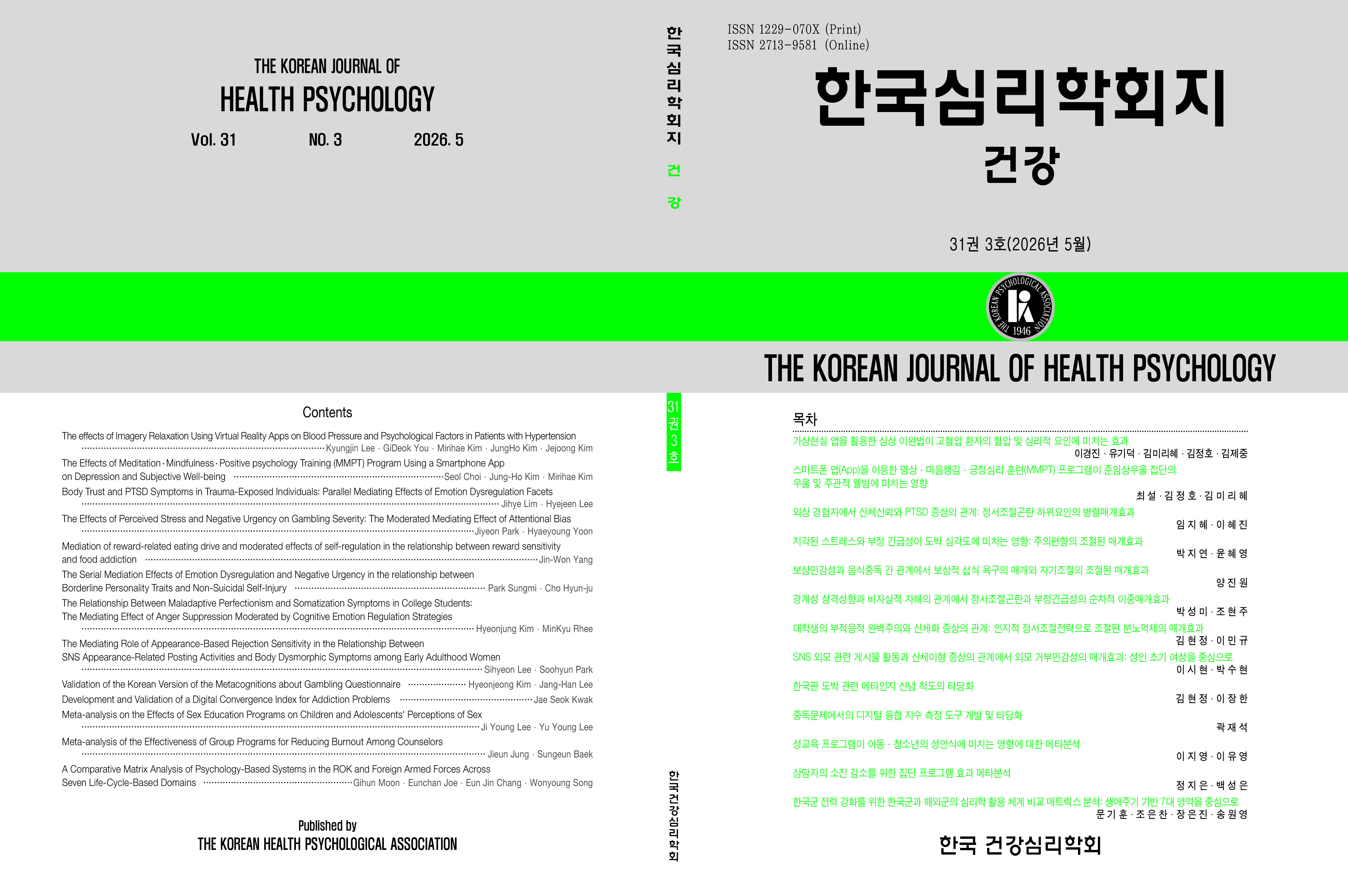
외상 경험자에서 신체신뢰와 PTSD 증상의 관계: 정서조절곤란 하위요인의 병렬매개효과
Body Trust and PTSD Symptoms in Trauma-Exposed Individuals: Parallel Mediating Effects of Emotion Dysregulation Facets
이혜진(Hyejeen Lee) (전남대학교 심리학과)

초록
신체신뢰는 신체 내부의 감각을 안전하고 믿을만한 것으로 경험하는 태도로서 정서조절의 초기 단계이며, 정서장애가 동반되는 외상후 스트레스 증상(PTSD)의 발현과 회복에도 중요한 역할을 한다. 본 연구는 신체신뢰가 PTSD 증상에 미치는 영향을 확인하고, 이 관계에서 충동조절곤란, 정서주의부족, 정서비수용성, 정서명료성부족, 전략접근제한, 목표지향행동으로 이루어진 정서조절곤란 하위요인의 병렬매개효과를 검증하고자 하였다. 참가자는 총 712명이며, 이 중에 DSM-5의 PTSD 진단기준 A에 해당하는 외상사건을 경험한 312명을 최종 분석 대상으로 선별하여 정서조절곤란 하위요인의 병렬매개효과를 검증하였다. 분석 결과, 신체신뢰는 외상 경험자 집단에서 PTSD 증상에 대한 직접효과는 유의하지 않았으나 정서조절곤란의 하위요인 중 정서주의부족, 정서명료성부족, 전략접근제한을 통해 유의한 간접효과를 보였다. 이는 신체신뢰가 PTSD 증상과 직접적으로 작용하기보다는 정서에 충분히 주의를 기울이지 못하고, 감정을 명확하게 구분하여 인식하지 못하며, 적절한 정서조절전략을 활용하지 못하는 정서조절의 취약성을 통해 간접적으로 작용함을 의미한다. 따라서 본 연구는 PTSD 증상을 정서조절의 관점에서 이해할 수 있는 경험적 근거를 제시하였으며, PTSD의 치료적 개입에서 정서조절곤란의 하위요인을 매개로 신체신뢰를 강화하는 접근의 필요성을 제안한다는 점에서 의의가 있다.
- keywords
- 외상후 스트레스 장애, 신체신뢰, 정서조절곤란, 정서 인식, 정서 명료성, 정서조절 전략 접근
Abstract
Body trust is the attitude of perceiving internal bodily sensations as safe and reliable. It represents an early stage of emotion regulation and plays a crucial role in both the manifestation and recovery from posttraumatic stress symptoms (PTSD), which are often linked to emotional disturbances. This study explored the impact of body trust on PTSD symptoms and examined the parallel mediating effects of six subdimensions of emotion regulation difficulties: impulse control challenges, lack of emotional awareness, nonacceptance of emotional responses, lack of emotional clarity, limited access to emotion regulation strategies, and difficulties in engaging in goal-directed behavior. A total of 712 participants completed the survey, with 312 individuals who had experienced a traumatic event meeting the DSM-5 Criterion A selected for final analysis. The results revealed that body trust did not directly affect PTSD symptoms; instead, it indirectly influenced them through three subdimensions of emotion regulation difficulties: lack of emotional awareness, lack of emotional clarity, and limited access to emotion regulation strategies. These findings indicate that body trust affects PTSD symptoms indirectly by highlighting vulnerabilities in emotion regulation, including insufficient attention to one's emotions, difficulty in identifying and differentiating them, and challenges in employing adaptive regulation strategies. This study provides empirical evidence for understanding PTSD symptoms from an emotion regulation perspective and suggests that therapeutic interventions should enhance body trust by addressing specific subcomponents of emotion regulation difficulties.
- keywords
- posttraumatic stress disorder(PTSD), body trust, emotion dysregulation, emotional awareness, emotional clarity, access to emotion regulation strategies
- 투고일Received
- 2025-10-29
- 수정일Revised
- 2025-12-29
- 게재확정일Accepted
- 2026-04-07
- 출판일Published
- 2026-05-30
- 다운로드 수
- 조회수
- 0KCI 피인용수
- 0WOS 피인용수