
Korean Journal of Health Psychology
- KOREAN
- P-ISSN1229-070X
- E-ISSN2713-9581
- KCI
Article Contents
- 2026 (Vol.31)
- 2025 (Vol.30)
- 2024 (Vol.29)
- 2023 (Vol.28)
- 2022 (Vol.27)
- 2021 (Vol.26)
- 2020 (Vol.25)
- 2019 (Vol.24)
- 2018 (Vol.23)
- 2017 (Vol.22)
- 2016 (Vol.21)
- 2015 (Vol.20)
- 2014 (Vol.19)
- 2013 (Vol.18)
- 2012 (Vol.17)
- 2011 (Vol.16)
- 2010 (Vol.15)
- 2009 (Vol.14)
- 2008 (Vol.13)
- 2007 (Vol.12)
- 2006 (Vol.11)
- 2005 (Vol.10)
- 2004 (Vol.9)
- 2003 (Vol.8)
- 2002 (Vol.7)
- 2001 (Vol.6)
- 2000 (Vol.5)
- 1999 (Vol.4)
- 1998 (Vol.3)
- 1997 (Vol.2)
- 1996 (Vol.1)
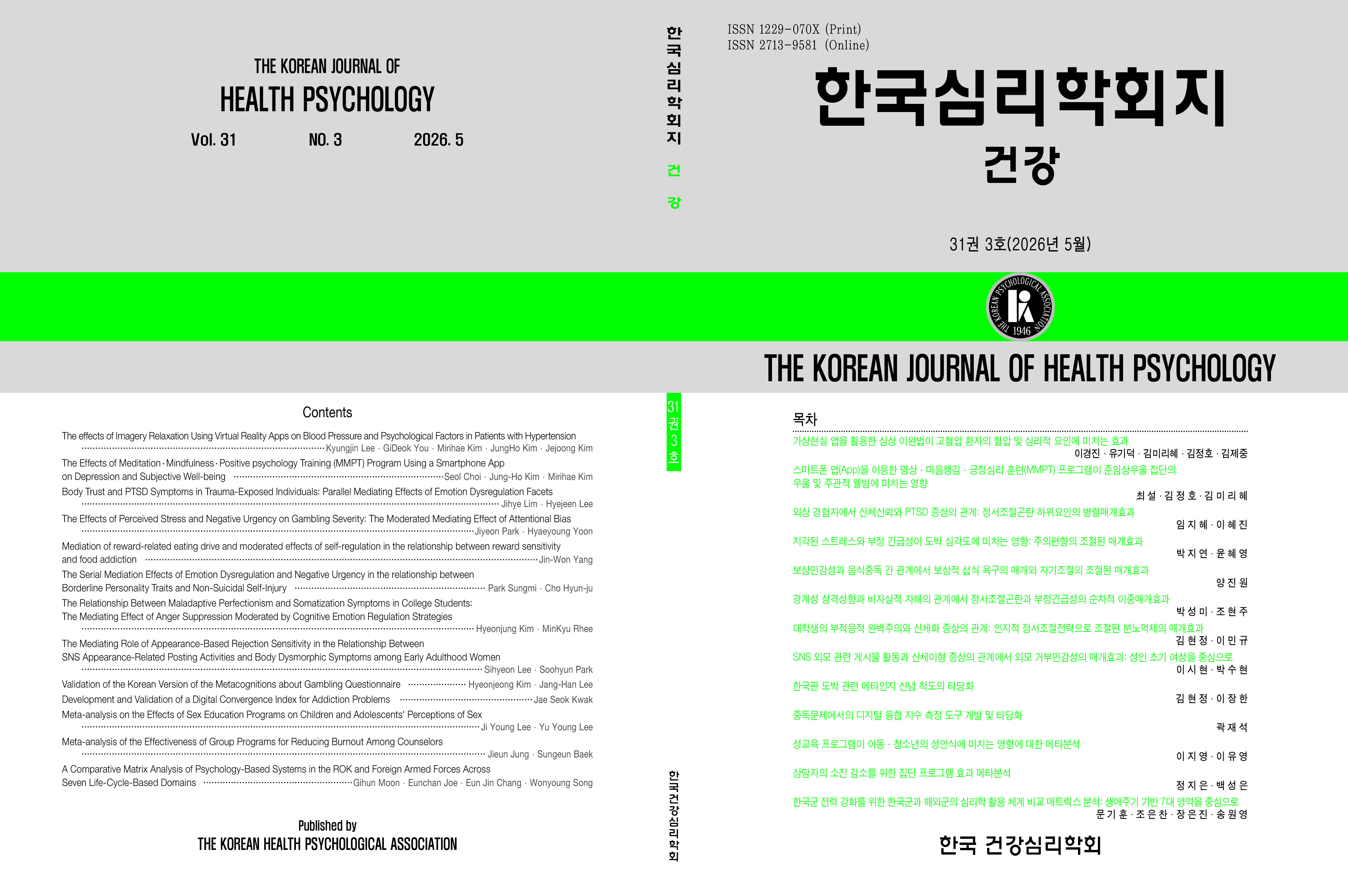
Body Trust and PTSD Symptoms in Trauma-Exposed Individuals: Parallel Mediating Effects of Emotion Dysregulation Facets
Hyejeen Lee (Department of Psychology, Chonnam National University)

Abstract
Body trust is the attitude of perceiving internal bodily sensations as safe and reliable. It represents an early stage of emotion regulation and plays a crucial role in both the manifestation and recovery from posttraumatic stress symptoms (PTSD), which are often linked to emotional disturbances. This study explored the impact of body trust on PTSD symptoms and examined the parallel mediating effects of six subdimensions of emotion regulation difficulties: impulse control challenges, lack of emotional awareness, nonacceptance of emotional responses, lack of emotional clarity, limited access to emotion regulation strategies, and difficulties in engaging in goal-directed behavior. A total of 712 participants completed the survey, with 312 individuals who had experienced a traumatic event meeting the DSM-5 Criterion A selected for final analysis. The results revealed that body trust did not directly affect PTSD symptoms; instead, it indirectly influenced them through three subdimensions of emotion regulation difficulties: lack of emotional awareness, lack of emotional clarity, and limited access to emotion regulation strategies. These findings indicate that body trust affects PTSD symptoms indirectly by highlighting vulnerabilities in emotion regulation, including insufficient attention to one's emotions, difficulty in identifying and differentiating them, and challenges in employing adaptive regulation strategies. This study provides empirical evidence for understanding PTSD symptoms from an emotion regulation perspective and suggests that therapeutic interventions should enhance body trust by addressing specific subcomponents of emotion regulation difficulties.
- keywords
- posttraumatic stress disorder(PTSD), body trust, emotion dysregulation, emotional awareness, emotional clarity, access to emotion regulation strategies
- Received
- 2025-10-29
- Revised
- 2025-12-29
- Accepted
- 2026-04-07
- Published
- 2026-05-30
- Downloaded
- Viewed
- 0KCI Citations
- 0WOS Citations