
Korean Journal of Health Psychology
- KOREAN
- P-ISSN1229-070X
- E-ISSN2713-9581
- KCI
Article Contents
- 2026 (Vol.31)
- 2025 (Vol.30)
- 2024 (Vol.29)
- 2023 (Vol.28)
- 2022 (Vol.27)
- 2021 (Vol.26)
- 2020 (Vol.25)
- 2019 (Vol.24)
- 2018 (Vol.23)
- 2017 (Vol.22)
- 2016 (Vol.21)
- 2015 (Vol.20)
- 2014 (Vol.19)
- 2013 (Vol.18)
- 2012 (Vol.17)
- 2011 (Vol.16)
- 2010 (Vol.15)
- 2009 (Vol.14)
- 2008 (Vol.13)
- 2007 (Vol.12)
- 2006 (Vol.11)
- 2005 (Vol.10)
- 2004 (Vol.9)
- 2003 (Vol.8)
- 2002 (Vol.7)
- 2001 (Vol.6)
- 2000 (Vol.5)
- 1999 (Vol.4)
- 1998 (Vol.3)
- 1997 (Vol.2)
- 1996 (Vol.1)
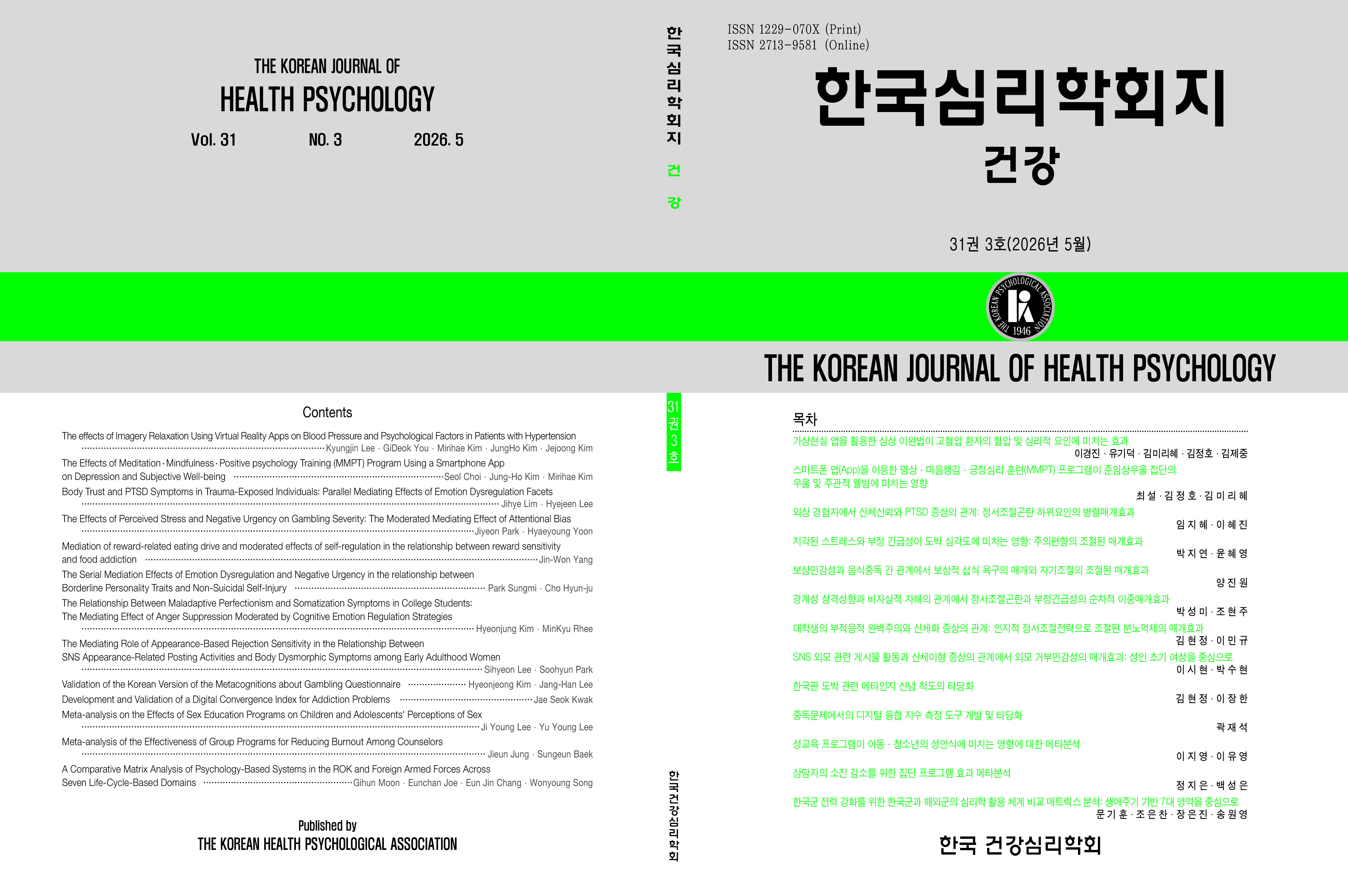
Mediation of reward-related eating drive and moderated effects of self-regulation in the relationship between reward sensitivity and food addiction

Abstract
This study aimed to investigate whether reward-related eating drive mediates the relationship between reward sensitivity and food addiction, and whether this mediation differs based on self-regulation levels. To achieve this, a self-report survey was conducted with 496 university students, and the data were analyzed using the PROCESS macro. The results indicated that reward sensitivity does not directly affect food addiction; however, a full mediation effect through reward-related eating drive was confirmed. Furthermore, self-regulation significantly moderated this ediation pathway. Analysis of conditional indirect effects revealed that the indirect effect was stronger at high levels of self-regulation, while it was non-significant at low levels. These findings suggest that self-regulation does not always have a protective role, but can serve dual functions depending on the context. Consequently, intervention strategies for food addiction should take into account individual temperament and personality traits.
- keywords
- reward sensitivity, self-regulation, reward-related eating drive, food addiction
- Received
- 2025-11-07
- Revised
- 2025-11-28
- Accepted
- 2026-03-30
- Published
- 2026-05-30
- Downloaded
- Viewed
- 0KCI Citations
- 0WOS Citations