
Korean Journal of Health Psychology
- KOREAN
- P-ISSN1229-070X
- E-ISSN2713-9581
- KCI
Article Contents
- 2026 (Vol.31)
- 2025 (Vol.30)
- 2024 (Vol.29)
- 2023 (Vol.28)
- 2022 (Vol.27)
- 2021 (Vol.26)
- 2020 (Vol.25)
- 2019 (Vol.24)
- 2018 (Vol.23)
- 2017 (Vol.22)
- 2016 (Vol.21)
- 2015 (Vol.20)
- 2014 (Vol.19)
- 2013 (Vol.18)
- 2012 (Vol.17)
- 2011 (Vol.16)
- 2010 (Vol.15)
- 2009 (Vol.14)
- 2008 (Vol.13)
- 2007 (Vol.12)
- 2006 (Vol.11)
- 2005 (Vol.10)
- 2004 (Vol.9)
- 2003 (Vol.8)
- 2002 (Vol.7)
- 2001 (Vol.6)
- 2000 (Vol.5)
- 1999 (Vol.4)
- 1998 (Vol.3)
- 1997 (Vol.2)
- 1996 (Vol.1)
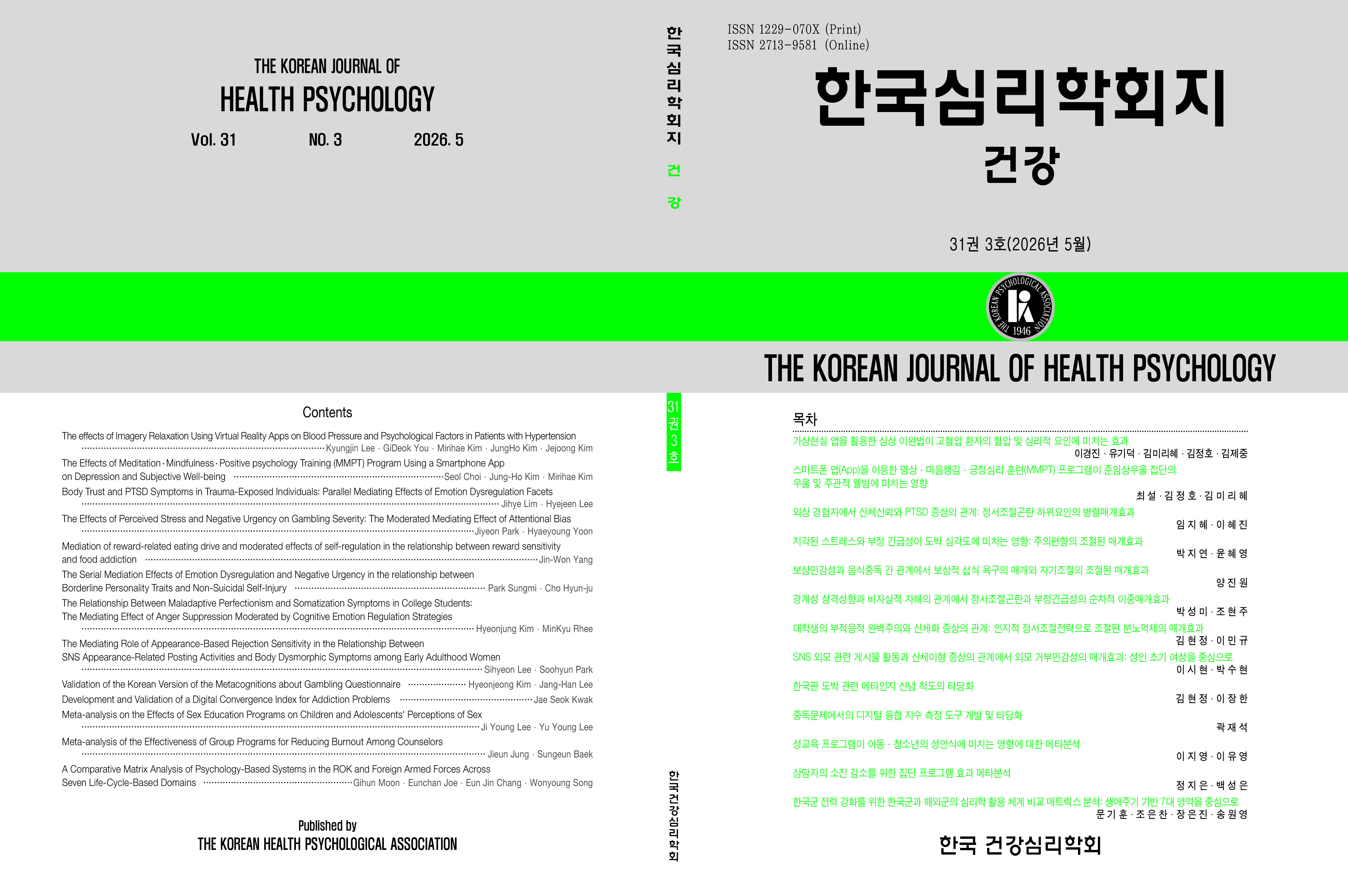
The Relationship Between Maladaptive Perfectionism and Somatization Symptoms in College Students: The Mediating Effect of Anger Suppression Moderated by Cognitive Emotion Regulation Strategies
MinKyu Rhee (Department of Psychology, Gyeongsang National University)

Abstract
This study investigates the mediating role of anger suppression in the relationship between maladaptive perfectionism and somatization symptoms among university students. It also explores how this mediation is influenced by adaptive and maladaptive cognitive emotion regulation strategies. Data were collected from 279 university students aged 18 and older across South Korea using the Hewitt Multi-dimensional Perfectionism Scale (HMPS), Frost Multi-dimensional Perfectionism Scale (FMPS), State-Trait Anger Expression Inventory-Korean version (STAXI-K), Cognitive Emotion Regulation Questionnaire (CERQ), and Somatization Symptom Scale (SSS). The findings are as follows: First, maladaptive perfectionism significantly increased both anger suppression and somatization symptoms, with anger suppression mediating the relationship between maladaptive perfectionism and somatization. Second, a significant moderated mediation effect was observed, where both adaptive and maladaptive cognitive emotion regulation strategies interacted with anger suppression to affect somatization symptoms. Specifically, adaptive strategies reduced somatization symptoms through their interaction with anger suppression, while maladaptive strategies intensified them. The implications and limitations of these findings are discussed.
- keywords
- Maladaptive Perfectionism, Anger Suppression, Somatization, Cognitive Emotion Regulation Strategies(CERS)
- Received
- 2025-11-14
- Revised
- 2026-01-22
- Accepted
- 2026-03-16
- Published
- 2026-05-30
- Downloaded
- Viewed
- 0KCI Citations
- 0WOS Citations