
Korean Journal of Health Psychology
- KOREAN
- P-ISSN1229-070X
- E-ISSN2713-9581
- KCI
Article Contents
- 2026 (Vol.31)
- 2025 (Vol.30)
- 2024 (Vol.29)
- 2023 (Vol.28)
- 2022 (Vol.27)
- 2021 (Vol.26)
- 2020 (Vol.25)
- 2019 (Vol.24)
- 2018 (Vol.23)
- 2017 (Vol.22)
- 2016 (Vol.21)
- 2015 (Vol.20)
- 2014 (Vol.19)
- 2013 (Vol.18)
- 2012 (Vol.17)
- 2011 (Vol.16)
- 2010 (Vol.15)
- 2009 (Vol.14)
- 2008 (Vol.13)
- 2007 (Vol.12)
- 2006 (Vol.11)
- 2005 (Vol.10)
- 2004 (Vol.9)
- 2003 (Vol.8)
- 2002 (Vol.7)
- 2001 (Vol.6)
- 2000 (Vol.5)
- 1999 (Vol.4)
- 1998 (Vol.3)
- 1997 (Vol.2)
- 1996 (Vol.1)
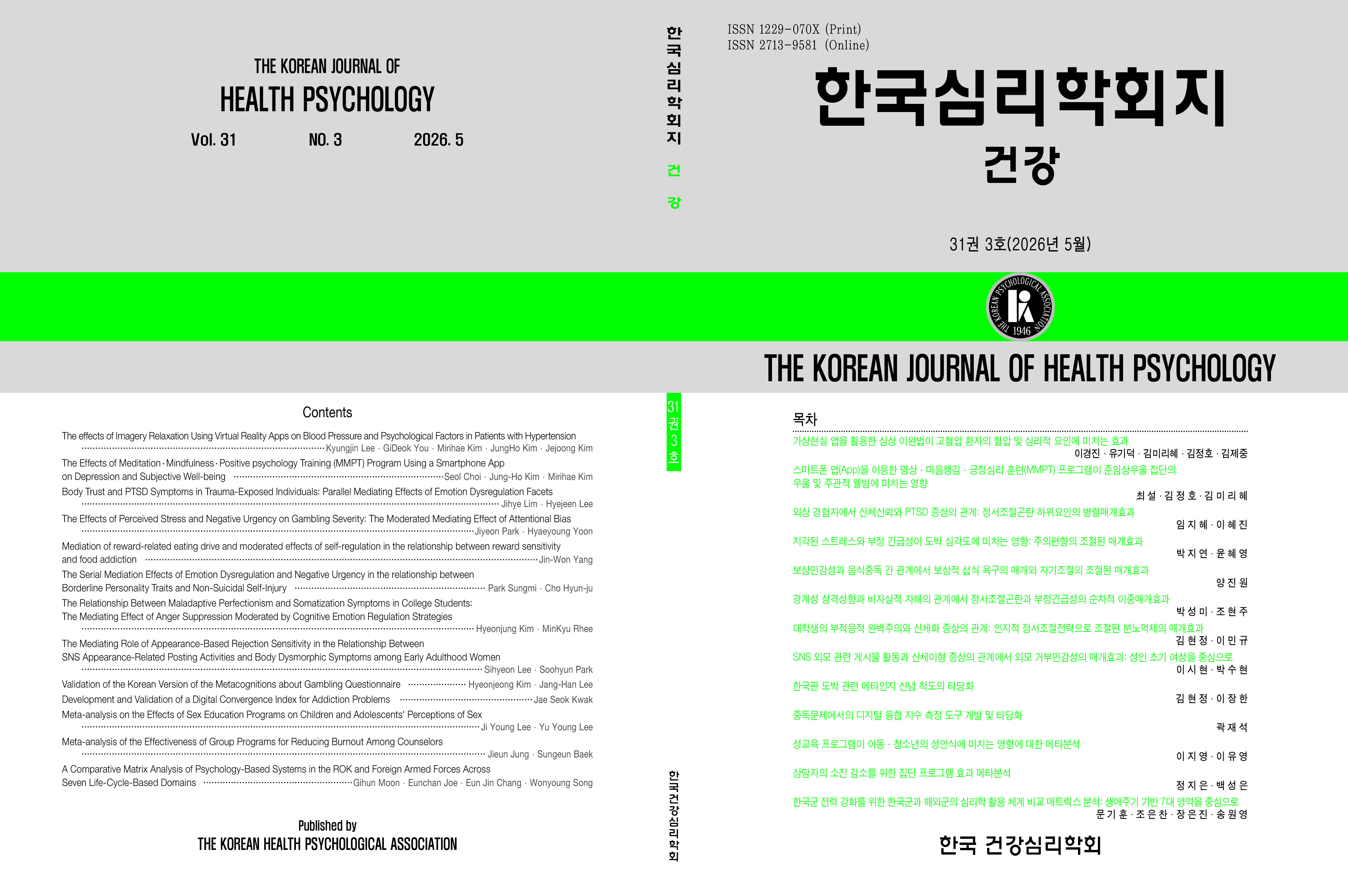
Validation of the Korean Version of the Metacognitions about Gambling Questionnaire
Jang-Han Lee (Department of Psychology, Chung-Ang University)

Abstract
The Self-Regulatory Executive Function (S-REF) model suggests that both positive and negative metacognitive beliefs about gambling may play a role in the persistence of gambling behavior. This study aimed to translate and validate the Korean version of the Metacognitions about Gambling Questionnaire (K-MGQ). A total of 273 adult males participated in the research. Confirmatory Factor Analysis (CFA) supported a two-factor structure comprising positive metacognitive beliefs (MGQ-P) and negative metacognitive beliefs (MGQ-N), aligning with the original scale. Convergent validity was established through significant positive correlations with the Korean version of the South Oaks Gambling Screen (K-SOGS), the Korean Gambling Symptom Assessment Scale (KG-SAS), and the Korean version of the NODS (K-NODS). Hierarchical regression analysis revealed that both positive and negative metacognitive beliefs significantly contributed to the variance in gambling severity, even when controlling for depression (K-PHQ-9), trait anxiety (K-STAI-T), and irrational gambling beliefs (K-GABS). Furthermore, Receiver Operating Characteristic (ROC) analysis assessed the scale’s clinical discriminative utility using K-SOGS cutoff scores. These results indicate that the K-MGQ is a reliable and valid tool for evaluating gambling-related metacognitive beliefs among Korean adult males. The paper also discusses implications, limitations, and avenues for future research.
- keywords
- Gambling, Metacognitive Beliefs, K-MGQ, Scale Validation, S-REF Model
- Received
- 2025-12-14
- Revised
- 2025-12-31
- Accepted
- 2026-03-16
- Published
- 2026-05-30
- Downloaded
- Viewed
- 0KCI Citations
- 0WOS Citations