


- ENGLISH
- P-ISSN1229-070X
- E-ISSN2713-9581
- KCI
논문 상세
- 2026 (31권)
- 2025 (30권)
- 2024 (29권)
- 2023 (28권)
- 2022 (27권)
- 2021 (26권)
- 2020 (25권)
- 2019 (24권)
- 2018 (23권)
- 2017 (22권)
- 2016 (21권)
- 2015 (20권)
- 2014 (19권)
- 2013 (18권)
- 2012 (17권)
- 2011 (16권)
- 2010 (15권)
- 2009 (14권)
- 2008 (13권)
- 2007 (12권)
- 2006 (11권)
- 2005 (10권)
- 2004 (9권)
- 2003 (8권)
- 2002 (7권)
- 2001 (6권)
- 2000 (5권)
- 1999 (4권)
- 1998 (3권)
- 1997 (2권)
- 1996 (1권)
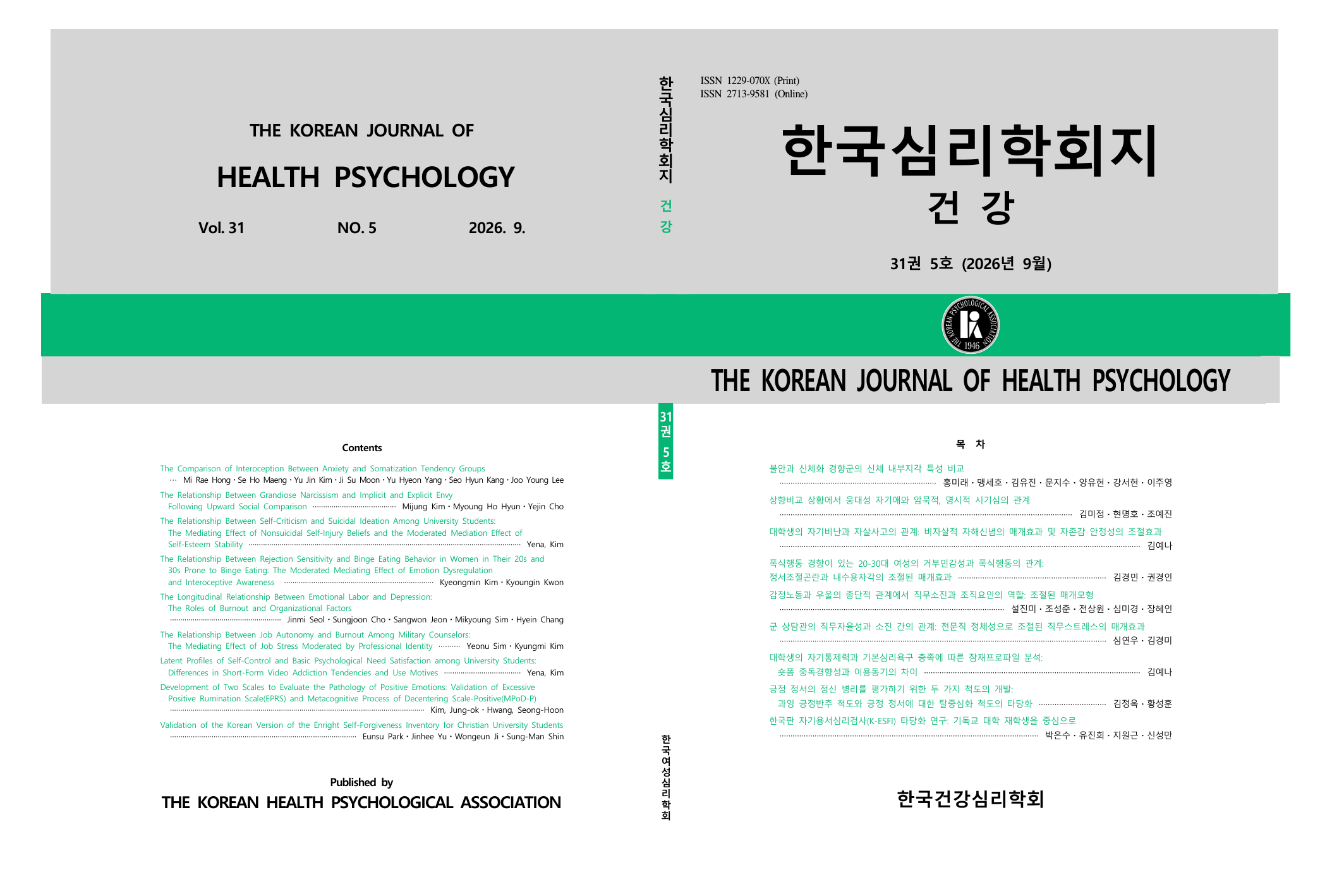
불안과 신체화 경향군의 신체 내부지각 특성 비교
The Comparison of Interoception Between Anxiety and Somatization Tendency Groups
맹세호(Se Ho Maeng) (동덕여자대학교)
김유진(Yu Jin Kim) (동덕여자대학교)
문지수(Ji Su Moon) (동덕여자대학교)
양유현(Yu Hyeon Yang) (동덕여자대학교)
강서현(Seo Hyun Kang) (동덕여자대학교)
이주영(Joo Young Lee) (동덕여자대학교)

초록
본 연구는 ‘내부지각의 3차원 모델’을 바탕으로 불안과 신체화 경향군, 대조 집단의 신체 내부지각 특성을 비교하고, 불안과 신체화 증상이 신체 내부지각 특성에 미치는 영향을 검증하고자 하였다. 만 19세 이상 49세 이하의 성인 남녀 중 실험에 참여가 가능한 89명을 선발하여 특성불안 및 신체화 척도의 절단점을 기준으로 불안경향군, 신체화경향군 및 대조집단으로 구분하였다. 내부지각 민감성은 신체지각 질문지(BPQ)의 신체 자각 소척도, 내부지각 정확성은 심적 추적 패러다임(Mental Tracking Paradigm)으로 측정하였다. 일원변량분석 결과, 세 집단에 따른 내부지각 정확성의 차이는 유의하지 않았다. 내부지각 민감성은 대조 집단이 불안, 신체화 집단보다 낮았다. 내부지각 예측오류 특성은 대조 집단보다 신체화 집단이 유의하게 높은 것으로 나타났다. 그러나 성별, 연령, 우울을 통제한 후에는 내부지각 특성에서 집단 간 차이를 확인할 수 없었다. 회귀분석 결과, 내부지각 민감성이 불안과 신체화 모두에 의해 유의하게 설명되었으나, 내부지각 예측오류 특성은 신체화 수준에 의해서만 유의하게 설명되었다. 본 연구의 결과를 종합하면, 불안은 신체 감각에 대한 주관적 민감성이 특징인 반면 신체화는 신체 감각에 대한 과대평가가 특징임을 알 수 있다. 이에 신체 내부지각 특성을 보다 정교하게 파악하기 위해서는 내부지각 예측오류 특성이라는 다차원적 평가틀을 도입할 필요성이 시사된다.
- keywords
- 불안, 신체화, 내부지각 정확성, 내부지각 민감성, 내부지각 예측오류 특성
Abstract
This study compared interoceptive characteristics among individuals with anxiety tendencies, individuals with somatization tendencies, and a control group within the framework of the "three-dimensional model of interoception,”and examined how anxiety and somatization symptoms affect those characteristics. A total of 89 adults aged 19 to 49 years were recruited and assigned to an anxiety tendency group, a somatization tendency group, or a control group on the basis of cutoff scores on trait anxiety and somatization scales. Interoceptive sensitivity was measured with the Body Awareness subscale of the Body Perception Questionnaire (BPQ), and interoceptive accuracy was assessed with the Mental Tracking Paradigm. The results were as follows. First, one-way analyses of variance revealed no significant differences in interoceptive accuracy across the three groups, whereas interoceptive sensitivity was significantly lower in the control group than in either the anxiety or the somatization group, and interoceptive trait prediction error was significantly higher in the somatization group than in the control group. Once sex, age, and depression were controlled, however, none of the between-group differences in interoceptive characteristics remained significant. Second, regression analyses showed that interoceptive sensitivity was significantly explained by both anxiety and somatization, whereas interoceptive trait prediction error was explained only by the level of somatization. These results suggest that anxiety is marked by heightened subjective sensitivity to bodily sensations, whereas somatization is marked by an exaggerated appraisal of them. Taken together, the findings point to the need for a multidimensional framework that incorporates interoceptive trait prediction error in order to characterize interoceptive features more precisely.
- keywords
- anxiety, somatization, interoceptive accuracy, interoceptive sensitivity, interoceptive trait prediction error
- 투고일Received
- 2026-06-26
- 수정일Revised
- 2026-08-19
- 게재확정일Accepted
- 2026-08-19
- 출판일Published
- 2026-09-30
- 다운로드 수
- 조회수
- 0KCI 피인용수
- 0WOS 피인용수