
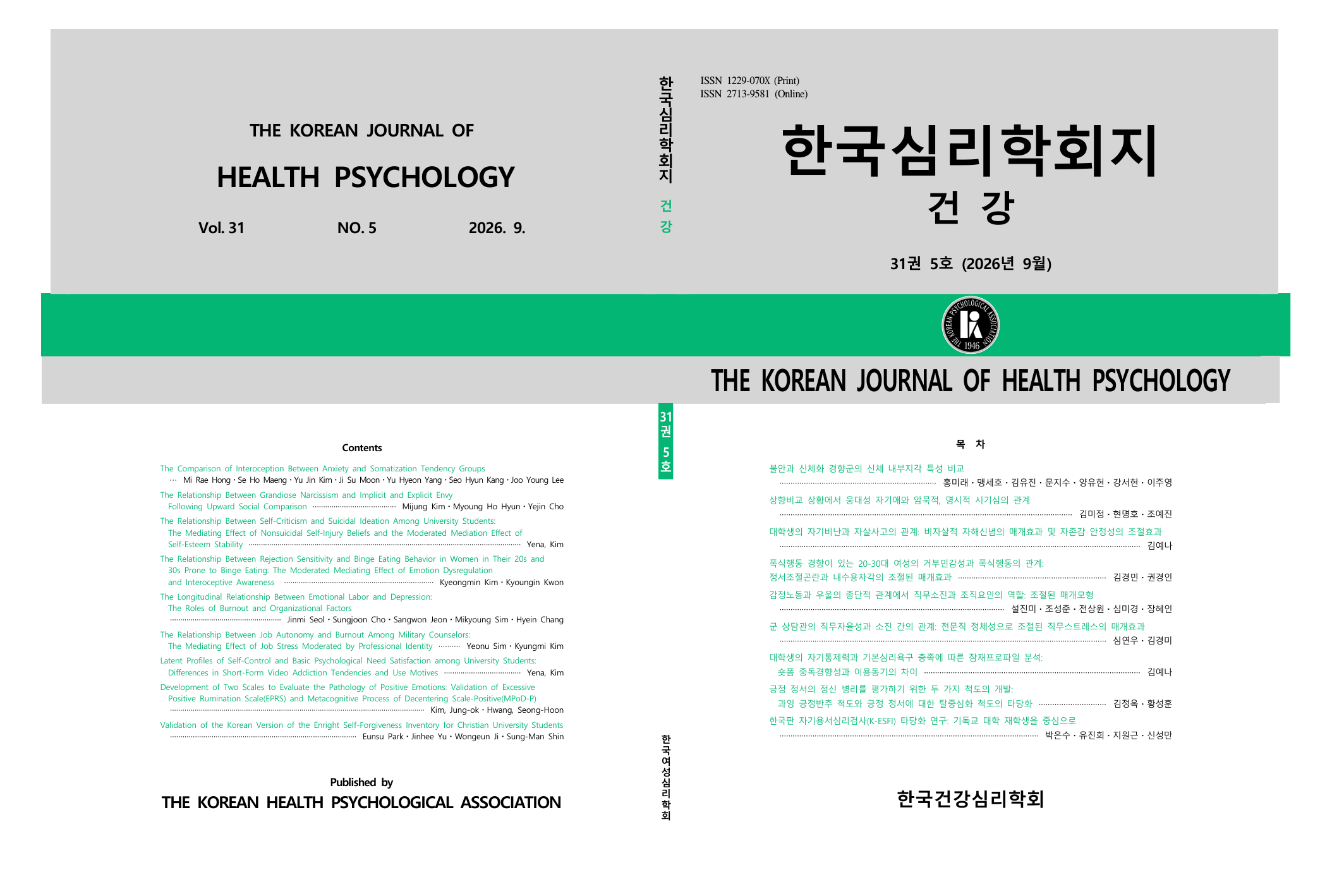
Korean Journal of Health Psychology
- KOREAN
- P-ISSN1229-070X
- E-ISSN2713-9581
- KCI
Article Contents
- 2026 (Vol.31)
- 2025 (Vol.30)
- 2024 (Vol.29)
- 2023 (Vol.28)
- 2022 (Vol.27)
- 2021 (Vol.26)
- 2020 (Vol.25)
- 2019 (Vol.24)
- 2018 (Vol.23)
- 2017 (Vol.22)
- 2016 (Vol.21)
- 2015 (Vol.20)
- 2014 (Vol.19)
- 2013 (Vol.18)
- 2012 (Vol.17)
- 2011 (Vol.16)
- 2010 (Vol.15)
- 2009 (Vol.14)
- 2008 (Vol.13)
- 2007 (Vol.12)
- 2006 (Vol.11)
- 2005 (Vol.10)
- 2004 (Vol.9)
- 2003 (Vol.8)
- 2002 (Vol.7)
- 2001 (Vol.6)
- 2000 (Vol.5)
- 1999 (Vol.4)
- 1998 (Vol.3)
- 1997 (Vol.2)
- 1996 (Vol.1)
The Comparison of Interoception Between Anxiety and Somatization Tendency Groups
Se Ho Maeng (Dongduk Women's University)
Yu Jin Kim (Dongduk Women's University)
Ji Su Moon (Dongduk Women's University)
Yu Hyeon Yang (Dongduk Women's University)
Seo Hyun Kang (Dongduk Women's University)
Joo Young Lee (Dongduk Women's University)

Abstract
This study compared interoceptive characteristics among individuals with anxiety tendencies, individuals with somatization tendencies, and a control group within the framework of the "three-dimensional model of interoception,”and examined how anxiety and somatization symptoms affect those characteristics. A total of 89 adults aged 19 to 49 years were recruited and assigned to an anxiety tendency group, a somatization tendency group, or a control group on the basis of cutoff scores on trait anxiety and somatization scales. Interoceptive sensitivity was measured with the Body Awareness subscale of the Body Perception Questionnaire (BPQ), and interoceptive accuracy was assessed with the Mental Tracking Paradigm. The results were as follows. First, one-way analyses of variance revealed no significant differences in interoceptive accuracy across the three groups, whereas interoceptive sensitivity was significantly lower in the control group than in either the anxiety or the somatization group, and interoceptive trait prediction error was significantly higher in the somatization group than in the control group. Once sex, age, and depression were controlled, however, none of the between-group differences in interoceptive characteristics remained significant. Second, regression analyses showed that interoceptive sensitivity was significantly explained by both anxiety and somatization, whereas interoceptive trait prediction error was explained only by the level of somatization. These results suggest that anxiety is marked by heightened subjective sensitivity to bodily sensations, whereas somatization is marked by an exaggerated appraisal of them. Taken together, the findings point to the need for a multidimensional framework that incorporates interoceptive trait prediction error in order to characterize interoceptive features more precisely.
- keywords
- anxiety, somatization, interoceptive accuracy, interoceptive sensitivity, interoceptive trait prediction error
- Received
- 2026-06-26
- Revised
- 2026-08-19
- Accepted
- 2026-08-19
- Published
- 2026-09-30
- Downloaded
- Viewed
- 0KCI Citations
- 0WOS Citations