
Korean Journal of Health Psychology
- KOREAN
- P-ISSN1229-070X
- E-ISSN2713-9581
- KCI
Article Contents
- 2026 (Vol.31)
- 2025 (Vol.30)
- 2024 (Vol.29)
- 2023 (Vol.28)
- 2022 (Vol.27)
- 2021 (Vol.26)
- 2020 (Vol.25)
- 2019 (Vol.24)
- 2018 (Vol.23)
- 2017 (Vol.22)
- 2016 (Vol.21)
- 2015 (Vol.20)
- 2014 (Vol.19)
- 2013 (Vol.18)
- 2012 (Vol.17)
- 2011 (Vol.16)
- 2010 (Vol.15)
- 2009 (Vol.14)
- 2008 (Vol.13)
- 2007 (Vol.12)
- 2006 (Vol.11)
- 2005 (Vol.10)
- 2004 (Vol.9)
- 2003 (Vol.8)
- 2002 (Vol.7)
- 2001 (Vol.6)
- 2000 (Vol.5)
- 1999 (Vol.4)
- 1998 (Vol.3)
- 1997 (Vol.2)
- 1996 (Vol.1)
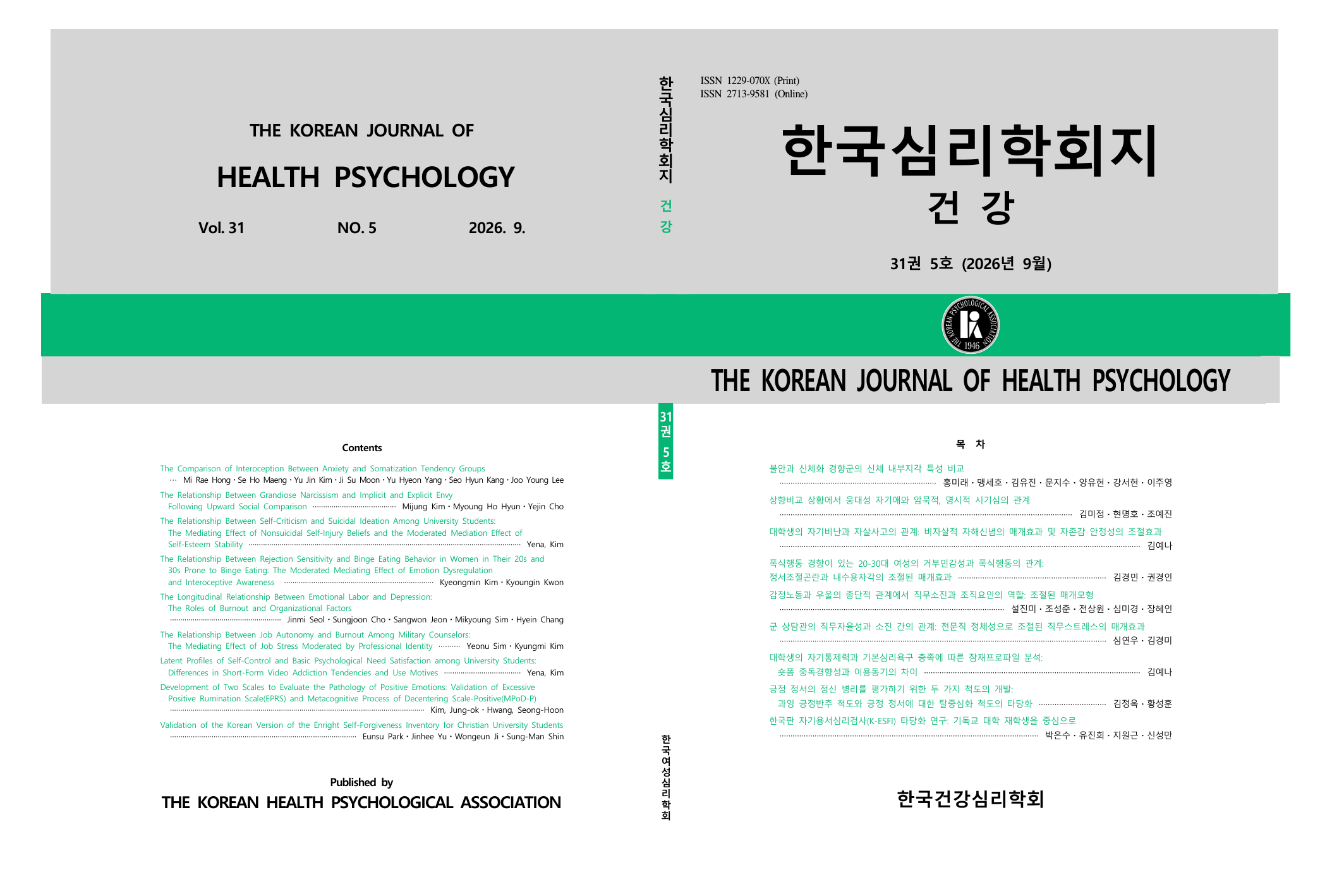
Latent Profiles of Self-Control and Basic Psychological Need Satisfaction among University Students: Differences in Short-Form Video Addiction Tendencies and Use Motives

Abstract
This study used a person-centered approach to identify latent profiles of self-control and basic psychological need satisfaction among university students and to examine how short-form video addiction tendencies and use motives differ across those profiles. Data were collected from 250 university students (125 men and 125 women). Self-control and the three dimensions of basic psychological need satisfaction—autonomy, competence, and relatedness—served as profile indicators, and models with one to six profiles were compared. Information criteria, classification accuracy, profile size, interpretability, and parsimony together favored a five-profile solution: a low competence–relatedness satisfaction profile (10.4%), an overall-low profile (17.2%), a low self-control–autonomy profile (24.4%), a balanced moderately high profile (36.0%), and a high basic psychological need satisfaction profile (12.0%). The overall-low and low self-control–autonomy profiles showed significantly stronger short-form video addiction tendencies than the other three profiles. As for use motives, these same two profiles reported stronger interpersonal motives than the low competence–relatedness satisfaction profile, and the low self-control–autonomy profile reported stronger habit–escape motives than the balanced moderately high and high basic psychological need satisfaction profiles. Accessibility–enjoyment motives were higher in the low self-control–autonomy, balanced moderately high, and high basic psychological need satisfaction profiles than in the overall-low profile, and utility motives were likewise higher in these three profiles than in the low competence–relatedness satisfaction profile. These findings indicate that low competence and relatedness satisfaction alone is not necessarily associated with stronger short-form video addiction tendencies. Rather, configurations marked by selectively low self-control and autonomy, or by uniformly low levels across all four indicators, appear more closely tied to problematic short-form video use. Accessibility–enjoyment and utility motives appeared in both higher- and lower-risk profiles, whereas habit–escape motives were especially salient in the low self-control–autonomy profile. The findings underscore the need for profile-specific prevention and intervention strategies that take into account university students’ configurations of self-control, basic psychological need satisfaction, and motives for short-form video use.
- keywords
- self-control, basic psychological needs, short-form video addiction tendencies, use motives, latent profile analysis
- Received
- 2026-08-20
- Revised
- 2026-09-10
- Accepted
- 2026-09-10
- Published
- 2026-09-30
- Downloaded
- Viewed
- 0KCI Citations
- 0WOS Citations