
Korean Psychological Journal of Culture and Social Issues
- P-ISSN1229-0661
- E-ISSN1229-0661
- KCI
Article Contents
- 2026 (Vol.32)
- 2025 (Vol.31)
- 2024 (Vol.30)
- 2023 (Vol.29)
- 2022 (Vol.28)
- 2021 (Vol.27)
- 2020 (Vol.26)
- 2019 (Vol.25)
- 2018 (Vol.24)
- 2017 (Vol.23)
- 2016 (Vol.22)
- 2015 (Vol.21)
- 2014 (Vol.20)
- 2013 (Vol.19)
- 2012 (Vol.18)
- 2011 (Vol.17)
- 2010 (Vol.16)
- 2009 (Vol.15)
- 2008 (Vol.14)
- 2007 (Vol.13)
- 2006 (Vol.12)
- 2005 (Vol.11)
- 2004 (Vol.10)
- 2003 (Vol.9)
- 2002 (Vol.8)
- 2001 (Vol.7)
- 2000 (Vol.6)
- 1999 (Vol.5)
- 1998 (Vol.4)
- 1997 (Vol.3)
- 1995 (Vol.2)
- 1994 (Vol.1)
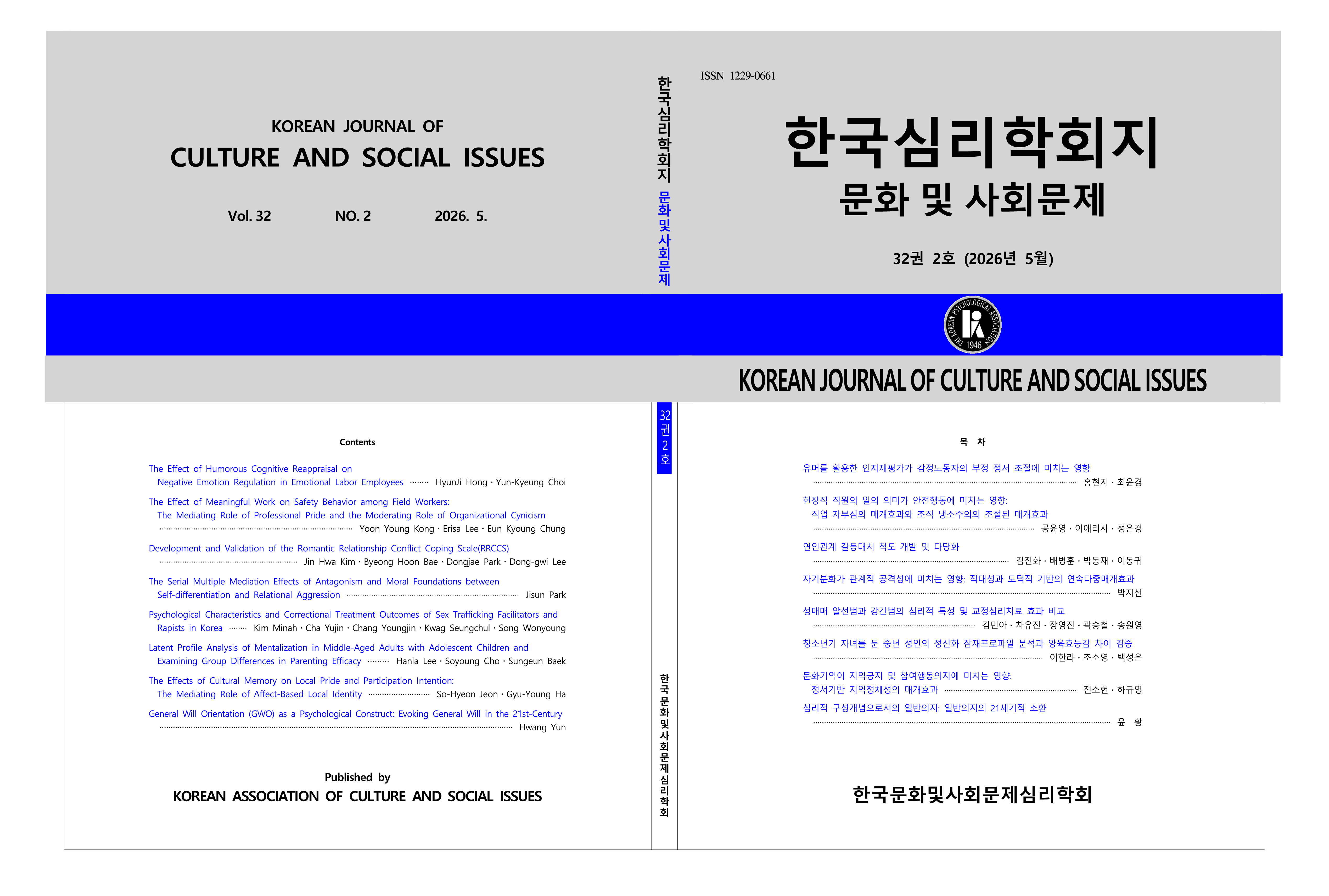
Latent Profile Analysis of Mentalization in Middle-Aged Adults with Adolescent Children and Examining Group Differences in Parenting Efficacy

Abstract
The objectives of this study were threefold: first, to classify latent profiles based on the mentalization patterns of middle-aged adults with adolescent children; second, to analyze the factors influencing group classification; and third, to examine differences in parenting self-efficacy according to the identified latent profiles. To achieve these purpose, data were collected from 600 adults with adolescent children, and latent profile analysis (LPA) was utilized. The results indicated that the mentalization patterns were classified into three latent groups, labeled as ‘low mentalization group’, ‘moderate mentalization group’, and ‘high mentalization group’ according to their characteristics. The analysis of influencing factors on latent profiles revealed that cognitive empathy, emotional empathy, emotional neglect, physical neglect, secure attachment, insecure attachment, somatization, depression and educational level had statistically significant effects on group classification. The analysis showed that cognitive parenting self-efficacy was highest in the high mentalization group, followed by the moderate mentalization group, and the low mentalization group. Conversely, anxiety and frustration in parenting was highest in the low mentalization group, followed by the moderate and the high mentalization group. Finally, based on these results, interventions and implications according to the latent profiles of mentalization were presented. This study is significant in identifying the characteristics of middle-aged adults based on their mentalization latent profiles and providing foundational data for exploring intervention strategies that consider the unique characteristics of each group.
- keywords
- mentalization, latent profile, parenting efficacy, neglect, attachment
- Received
- 2026-02-18
- Revised
- 2026-03-21
- Accepted
- 2026-05-07
- Published
- 2026-05-31
- Downloaded
- Viewed
- 0KCI Citations
- 0WOS Citations