


- P-ISSN1229-0661
- E-ISSN1229-0661
- KCI
논문 상세
- 2026 (32권)
- 2025 (31권)
- 2024 (30권)
- 2023 (29권)
- 2022 (28권)
- 2021 (27권)
- 2020 (26권)
- 2019 (25권)
- 2018 (24권)
- 2017 (23권)
- 2016 (22권)
- 2015 (21권)
- 2014 (20권)
- 2013 (19권)
- 2012 (18권)
- 2011 (17권)
- 2010 (16권)
- 2009 (15권)
- 2008 (14권)
- 2007 (13권)
- 2006 (12권)
- 2005 (11권)
- 2004 (10권)
- 2003 (9권)
- 2002 (8권)
- 2001 (7권)
- 2000 (6권)
- 1999 (5권)
- 1998 (4권)
- 1997 (3권)
- 1995 (2권)
- 1994 (1권)
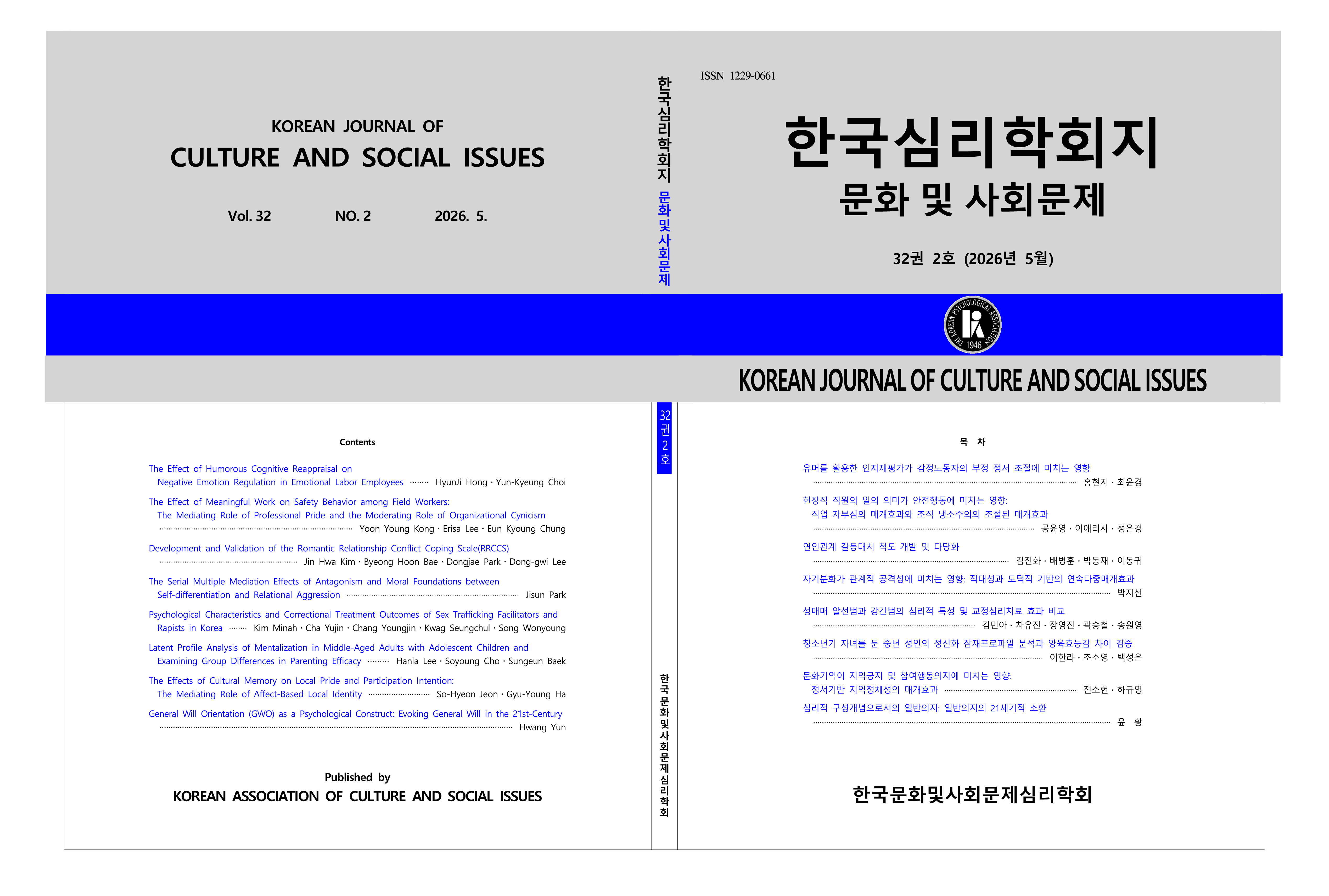
청소년기 자녀를 둔 중년 성인의 정신화 잠재프로파일 분석과 양육효능감 차이 검증
Latent Profile Analysis of Mentalization in Middle-Aged Adults with Adolescent Children and Examining Group Differences in Parenting Efficacy
조소영 (경북대학교)
백성은 (경북대학교)

초록
본 연구의 목적은 첫째, 청소년기 자녀를 둔 중년 성인의 정신화 양상에 따라 잠재프로파일을 분류하는 것이고, 둘째, 집단 구분에 영향을 주는 요인을 분석하기 위함이며, 셋째, 잠재프로파일에 따른 양육효능감의 차이를 검증하는 데 있다. 이를 위해 청소년기 자녀가 있는 중년 성인 600명을 대상으로 자료를 수집하고, 잠재프로파일분석(Latent Profile Analysis)을 진행하였다. 분석 결과 정신화 양상에 따라 3개의 잠재 집단으로 분류되었고, 집단 특성에 따라 ‘저정신화 집단’, ‘중정신화 집단’, ‘고정신화 집단’으로 명명하였다. 잠재프로파일의 영향요인 분석 결과, 인지적 공감, 정서적 공감, 정서적 방임, 신체적 방임, 안정애착, 불안정애착, 신체화, 우울, 학력이 집단 분류에 통계적으로 유의한 효과를 보였다. 양육효능감의 잠재프로파일별 차이를 분석한 결과, 인지적 양육효능감은 고정신화 집단, 중정신화 집단, 저정신화 집단 순으로 높게 나타났으며, 양육 과정에서 경험하는 불안과 좌절감은 저정신화 집단, 중정신화 집단, 고정신화 집단 순으로 높게 나타났다. 마지막으로 본 연구의 결과를 바탕으로 정신화 잠재프로파일에 따른 개입 및 시사점을 제시하였다. 본 연구는 중년 성인의 정신화 잠재프로파일에 따른 특성을 규명하고, 집단별 특성을 고려한 개입 방안을 모색하는 데 기초 자료를 제공한다는 데 의의가 있다.
- keywords
- 정신화, 잠재프로파일, 양육효능감, 방임, 애착
Abstract
The objectives of this study were threefold: first, to classify latent profiles based on the mentalization patterns of middle-aged adults with adolescent children; second, to analyze the factors influencing group classification; and third, to examine differences in parenting self-efficacy according to the identified latent profiles. To achieve these purpose, data were collected from 600 adults with adolescent children, and latent profile analysis (LPA) was utilized. The results indicated that the mentalization patterns were classified into three latent groups, labeled as ‘low mentalization group’, ‘moderate mentalization group’, and ‘high mentalization group’ according to their characteristics. The analysis of influencing factors on latent profiles revealed that cognitive empathy, emotional empathy, emotional neglect, physical neglect, secure attachment, insecure attachment, somatization, depression and educational level had statistically significant effects on group classification. The analysis showed that cognitive parenting self-efficacy was highest in the high mentalization group, followed by the moderate mentalization group, and the low mentalization group. Conversely, anxiety and frustration in parenting was highest in the low mentalization group, followed by the moderate and the high mentalization group. Finally, based on these results, interventions and implications according to the latent profiles of mentalization were presented. This study is significant in identifying the characteristics of middle-aged adults based on their mentalization latent profiles and providing foundational data for exploring intervention strategies that consider the unique characteristics of each group.
- keywords
- mentalization, latent profile, parenting efficacy, neglect, attachment
- 투고일Received
- 2026-02-18
- 수정일Revised
- 2026-03-21
- 게재확정일Accepted
- 2026-05-07
- 출판일Published
- 2026-05-31
- 다운로드 수
- 조회수
- 0KCI 피인용수
- 0WOS 피인용수