
Korean Journal of Health Psychology
- KOREAN
- P-ISSN1229-070X
- E-ISSN2713-9581
- KCI
Article Contents
- 2026 (Vol.31)
- 2025 (Vol.30)
- 2024 (Vol.29)
- 2023 (Vol.28)
- 2022 (Vol.27)
- 2021 (Vol.26)
- 2020 (Vol.25)
- 2019 (Vol.24)
- 2018 (Vol.23)
- 2017 (Vol.22)
- 2016 (Vol.21)
- 2015 (Vol.20)
- 2014 (Vol.19)
- 2013 (Vol.18)
- 2012 (Vol.17)
- 2011 (Vol.16)
- 2010 (Vol.15)
- 2009 (Vol.14)
- 2008 (Vol.13)
- 2007 (Vol.12)
- 2006 (Vol.11)
- 2005 (Vol.10)
- 2004 (Vol.9)
- 2003 (Vol.8)
- 2002 (Vol.7)
- 2001 (Vol.6)
- 2000 (Vol.5)
- 1999 (Vol.4)
- 1998 (Vol.3)
- 1997 (Vol.2)
- 1996 (Vol.1)
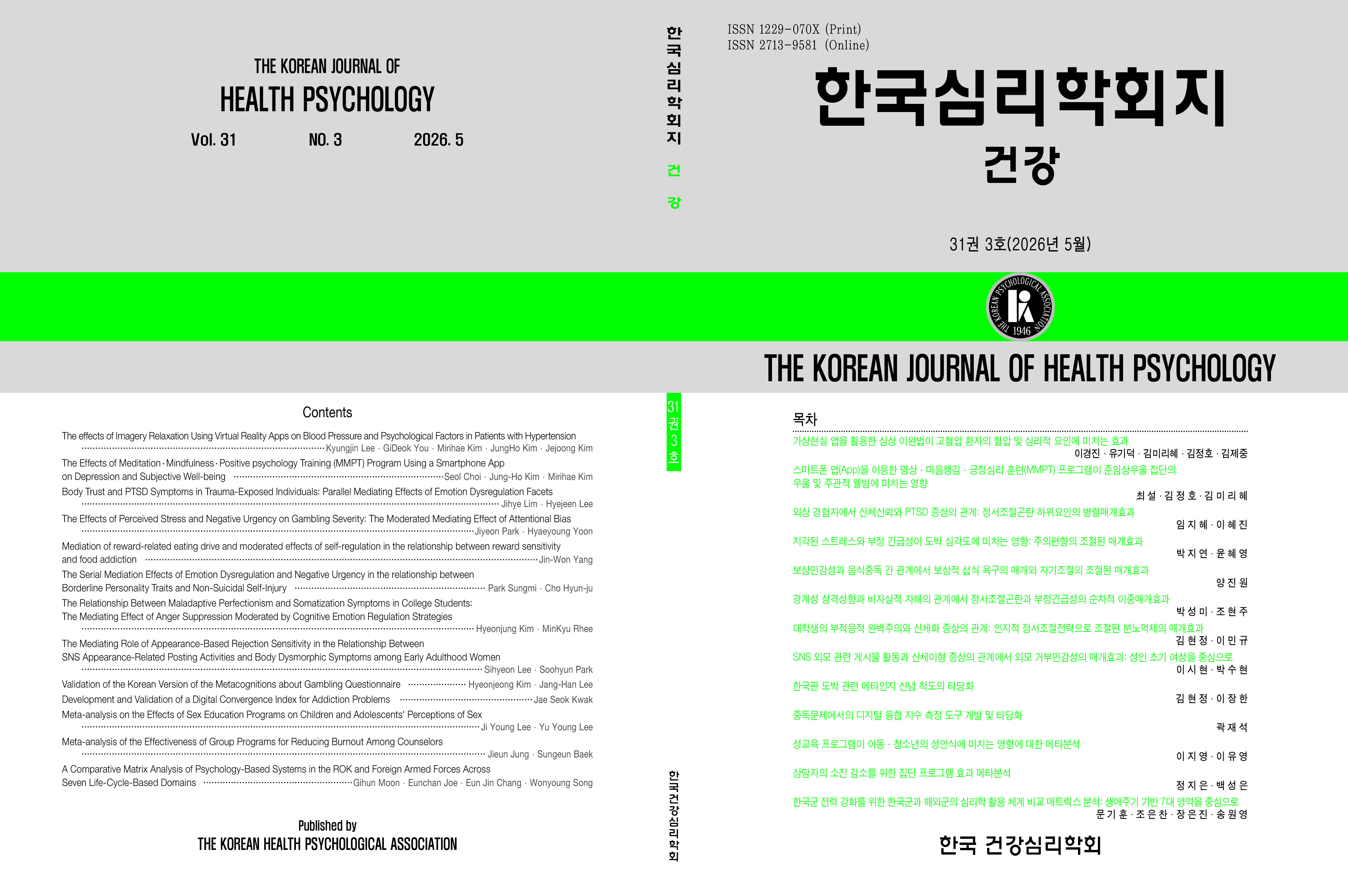
A Comparative Matrix Analysis of Psychology-Based Systems in the ROK and Foreign Armed Forces Across Seven Life-Cycle-Based Domains
(Department of Counseling Konyang University)
(Department of Counseling Psychology Korea Baptist Theological University)
(Department of Counseling & Psychotherapy Konyang University)

Abstract
This study aimed to identify strategic tasks for enhancing military capability within the Republic of Korea (ROK) Armed Forces, emphasizing the growing significance of cognitive performance and psychological readiness for maintaining combat effectiveness in modern operational environments. A document-based analysis was conducted, utilizing domestic and international academic literature, defense and public health policy documents, legal and regulatory materials, and publicly available evaluation reports, through a comparative matrix approach. The military psychology application system of the ROK Armed Forces was organized into seven domains: selection and service suitability, mental force and intangible capabilities, mental health promotion and counseling, suicide prevention and high-risk intervention, organizational culture, post-discharge support, and research and policy development. This structure was used to assess its status and limitations, comparing it to systems in the United States, the United Kingdom, Canada, and Israel. The findings reveal that the ROK Armed Forces have established a robust institutional foundation, including comprehensive screening and evaluation systems, mental force education, multi-layered counseling and medical services such as the military counseling officer system, and crisis intervention mechanisms like the Defense Helpline. In contrast, the comparison countries more effectively connect selection data to job placement and performance criteria, institutionalize resilience training and peer-based interventions, and strengthen ties between evidence-based treatment, long-term data tracking, and policy development. Based on these insights, the study recommends expanding the use of selection data for job assignment and early adaptation support, incorporating resilience, combat stress, and acute crisis response skills into mental force education, standardizing counseling, medical, and case management processes, and establishing a performance management pipeline that extends into the post-discharge phase. These recommendations are best understood within a multi-tiered support system, systematically integrating universal support, risk screening, and intensive individualized interventions.
- keywords
- Republic of Korea Military, Life Cycle Analysis, Military Psychology, Force Readiness
- Received
- 2026-03-25
- Revised
- 2026-04-15
- Accepted
- 2026-04-15
- Published
- 2026-05-30
- Downloaded
- Viewed
- 0KCI Citations
- 0WOS Citations