


- ENGLISH
- P-ISSN1229-070X
- E-ISSN2713-9581
- KCI
논문 상세
- 2026 (31권)
- 2025 (30권)
- 2024 (29권)
- 2023 (28권)
- 2022 (27권)
- 2021 (26권)
- 2020 (25권)
- 2019 (24권)
- 2018 (23권)
- 2017 (22권)
- 2016 (21권)
- 2015 (20권)
- 2014 (19권)
- 2013 (18권)
- 2012 (17권)
- 2011 (16권)
- 2010 (15권)
- 2009 (14권)
- 2008 (13권)
- 2007 (12권)
- 2006 (11권)
- 2005 (10권)
- 2004 (9권)
- 2003 (8권)
- 2002 (7권)
- 2001 (6권)
- 2000 (5권)
- 1999 (4권)
- 1998 (3권)
- 1997 (2권)
- 1996 (1권)
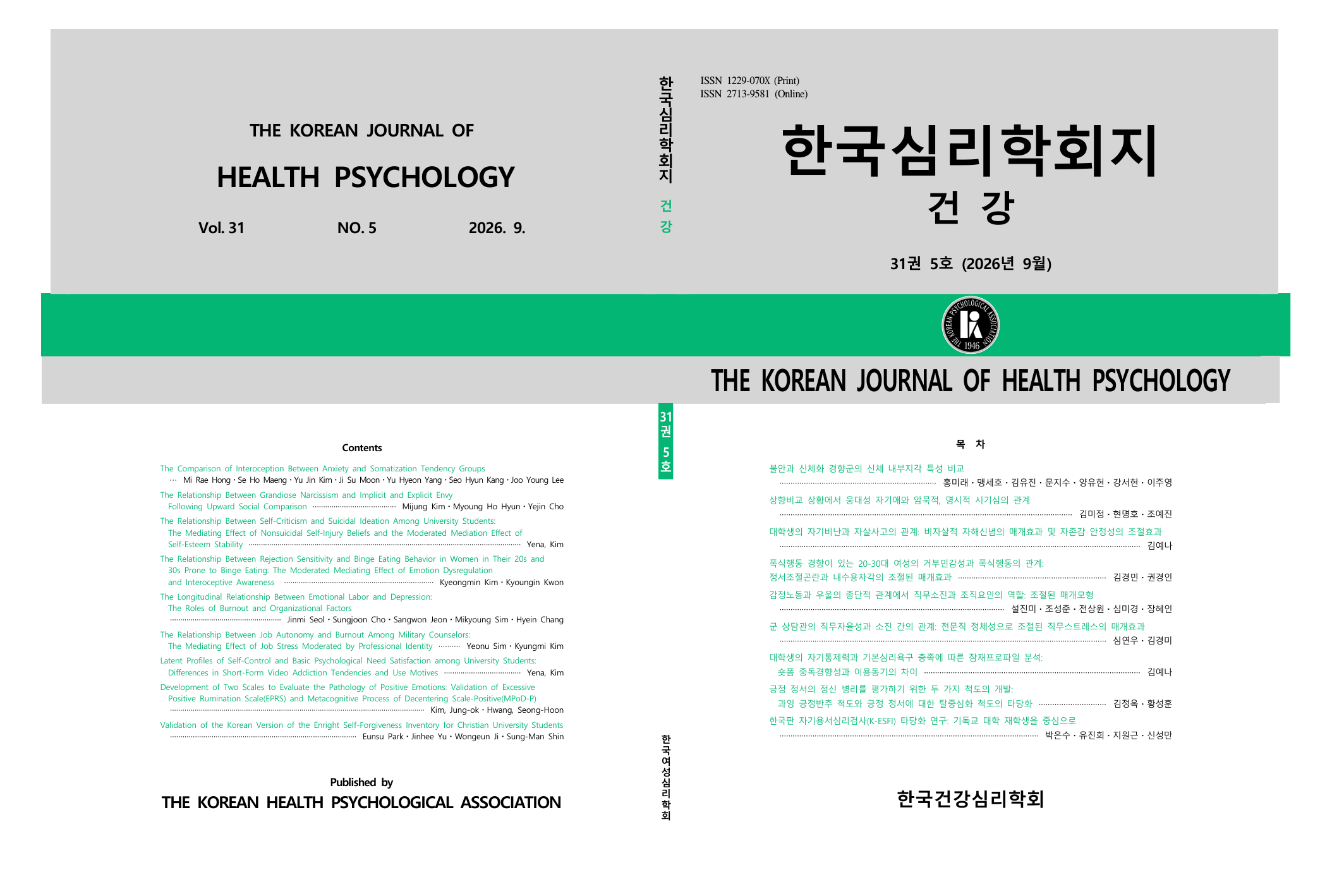
대학생의 자기비난과 자살사고의 관계: 비자살적 자해신념의 매개효과 및 자존감 안정성의 조절효과
The Relationship Between Self-Criticism and Suicidal Ideation Among University Students:The Mediating Effect of Nonsuicidal Self-Injury Beliefs and the Moderated Mediation Effect of Self-Esteem Stability

초록
본 연구는 대학생의 자기비난과 자살사고 간 관계에서 비자살적 자해 신념의 매개효과를 확인하고, 자기비난과 비자살적 자해 신념 간 관계를 자존감 안정성이 조절하는지를 검증하였다. 전국 17개 시도에 거주하는 대학생 250명을 대상으로 수집한 온라인 설문자료를 분석하였으며, 자기비난 방식 척도, 청소년용 비자살적 자해 신념 척도, 자존감 안정성 척도 및 한글판 단축형 자살사고 척도를 사용하였다. 자료분석에는 SPSS PROCESS macro의 조절된 매개모형을 적용하고 부트스트래핑을 통해 조건부 간접효과를 검증하였다. 분석 결과, 자기비난은 비자살적 자해 신념 및 자살사고와 정적 관련을 보였으며, 자존감 안정성과는 부적 관련을 보였다. 또한 자존감 안정성이 낮을수록 자기비난과 비자살적 자해 신념 간 정적 관련성이 강하게 나타났다. 비자살적 자해 신념은 자기비난을 통제한 후에도 자살사고와 유의한 정적 관련을 보였으며, 자기비난이 비자살적 자해 신념을 거쳐 자살사고와 연결되는 조건부 간접효과는 자존감 안정성이 높아질수록 감소하는 것으로 나타났다. 이러한 결과는 자살위험 평가와 상담에서 자기비난의 수준뿐 아니라 자해에 관한 신념과 자존감의 안정성을 함께 평가할 필요가 있음을 시사한다.
- keywords
- 자기비난, 비자살적 자해신념, 자존감 안정성, 자살사고, 조절된 매개효과
Abstract
This study examined whether beliefs about nonsuicidal self-injury (NSSI) mediate the association between self-criticism and suicidal ideation among university students and whether self-esteem stability moderates the association between self-criticism and NSSI beliefs. Online survey data were collected from 250 university students residing across all 17 provincial-level administrative regions of South Korea, who completed measures of self-criticism, NSSI beliefs, self-esteem stability, and suicidal ideation. A moderated mediation model was tested with the SPSS PROCESS macro, and conditional indirect effects were examined with bootstrapping. Self-criticism was positively associated with NSSI beliefs and suicidal ideation and negatively associated with self-esteem stability. The positive association between self-criticism and NSSI beliefs was stronger at lower levels of self-esteem stability, and NSSI beliefs remained positively associated with suicidal ideation after self-criticism was controlled. The conditional indirect association between self-criticism and suicidal ideation through NSSI beliefs also weakened as self-esteem stability rose. These results indicate that suicide risk assessment and counseling should attend not only to the degree of self-criticism but also to beliefs about self-injury and to the stability of self-esteem.
- keywords
- self-criticism, nonsuicidal self-injury beliefs, self-esteem stability, suicidal ideation, moderated mediation
- 투고일Received
- 2026-08-19
- 수정일Revised
- 2026-09-09
- 게재확정일Accepted
- 2026-09-09
- 출판일Published
- 2026-09-30
- 다운로드 수
- 조회수
- 0KCI 피인용수
- 0WOS 피인용수