
Korean Journal of Health Psychology
- KOREAN
- P-ISSN1229-070X
- E-ISSN2713-9581
- KCI
Article Contents
- 2026 (Vol.31)
- 2025 (Vol.30)
- 2024 (Vol.29)
- 2023 (Vol.28)
- 2022 (Vol.27)
- 2021 (Vol.26)
- 2020 (Vol.25)
- 2019 (Vol.24)
- 2018 (Vol.23)
- 2017 (Vol.22)
- 2016 (Vol.21)
- 2015 (Vol.20)
- 2014 (Vol.19)
- 2013 (Vol.18)
- 2012 (Vol.17)
- 2011 (Vol.16)
- 2010 (Vol.15)
- 2009 (Vol.14)
- 2008 (Vol.13)
- 2007 (Vol.12)
- 2006 (Vol.11)
- 2005 (Vol.10)
- 2004 (Vol.9)
- 2003 (Vol.8)
- 2002 (Vol.7)
- 2001 (Vol.6)
- 2000 (Vol.5)
- 1999 (Vol.4)
- 1998 (Vol.3)
- 1997 (Vol.2)
- 1996 (Vol.1)
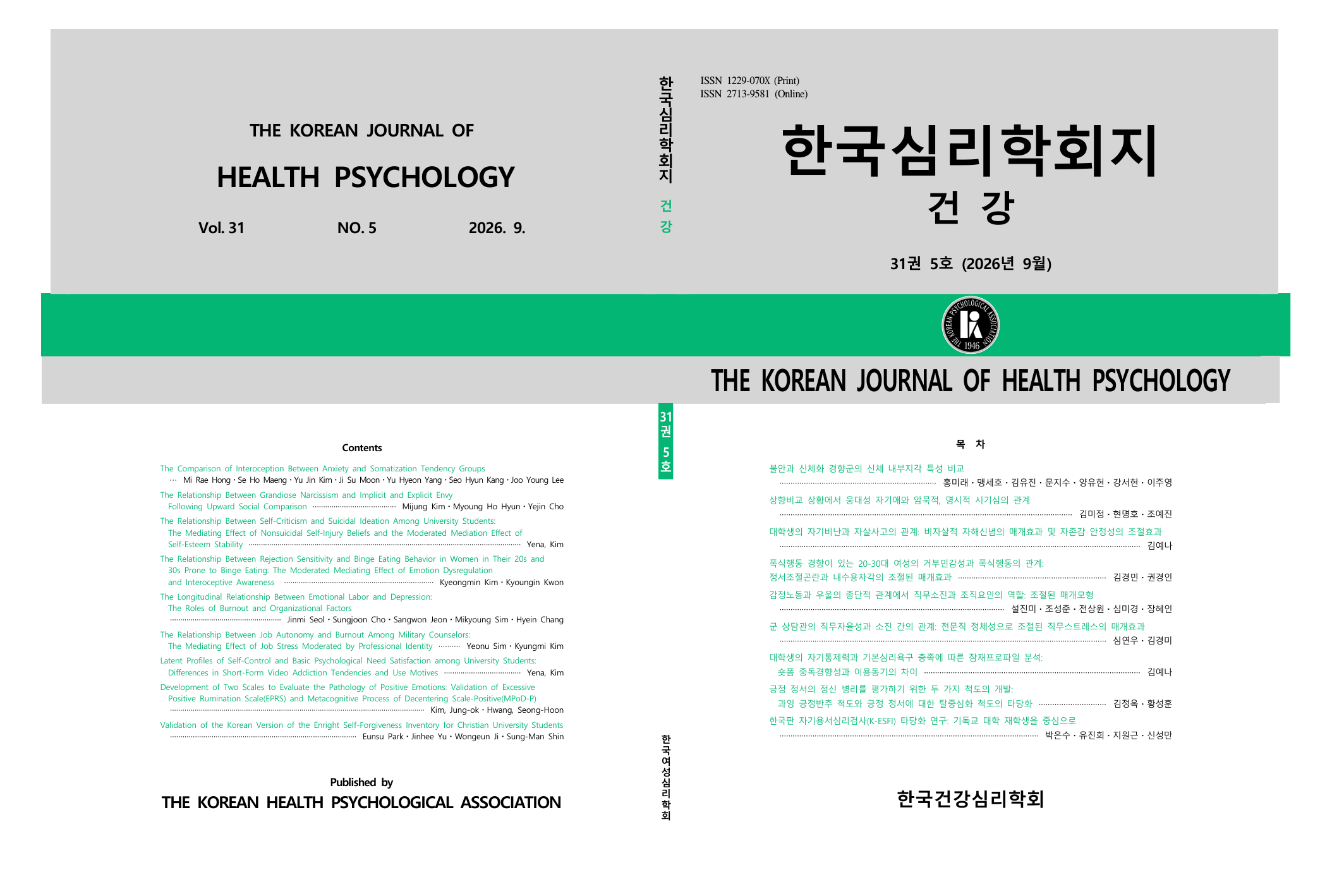
The Relationship Between Self-Criticism and Suicidal Ideation Among University Students:The Mediating Effect of Nonsuicidal Self-Injury Beliefs and the Moderated Mediation Effect of Self-Esteem Stability

Abstract
This study examined whether beliefs about nonsuicidal self-injury (NSSI) mediate the association between self-criticism and suicidal ideation among university students and whether self-esteem stability moderates the association between self-criticism and NSSI beliefs. Online survey data were collected from 250 university students residing across all 17 provincial-level administrative regions of South Korea, who completed measures of self-criticism, NSSI beliefs, self-esteem stability, and suicidal ideation. A moderated mediation model was tested with the SPSS PROCESS macro, and conditional indirect effects were examined with bootstrapping. Self-criticism was positively associated with NSSI beliefs and suicidal ideation and negatively associated with self-esteem stability. The positive association between self-criticism and NSSI beliefs was stronger at lower levels of self-esteem stability, and NSSI beliefs remained positively associated with suicidal ideation after self-criticism was controlled. The conditional indirect association between self-criticism and suicidal ideation through NSSI beliefs also weakened as self-esteem stability rose. These results indicate that suicide risk assessment and counseling should attend not only to the degree of self-criticism but also to beliefs about self-injury and to the stability of self-esteem.
- keywords
- self-criticism, nonsuicidal self-injury beliefs, self-esteem stability, suicidal ideation, moderated mediation
- Received
- 2026-08-19
- Revised
- 2026-09-09
- Accepted
- 2026-09-09
- Published
- 2026-09-30
- Downloaded
- Viewed
- 0KCI Citations
- 0WOS Citations