


- ENGLISH
- P-ISSN1229-070X
- E-ISSN2713-9581
- KCI
논문 상세
- 2026 (31권)
- 2025 (30권)
- 2024 (29권)
- 2023 (28권)
- 2022 (27권)
- 2021 (26권)
- 2020 (25권)
- 2019 (24권)
- 2018 (23권)
- 2017 (22권)
- 2016 (21권)
- 2015 (20권)
- 2014 (19권)
- 2013 (18권)
- 2012 (17권)
- 2011 (16권)
- 2010 (15권)
- 2009 (14권)
- 2008 (13권)
- 2007 (12권)
- 2006 (11권)
- 2005 (10권)
- 2004 (9권)
- 2003 (8권)
- 2002 (7권)
- 2001 (6권)
- 2000 (5권)
- 1999 (4권)
- 1998 (3권)
- 1997 (2권)
- 1996 (1권)
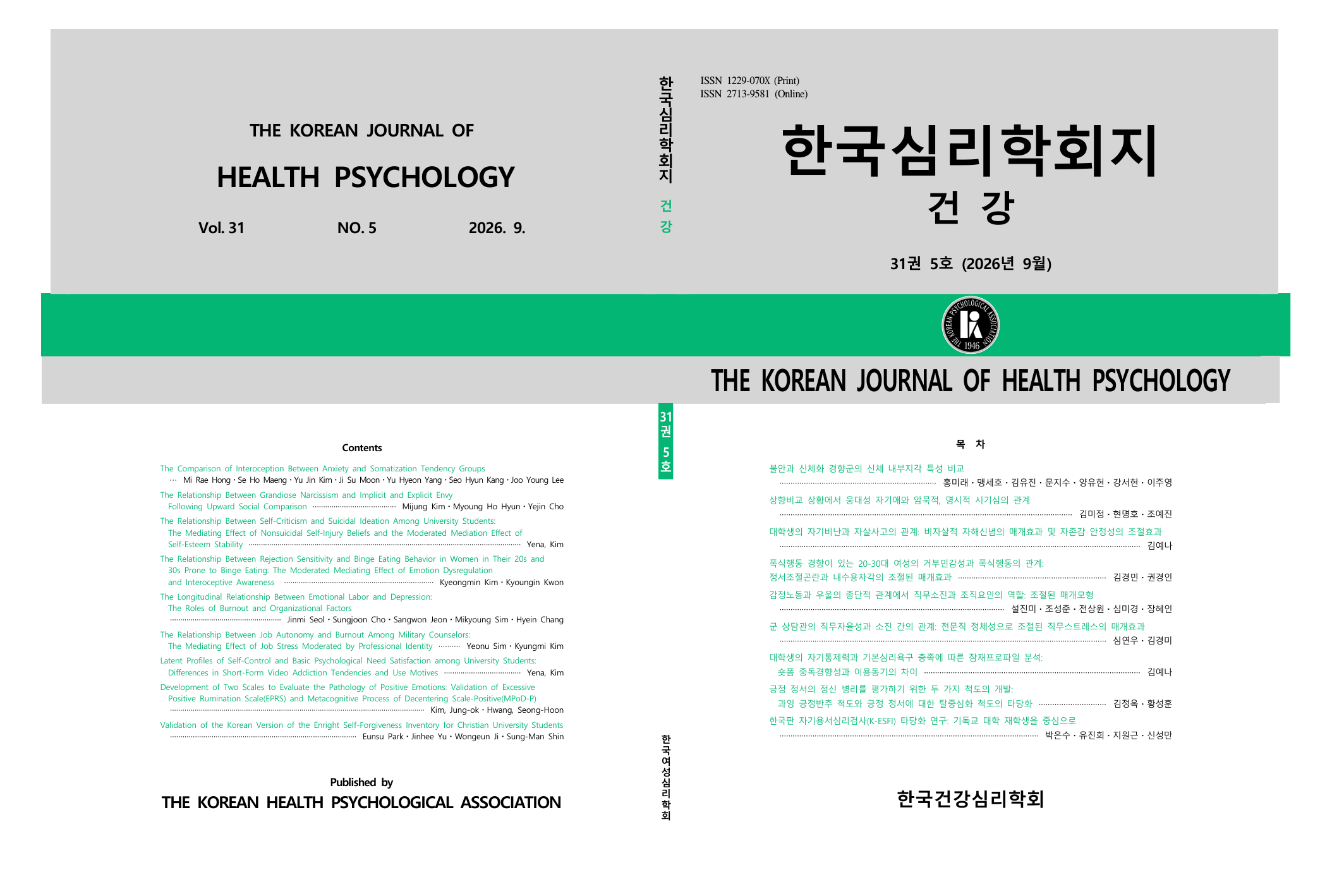
긍정 정서의 정신 병리를 평가하기 위한 두 가지 척도의 개발: 과잉 긍정반추 척도와 긍정 정서에 대한 탈중심화 척도의 타당화
Development of Two Scales to Evaluate the Pathology of Positive Emotions: Validation of Excessive Positive Rumination Scale(EPRS) and Metacognitive Process of Decentering Scale-Positive(MPoD-P)
황성훈(Seong-Hoon Hwang) (한양사이버대학교)

초록
긍정 정서 병리에 대한 평가도구가 부정 정서에 비해 부족한 상황에서 본 연구는 긍정 정서에 대한 부적응적 반응 양식과 적응적 조절을 평가하는 두 척도를 타당화하고자 하였다. 전자는 과도한 긍정 정서를 산출하는 역기능적 반응 양식을 평가하는 과잉 긍정반추 척도(EPRS)이고, 후자는 긍정 정서에 대해 적절한 거리를 두고 조절하는 정도를 평가하는 긍정 탈중심화 척도(MPod-P)이다. 두 척도는 반응 양식과 탈중심화를 각각 측정하는 기존척도를 개작하는 방식으로 제작되었다. 사이버대생 296명을 대상으로 두 척도와 함께, 긍정 정서에 대한 반응양식 질문지(RPA), Perth 정서조절역량척도(PERCI)중 긍정 정서 소척도, 긍정 긴급성 척도(PU), 양극성 장애 척도, 드렉셀 탈융합 척도(DDS), 비집착 척도(NAS), 5요인 마음챙김 척도(FFMQ) 단축형, 평정심 척도 등을 온라인으로 실시하였다. 탐색적 요인 분석을 하고, 목표 회전 및 탐색적 구조방정식을 통해 요인 구조를 정제한 결과, EPRS는 단일요인 구조가, MPoD-P는 3요인 구조가 적절하였다. EPRS는 긍정 정서 조절의 역량 저하, 긍정 긴급성, 양극성 장애 증상 등과 정적 상관을 보여 수렴 및 공존 타당도가 확인되었다. MPoD-P는 탈융합, 비집착, 마음챙김, 평정심 등과 정적 상관을 보여 수렴 타당도가 지지되었으나, 긍정 정서의 병리를 측정하는 척도들과 기대한 유의한 부적 상관을 보이지는 않았다. 두 척도는 양호한 내적 일치도와 검사-재검사 신뢰도를 보였다. 긍정 정서 조절의 취약성 요인과 보호 요인을 측정하는 두 척도를 함께 활용하는 방안에 대해 논의하였으며, 향후 연구의 방향을 제시하였다.
- keywords
- 과잉 긍정반추, 긍정 탈중심화, 긍정 정서 조절 부전, 탐색적 구조방정식
Abstract
Measures of the pathology of positive emotions remain far scarcer than measures of negative emotions. This study therefore sought to validate two scales: one assessing maladaptive responses to positive emotions and the other assessing their adaptive regulation. The Excessive Positive Rumination Scale (EPRS) measures dysfunctional response styles that generate excessive positive emotions, whereas the Metacognitive Process of Decentering Scale–Positive (MPoD-P) measures the ability to regulate positive emotions from an appropriate psychological distance. The two scales were adapted from existing measures of response styles and of decentering, respectively. An online survey was administered to 296 cyber university students. Besides the two new scales, it included the Response to Positive Affect Questionnaire (RPA), the positive emotion subscale of the Perth Emotion Regulation Competency Inventory (PERCI), the Positive Urgency Scale (PU), the Bipolar Disorder Scale, the Drexel Defusion Scale (DDS), the Non-Attachment Scale (NAS), the short form of the Five Facet Mindfulness Questionnaire (FFMQ), and an Equanimity Scale. Exploratory factor analysis and exploratory structural equation modeling with target rotation yielded a single-factor structure for the EPRS and a three-factor structure for the MPoD-P. Scores on the EPRS correlated positively with reduced positive emotion regulation ability, positive urgency, and bipolar symptoms, supporting its convergent and concurrent validity. Scores on the MPoD-P correlated positively with defusion, non-attachment, mindfulness, and equanimity, supporting its convergent validity; contrary to expectation, however, they were not significantly negatively correlated with measures of positive emotion pathology. Both scales demonstrated good internal consistency and test–retest reliability. The discussion considers how the two scales might be used together to assess vulnerability and protective factors in positive emotion regulation, and outlines directions for future research.
- keywords
- excessive positive rumination, positive decentering, dysregulation of positive emotion, exploratory structural equation modeling
- 투고일Received
- 2026-03-25
- 수정일Revised
- 2026-07-02
- 게재확정일Accepted
- 2026-07-02
- 출판일Published
- 2026-09-30
- 다운로드 수
- 조회수
- 0KCI 피인용수
- 0WOS 피인용수