
Korean Journal of Health Psychology
- KOREAN
- P-ISSN1229-070X
- E-ISSN2713-9581
- KCI
Article Contents
- 2026 (Vol.31)
- 2025 (Vol.30)
- 2024 (Vol.29)
- 2023 (Vol.28)
- 2022 (Vol.27)
- 2021 (Vol.26)
- 2020 (Vol.25)
- 2019 (Vol.24)
- 2018 (Vol.23)
- 2017 (Vol.22)
- 2016 (Vol.21)
- 2015 (Vol.20)
- 2014 (Vol.19)
- 2013 (Vol.18)
- 2012 (Vol.17)
- 2011 (Vol.16)
- 2010 (Vol.15)
- 2009 (Vol.14)
- 2008 (Vol.13)
- 2007 (Vol.12)
- 2006 (Vol.11)
- 2005 (Vol.10)
- 2004 (Vol.9)
- 2003 (Vol.8)
- 2002 (Vol.7)
- 2001 (Vol.6)
- 2000 (Vol.5)
- 1999 (Vol.4)
- 1998 (Vol.3)
- 1997 (Vol.2)
- 1996 (Vol.1)
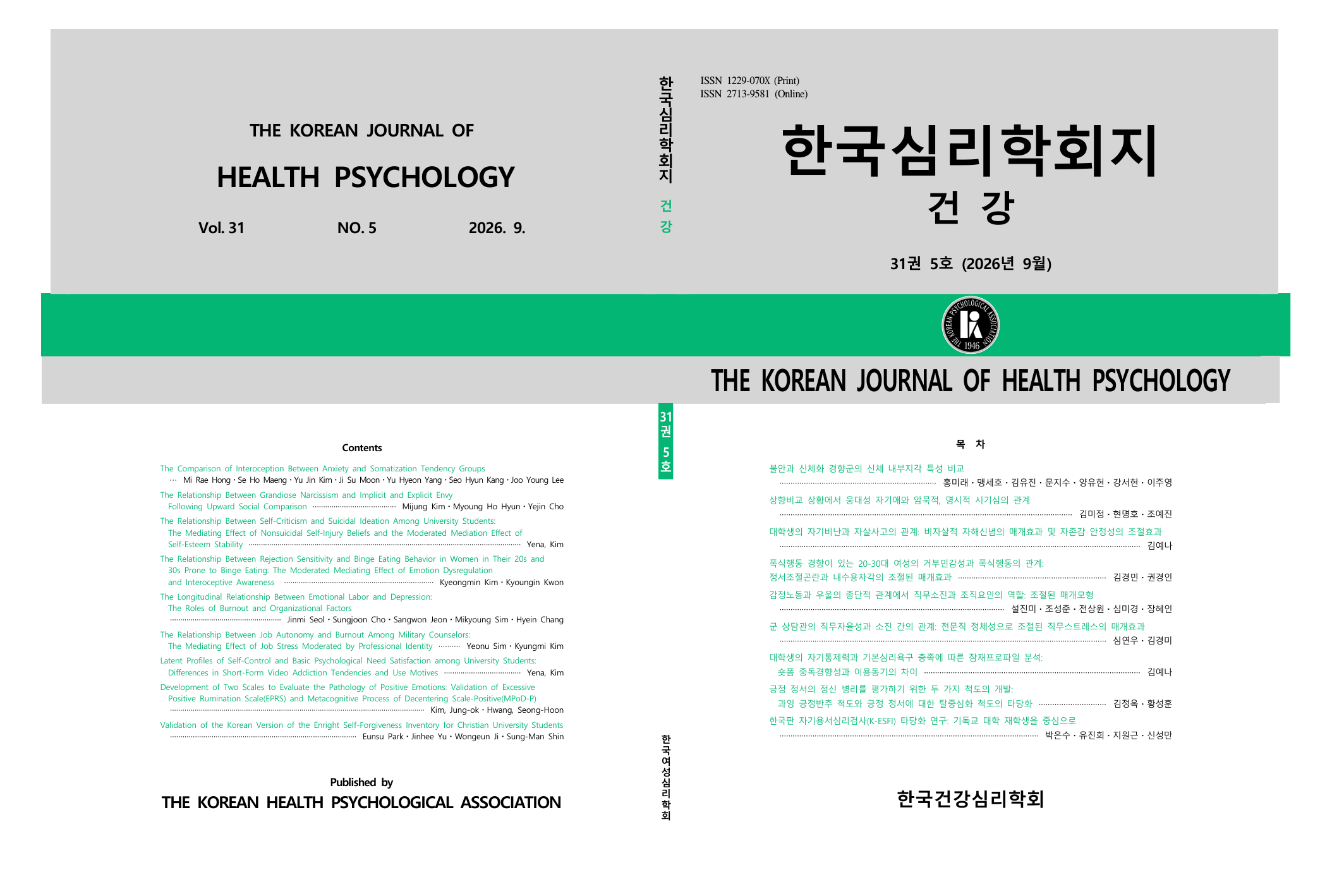
Development of Two Scales to Evaluate the Pathology of Positive Emotions: Validation of Excessive Positive Rumination Scale(EPRS) and Metacognitive Process of Decentering Scale-Positive(MPoD-P)
Seong-Hoon Hwang (Hanyang Cyber University)

Abstract
Measures of the pathology of positive emotions remain far scarcer than measures of negative emotions. This study therefore sought to validate two scales: one assessing maladaptive responses to positive emotions and the other assessing their adaptive regulation. The Excessive Positive Rumination Scale (EPRS) measures dysfunctional response styles that generate excessive positive emotions, whereas the Metacognitive Process of Decentering Scale–Positive (MPoD-P) measures the ability to regulate positive emotions from an appropriate psychological distance. The two scales were adapted from existing measures of response styles and of decentering, respectively. An online survey was administered to 296 cyber university students. Besides the two new scales, it included the Response to Positive Affect Questionnaire (RPA), the positive emotion subscale of the Perth Emotion Regulation Competency Inventory (PERCI), the Positive Urgency Scale (PU), the Bipolar Disorder Scale, the Drexel Defusion Scale (DDS), the Non-Attachment Scale (NAS), the short form of the Five Facet Mindfulness Questionnaire (FFMQ), and an Equanimity Scale. Exploratory factor analysis and exploratory structural equation modeling with target rotation yielded a single-factor structure for the EPRS and a three-factor structure for the MPoD-P. Scores on the EPRS correlated positively with reduced positive emotion regulation ability, positive urgency, and bipolar symptoms, supporting its convergent and concurrent validity. Scores on the MPoD-P correlated positively with defusion, non-attachment, mindfulness, and equanimity, supporting its convergent validity; contrary to expectation, however, they were not significantly negatively correlated with measures of positive emotion pathology. Both scales demonstrated good internal consistency and test–retest reliability. The discussion considers how the two scales might be used together to assess vulnerability and protective factors in positive emotion regulation, and outlines directions for future research.
- keywords
- excessive positive rumination, positive decentering, dysregulation of positive emotion, exploratory structural equation modeling
- Received
- 2026-03-25
- Revised
- 2026-07-02
- Accepted
- 2026-07-02
- Published
- 2026-09-30
- Downloaded
- Viewed
- 0KCI Citations
- 0WOS Citations