

JOURNAL OF INFORMATION SCIENCE THEORY AND PRACTICE
- P-ISSN2287-9099
- E-ISSN2287-4577
- SCOPUS, KCI

14권 3호
초록
Abstract
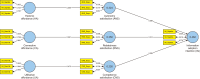
This study examines whether the self-determination theory (SDT)-affordance framework, developed in short-form video healthinformation research, can explain the intention to adopt internship information in a career-information context. This exploratory TikTok study is situated within an internship-focused creator community. The single-account setting contextualizes the case rather than claiming population-level representativeness. A cross-sectional online survey was conducted among followers of @Baihaqi Hamman | Info Magang in Indonesia (n=422). The Indonesian instrument adapted Song et al.’s SDT-affordance measures from health information to internship information. Relationships among hedonic, utilitarian, and connective affordances, psychological need satisfaction, and internship-information adoption intention were examined using partial least squares structural equation modelling with bootstrapping. The results were consistent with the theorized SDT-affordance pattern. Autonomy, competence, and relatedness satisfaction were positively associated with adoption intention, while each affordance was positively associated with its corresponding psychological need. Relatedness satisfaction showed the strongest association. Descriptive indirect estimates also followed the expected direction but require cautious interpretation because of the exploratory, cross-sectional, single-account design. This study adapts Song et al.’s SDT-affordance framework from health-information adoption to internshipinformation adoption. It provides context-bound evidence from one creator community and develops propositions for future multicreator, multi-platform, and cross-cultural research. The study relied on a convenience sample, self-reported intention, and a crosssectional practitioner-researcher setting. Therefore, it indicates theoretical consistency rather than causal or population-level generalizability.
초록
Abstract
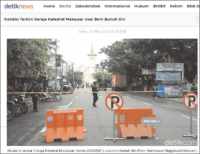
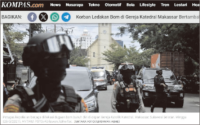
This study aims to understand how media framing operates in Indonesia in the context of sensitive issues such as terrorism and religion. This study also aims to provide an understanding of how Indonesian journalism handles sensitive religious issues and to reveal the potential impact of various framing strategies on public perception and social stability. The research method employs Gamson and Modigliani’s framing model analysis, offering a holistic framework by integrating various framing elements, including metaphors, exemplars, catchphrases, depictions, and visual images. The objects of the study are the two most popular Indonesian online media outlets in 2024, namely Detik.com and Kompas.com. The results of the analysis show that the two media sites apply different but complementary framing strategies in shaping public understanding of terrorist events. Detik.com shows a tendency to construct reality through dramatization and sensationalization. In contrast, Kompas.com adopts a more conservative approach, focusing on moral-spiritual dimensions and implementing a policy of not displaying photos of perpetrators and victims as a form of sensitive journalistic ethics. The media’s construction of reality regarding this event has the potential to create “violence” against the Muslim community, especially Muslim women, in the context of representation and social stigmatization, because their religious identity is very easily identified from their visual appearance. Framing analysis reveals that media framing strategies have consequences that go far beyond the mere delivery of information, but can significantly affect the social lives of Muslim women in Indonesia’s plural and complex society.



초록
Abstract
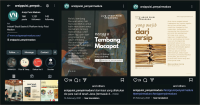
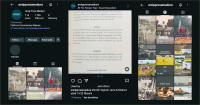
Madurese poetry, often published in regional newspapers and written in the local language, represents a vital yet overlooked facet of Indonesia’s literary heritage. Despite its cultural and historical significance, this body of work remains vulnerable to disappearance due to limited archiving infrastructures and the marginalization of regional voices within national narratives. This study investigates how independent archival initiatives, particularly the community-driven efforts of Arsip Puisi Penyair Madura and Arsip Prosa Madura, contribute to preserving and reviving the Madurese literary heritage. Using semi-structured interviews with two key informants and document and content analysis of community-managed digital platforms, this study examines how poets, readers, and community organizers understand the role of archives, their relationship with libraries, and the potential of digital technologies for preservation. The findings suggest that inclusive, participatory archiving models can bridge the gap between libraries and marginalized communities. This paper advocates for stronger collaborations between formal institutions and grassroots archives, urging libraries to embrace their role not only as repositories of knowledge but as active participants in cultural justice and heritage sustainability.

초록
Abstract
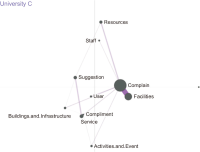
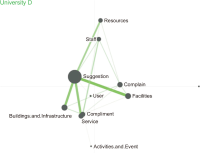
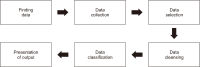
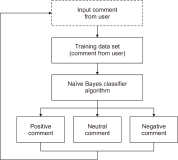
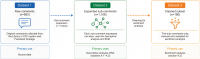
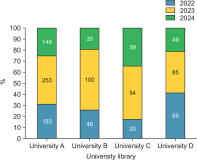
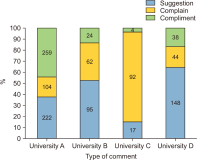
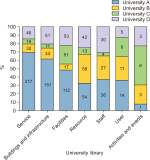
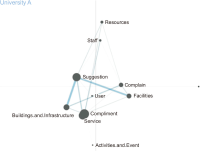
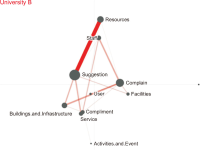
This study examines key factors influencing university library users’ experiences. User-generated comments (UGCs) were determined as the source of the users’ feedback. UGCs were collected from four Thai university libraries from 2022 to 2024, totaling 983 comments. After text cleaning (removing special characters, emojis, and URLs), 960 UGCs were obtained for analysis. The researchers separated the text into sentences and defined types and themes for UGCs. Finally, 1,108 UGCs were used for descriptive analysis and epistemic network analysis, and 196 comments were used for sentiment analysis. It was found that facilities and infrastructure were the most highly mentioned issues. University C’s users showed the highest dissatisfaction regarding basic facility needs. University B’s users emphasized additional resources. Additionally, this study illustrated the importance of service quality and human-centered support. It was revealed that 65.31% of users were positive about the library staff and services. This study suggested that libraries should be flexible, user-friendly, accessible, and attentive by using analytical tools to monitor real-time feedback for effective improvement. Well-managed university libraries should provide physical and digital services while maintaining personalized, responsive, and adaptive practices to support academic activities.
초록
Abstract
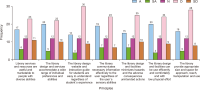
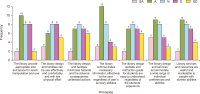
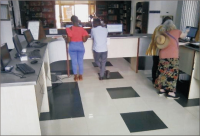
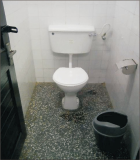
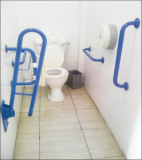
This study investigates how Ghanaian public university libraries conform to universal design principles to accommodate students with disabilities. The study employed a multiple case study design and was underpinned by the Social Model of Disability. A convergent mixed-parallel design was adopted, and online questionnaires were administered to 261 students with disabilities while in-depth interviews were conducted with 28 participants. The data were analysed thematically. Most university libraries were not universally designed to accommodate the needs of students with disabilities, which negatively affected information access, participation, and independence. Findings from students with disabilities revealed that the library design does not accommodate a wide range of individual preferences and abilities, nor does it provide an appropriate size and space for approach, reach, manipulation, and use. There is a need to strengthen policy and enforcement. Mandatory implementation of universal design and accessibility standards must be linked to accreditation or funding as enforcement incentives. The study emphasises the importance of allocating sufficient funds by university management and government for redesigning library facilities and services to facilitate the inclusion and equal participation of students with disabilities. Empirically, the study found lower adherence to universal design principles among Ghanaian academic libraries, revealing systemic barriers to access for differently abled students. The study is original, as it applies theoretical triangulation, integrating the principles of universal design and the Social Model of Disability to expose accessibility barriers in Ghanaian academic libraries, as well as institutional and attitudinal systems that perpetuate disablement.


초록
Abstract
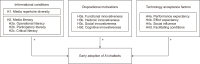
Generative AI chatbots, such as ChatGPT and Gemini, mark a structural shift in human–computer interaction and informationseeking behavior by enabling natural-language–mediated automation of cognitive tasks. This transformation highlights the need to understand how such technologies diffuse within the general population. Drawing on the Diffusion of Innovations (DOI) theory, the Motivated Consumer Innovativeness (MCI) framework, and the Unified Theory of Acceptance and Use of Technology (UTAUT), this study examines the early adoption of AI chatbots in South Korea using a nationally representative sample of 8,690 respondents from the 2024 Korean Media Panel Survey. The findings reveal a distinct socio-technological profile of early adopters: Individuals with a diverse media repertoire and high participatory literacy are significantly more likely to adopt. The results also show a negative association between cognitive innovativeness and adoption, alongside a positive association between effort expectancy and adoption. Interpreted through the concept of cognitive economy, these findings suggest that early adoption may be driven less by intellectual exploration than by the perceived ease and efficiency with which AI chatbots support routine information tasks. The study refines diffusion theory by suggesting that innovativeness may operate differently depending on whether a technology is perceived as expanding or substituting for users’ cognitive activity.