
Korean Journal of Health Psychology
- KOREAN
- P-ISSN1229-070X
- E-ISSN2713-9581
- KCI
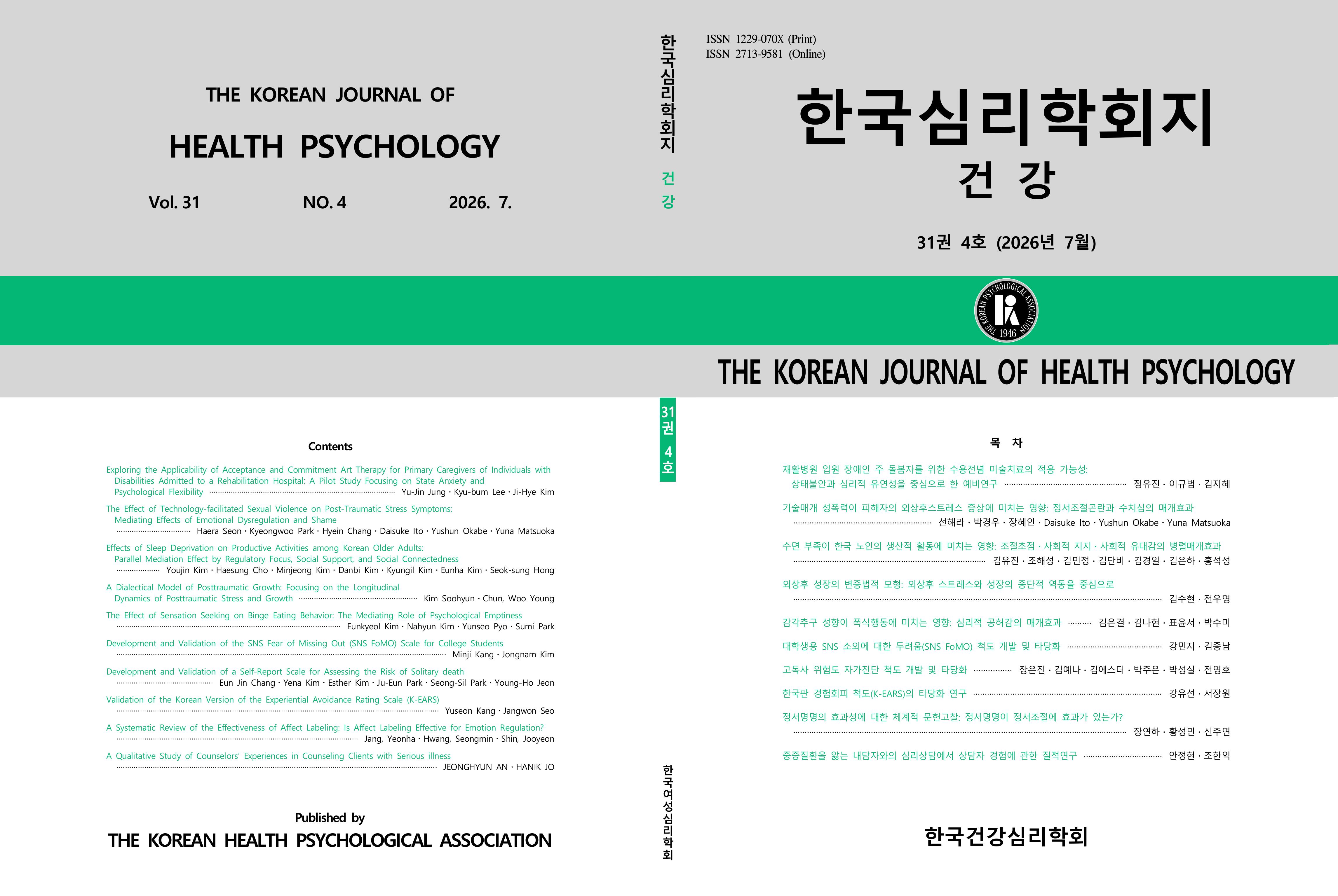
Vol.31 No.4
Abstract
This pilot study investigated the applicability of Acceptance and Commitment Art Therapy (ACAT) for primary caregivers of individuals with disabilities in a rehabilitation hospital, focusing on state anxiety and psychological flexibility. We employed a nonequivalent control group pretest-posttest design. Seventeen primary caregivers of individuals with disabilities admitted to a rehabilitation hospital in Seoul, South Korea, were assigned to either the treatment group (n=9) or the comparison group (n=8). The treatment group received eight weekly 40-minute individual ACAT sessions, while the comparison group received no intervention during the same period. To examine changes before and after ACAT, state anxiety, psychological flexibility, and salivary cortisol levels were measured at pretest and posttest. Due to the small sample size, nonparametric statistical methods were used for data analysis. Results showed that the treatment group experienced significant within-group decreases in state anxiety and significant within-group increases in psychological flexibility, while the comparison group showed no significant changes in these variables. Although the between-group difference in state anxiety changes was not statistically significant, there was a significant between-group difference in the change in psychological flexibility. However, in the additional analysis controlling for pretest scores, no significant between-group differences were found in state anxiety, psychological flexibility, or salivary cortisol. No significant changes in salivary cortisol levels were observed in either group. These findings indicate the applicability of ACAT for primary caregivers of individuals with disabilities in rehabilitation hospitals and offer preliminary data for systematizing tailored psychological support programs in rehabilitation settings.
Abstract
Technology-facilitated sexual violence (TFSV) refers to sexual violence that occurs through online and digital communication technology. Although its incidence is increasing, the effects on victims' mental health and the underlying mechanisms have not been extensively studied. This study examined the relationship between TFSV exposure and post-traumatic stress disorder, and attempted to identify the roles of emotion dysregulation and shame in this process. The experiences of TFSV, post-traumatic stress symptoms, emotion dysregulation, and shame were measured through a self-report questionnaire completed by 315 Korean adults. Structural equation modeling revealed a positive TFSV and post-traumatic stress symptoms, a relationship significantly mediated by emotion dysregulation. While the mediating effect of shame was not significant, the sequential mediating effect of emotion dysregulation and shame on the relationship between TFSV and post-traumatic stress symptoms was significant. This finding indicates that TFSV leads to emotional dysregulation, which in turn intensifies shame, contributing to an increase in post-traumatic stress symptoms. This study has clinical implications, as it aims to draw social interest to the rising damage caused by TFSV and proposes treatment targets by examining its effects on victims' mental health and psychological mechanisms.
Abstract
This study investigated how regulatory focus, social support, and social connectedness collectively mediate the relationship between sleep deprivation and engagement in productive activities—defined as “all activities that create value”—among older adults. A survey was administered to 500 individuals aged 60 and above; after excluding 30 responses due to carelessness, data from 470 participants were analyzed. We used Model 4 of the SPSS PROCESS macro and bootstrapping to test the significance of the mediating effects. Results indicated that sleep deprivation was negatively correlated with productive activities, regulatory focus, social support, and social connectedness. Furthermore, these three variables significantly mediated the link between sleep deprivation and productive activities. While sleep deprivation initially showed a significant direct effect on productive activities, this effect became non-significant once the mediating variables were included, demonstrating a full mediation. These findings suggest that fostering productive activities in older adults requires strengthening both individual psychological traits and social relational resources.
Abstract
This study sought to conceptualize Posttraumatic Growth (PTG) as a dynamic, dialectical process where distress and growth interact and evolve, moving beyond the simplistic ‘constructive’ versus ‘illusory’ growth debate. We analyzed longitudinal data from 228 individuals across three waves, approximately 32 months following the Hebei Spirit oil spill in Taean. The findings empirically validated our proposed dialectical transition model of PTG. Initially, we observed the ambivalence of growth in the early stages, where PTG correlated positively with posttraumatic stress and negatively with subjective well-being. This suggests PTG may function as a defensive mechanism to cope with distress. Second, coping styles mediated this dialectical transition. While avoidant coping initially contributed to growth, ‘positive reinterpretation’ emerged as the primary driver moving growth toward constructive maturity over time. Third, by 32 months post-trauma, the correlation between distress and growth disappeared, and PTG significantly predicted subjective well-being. This indicates a state of dialectical synthesis, where the traumatic experience is fully integrated into the individual's life narrative. This research is significant for providing longitudinal evidence that PTG is not a static outcome but a dynamic transitional process achieved through an intense struggle with distress. Moreover, it offers a theoretical basis for time-specific health psychology interventions aimed at supporting the long-term adaptation of trauma survivors.
Abstract
This study investigated whether psychological emptiness mediates the relationship between sensation seeking and binge eating behavior in female college students. We recruited 201 female university students in Korea to complete an online survey. Sensation seeking was assessed using the UPPS-P scale, binge eating behavior with the Binge Eating Scale (BES), and psychological emptiness with the Korean version of the Multidimensional State Emptiness Scale (K-MSES). Correlation and mediation analyses were performed to test the proposed model. Results showed significant positive correlations among sensation seeking, psychological emptiness, and binge eating behavior. Psychological emptiness fully mediated the relationship between sensation seeking and binge eating behavior. Specifically, among the subcomponents of psychological emptiness, only inner emptiness significantly mediated this relationship. These findings suggest that binge eating behavior may develop as a maladaptive coping mechanism for the inner emptiness experienced by individuals with high sensation-seeking tendencies. The study underscores the importance of addressing psychological emptiness in the prevention and intervention of binge eating behaviors among young women.
Abstract
The purpose of this study is to develop and validate the SNS Fear of Missing Out (SNS FoMO) Scale for College Students. In the preliminary study, the concept of SNS FoMO was established through a literature review, and 50 initial items were generated via literature analysis, focus group interviews (FGI), and an analysis of internet news articles. Following two rounds of expert content validity verification, 37 preliminary items across 5 factors were constructed. A preliminary survey of 100 college students then identified 31 items across 4 factors through item analysis, exploratory factor analysis, and reliability analysis. In the main study, a survey was administered to 350 college students. This survey included the 31 items selected from the preliminary study, along with scales for validity verification. Data were analyzed using item analysis, exploratory factor analysis (N=150), confirmatory factor analysis (N=200), and reliability and validity analyses. As a result, a final 23-item scale with 4 factors—‘Functional Impairment due to Obsession with Updates,’ ‘Relative Deprivation,’ ‘Repetitive Checking Behavior,’ and ‘Fear of Exclusion’—was confirmed, demonstrating good reliability. Additionally, the criterion and convergent validity of the scale were verified through significant correlations with related scales (the Modified Fear of Missing Out Scale and the SNS Addiction Proneness Scale for College Students). Finally, the study concludes with a discussion of the findings, significance, limitations, and suggestions for future research.
Abstract
This study aimed to develop and validate a self-report screening scale to help individuals easily assess their risk of solitary death. We began by conducting a comprehensive literature review and expert consultations to establish the conceptual framework and subdomains of solitary death risk, from which 22 preliminary items were generated. After expert content validity evaluation and a pilot study involving 600 adults from an online panel, eight final items were selected.A main survey with a separate sample of 600 adults was then conducted to evaluate the scale's reliability and validity. The results supported a unidimensional structure comprising the eight items, and confirmatory factor analysis indicated that the modified model demonstrated an overall acceptable fit. The scale exhibited high internal consistency (Cronbach's α = .91). Furthermore, the scale showed significant positive correlations with loneliness, social isolation, depression, and anxiety, and significant negative correlations with social network and subjective well-being, thereby supporting both convergent and discriminant validity. Test-retest reliability was also statistically significant, indicating the scale's temporal stability. These findings suggest that the developed scale is a reliable and valid instrument that comprehensively captures the multidimensional nature of solitary death risk. The study's implications, practical applications, and limitations are discussed in detail.
Abstract
Experiential avoidance refers to a behavioral tendency to avoid contact with unwanted internal experiences and to alter their form or frequency, and has been identified as a key process contributing to the development and maintenance of various psychological disorders. As the importance of this construct has become increasingly recognized, several instruments have been developed to assess experiential avoidance. However, existing measures have shown limitations in terms of factor-structural stability. To address these limitations, the Experiential Avoidance Rating Scale (EARS) was recently developed. The present study aimed to translate the EARS into Korean and examine its psychometric properties. Data were collected from 800 Korean adults aged 19 years and older. Internal consistency and factor structure were examined, and measurement invariance across gender and age groups was tested to determine whether the structural properties of the scale differed across subgroups. In addition, convergent, discriminant, and concurrent validity were evaluated by examining associations with related and distinct constructs. Incremental validity was further examined using hierarchical regression analyses. Results indicated that the Korean version of the EARS demonstrated good internal consistency and a unidimensional factor structure consistent with the original scale. Measurement invariance across gender and age groups was supported, indicating that comparisons across subgroups are appropriate. Convergent, discriminant, concurrent, and incremental validity were all found to be satisfactory. These findings suggest that the Korean version of the EARS is a promising instrument for the valid assessment of experiential avoidance.
Abstract
This study systematically reviewed the effects of affect labeling on emotion regulation, examining patterns of findings and sources of variability. Affect labeling is recognized as a useful emotion regulation strategy; however, its effects have varied across outcome measures and application contexts. To clarify these patterns, a systematic review was conducted in accordance with PRISMA guidelines, analyzing studies published between 2005 and 2024. Searches of three Korean and four international academic databases identified 43 eligible studies. Overall, affect labeling consistently reduced or stabilized emotional reactivity as measured by psychophysiological and behavioral indicators. In contrast, findings for self-reported emotional experience were mixed, showing decreases, no change, and sometimes increases. This suggests that while affect labeling may attenuate psychophysiological responses, it may not similarly alter subjectively experienced emotion. Variability in outcomes was also linked to individual factors, including emotional vocabulary, emotion differentiation, mental health status, and anxiety. Contextual factors such as labeling format and perspective, emotional stimulus type, task structure, and therapeutic or intervention context also played a role. These findings suggest that affect labeling is not a uniformly effective technique for reducing emotion across all situations. Instead, it is a conditional emotion regulation strategy whose effects vary depending on individuals and contexts. This underscores the importance of evaluating affect labeling across subjective, psychophysiological, and behavioral domains, advocating for more context-sensitive applications in future research and counseling practice.
Abstract
This study explored the lived experiences of counselors providing psychotherapy to clients with serious illnesses. To achieve this, in-depth interviews were conducted with eight counselors experienced in working with this population. The collected data were analyzed using thematic analysis, following Braun and Clarke's (2021) procedures. The analysis identified seven major themes and 18 subthemes: (1) emotional experiences, (2) existential companionship, (3) accumulation of loss, (4) self-care, (5) intervention practices in serious illness settings, (6) existential reflection and transformation, and (7) perceptions of the counseling environment and support systems. Participants described experiencing a range of emotions within the uncontrollable context of illness progression and the possibility of death. They reported engaging in existentially grounded companionship, encountering repeated loss, attempting to maintain self-care, and experiencing changes in their understanding of life and death. These findings provide a detailed account of the inner experiences of counselors working in this context, contributing to our understanding of counseling practice in serious illness and offering implications for future research.